LandOffer
Job search
StrataScratch Review: SQL Practice, Data Projects, and AI Mock Interviews
Choose coding questions, a data project, or a mock interview by the work you need to practice, then check access and AI credits.
StrataScratch now covers more than SQL question practice: its public catalog includes analytical, algorithm, visualization, and conceptual work, alongside Data Labs and AI mock interviews. It is worth considering when the gap in your preparation involves analyzing a dataset or explaining decisions as well as writing a query. Choose the practice format first, then check which features your plan allows and how much AI usage it includes. A subscription cannot make every practice output equally useful for your interview.
This review uses current official pages and logged-out observations on October 13–14, 2026. We inspected a coding question, a project assignment, the language filter, pricing, and mock-interview settings. We did not create an account, execute vendor code, upload work, start an AI interview, or purchase access. LandOffer publishes this review; browse recent roles on LandOffer.ai to identify the actual analysis or engineering tasks your target role expects.
Choose the output you need to practice
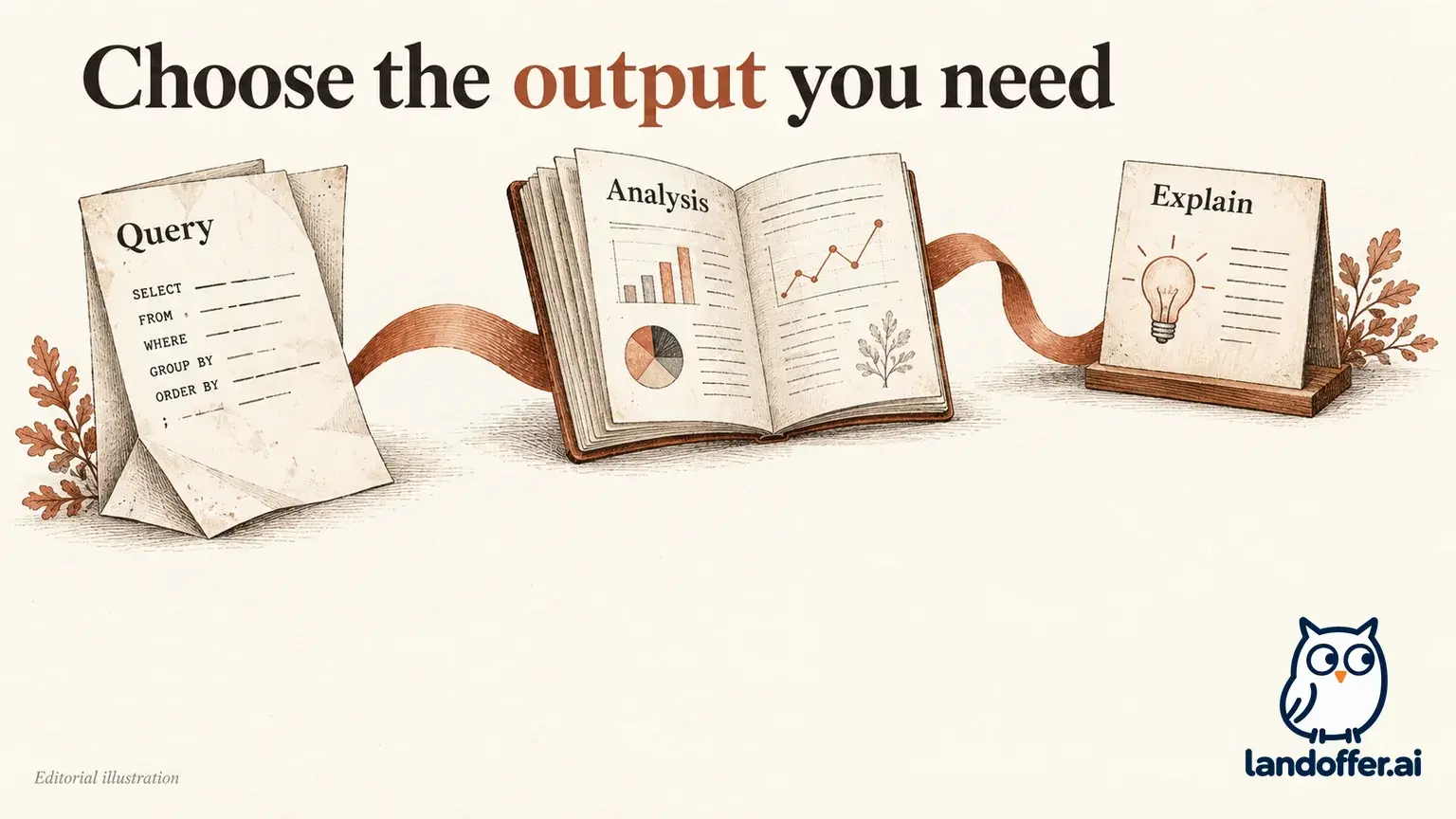
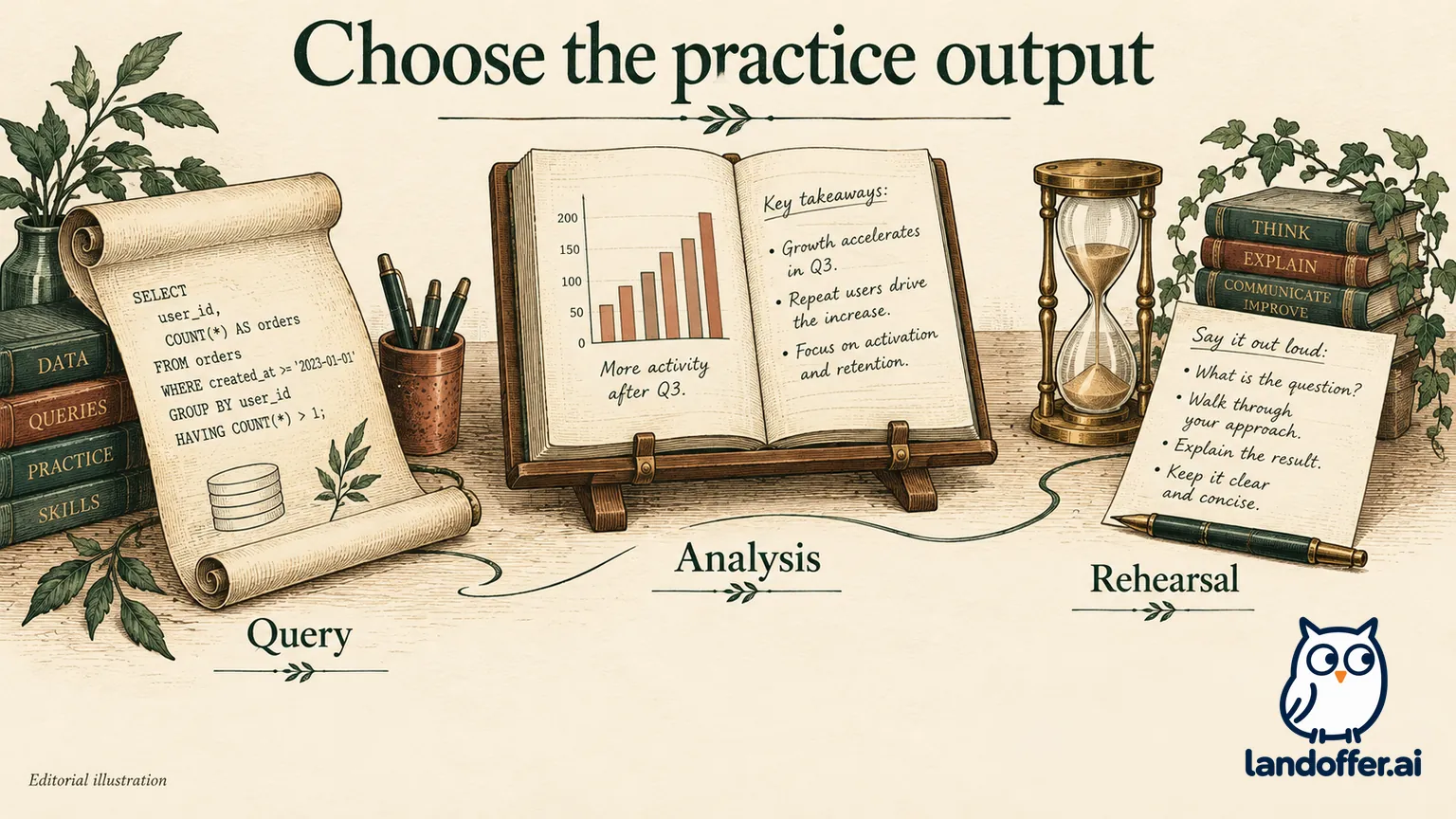
The current platform catalog separates analytical questions from algorithms, ML coding, statistics coding, visualization, and concepts. Use the categories to select work that exposes your missing skill, instead of choosing by the total number of questions. A candidate who needs to explain a modeling choice may gain little from another short aggregation exercise, while a candidate struggling with SQL joins may not need a full project yet.
Start with the expected deliverable in a real role description or interview invitation. “Write a query” points toward coding practice. “Analyze this data and justify your recommendation” points toward an analysis or project. “Explain your approach under time pressure” adds a rehearsal need. One interview can contain all three, but practice should expose which part breaks down.
Use this distinction when reading free and paid access. A visible assignment is an opportunity to inspect the work; it does not prove you can download its dataset, create a hosted notebook, open a solution, or receive grading. Likewise, a mock setup page shows configurable practice, not the quality of a completed feedback report. We checked those boundaries separately.
SQL options and the assumptions inside a question
Opening the catalog's Postgres control revealed options for Postgres, MySQL, MSSQL, Oracle, Pandas, Polars, PySpark, and R. That is an observed menu, not a successful runtime test in all eight options. The menu alone does not establish that every question supports every option. Choose the engine or library your assessment requires before treating a solution as ready to reuse.
We opened Finding Updated Records, labeled updated in October 2026. Its prompt uses a stated assumption about non-decreasing salaries to identify a current record without a timestamp. That assumption makes the exercise possible. It would be unsafe to carry the same rule into a workplace dataset where salaries can decrease or where “current” has another definition.
The logged-out detail displayed PostgreSQL, Run Code and Check Solution controls, and a message requiring login to execute code. It also displayed an upgrade control for the dataset schema. We did not press Run Code or Check Solution. A question appearing without a PRO badge in the catalog therefore did not establish unrestricted anonymous execution or schema access in this observation.
Read the prompt as an output contract. Note the identifying columns, ordering requirement, and permitted assumptions before choosing syntax. If an answer appears correct only because you silently supplied a missing rule, you have practiced a different question. This is especially relevant when switching between concise coding prompts and less prescribed analysis assignments.
Projects make your reasoning part of the deliverable
In Data Labs, the public directory exposes projects, mini-analyses, and user solutions. We inspected Customer Churn Prediction. Its assignment asks for exploration, a justified train/test split, model selection, evaluation metrics, and production concerns. The page associates it with Spotify while describing telecom customer data. Treat that as the platform's practice attribution, not evidence of a current employer assessment.
The assignment text was readable, but the page said login was required to download the dataset. We did not download it or open a hosted notebook. Those limits matter if you intend to spend a weekend on the project: reading the brief and obtaining the files are separate steps. Inspect your account's entitlement before committing a schedule around hosted execution or grading.
The September 21 mini-analysis explanation describes bounded business tasks using small, uncleaned datasets and a short report. That format can reveal choices that a well-specified query hides: what missing values mean, whether a metric should be weighted, or whether the data supports the question at all. Its value comes from documenting those choices, not merely producing a notebook that runs.
Worked project: a perfect result with an unavailable feature
Here is an original teaching exercise, not a StrataScratch assignment or an AI-graded submission. A fictional support team wants to flag tickets likely to remain unresolved for more than 24 hours. The prediction must happen when each ticket opens. That decision time is the first line of the brief, because it determines which fields can be used.
Our invented eight-ticket dataset contains a count of earlier tickets captured at opening, eventual resolution time, and a label indicating whether resolution exceeded 24 hours. There are four positive and four negative labels. Customer identifiers would let you join records, but they would not by themselves explain why a ticket might breach the threshold.
| Field | Available at ticket opening? | Decision |
|---|---|---|
| Opening timestamp | Yes | Establish the prediction cutoff and chronological evaluation |
| Earlier-ticket count captured at opening | Yes, under this exercise's snapshot rule | Candidate input, with its collection rule documented |
| Eventual resolution minutes | No | Exclude from predictors; use only to construct the outcome |
| Ticket identifier | Yes | Keep for traceability, not as a meaningful predictive explanation |
A shortcut rule uses eventual resolution minutes: flag the ticket if the number exceeds 1,440. It matches all eight labels. That is 8/8 on our rows, but it simply reads the completed outcome. The value does not exist when the prediction is required. The 8/8 tally supplies no evidence that this rule can prioritize a newly opened ticket: its input is recorded after resolution.
For comparison, a deliberately simple available-input rule flags earlier-ticket counts of at least three. Our counts are 0, 4, 2, 5, 1, 3, 4, and 4. The corresponding outcome labels are 0, 0, 1, 1, 0, 1, 0, and 1. The rule gets five of eight labels right. A local calculation confirms both totals; neither is a production model evaluation or a StrataScratch score.
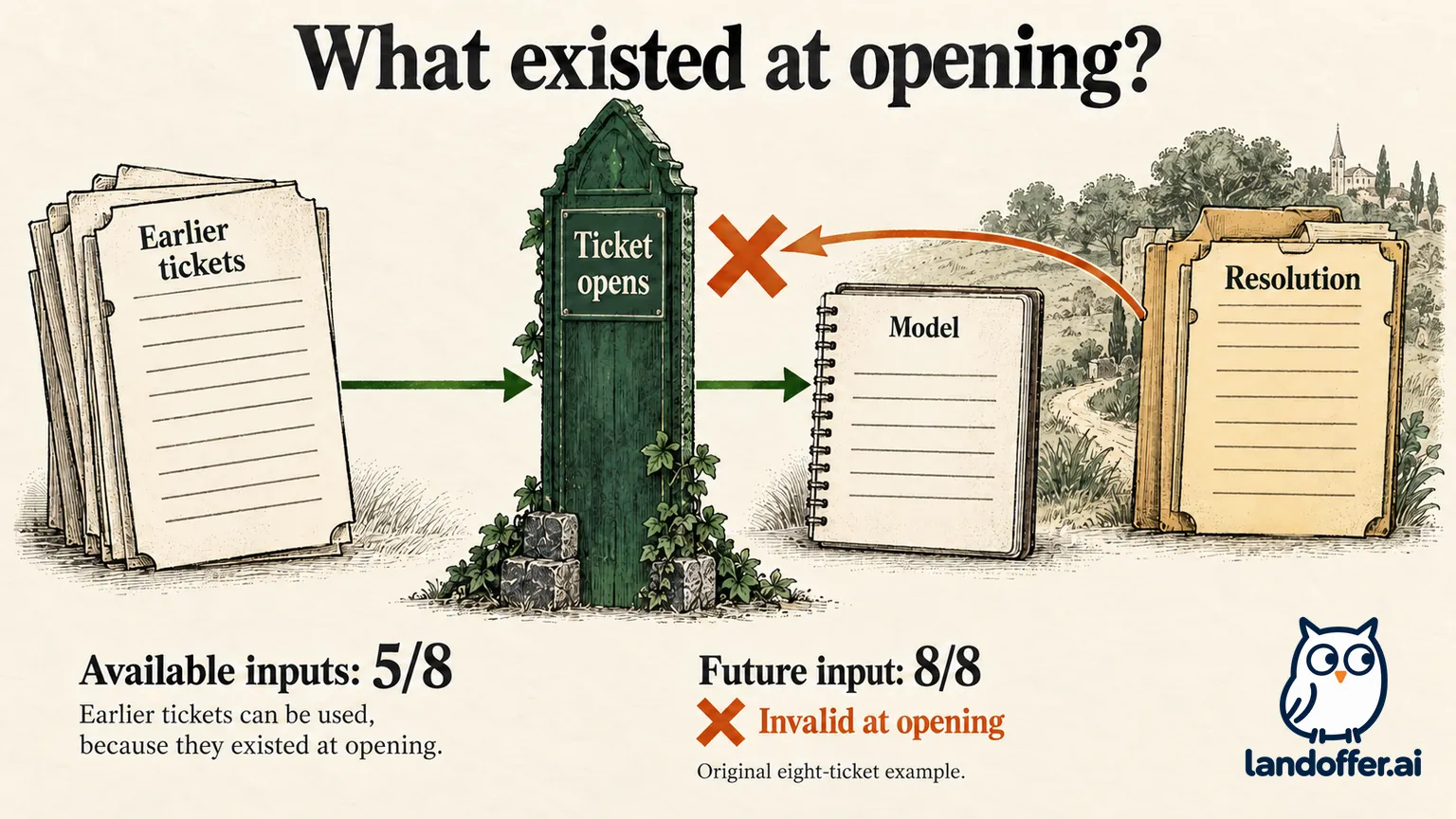
The five correct predictions are a usable starting point for examining errors in this exercise. It tells us that the simple available-input rule makes errors. It does not tell us that the eventual-resolution feature should be restored. Adding an unavailable predictor would improve this worksheet's number while making the intended decision impossible.
The completed README for this exercise would say: “Predict at ticket opening. Use only fields captured by that cutoff. Build outcome labels from later resolution records. Order evaluation by opening time, and fit learned preprocessing on training data only. The eight-row rule is an illustrative baseline; it is insufficient to establish deployment performance.” That statement connects the model inputs to the actual task.
If feedback praised the 8/8 result without addressing the timing violation, keep the field-availability check in your own review. A reassuring score would leave the original defect unresolved. If it identified the unavailable field, your next action would be to remove it and rerun the evaluation. You can assess the usefulness of a critique through the correction it supports, without treating an automated score as a hiring verdict.
AI grading and AI mocks answer different questions
StrataScratch's September 22 grader announcement describes evaluation of project rigor and reasoning, with critique rather than corrected code. The earlier mini-analysis article says automatic grading was not yet available. The later announcement and current paid-feature table describe it, so older launch copy should not define today's offer. We have not submitted a project or measured the evaluator's consistency.
For a project, the useful question is whether feedback identifies a defect you can verify, such as the unavailable predictor above. For a mock, the useful question is whether you can formulate and communicate an answer in the allotted time. A candidate can have correct written analysis and still need practice explaining it aloud. These outputs serve different preparation gaps.
On the public mock-interview page, Quick Start displayed SQL, medium difficulty, 60 minutes, and two questions. Expanding Advanced Filters revealed language, difficulty, company, duration, question count, and a Debug-AI-Code option. We inspected settings without starting a session. We cannot report spoken-feedback accuracy, scoring reliability, or resemblance to a particular employer's interview from that setup alone.
For your first completed mock, inspect one actionable item against the work you actually did. A comment about an omitted edge case should identify the case. A communication comment should connect to a specific explanation or omission. Save your original attempt and your correction, rather than accepting a numerical rating without a traceable reason.
Content access, credits, and billing
The current pricing page displayed $24 monthly, $139 yearly, and $289 once for lifetime access. The yearly $11.58 monthly equivalent is not a monthly charge. Monthly and yearly plans advertise 1,000 AI credits per month; lifetime advertises 25,000 once without expiry. A promotion was visible, but we did not apply it or verify a discounted checkout.
The feature table separates free question/project access from paid solutions, hosted notebooks, AI grading, and mocks. Free's 50-credit label does not establish permission to use every AI feature. Defense rehearsal was marked coming soon, so it should not justify a purchase today. Check both the feature and its allowance.
The credit FAQ gives examples of average usage, not a fixed per-action tariff. Project size and tool complexity can change consumption. Record credits before and after an actual task in your account; a monthly allowance alone cannot prove how many interviews your particular usage will support.
Worked choice: Maya needs a query and an explanation
Maya is a fictional applicant with a SQL screen in ten days and a possible analysis follow-up. Her budget is $40. She can already write joins, but she tends to skip explaining why a dataset supports her conclusion. Her preparation needs two query attempts, one bounded analysis, and one spoken rehearsal, rather than a long sequence of unrelated algorithm questions.
She allocates two one-hour blocks to coding, two hours to the original ticket exercise and README, and 45 minutes to explaining the result aloud. Her completed selection is coding practice for syntax and assumptions, a local analysis artifact for feature timing, and a rehearsal for reasoning. She does not need a full predictive project before she can test the central weakness.
Maya starts with accessible free material. If a specific hosted notebook or AI mock is needed and included in her account's selected plan, the displayed $24 month fits her $40 budget. The $139 year and $289 lifetime offer exceed it. If local analysis and a practice partner expose the gap adequately, she can keep the free route. Buying a mock is justified by a feedback need, not by the existence of an AI-credit badge.
Her acceptance evidence is concrete: she explains why 8/8 is unusable, identifies which input is available at opening, and presents the weaker rule without claiming deployment readiness. A later critique can help her revise the explanation. Before buying feedback, she writes down those three acceptance points so she can judge whether the session addresses her actual gap.
Check the refund discrepancy before subscribing
Current pricing advertises a five-day money-back guarantee for paid plans. The linked terms, labeled last updated November 11, 2020, describe subscriptions as generally non-refundable, with legal and discretionary exceptions. The terms also describe renewal, cancellation, and access through the paid period. We did not test cancellation or a refund. Ask which current guarantee applies to your purchase if that protection determines your choice.
Choose one practice output you can review afterward: a query result, an analysis with documented assumptions, or a mock followed by a correction. Then browse recent roles on LandOffer.ai and compare that output with the responsibilities you want to demonstrate. Role discovery gives your practice a target; it does not validate the notebook or interview feedback for you.
Sources and Further Reading
- Current interview-question catalog
- Finding Updated Records: inspected public detail
- Data Labs
- Customer Churn Prediction: inspected assignment
- Mini-analyses: September 21, 2026 explanation
- Project and mini-analysis grader: September 22, 2026 announcement
- Mock-interview setup
- Current pricing, feature table, and credits FAQ
- Dated terms and cancellation policy