LandOffer
Job search
DataLemur vs. StrataScratch: SQL Practice, Broader Data Prep, and Feedback
Choose focused SQL practice or broader data exercises by the task you must demonstrate and the feedback you need.
DataLemur fits a focused need for SQL questions, graduated hints, and data interview concepts. StrataScratch fits a broader preparation task that includes multiple SQL dialects, Python analysis, projects, and documented AI feedback options. Start with the format of your next interview: paying for a broader library does little for a candidate whose only gap is independently writing a query, while a correct query alone may leave a take-home explanation unfinished.
LandOffer publishes this comparison. We reviewed current public plans and logged-out workspaces on October 14, 2026, including actual hint and access controls. We did not buy subscriptions, submit work for AI grading, or attend an interview. Browse recent roles on LandOffer.ai to identify the task you need to demonstrate. The learner cases and activation dataset below are original fictional examples, not vendor questions or customer outcomes.

Compare the exercise you need to finish
Both platforms extend beyond a list of SQL puzzles. DataLemur presents SQL and data science interview questions, and its public navigation includes statistics, machine learning, and Python categories. StrataScratch presents coding, conceptual questions, data projects, and mock interview options. Calling DataLemur “SQL only” or treating StrataScratch as merely a larger SQL bank would obscure the relevant choice.
The table compares documented formats and states which controls we actually inspected. We observed public controls and descriptions, not paid feature quality.
| Preparation need | DataLemur | StrataScratch |
|---|---|---|
| SQL practice with help | SQL questions, multiple hints, full solutions advertised | Coding questions, hints, walkthroughs, user solutions advertised |
| SQL dialect choice | Inspected question displayed PostgreSQL 14 | Inspected catalog menu listed Postgres, MySQL, MSSQL, Oracle |
| Data concepts | Statistics, probability, ML questions in paid offer | Concept questions plus advertised premium AI grading |
| Analysis deliverables | Do not assume a hosted project workspace from question access | Project briefs; premium notebooks, solutions, and AI scoring advertised |
| Spoken interview rehearsal | Paid coaching is a separate bundle | AI mock interviews advertised with premium access and credits |
| Feedback verified here | A public hint opened; solution requested sign-in | Public project brief and paid-feature matrix inspected; grading not tested |
StrataScratch's catalog menu also listed Pandas, Polars, PySpark, and R. Menu labels establish selectable formats, not proof that every problem works identically in every language. Choose the engine named for your interview so practice exposes its date functions and syntax before the screen.
For DataLemur, the inspected salary question displayed an editor, Run Code, Submit, and the PostgreSQL label. Opening its first hint worked without signing in; choosing Solution opened a sign-in request. That observation does not establish that every solution is paid or that execution works without an account. We did not run or submit the starter query.
Two candidates with twelve hours make different choices
Ines is a fictional analyst candidate facing a SQL screen in eight days. She has twelve study hours and a $20 tool budget. Her gap is choosing joins and explaining a denominator without hints, rather than operating a notebook or training a model.
Her completed allocation is six hours of independent query attempts, three hours reviewing missed reasoning, two hours solving changed datasets, and one hour explaining results aloud. She starts with publicly accessible material. If the specific questions she needs require Premium help, DataLemur's observed $15 monthly offer fits the budget; StrataScratch's $24 monthly offer does not. Exploring projects and AI tools would also take time away from Ines’s SQL attempts.
This is a budget-and-task decision, not a judgment that DataLemur gives better SQL feedback. If Ines must practice Oracle and finds suitable questions in StrataScratch's free subset, that subset may be the better starting point. A product recommendation should change when an actual constraint changes.
Ravi is a fictional data scientist candidate with the same twelve study hours, a $30 budget, and a take-home analysis followed by a discussion. His required deliverables are a reproducible notebook, a short README, a metric definition, and an explanation of limitations. He already writes basic SQL independently.
Ravi allocates two hours to query practice, five to analysis, two to the README, two to revising a weak conclusion, and one to an oral defense. StrataScratch's observed $24 monthly plan leaves $6 uncommitted and advertises the notebook and project-feedback features relevant to that sequence. He first inspects a free project brief to confirm that its task resembles his requirement. Ravi buys only if the advertised paid workspace or feedback supplies a missing part of his plan. We have not established that its AI critique is accurate.
DataLemur's $15 monthly plan would leave more cash, and its conceptual questions could help Ravi rehearse statistics. It would not, based on our inspected evidence, supply the same documented project workspace. If he already has a local notebook and a reliable reviewer, keeping that workflow and using free conceptual practice may be sufficient. Neither candidate needs an annual plan to carry out this short schedule.
A worked exercise: the query and the analysis ask different questions
Consider an original synthetic activation exercise. The eligible cohort contains three users, A, B, and C. User A completes two events during the first seven days after signup. User B completes one event on day ten. User C completes none. Assume every user has a full seven-day observation window. The metric is the share of eligible users with at least one event during their first seven days.
The correct result is one activated user out of three eligible users, or about 33.3%. An inner join that drops C can change the denominator to two users and produce 50%. Counting A's two events as two activations can instead produce two divided by three, or about 66.7%. Both wrong answers can emerge from queries that execute successfully.
| User | Qualifying events | User-level activation flag |
|---|---|---|
| A | Two during first seven days | 1 |
| B | None; day-ten event is outside the window | 0 |
| C | None | 0 |
| Total | Two events | One activated user / three eligible users |
For the SQL task, define one row per eligible user. Start from the cohort, retain users without events, and reduce qualifying events to a binary flag. Then average the flags or divide the count of activated users by the eligible-user count. Duplicate events should not increase the user-level result. Define the exact endpoint consistently: this example includes signup time and excludes the instant seven days later.
We checked the example locally in SQLite using invented timestamps. The baseline returned one activated user and three eligible users. Adding another event for A left the result unchanged. Adding a qualifying event for B changed it to two out of three. An empty eligible cohort returned no rate rather than inventing zero percent. These checks test our exercise, not either platform's SQL runtime or grading.
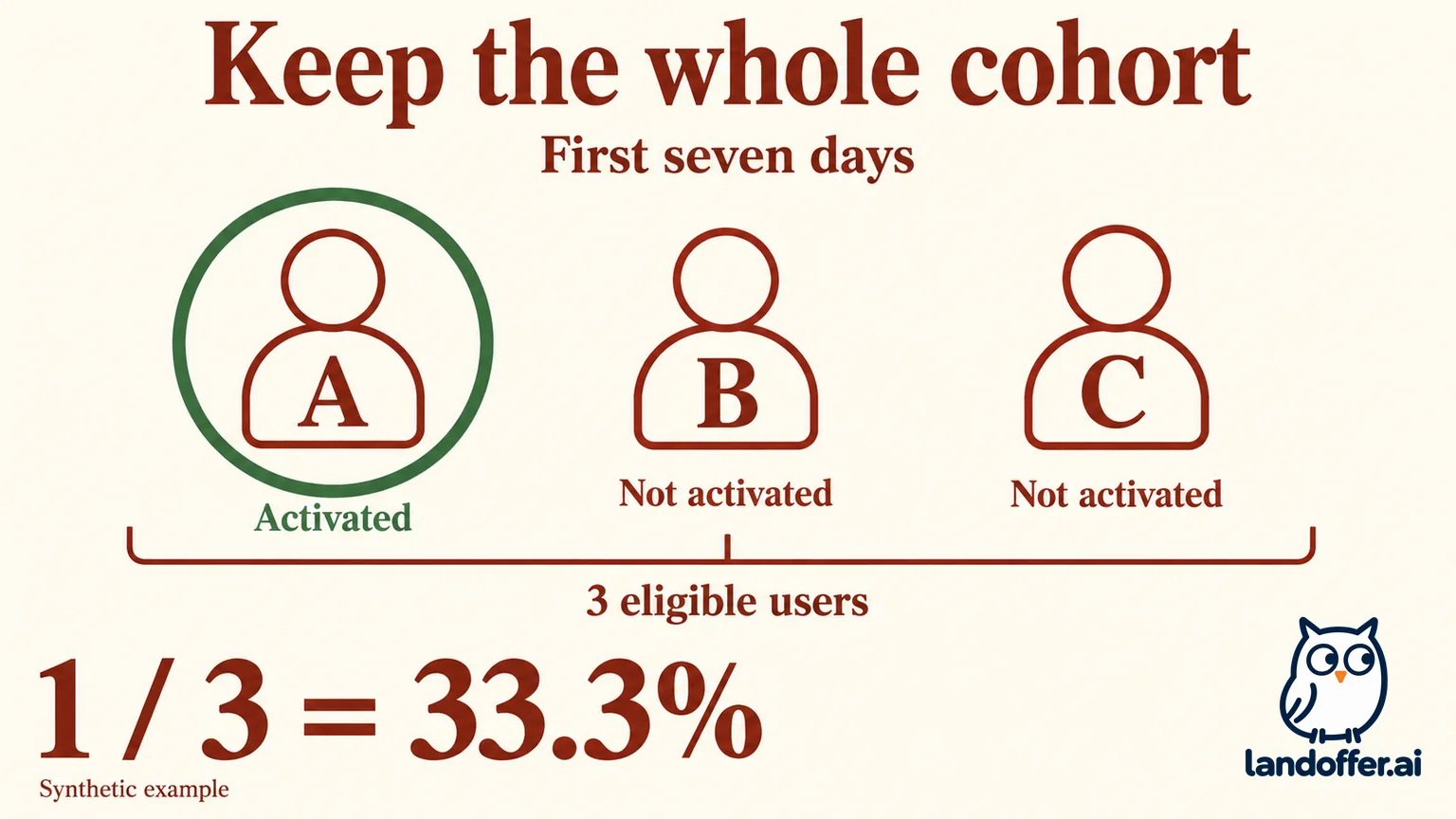
Now treat the same result as an analysis deliverable. The notebook should state who qualifies for the cohort and display A=1, B=0, C=0 before calculating the rate. The README should explain the observation window, duplicate handling, and the meaning of an empty cohort. A reviewer should be able to reconstruct why C remains in the denominator without reverse-engineering the query.
A defensible conclusion is: “Under this first-seven-day definition, one of three eligible users activated. This tiny synthetic cohort illustrates metric construction; it does not establish a product trend or the effect of an intervention.” The result cannot tell you whether a marketing campaign caused activation, and the example deliberately provides no campaign comparison.
If newer users have not yet had seven days to act, the definition needs another decision: restrict to mature cohorts or state that the rate is incomplete. That decision belongs in the analysis, even when the SQL syntax is correct. Broader project practice is useful when your interview asks you to defend such choices. Focused query practice is sufficient when the immediate assessment stops at producing and explaining the result.
Project access and feedback are separate entitlements
We inspected StrataScratch's Customer Churn Prediction assignment. The public brief requested exploratory analysis, a reasoned train/test split, a model choice, evaluation metrics, and deployment considerations. It also displayed a login requirement for downloading the dataset. Reading the brief was not the same as obtaining its data, running a hosted notebook, or receiving a grade.
Its current pricing matrix distinguishes those layers. Free access includes project access and limited dataset downloads, while hosted notebooks, project solutions, and AI scoring are premium features. The free plan's credit badge should not override a feature row showing that a particular AI tool is unavailable on Free.
StrataScratch's September 22, 2026 grader announcement describes feedback on project reasoning and says it does not return corrected code. That is a documented product design, not a measurement of feedback accuracy. We did not submit our activation example to it or compare its critique with a human review.
For a useful feedback check, ask whether the response identifies the actual denominator, explains why the inactive user belongs, and requests a correction that changes your work. A numerical grade without that reasoning would leave the central error unresolved. Conversely, a specific critique can be useful even if you disagree with the score. Keep your own metric definition and test cases available when reviewing automated suggestions.
DataLemur's hints can help you identify a missing SQL idea, but seeing a hint is different from reproducing the solution independently. Close the help, change the dataset, and explain the expected output before solving again. Our activation example offers a concrete way to do that without copying either vendor's published question or answer.
Choose the access period after choosing the task
The public DataLemur offer showed $15 monthly and $60 yearly. The yearly price is an annual charge, even though the page also expresses it as $5 per month. Its $300 one-time bundle combines lifetime access, a signed book, and a one-hour coaching call. Compare that bundle only if you need those additional deliverables; it is a different purchase from question access. DataLemur pricing.
StrataScratch showed $24 monthly, $139 annually, and $289 lifetime. Monthly and yearly plans advertised 1,000 AI credits each month; lifetime advertised a one-time 25,000-credit balance that does not expire. Those allocations should not be read as unlimited AI use. They also do not establish a fixed number of graded projects, since the actual consumption can depend on the activity.
An annual monthly equivalent spreads the displayed cost; it does not reduce the amount charged upfront. For Ines and Ravi, however, the immediate question is whether one month supplies a needed input. Neither worked plan depends on a year's worth of exercises. Buy a longer term only when the continuing practice schedule and feature need support it.
DataLemur's terms generally make paid fees nonrefundable, subject to legal requirements and discretionary exceptions, and distinguish cancellation of renewal from refunding the current paid period. StrataScratch's current pricing advertises a five-day money-back guarantee, while its terms page, dated November 11, 2020, contains a general nonrefund position. Confirm the current purchase-specific guarantee before depending on it; this review cannot resolve that discrepancy or report an untested refund.
Use DataLemur when focused questions and hints address your actual gap. Choose StrataScratch when the needed practice extends to an analysis artifact and its documented workspace or feedback adds something you lack. Keep your existing free or local workflow when it already provides the exercise and review you need. Before paying, attempt one relevant task, record where you needed help, and buy only the access that addresses that gap. Explore LandOffer.ai with that preparation need tied to the roles you are pursuing.