LandOffer
Job search
AI Mock Interviews vs. Peer Practice vs. Paid Coaches: What Feedback Are You Buying?
Choose repeated rehearsal, reciprocal practice, or expert critique by the feedback your next interview needs.
Choose an AI mock when repeated solo rehearsal is your immediate need, peer practice when you need a listener's reactions and can return the favor, and a paid coach when a defined gap calls for relevant expertise. Each route supplies feedback in a different way. Choose by the gap you need to diagnose. A useful session leaves you with a specific correction you can test in another attempt. Price, a human face, or a numerical score does not establish that correction by itself.
This comparison reviews current public offers and limited logged-out page observations on October 14, 2026. We did not attend sessions, record answers, purchase coaching, or benchmark an AI evaluator. LandOffer publishes this article. You can browse recent roles on LandOffer.ai to identify the round and responsibilities you need to rehearse before choosing how to get feedback.
Compare the work, not the label
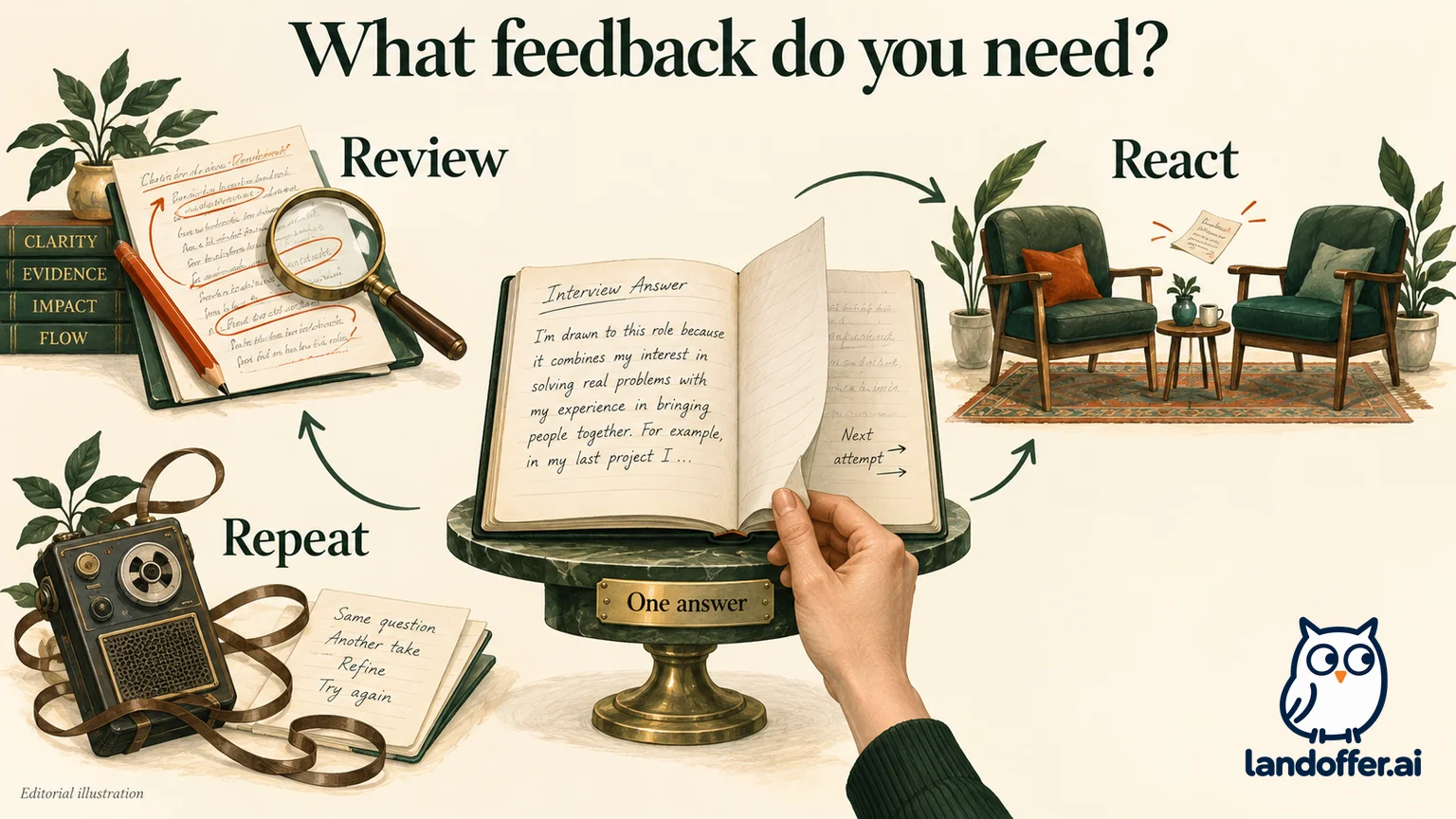
“Mock interview” can mean a solo recording with automated comments, a reciprocal call with another candidate, or a session led by someone hired to assess your work. Some products combine them. Aced Practice, for example, describes both peer practice and AI feedback. Interviewing.io's FAQ describes paid human interviews as well as a free AI interviewer for coding and system design. You need to identify the specific service you are using.
Decide what you need another reviewer to notice in your answer. A tool may help reveal missing detail. A peer may tell you where they lost the thread. An expert may challenge whether your technical choice fits the problem. Use those possibilities to frame a feedback request. The session still needs to supply an example of what to change.
| Practice route | What you contribute | Feedback to inspect | Main choice constraint |
|---|---|---|---|
| Solo AI mock | Your answer and time for another attempt | A comment tied to what you said or produced | Relevant question format, permissions, and usable feedback |
| Reciprocal peer mock | Candidate time plus time interviewing the other person | A listener's questions and examples of confusion | Scheduling, preparation, and willingness to return useful feedback |
| Paid human session | Payment, a clear brief, and attempted work | Expert critique within the agreed round and scope | Relevant experience, availability, and actual session deliverables |
Use the same standard across all three: does the feedback point to evidence, identify a consequential gap, and give you a next action? A comment can sound sophisticated while failing that test. “Improve your executive presence” is difficult to use until the reviewer identifies what happened in the answer and what to change.
AI practice: repetition with feedback you must check
Huru's current public page advertises free job-seeker access without a subscription, including unlimited mocks and a full AI feedback report. Its paid Enterprise offer is for organizations. The page describes recorded spoken answers and scoring criteria including relevance, structure, specificity, impact, and articulation. These are vendor descriptions, not results from a session we completed.
Huru also says speech can be misheard and that scores are coaching signals rather than hiring decisions. Read the comment against your actual answer before accepting it. If a transcript drops a technical term, a suggestion based on that omission may address the transcription rather than your reasoning. Correct the factual record first.
Solo rehearsal can fit short practice windows because you do not need a partner in the same window. That is an operational advantage, not proof of feedback quality. A candidate who has not attempted an answer may benefit from repeated starts and revisions before paying someone to listen. Conversely, repeating the same answer until a score rises can teach you to satisfy the tool's pattern without answering a changed question.
Use a changed follow-up to check transfer. If you practice describing a release decision, ask yourself how the explanation changes when a rollback is unavailable. Can you still explain the options and the criterion? The useful outcome is reasoning you can adapt, not a number you can reproduce.
Peer practice: include the time you owe the other person
Aced describes reciprocal sessions of approximately 30 minutes in each role, about an hour overall, with a shared editor for relevant technical rounds. Its free route uses monthly practice credits; members receive unlimited access. We expanded the public FAQ, but did not schedule a match or verify partner availability. These are the currently described boundaries of that example, not rules for every peer community.
The interviewer half is part of the work. Prepare the question, understand its requirements, and be ready to explain where the other candidate's answer became unclear. You can learn from seeing someone else make choices, but that does not make your partner's time disposable. If you only have 25 minutes, do not plan around completing an hour-long reciprocal session.
A peer's reaction can reveal something valuable even when they cannot judge every technical detail. “I did not know which part you personally owned” is a direct report of what they understood. “Your architecture would fail at production scale” requires more support: which workload, failure mode, and component? Treat those two statements differently.
Ask for the moment of confusion rather than an overall verdict. If your partner cannot follow your explanation after the third sentence, you have a place to revise. You do not need them to predict whether a hiring panel would pass you. Save the question they asked and the revised explanation so the next session can test the change.
Paid coaches: buy a defined review
Interviewing.io's public FAQ says human interviews start at $179, with price varying by subject and company preference. It describes experience and trial-interview screening for interviewers. Those claims explain its selection process; they do not establish how well a particular interviewer matches your target round. We did not obtain a final quote or attend a session.
Aced's coaching support page describes a 60-minute session tailored to goals, with feedback during and after it. A normal coaching session does not include membership. Its software-engineering coaching catalog lets you inspect role and skill profiles. Read the coach’s stated skills and ask how the session will address your target round. A listed employer does not establish experience assessing that exact round or level.
Write the work you want reviewed before selecting a coach. “Backend trade-off discussion, with a debrief on requirement discovery and failure handling” is more specific than “help me pass.” Decide whether the session is a realistic mock, collaborative explanation, or critique of an existing attempt. Trying to fit all three into one hour may reduce the time available for the priority.
Also distinguish feedback format from session length. Ask whether the promised follow-up is written, recorded, or delivered verbally, and whether it includes a prioritized next step. Before the call ends, identify the one correction you will make and the follow-up question that will test it. A concise critique can be enough if you can connect it to the answer and test the correction.
Three candidates make different choices
These are fictional planning examples, not reports about customers or completed vendor sessions. Nina has four 25-minute windows this week, no spending budget, and trouble beginning a behavioral answer aloud. She chooses solo practice using an accessible free offer. Each window contains one attempt, one review, and one revised opening. Her total allocation is 100 minutes; it is her schedule, not a provider's required session duration.
Nina's target is to start with her actual responsibility and the decision she made. She keeps a changed follow-up for the final window. Paying for specialist critique before she has a complete answer would leave the reviewer with less useful material. She can revisit that choice if repeated attempts reveal a gap she cannot diagnose.
Priya has two uninterrupted hour-long windows, no spending budget, and a prepared coding attempt she struggles to explain to another person. She chooses reciprocal peer practice if a suitable match is available. Two described hour-long sessions consume two hours of calendar time, with roughly one hour as the candidate and another as interviewer. She does not count the entire two hours as being interviewed.
Priya asks each partner to note the first point where her reasoning becomes unclear. She also prepares the assigned problem for the interviewer half. Her decision buys a real audience reaction through mutual work. It does not assume that an unknown peer can certify correctness or simulate a particular company's evaluation.
Evan has a $200 budget and a backend mock coming up. He has two attempted designs but cannot decide which failure-handling assumptions he should state first. He considers one relevant human session at the advertised $179 starting price, conditional on the actual quote staying within $200 and the round matching his need. A more expensive company-specific quote would change his decision.
Evan prepares the two attempts and requests a debrief on their assumptions. He avoids a multi-session package until the first review reveals repeatable work for later sessions. His choice is about the expertise he needs for a defined comparison. Nina's repeated practice and Priya's peer reaction remain sensible choices for their different gaps.
Worked example: turn a vague answer into reviewable evidence
Consider an original fictional release incident. A background consumer began rejecting newly queued jobs after a deployment. Existing users could still access the service. The candidate inspected consumer logs, compared rolling back with pausing the new batch, chose to pause while investigating, and tested new jobs in staging before resuming. Those are the facts available in this exercise. No customer-impact metric or exact recovery time is supplied.
The first answer is: “We had a deployment issue. We worked together and fixed it quickly.” It names neither the candidate's action nor the options. Its claim about speed cannot be checked from the provided facts. Even a friendly listener has little evidence to review.
Three possible comments show what feedback can contribute. They are invented editorial examples, not output from an AI system, peer, or paid coach we tested.
| Illustrative comment | Evidence behind it | Correction |
|---|---|---|
| “You describe the team but omit your own action.” | The first answer uses “we” and gives no specific action | State that you inspected consumer logs and compared two responses |
| “Why did pausing seem acceptable?” | The first answer gives no decision criterion | Explain the distinction between existing service access and newly queued work |
| “How did you check it was safe to resume?” | The first answer jumps directly to “fixed” | Describe the staging check without inventing a broader production guarantee |
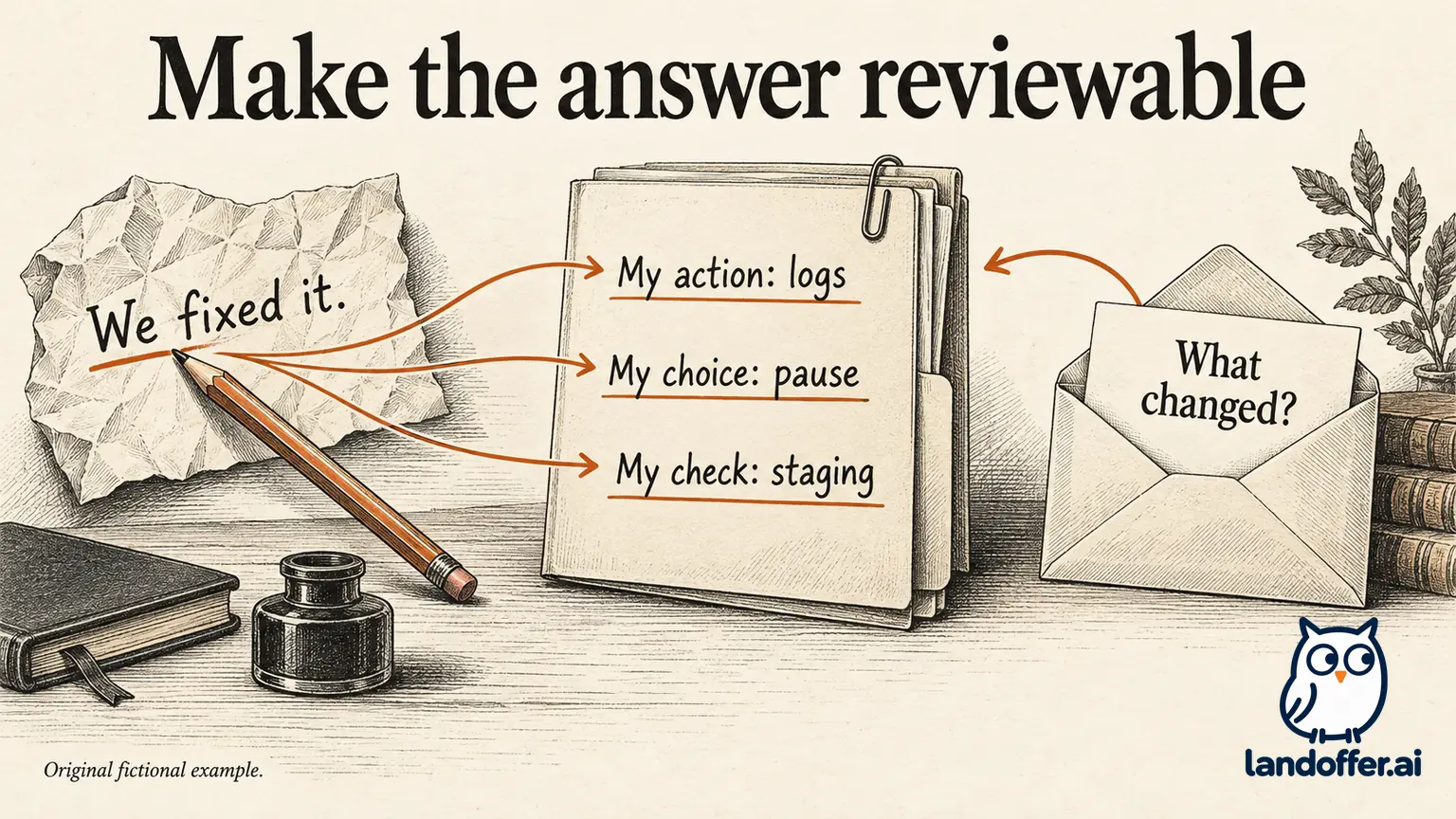
The revised answer is: “After the deployment, the background consumer rejected newly queued jobs while existing users could still access the service. I inspected the consumer logs and compared a rollback with pausing the new batch. I chose to pause the batch while we investigated. Before resuming, we tested new jobs in staging. I would explain the remaining production checks separately, because this example does not establish them.”
This revision supplies ownership, options, a criterion, and a bounded check. It still leaves questions open: what caused the rejection, whether pausing affected deadlines, and which checks were needed after staging. A reviewer should identify those missing facts instead of supplying them. Leave recovery time unspecified until you have evidence for it. A stronger answer can be precise about the actions without adding a result the facts do not support.
Now change the follow-up: “What if existing users were also affected?” The candidate must reconsider the pause decision and explain why rollback, traffic controls, or another response might become more urgent. Repeating the revised paragraph unchanged would miss the changed condition. That follow-up tests whether the correction improved reasoning rather than memorization.
Protect the useful evidence and the session budget
Use an anonymized or synthetic practice scenario when workplace details are private. Before recording or sharing an answer, inspect the service's recording, transcript, visibility, and retention controls. A display alias does not by itself answer those questions. Share only the facts necessary for the feedback you want, and keep a private record of your original attempt and correction.
Time and cancellation rules also affect your choice. Aced's support page says missed coaching or changes within 24 hours count as a used session. Its unused-session refund rules include a six-month window and package recalculation. These are documented conditions, not a refund we tested. Check the terms of the particular purchase rather than assuming that credits, membership, and used coaching have the same remedy.
Write one complete answer before adding another session to your calendar. Pick the question, identify the feedback gap, and choose the least costly route that can address it in your available time. After the review, redo the answer under a changed condition. If you still need a target, browse recent roles on LandOffer.ai and use the stated responsibilities to choose that condition. Job discovery gives the practice a purpose; it does not grade the answer.