LandOffer
Job search
Company-Specific Mock Interviews: What to Verify Before Paying for an Expert
A company badge starts the search. A completed coach shortlist and fictional system-design feedback review show how to verify fit and buy a useful assessment.
A company-specific mock interview is worth paying for when the interviewer can assess your target role, level, and round, then leave you with specific work to redo. An employer name on a profile is only a starting point. Before buying, verify what the expert actually interviewed, how recently, what happens during the session, and which notes, annotations, or other feedback you can use afterward. A company filter does not establish employer endorsement, access to a current hiring rubric, or an accurate prediction of your outcome.
This guide uses current official service descriptions and public browser checks as of October 20, 2026. We did not book a session, authenticate a coach's employment, or test feedback quality. The worked shortlist and practice notes below are explicitly fictional. LandOffer publishes this guide; you can browse recent roles on LandOffer.ai to identify a concrete target before paying for preparation.

Separate company familiarity from assessment fit
There are several different claims behind “expert from your target company.” Someone may have worked there without interviewing candidates. An interviewer may have assessed coding while your upcoming round is system design. A former hiring manager may offer valuable judgment while needing to distinguish past experience from today's process.
Those distinctions determine whether the coach can evaluate the weakness you are paying to examine. Ask for the role family, interview types, candidate levels, and approximate period of interviewing experience. You do not need confidential question banks or internal scorecards to obtain useful practice. You need someone who can choose an appropriate challenge, ask realistic follow-ups, and explain the evidence behind their evaluation.
We inspected IGotAnOffer's mock directory and selected Meta in its company filter; the selector and URL reflected that choice. That observation establishes that we could select the company category; it is not a test of matching accuracy or session availability. It does not prove every returned profile has interviewed your exact level or that the platform has verified every claim in the way you expect.
For a concrete profile-reading example, Taru's public page lists Meta software-engineering employment from April 2018 to April 2024 and describes interviewing experience with L4–L6 candidates. It also names several practice formats. Those are separate pieces of profile evidence, not an independent employment investigation or a recommendation of this coach for a particular vacancy. The employment dates alone would not justify describing the person as a current Meta interviewer.
Worked shortlist: choose evidence that matches the task
Suppose fictional candidate Rina is preparing for a senior backend system-design round at Company A. She wants to know whether she explains failure handling and makes defensible design choices under follow-up questions. All three profiles below are invented; none represents an actual coach or platform listing.
| Fictional option | Evidence in the shortlist | Rina's decision |
|---|---|---|
| Coach North | Former Company A engineer; profile discusses coding interviews from several years ago; system-design scope unstated | Do not book on the company match alone; ask about relevant rounds and levels |
| Coach River | Engineer at Company B; states recent senior system-design interviewing; offers a design mock with evidence-based debrief | Best provisional fit for the named gap, subject to scope and availability confirmation |
| Coach West | Company A recruiting background; offers résumé and behavioral preparation | Useful for another task, but not selected for evaluating backend architecture |
Rina provisionally chooses River because the evidence aligns with what she wants assessed. That choice gives up the target-company badge. If North later confirms relevant system-design experience and an appropriate debrief, the comparison changes. If the real gap turns out to be behavioral storytelling, West may become the better match.
Her clarification request is: “I am preparing for a senior backend system-design round. Can you run a realistic design exercise, challenge failure handling, and leave two or three prioritized findings with examples from my answer? Please distinguish your general senior-engineer assessment from anything you know about Company A's current process.”
That is a completed selection decision with a remaining condition, rather than a numerical ranking built from unverifiable biographies. Rina does not ask for leaked questions, a pass guarantee, or an internal referral. A coach who distinguishes their experience from Company A’s current process leaves Rina with a clearer basis for choosing.
Confirm the format and deliverable before the appointment
IGotAnOffer's session-scope help says the coach works with the client to decide what to cover during an hour and allows specifying companies and question types. Its directory describes a 45-minute mock followed by 15 minutes of feedback. Treat that as a documented format to confirm for your session, not proof that every coach provides the same written report or advance preparation.
Ask how much of the purchased time is interview simulation, discussion, and review. If you need a realistic uninterrupted attempt, say so; a guided lesson with frequent hints can be useful but measures something different. Agree on whether the coach should intervene immediately or save feedback until the agreed debrief so you can complete an uninterrupted attempt.
Also specify the artifact. “Feedback included” might mean spoken comments, brief platform notes, a recording, an annotated answer, or a detailed report. Ask which one you receive, when it arrives, and whether follow-up questions are included. Do not assume résumé review or asynchronous document editing comes with a technical mock unless agreed.
There may be a constraint on asking directly before purchase. IGotAnOffer's messaging help says pre-booking coach messaging is unsupported and offers support as a route to obtain answers. The page also describes messaging after booking. For an unresolved requirement, use the support route first rather than assuming a later cancellation will always be possible.
Worked session brief and feedback review
Here is Rina's completed fictional brief. It contains enough information to choose an appropriate exercise without sharing her employer's private architecture or customer data.
Target: senior backend system-design practice; company-specific expectations only where the coach can substantiate them. Format: 45-minute independent attempt and 15-minute debrief. Focus: failure handling and explaining trade-offs. Use an original webhook-delivery design task, with no proprietary diagrams. During the mock, challenge assumptions without giving the solution. Requested output: two prioritized observations, the point in my answer supporting each, and one independent redo task. Recording: no recording planned unless separately agreed.
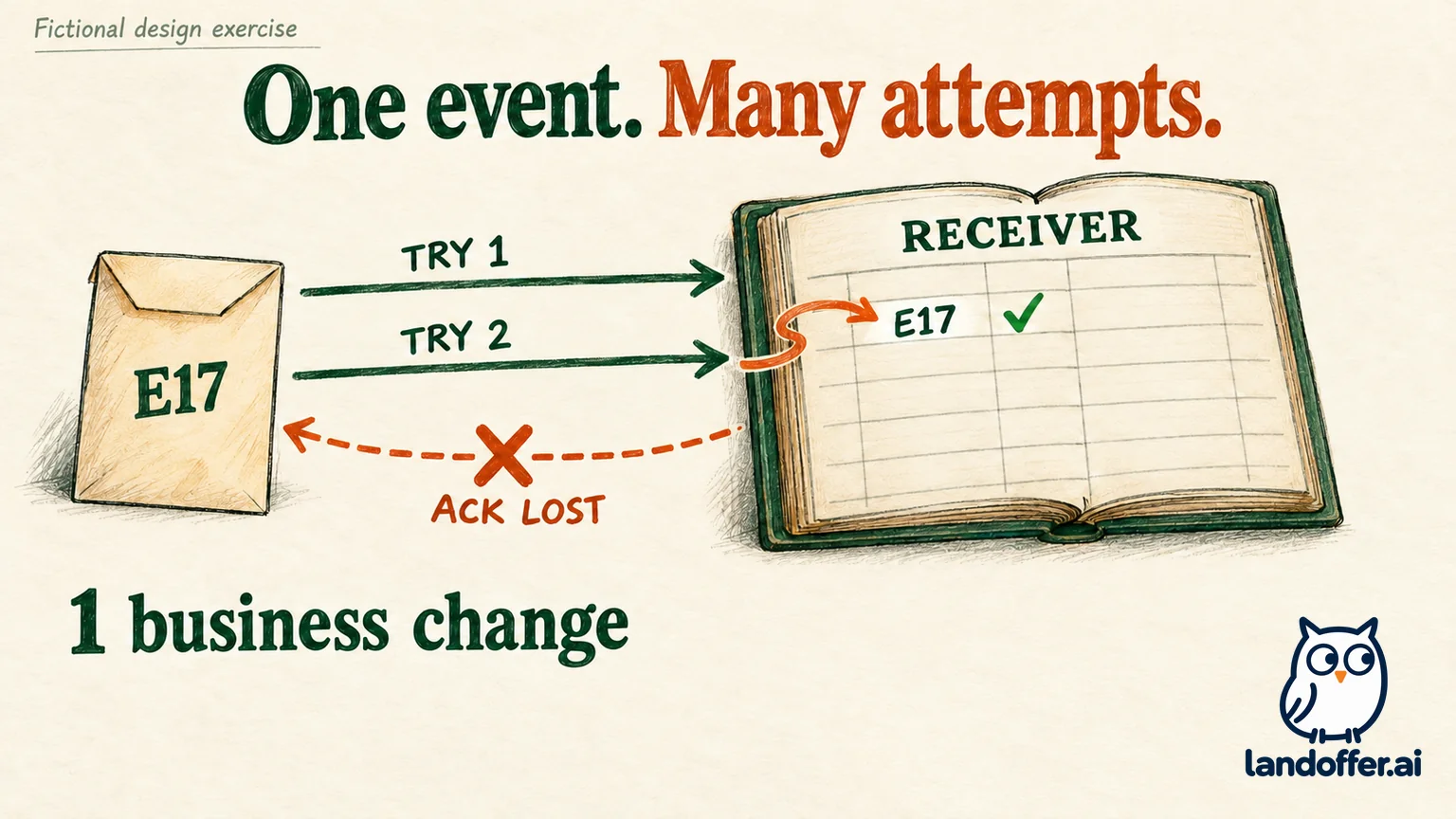
For this illustrative session, the task is to design a service delivering event notifications to customer endpoints. Rina proposes a queue, workers, and retries. Her initial answer says a timeout means the receiver did not process the event, so the worker can safely send it again. That is the assumption worth probing: a receiver could commit the operation, but the acknowledgment might be lost.
Now compare two possible feedback artifacts:
| Fictional feedback | Review of its usefulness |
|---|---|
| “Good structure, but go deeper on reliability.” | Too broad to direct the next practice attempt; it gives no observed decision or missing case |
| “After the receiver timed out, you treated the result as a failed operation. Explain the case where processing succeeded but the acknowledgment was lost. Then separate retry policy from duplicate protection.” | Names a point in the answer, identifies the missing failure scenario, and defines a specific redo |
Rina's corrected explanation is: “The delivery result may be unknown after a timeout. A retry can create duplicate delivery, so I would use a stable event identifier across attempts and define how a receiver recognizes an already processed event. Retry backoff controls load; it does not itself prevent duplicate effects.”
For an illustrative receiver that controls its own database, she adds a unique processed-event record and the business change in the same transaction. A repeated identifier finds the prior record rather than applying the change twice. This depends on the receiver's storage and transaction model. An outbound notification service cannot promise exactly-once business effects for arbitrary customer endpoints merely by attaching an identifier.
Her independent redo has three traces: normal acknowledgment; successful receiver processing followed by a lost acknowledgment and a retry; and two concurrent deliveries of the same event. For each, she must explain when the durable record is written and how the second attempt is handled. She also states how long duplicate records are retained and what happens outside that window.
Her completed trace review for event E17 reads as follows. It assumes the receiver enforces a unique event identifier and commits that record atomically with the business change.
| Trace | Receiver result | What a retry does |
|---|---|---|
| Normal acknowledgment | E17 and the business change commit together | No retry is needed |
| Processing succeeds, acknowledgment is lost | E17 remains durably recorded | Recognizes E17 and avoids another business change |
| Two concurrent E17 deliveries | The uniqueness constraint permits one committed processing record | The other attempt resolves the conflict and reads the committed result |
A crash before that transaction commits leaves neither change committed; a crash after commit leaves both. An external side effect outside this transaction would need another design. The trace is an illustrative reasoning check, not a tested implementation.
The completed review outcome is to keep the second feedback artifact and use these traces to explain the correction. It demonstrates a usable correction without assigning a fictional hire/no-hire score. Another session becomes relevant if the redo still exposes an unclear boundary or a reviewer needs to challenge her explanation again; buying more time is not the automatic next step.
Match the final quote and cancellation rules to the slot
Different services charge for different matching and session arrangements. Interviewing.io's current FAQ, inspected in the browser, says premium interviews start at $179 and vary with subject matter and a specific-company interviewer request. It allows company requests, but we did not verify an available interviewer, final quote, or booking. A starting price is not the cost of every company-specific match.
On IGotAnOffer, the inspected directory displayed one credit at $50 and coaches charging two to five credits for an hour. Package prices can change the effective credit cost. Read the selected coach's rate and the actual purchase total together; do not compare one platform's credit unit with another platform's full session price.
Three policy clocks are easy to confuse. IGotAnOffer's cancellation help allows free cancellation or rescheduling more than 24 hours before the start, says it is unavailable within 24 hours, and counts a no-show or lateness over 15 minutes as used. Its credit policy gives a 30-day unused-credit refund window, describes repricing used credits when calculating refunds, and says credits expire after 12 months. Neither condition means you can freely cancel a last-minute appointment.
The directory separately describes a first-session satisfaction refund contacted within 24 hours, limited to one session per client. Keep that separate from cancellation and unused credits. Before paying, save the policy for your selected offer and ask how a coach no-show, substitute interviewer, or technical failure would be handled.
Verify availability, privacy, and the service itself
Check the time zone, actual appointment confirmation, and whether a specific person or merely a matching category is promised. An available-looking calendar is not a confirmed booking. If the interviewer changes, the replacement should still meet your agreed round and feedback requirements.
Recording needs its own agreement. IGotAnOffer's recording help says Google Meet sessions are not recorded automatically and recording must be specifically requested. Confirm consent, delivery, access, and retention before assuming you will have a replay. Keep practice examples sanitized even when a session is described as private.
Check that the service still exists before buying based on an old comparison. Hello Interview's official notice says its live mock and mentorship programs ended May 31, 2026, while other study products continue. A course subscription or surviving preparation page does not establish that human sessions remain bookable.
The purchase should end with a clear appointment and a defined assessment task. Start with the smallest engagement that can answer your actual question, review the feedback for evidence, and complete a redo. Then browse recent roles on LandOffer.ai and adjust the next practice task to the role and round you are pursuing.
Sources and Further Reading
- IGotAnOffer mock directory — company selector, credit units, session format, and first-session refund description.
- Taru's public profile — example of separating stated employment dates from service scope.
- Session-scope help — arranging the focus of a coaching hour.
- Pre-booking messaging help — support route and messaging limitation.
- Cancellation and no-show policy — appointment restrictions.
- Refund and expiration policy — unused-credit conditions.
- Recording help — recording request requirement.
- Interviewing.io FAQ — company matching and variable starting price.
- Hello Interview program sunset — official live-program closure notice.
- AWS Builders’ Library: making retries safe — technical background for stable identifiers and atomic side effects in the fictional exercise.