LandOffer
Job search
Huru Review: Free AI Mock Interviews, Custom Practice, and Feedback Limits
Evaluate Huru's free practice using the job you want and the evidence in your answers; keep content feedback separate from technical validation.
Huru is a reasonable free option for rehearsing spoken interview answers against a particular job description. Its current offer includes unlimited mock interviews, custom practice, and full feedback reports for job seekers. Use it to choose relevant questions, answer aloud, and compare any quoted feedback with your recording and source notes.
Its limits matter for tech candidates. Current documentation distinguishes question-by-question practice from LIVE interviews with follow-ups. After LIVE practice, Huru also describes pace and filler-word measures and, for video, visual-delivery analysis. It still excludes tone, pitch, accent and emotion analysis, and does not execute code. A score cannot establish technical correctness or predict an employer's decision.
This review first inspected official public pages on October 14, 2026. The homepage, About, facts and app privacy pages were rechecked on October 20 to update LIVE-mode and data-processing descriptions; the other policy observations retain their original check date. We did not create an account, record an interview, or test scoring. LandOffer publishes this review and offers job-search tools; browse recent roles if you need a specific posting to focus your practice. Both worked examples below are fictional planning exercises, not Huru-generated questions or observed feedback.

Start with the current free offer
The current pricing section lists a $0 job-seeker offer with no subscription. It includes unlimited mock interviews, the full feedback report, custom interview creation, the Chrome extension, supported languages, and the Interview Skills Agent. Older reviews built around personal subscription prices can therefore describe a different purchase decision from the one presented today.
Huru's facts page dates the move to free access to September 28, 2026. It describes a role library and custom interviews created from a job title and description. These are vendor descriptions of the available practice routes; we did not inventory the questions or measure how closely generated questions follow a posting.
Organization plans add program management, cohort reporting, and related administrative capabilities. A job seeker practicing independently should not treat that separate sales route as a required upgrade for the advertised free practice. Likewise, organizational reporting is not evidence that a personal practice account is automatically visible to recruiters.
The current homepage also lists LIVE interviews lasting five, ten, fifteen or twenty minutes, with Supportive, Standard and Demanding personas and audio or video participation. Question-by-question practice remains another route. Choose the mode that matches the task you want to rehearse; we did not test whether follow-ups or delivery measures behave as described.
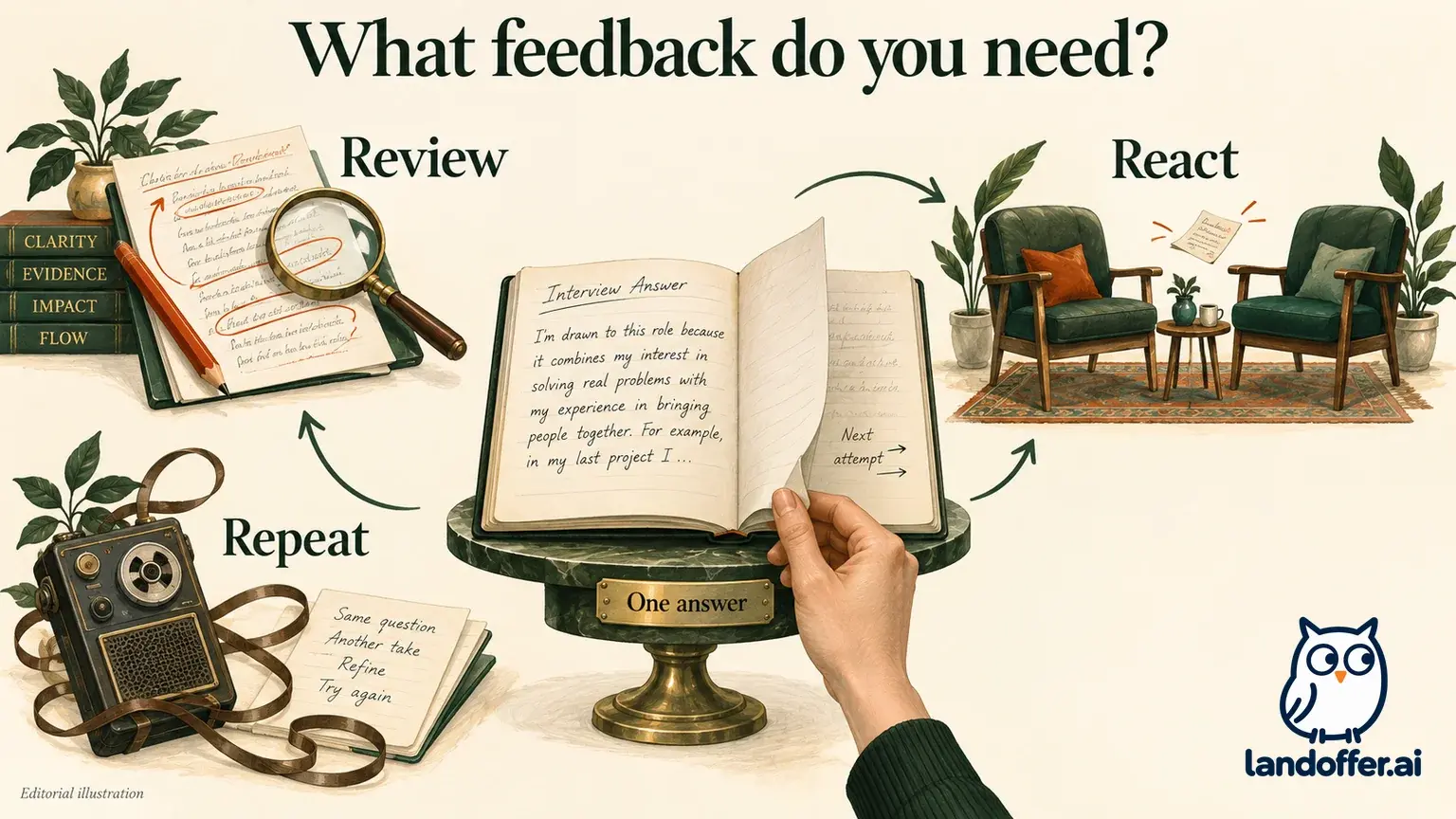
Free access makes a small trial easier to justify. It still takes time to prepare input, speak an answer, and inspect the result. If the questions miss your target role or the feedback cannot be traced to what you said, additional repetitions may simply rehearse the wrong task. After the first attempt, identify one change you can explain: a missing diagnostic step, an unsupported result, or an answer that never reaches the question. If you cannot do that, inspect the prompt and transcript before repeating it.
Understand what the feedback measures
Huru describes five scoring dimensions: relevance, structure, specificity, impact, and articulation. Its public homepage contains a report demonstration explicitly labeled as a fictional profile. The displayed score is demonstration material, not an independent result or a score from our review.
The public Speech & Grammar and Confidence descriptions concern clarity and support for an answer. Current product limits additionally say LIVE practice measures pace and filler words after the interview; video adds eye contact, posture, expressions and gestures. Tone, pitch, accent and emotions remain excluded. These are vendor descriptions, not tested measurements. Feedback follows the practice interview rather than arriving while you speak.
For a software or reliability interview, this makes Huru more relevant to explaining a decision than proving a program works. You can rehearse why you investigated a failure, what evidence you found, and what you learned. Code execution, debugging against a real environment, and architectural validation require their own practice.
Huru's AI-coaching guide also acknowledges that speech transcription can mishear an answer and that the tool cannot verify whether a story is true. Treat suggested improvements as proposals you must check. A stronger sentence is useful only if it preserves the event, your responsibility, and the limits of the result.
Worked custom-practice brief: an SRE application
Claire is a fictional operations engineer applying for a site reliability role. She has handled Linux incidents, written small Python support scripts, and contributed to postmortems. She has not designed a multi-region service or owned the team's capacity-planning program. Her goal is to explain relevant experience and identify the gaps she still needs to study. She wants to answer a follow-up without feeling pressured to describe systems she has never owned.
She prepares this sanitized job input: “Site reliability engineer supporting Linux services. Responsibilities include incident triage, Python automation, postmortem follow-up, and capacity investigations. Explain diagnostic decisions, collaborate with the on-call lead, and communicate operational risk.” This is our invented brief, not an actual employer posting or text submitted to Huru.
The custom route is useful here because the same broad job title can hide very different responsibilities. A generic question about teamwork might be worth rehearsing, but it would not reveal whether Claire can explain an operational investigation. Her practice selection is therefore tied to the work in the brief.
| Responsibility in Claire's brief | Question she chooses to rehearse | Evidence boundary she records |
|---|---|---|
| Incident triage | What did you check first when a Linux service began timing out, and why? | Use one incident she investigated; distinguish her findings from the lead's production decision. |
| Python automation | What manual support step did your script replace, and how did you check its output? | Explain the script and checks she performed; do not claim fleet-wide reliability gains. |
| Postmortem follow-up | How did an incident lead to a change in a runbook or alert? | Describe her contribution and whether the follow-up was actually completed. |
| Capacity investigation | What would you examine before deciding a service needed more capacity? | Practice a hypothetical diagnostic approach; do not present it as a system she operated. |
These are Claire's planned questions, not a prediction of the questions Huru will generate. She would compare a generated set with this map and keep the questions that test the responsibilities she needs to discuss. A question about consensus algorithms could reveal a study gap, but it would not turn her support-script experience into distributed-systems ownership.
She allocates 30 minutes: 12 for a first spoken attempt, eight for checking the answer against her notes, and 10 for a focused retake. This is a personal time budget rather than a measured Huru session duration. Her first success criterion is whether a listener can identify why she investigated the configuration change and which observation supported that choice.
For Python practice, she still runs a separate exercise with actual inputs and expected outputs. An interview answer about a script and an executed test serve different purposes. She combines the spoken explanation with an executed test so each part of her preparation has a clear purpose.
Worked feedback check: fifteen minutes or fifty?
Here is a constructed verification exercise for Claire's first incident answer. The event, notes, and possible transcription mistake are all fictional. We did not observe this error in Huru or measure its transcription accuracy.
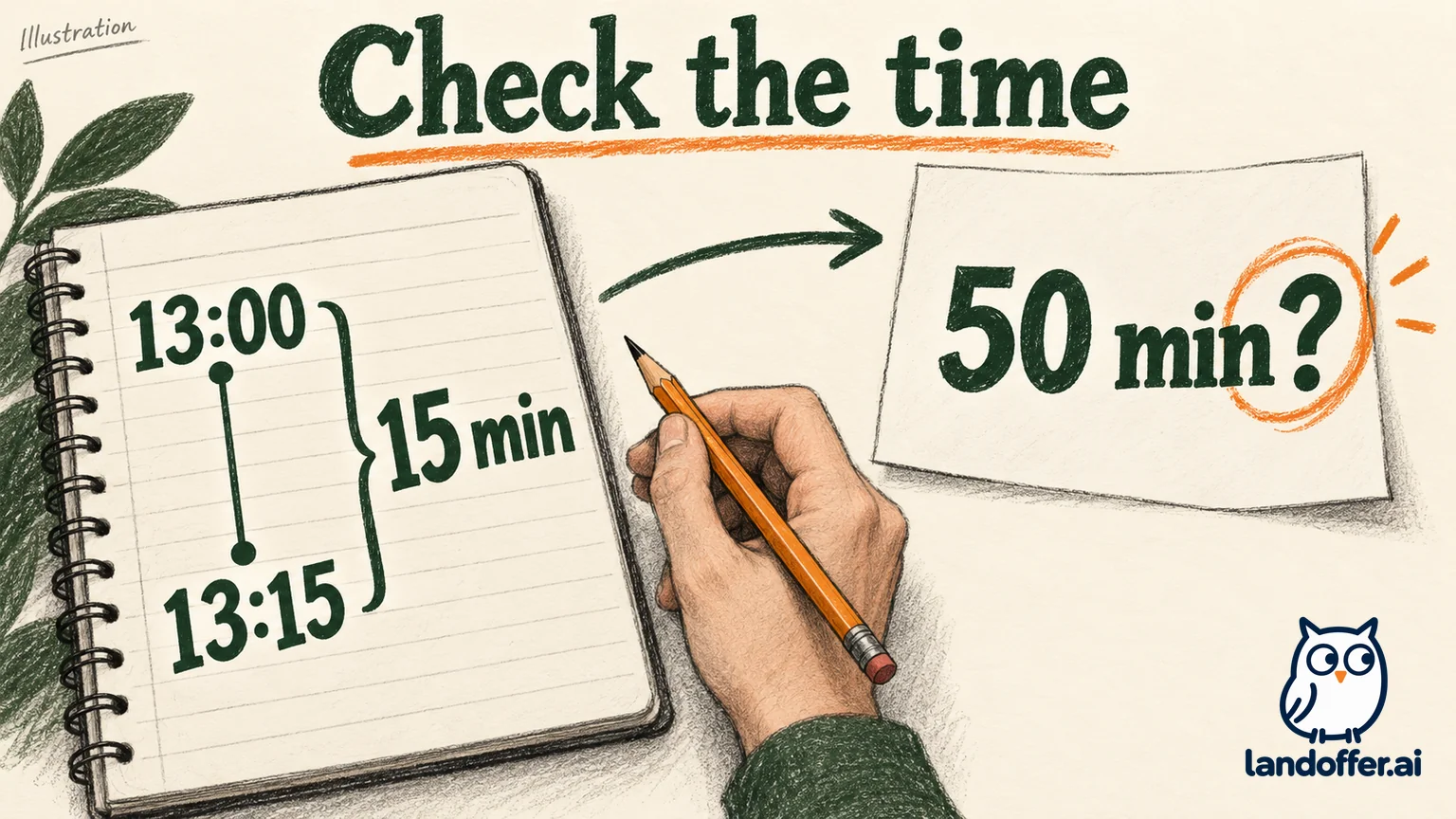
Her source notes say an alert fired at 13:00. She compared failing requests with a recent configuration change and reproduced the failure in a test environment. The on-call lead approved and performed a configuration rollback. The service was stable at 13:15. Claire collected the relevant logs and helped document the investigation; she did not write a production code patch during the incident.
Now suppose a practice transcript says, “We restored service in fifty minutes after I wrote a patch.” That sentence contains two problems against the fictional source record. We constructed both discrepancies to demonstrate the check; they are not findings about Huru’s error rate. The duration should be fifteen minutes, and the action was a configuration rollback performed by the lead. Improving the sentence's fluency would preserve both errors.
| Item Claire checks | Source record | Her completed decision |
|---|---|---|
| Duration | 13:00 alert to 13:15 stable | Correct fifty to fifteen; check the spoken recording before assuming whether speech or transcription caused the difference. |
| Recovery action | Configuration rollback | Reject the patch description; explain the configuration evidence instead. |
| Responsibility | Claire investigated; on-call lead approved and performed rollback | Keep those actions attached to the right people. |
| Result | Service became stable during the incident | Keep that bounded result; do not infer a permanent reduction in incidents. |
Her next practice sentence is: “I linked the failures to a recent configuration change and reproduced the issue in a test environment. The on-call lead performed the rollback, and the service was stable fifteen minutes after the alert.” She can then explain which evidence made the configuration change worth investigating.
The sequence for checking a real answer would be to compare the quoted words with the recording and her own notes. If the recording contains the wrong number, the retake should correct the spoken answer. If she spoke correctly but the transcript differs, she should avoid rewriting her experience to fit the transcript. This exercise does not assume Huru offers an editable-transcript control.
Claire chooses one follow-up for the retake: “What evidence would have made you reject the configuration-change hypothesis?” That tests her reasoning beyond the polished summary. She would discuss request patterns, reproduction conditions, and alternative explanations she could investigate. A technical peer can challenge whether those checks make sense.
This gives her a useful stopping rule. She can move on when the account is factually consistent and the diagnostic decision is understandable. A higher score with the wrong duration would fail her check. A lower score attached to an accurate account can still identify a useful clarity problem. The score remains one input into that review.
Check what happens to recordings and results
The linked app privacy policy says Huru collects and stores interview responses, video recordings, and performance analytics. It describes recordings remaining until the user deletes them or closes the account. The policy inspected on October 20 also describes deleting interview results and associated recordings, transcripts, scores, and metadata. We read those statements publicly; we did not test deletion or recovery behavior. Its displayed update date was October 20, 2026; we did not establish an independent revision history.
The policy distinguishes several retention categories: account data until deletion or three years of inactivity, recordings until manual deletion or account closure, aggregated analytics for 25 months, payment records for seven years, and support communications for three years from the last interaction. Avoid treating an analytics retention period as a promise that interview recordings disappear on that same schedule.
For a first practice, use a job description and a sanitized incident summary. Remove customer identifiers, internal dashboards, private code, and security details that are unnecessary to explain your decision. Free access changes the price; it does not remove the need to decide which information you are comfortable storing in a service.
The current policy names Google, OpenAI, and Anthropic as AI service providers processing interview audio, camera snapshots, and transcripts to run and score interviews. This establishes disclosed processing beyond your device; it does not establish every downstream retention rule or a specific model-training exclusion for your content. If those conditions determine whether you can use the tool, obtain a clear answer before providing sensitive material.
Huru's terms of service were dated September 2025 when checked and contain broad limitations concerning the accuracy and reliability of materials. They should not be used as proof of a current personal subscription price. The current free offer and the limits on what an answer score establishes remain separate questions.
Who should try Huru, and who should keep another routine?
Try it if your immediate gap is saying relevant answers aloud and you are willing to inspect the feedback rather than accept every suggestion. The current free offer makes that experiment possible without choosing a personal subscription term. Start with a role-specific brief and one incident you can explain accurately.
Keep a separate routine for executed coding tests and system-behavior checks. For delivery feedback, verify which Huru mode you use: the current LIVE description includes pace, fillers and optional video measures, while a content score alone does not establish those observations. A human practice partner can challenge a follow-up and assess whether your technical explanation makes sense.
Before another repetition, choose one check: explain the diagnostic choice, correct the duration, or name the uncertainty. Save that check beside your role brief so you can tell whether the next attempt addressed it. For your search, explore LandOffer.ai and choose one relevant role to turn into a bounded practice brief. Keep the facts of your experience under your own review.