LandOffer
Job search
Big Interview vs. Huru: Structured Lessons or Repeated AI Interview Practice?
Choose structured lessons when an answer framework is missing; choose repeated practice when follow-up explanations need work, while checking actual access.
Choose Big Interview when your main gap is knowing how to build an interview answer and you want a structured learning route alongside practice. Start with Huru when you already have material to discuss and want repeated AI rehearsals without a personal subscription. Both now describe conversational AI practice. Compare the preparation gap you need to fill, the features you can access, and the feedback you can verify.
This comparison uses current official pages checked October 20, 2026. We did not open a paid account, record an answer, or benchmark either scoring system. LandOffer.ai publishes this guide. If you need a target for practice, browse recent roles on LandOffer.ai, then use one role's actual responsibilities to choose a relevant story. Both worked examples below are fictional.
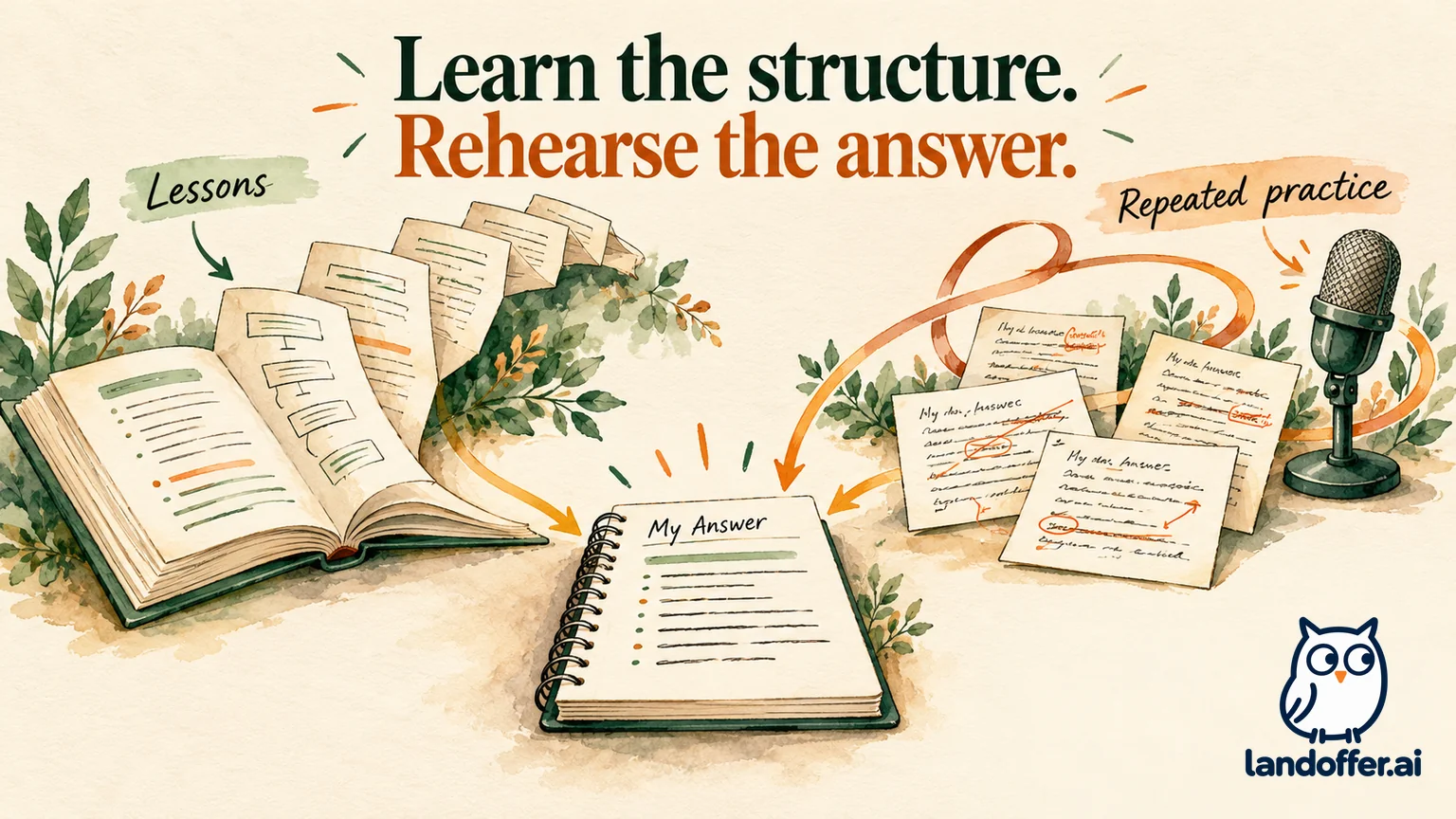
Compare learning, rehearsal, and access separately
Big Interview's learning page describes video and written lessons, quizzes, story frameworks, and a Fast-Track route advertised as taking under two hours. That sequence can help you turn scattered interview tips into a factual outline you can rehearse. Completing a lesson does not prove you can answer an unexpected follow-up.
Huru's current homepage offers both question-by-question practice and live interviews with an AI interviewer that follows up. Its personal pricing section advertises free access with no subscription and unlimited mock interviews, including the live mode. Huru is therefore more than a static question recorder, while Big Interview is more than a course library.
| Need | Big Interview's documented route | Huru's documented route |
|---|---|---|
| Learn an answer framework | Structured written/video curriculum and quizzes | Answer feedback and suggested improvements; not an equivalent verified course sequence in this review |
| Rehearse a job-specific conversation | PracticeAI uses a required job description and an optional resume | Live AI interview or custom practice based on a role or description |
| Repeat an isolated answer | Recorded-answer practice tools | Question-by-question practice |
| Receive delivery feedback | VideoAI is a distinct feature whose availability depends on access | Current live-interview descriptions add pace/fillers and video-specific signals |
| Establish entitlement | Check the individual plan or institution's enabled tools and allocation | Current public job-seeker offer lists all features as free |
These are product descriptions, not a quality ranking. A free route is useful when it lets you perform the practice task you need. A paid learning product can still make sense if its structure helps you identify and practice what you have been missing.
Big Interview's AI tools have different boundaries
Big Interview's PracticeAI documentation, updated October 16, describes an audio-only conversation. Questions evolve from the job description, optional resume, and discussion. Feedback includes role alignment, clarity, and confidence, with transcripts and an optimized-answer example.
Its institutional allowance deserves particular attention. The same page says organizations commonly include five PracticeAI interviews, but the number depends on licensing. It explicitly says that used interviews do not automatically reset after a waiting period. That does not establish a personal subscriber's allowance. Check your own account before designing a week around a particular number of AI conversations.
VideoAI concerns recorded-video feedback and is described as an optional paid upgrade for schools and organizations. A university login does not establish that both VideoAI and PracticeAI are enabled. Equally, an organizational help example should not be converted into a promise that every personal purchase includes five sessions.
Start with your institution or alumni service if it already provides Big Interview. Find out which learning and practice features are actually available before paying separately. A missing AI feature does not erase access to useful lessons, but it may change where you perform the rehearsal portion.
Huru's current live mode changes the comparison
Huru's About page describes answer scoring on relevance, structure, specificity, impact, and articulation. It also states that after a live interview it measures pace and filler words and, on video, eye contact, posture, expressions, and gestures. Descriptions excluding these signals from all Huru practice are outdated; the current About page explicitly adds them for live mode.
The same page excludes analysis of tone, pitch, accent, or emotions, says feedback comes after the interview rather than while speaking, and states that it does not run code. Huru's scores are described as coaching signals. Neither an answer score nor a visual delivery indicator establishes an employer's assessment of you.
The homepage describes live sessions of five, ten, fifteen, or twenty minutes, with selectable pressure settings and audio-only or video practice. Those choices may help you target a short rehearsal or practice responding to follow-up questions. We did not test whether a particular session generates the intended challenge or whether every setting is available in every account context.
Use the mode that fits the gap. A single-answer drill isolates an unclear explanation; a conversation tests whether you can respond when someone asks why. If the trade-off sentence is missing, revise it before starting another full mock.
Worked answer: one missing trade-off, two preparation routes
Consider a fictional engineer, Rohan, preparing to discuss a technical decision in a behavioral interview. His first answer is:
A backfill made our dashboard slow. I worked on the service and we improved the processing. The team was happy with the result.
The problem is not that he needs more impressive vocabulary. The answer omits the alternatives, the constraint that determined the choice, and the boundary of the result. For this teaching example, his factual notes say there was a fixed database-connection budget, he compared extra workers with batching requests, and the improvement was observed only in a limited pilot.
A lesson-led revision first gives those facts a structure:
During a backfill, the dashboard became slow. I needed to improve processing without increasing our fixed database-connection budget. I compared adding workers with batching requests; adding workers would exceed the budget in our design, so I implemented batching and tested it with the team in a limited pilot. The backlog declined during that pilot, but we had not tested peak load, so we kept the rollout limited.
This is original fictional copy, not a Big Interview template response or a Huru-generated suggestion. It is not evidence that batching is generally better than adding workers. The example supplies the design constraint; another system could justify a different choice.
| Review route | Completed editorial diagnosis | Next useful practice |
|---|---|---|
| Lesson-led work | Original answer lacked a visible constraint, alternative, action, and bounded result | Learn the framework, organize the factual notes, then say the revised answer aloud |
| Repetition-led work | Revised answer now explains the trade-off, but follow-up reasoning remains untested | Rehearse why extra workers were rejected and what peak-load evidence would be needed |
The comparison does not require fabricated AI scores. For a learner who cannot yet find those story elements, Big Interview's documented curriculum is relevant. For someone who already recognizes them and wants to practice explaining them under follow-up, Huru's current live mode is a plausible free route. Big Interview PracticeAI could also serve that rehearsal need if enabled with remaining interviews.
Rohan's own review question stays the same across tools: did the next answer explain the actual decision without extending the pilot result into an untested claim? Reject a rewrite that changes the fixed connection budget or turns the limited pilot into a full rollout.

Worked preparation calendar: choose by the gap
Now compare two fictional candidates with the same interview date next week. Nina struggles to organize any story. Omar already has three factual outlines but freezes when asked to explain an alternative. Both have five available preparation blocks. This is an editorial schedule, not a provider's promised curriculum or measured learning outcome.
| Preparation block | Nina: structure is missing | Omar: follow-up practice is missing |
|---|---|---|
| First | Check existing Big Interview access and learn one story framework | Set one role description and choose a truthful story for Huru practice |
| Second | Turn one experience into situation, task, action, and result notes | Rehearse the story in a short live mock and inspect the debrief |
| Third | Record the answer and identify the missing decision sentence | Revise the decision sentence before repeating the answer |
| Fourth | Try a conversation if enabled, then inspect the transcript | Try another live session focused on explaining the rejected option |
| Fifth | Rehearse an unseen follow-up with a peer and check factual accuracy | Ask a peer whether the technical reasoning actually answers the question |
Nina chooses the lesson-led route first. If she has institutional access, she checks enabled features rather than assuming she must buy a personal plan. If no AI conversation is available, her first three blocks still have a defined purpose; she can use a suitable free rehearsal route or a peer for the fourth. The plan does not depend on obtaining an unverified AI allowance.
Omar chooses Huru's advertised free practice first because the missing task is repetition with follow-up, rather than another introductory curriculum. He changes the answer between mocks instead of treating the number completed as his goal. A technically informed peer remains useful because neither platform's score proves the design explanation is sound.
Suppose Nina's institution confirms two PracticeAI interviews remain. She can reserve one for her first coherent story and one after revising it. She should not schedule a third on the assumption that tomorrow resets the balance; the current documentation explicitly rejects automatic waiting-period resets. This is a hypothetical confirmed balance, not a universal plan entitlement.
Compare the purchase and the recording arrangement
Big Interview's personal pricing lists a $39 monthly BootCamp, a $99 three-month Accelerator subscription, and $299 lifetime Pro access. We read these public offers without completing checkout. “Lifetime” describes an access offer, not proof that every named AI tool has an unlimited allowance. Confirm the named AI feature and its allowance for your selected access route before paying.
Huru's facts page dates free personal access to September 28, 2026 and separates organizational offerings. Avoid evaluating the current personal choice using old paid subscription prices from third-party reviews. We have not tested operational limits, service uptime, or future pricing commitments on either product.
Recordings create another comparison. Big Interview's general FAQ distinguishes saved practice videos, sharing, and instructor assignments. Its privacy policy describes institutional sharing under the relevant agreement. Personal rehearsal and an assigned submission can therefore have different audiences and completion requirements.
Huru's linked app policy, read in the browser, describes stored responses, recordings, analytics, and deletion of associated interview results. It names Google, OpenAI, and Anthropic as AI service providers processing interview material. We did not test deletion, account permissions, or sharing controls. Before recording, use a nonconfidential story and review the actual account's audience and retention settings. University access is convenient; it does not by itself establish private storage visible only to you.
Make the next repetition earn its place
Big Interview is the stronger fit to investigate when you need an explicit teaching sequence before practicing. Huru is the easier personal-price starting point when you want repeated question drills or current live AI conversations and can evaluate the feedback yourself. Existing institutional access can change the cost decision, while feature configuration can change the practice decision.
Keep a technical peer or coach when you need someone to challenge the reasoning in depth. Neither product has been benchmarked here for grading accuracy, and neither should be treated as an employer's pass signal. Choose one factual answer, identify its missing part, and check whether the next take fixes it. Then explore LandOffer.ai to keep that preparation connected to the roles you intend to pursue.
Sources and Further Reading
- Big Interview learning curriculum
- Big Interview PracticeAI and account limits
- Big Interview VideoAI FAQ
- Big Interview personal pricing
- Big Interview general FAQ
- Big Interview privacy policy
- Huru current practice modes and free personal offer
- Huru current product boundaries
- Huru facts and press kit
- Huru app privacy policy