LandOffer
Job search
Interviews by AI Review: Audio or Text Practice and the Free-Plan Boundary
Choose an audio or text practice goal, use the three-question allowance deliberately, and check Pro billing and interview-data terms.
Interviews by AI is a reasonable free test for turning a job description into a few questions and revising your answers. It supports audio and text practice, with AI feedback and sample answers. Its Basic plan gives three questions per month; Pro adds more volume, resume context and longer responses. Choose it when you need a short question-and-answer revision workflow. Judge readiness through the skills and explanations the actual role requires.
Choose the role before choosing the practice format. If your search is still broad, browse recent roles on LandOffer.ai, select a posting you understand and identify one requirement you can discuss from experience. LandOffer publishes this review. Job discovery and checking an interview answer serve different parts of the search.
We checked public pages and controls on October 14, 2026, including pricing FAQs, the initial preparation form and the combined privacy policy and terms. We did not generate questions, submit answers, record audio, upload a resume, sign in or buy Pro. Elise’s examples below are fictional editorial exercises, not product outputs or candidate testimonials.
What the public preparation form actually shows
The Interviews by AI homepage describes generating behavioral and technical questions from a job description, accepting spoken or written answers, and returning feedback based on frameworks such as STAR plus a sample answer. Treat those descriptions as the offered workflow. They do not establish the accuracy of a generated question or the truth of a polished sample response.
The initial preparation form showed a custom job-description field with 5,000 characters available and several sample roles. Its maximum-response-time controls showed two minutes selected, three minutes available, and four minutes locked to Pro. Resume upload was also marked Pro. The empty form displayed three free questions remaining and a disabled Generate questions button. We stopped before supplying an input.
That observed form distinguishes response time from interview length. A two-minute setting does not mean a complete interview lasts two minutes, and three questions do not mean three full mock interviews. We have not tested what happens when a response reaches the limit, when generation fails or when a candidate retries the same question.
A custom posting gives you more control over relevance than a generic role label. Read it first: a QA title might emphasize API contracts, manual exploratory work, browser automation or release coordination. An answer can sound competent while demonstrating the wrong part of the job. For a focused practice attempt, select the duty you want to explain. Keep the complete posting separately so you still assess the rest of the job.
Audio and text ask you to do different work
Text is useful when you need to organize the facts of an answer. You can check whether the example names your contribution, explains the decision and states an outcome you can support. Writing also lets you notice a missing condition before rehearsing it aloud.
Audio asks you to retrieve those facts and explain them while speaking. You may discover that a sentence you could edit easily on the page is difficult to produce without notes. Use that difficulty to choose the sentence you will rehearse next. Audio input alone does not establish that the software evaluates vocal delivery, accent, eye contact or body language. The public descriptions inspected here do not establish those capabilities or a technical code-execution assessment.
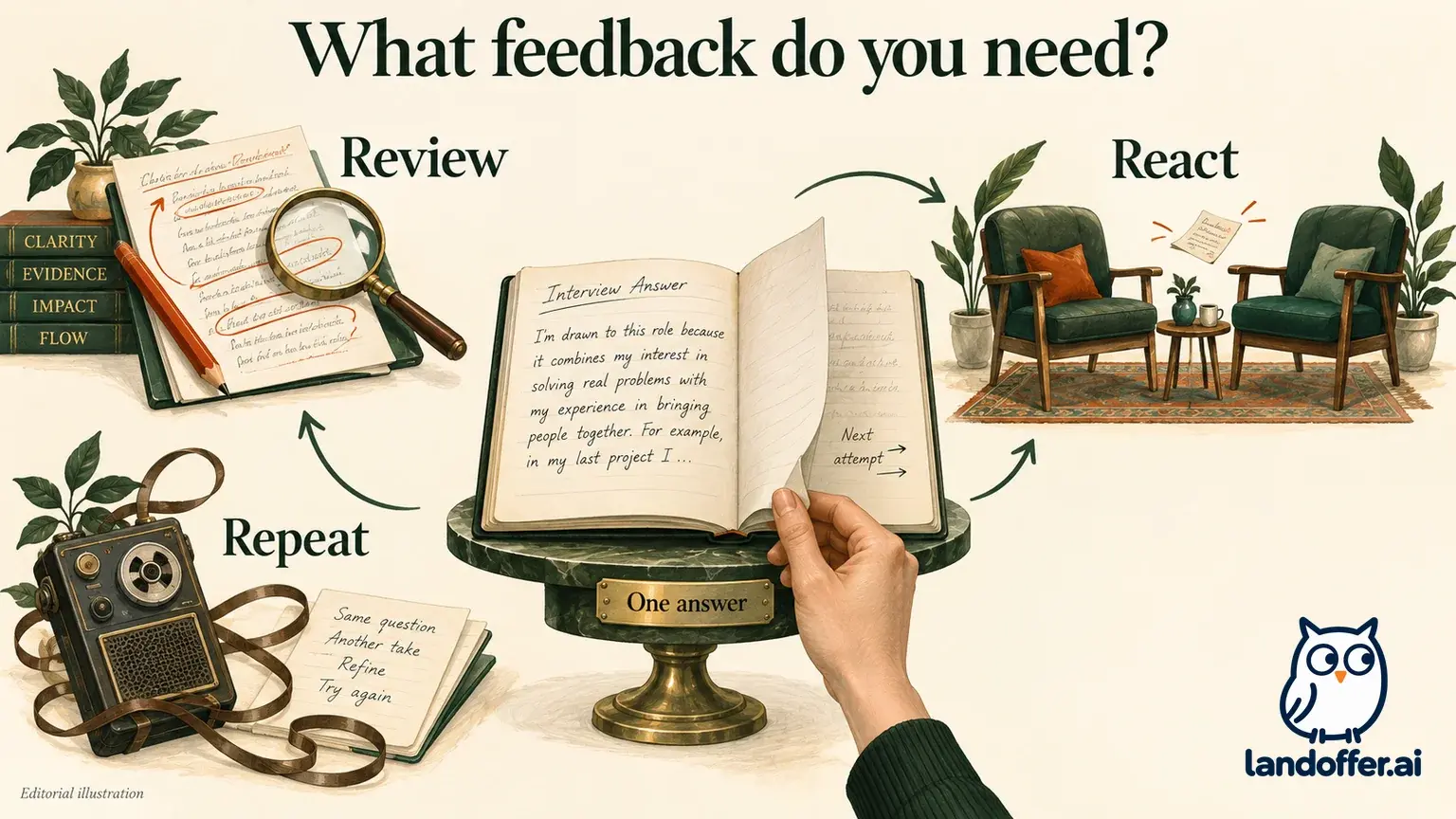
Use the same evidence in both formats. Otherwise you may mistake a richer second story for an improvement caused by switching from text to audio. Keep the target question, project facts and desired explanation consistent, then compare what the answer communicates. Your own replay or a listener’s summary can add information that a paragraph of feedback does not capture.
There is no requirement to begin with your most sensitive project. A sanitized example can still include a concrete decision, a test input and a clear limit. The objective is to practice explaining your work accurately; confidential system names and customer records rarely help a listener assess that skill.
A completed three-question allocation for a QA candidate
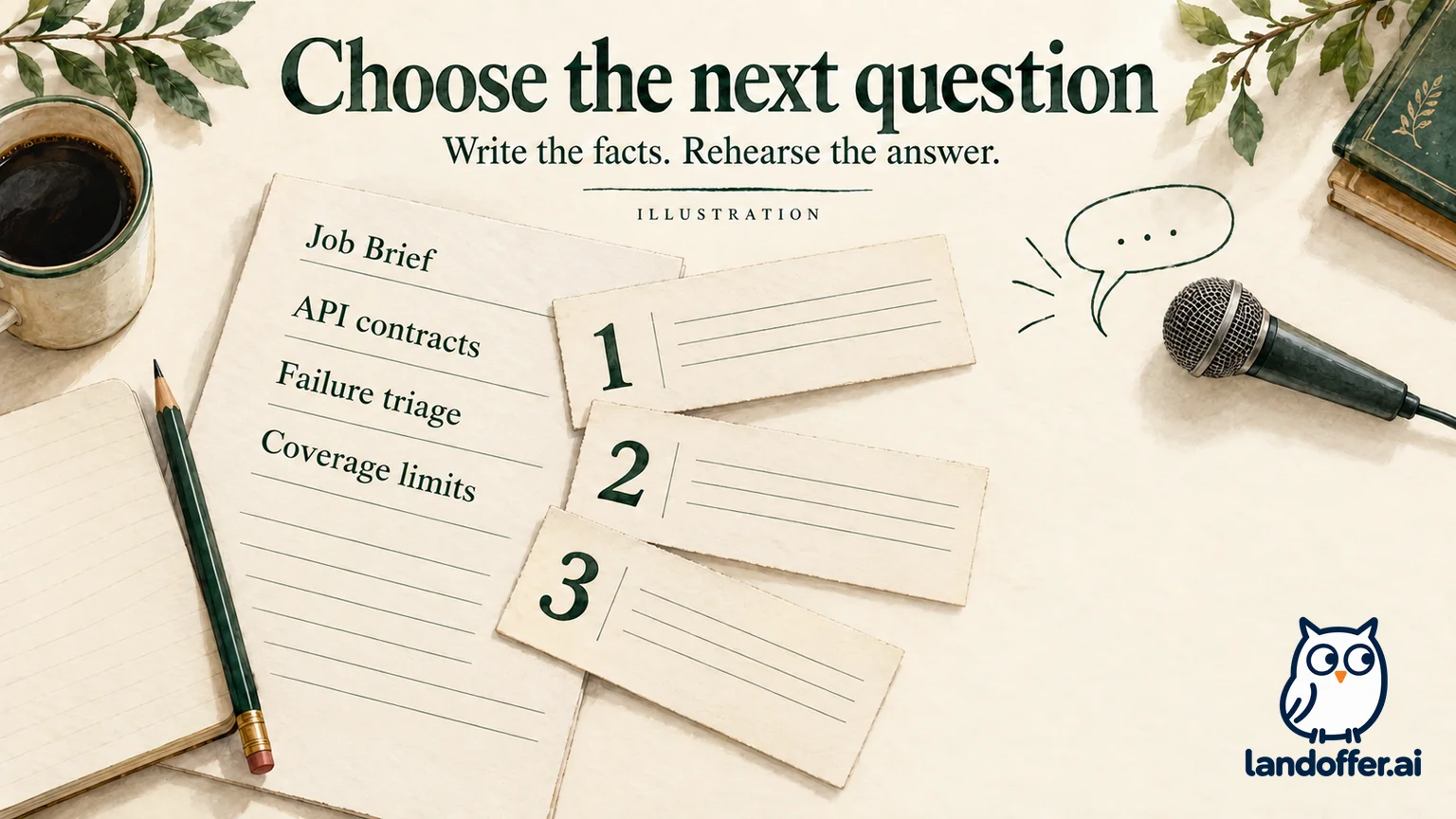
Elise is a fictional QA automation engineer interviewing in five days. Her target posting emphasizes API contract tests, failure triage and communicating coverage limits. She has $10 available for an optional tool purchase, but her immediate problem is choosing examples that demonstrate those requirements.
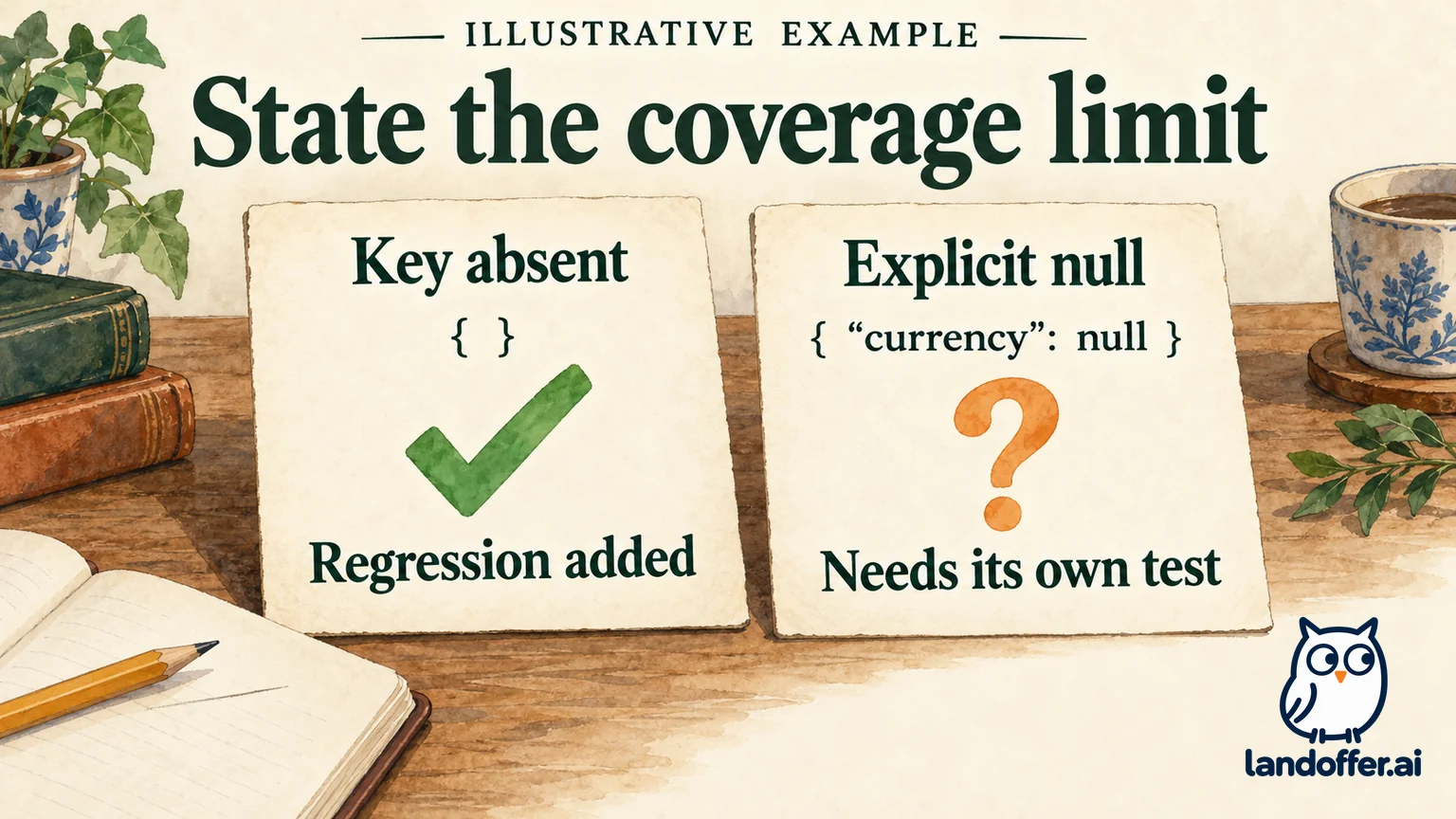
She prepares three question targets before using any service. These are questions written for this article, not questions generated by Interviews by AI. Her case record is an invented change to a checkout API: a revised schema requires a currency field, while her regression work covered the missing-field case. The explicit-null case still needs a separate check.
| Practice target | Evidence Elise prepares | Completed choice |
|---|---|---|
| Explain a contract-test decision | Revised schema requirement and a fixture with the currency key absent | Start here because it demonstrates her own test contribution. |
| Describe how she would triage a failing test | Request fixture, expected validation response and the failing assertion | Explain the first comparison she would make before blaming the service. |
| Tell a release lead what was not covered | Missing-field regression covered; explicit null and downstream display behavior unresolved | Rehearse stating the limit without implying the release is fully validated. |
This allocation makes the free boundary useful: each question has a different purpose. Three versions of “tell me about yourself” would consume attention while leaving the posting’s technical requirements unexplained. Elise also avoids borrowing a teammate’s implementation story to make her answer sound more senior.
She plans one initial answer for each target and an offline retake after reviewing it. That is six attempts in her preparation plan, but we cannot declare that the product would charge six questions: retry accounting was not tested. She can record the extra attempts locally or practice with a peer without assuming the free allowance resets tomorrow.
Her completed decision is to begin with Basic and keep the retakes outside the tool. If she chooses additional triage questions after reviewing the first three answers, a month of Pro could fit her budget before tax. For this trial, she can use the three relevant requirements and her own evidence notes. She can decide later whether resume context adds something the brief lacks.
A completed answer comparison: missing is different from null
Elise writes this fictional preparation answer:
“The checkout schema change made currency required. I added a regression fixture that omitted the currency key and asserted that validation rejected the request. I compared the failure with the revised contract before reporting it. That test covered an absent key. I had not yet added a fixture with currency explicitly set to null, so I listed that as a separate coverage gap rather than saying the change was fully tested.”
The answer contains a situation, her action and a bounded result. It does not need a percentage improvement to be useful. Its result is the addition of a particular regression check and the communication of a remaining gap. That is narrower than a claim about every currency-related failure.
Now consider an independently written spoken rehearsal version: “I tested the currency change and made sure invalid requests failed. Then I told the release lead it was covered.” This is a deliberately weaker example we constructed. We did not record Elise or observe a transcription error. The shorter version loses which input she tested and overstates the conclusion.
| Comparison point | Finding in the constructed answers | Revision Elise keeps |
|---|---|---|
| Test input | The written version names an absent key; the spoken version says only “invalid requests.” | Say “a request without the currency key.” |
| Personal contribution | “I tested” hides the regression fixture and assertion she added. | Name the fixture and expected rejection. |
| Coverage limit | “It was covered” erases the explicit-null gap. | State that null remained a separate case. |
| Result claim | An imagined sample claim would be “all currency bugs were prevented.” | Reject that claim; no evidence in this case supports it. |
Her finished retake is: “I added a regression test for a request without the currency key after the schema made that field required. The expected result was a validation rejection. I also told the release lead that explicit null still needed its own fixture, so my test did not establish complete coverage of the change.”
That answer preserves the condition and the limit while using language she can say aloud. It remains an editorial example, not a tested product result. For a real project, Elise would check the schema version, fixture and actual assertion before using this account of her work. If the API treated an absent key as a default instead, she would need to change the answer.
An AI sample can suggest structure or wording. It should not supply accomplishments, incident impact or technical guarantees you cannot substantiate. When a suggestion sounds stronger, identify the new claim it introduces. Keep the sentence only if your evidence supports that claim.
The free boundary, Pro and the renewal decision
The pricing page showed Basic at $0 with three monthly questions and Pro at $9 per month, including unlimited questions, resume upload and longer responses. Its expanded FAQ says each generated question you practice counts once and the allowance resets at the start of each monthly period. Basic requires no credit card.
Pro is month to month, and the cancellation FAQ says access continues until the paid period ends. The terms, effective August 24, 2026, describe automatic monthly renewal and fees that are nonrefundable except where required by law. They also qualify unlimited use: exceeding 1,000 questions per month may trigger restrictions or an additional agreement. That is a fair-use condition, not a guarantee of a fixed 1,000-question package.
For Elise, the price is only one part of the decision. Her purchase would make sense if she wanted enough additional relevant practice to justify a recurring subscription. A larger allowance would not resolve a missing schema fact or tell her whether the story accurately describes her work. Those checks remain necessary regardless of plan.
Before upgrading, define the next useful unit of work. For example, Elise might want to practice three additional triage scenarios and compare how clearly she explains the first diagnostic step. If she cannot name what she needs beyond the initial trial, she has little basis for buying more volume. A resume upload is also valuable only if the extra context improves the preparation she needs; we did not test that feature’s output.
Audio deletion and saved interview history are separate
The public data FAQ says audio is deleted immediately after transcription and that signed-in users can revisit saved interview history. This is the vendor’s storage statement, not an independently verified deletion test. A typed answer avoids transmitting an audio recording for that answer, but the text still goes to the service.
The combined privacy policy says generated questions, responses and AI feedback are saved and used to personalize and improve the service. It also describes Google sign-in information and Mixpanel analytics. The material reviewed did not establish a complete AI-provider processing chain, a universal interview-history retention deadline or a tested deletion workflow. Do not turn “audio deleted” into “nothing from my interview remains.”
For this exercise, Elise keeps the real employer name, internal endpoints and production payloads out of the brief. Her synthetic fixture communicates the relevant distinction without sending a customer request. If she later needs to practice a confidential story, she should establish whether she can share that material and whether the service’s data terms meet that requirement before entering it.
Privacy also affects the usefulness of resume context. A resume may add identifying details that the role brief did not require. Compare the benefit you need with the material you would supply, and use a sanitized version only when it still represents your background accurately. We have not tested what the upload accepts or how its contents alter feedback.
Who should try it, and who should use another route
Try Interviews by AI when a small set of posting-specific question drills and answer revisions addresses your immediate gap. Use text to establish the facts, then rehearse saying them without adding claims. After the trial, save one revision and its evidence: Elise restores the absent-key condition and preserves the untested-null limit. That gives the next attempt a specific purpose.
Use a knowledgeable peer or coach when you need sustained follow-ups about technical decisions and ownership. Use direct coding or test execution when the gap is whether an implementation behaves as claimed. The public workflow reviewed here does not establish either kind of validation, and more generated questions do not substitute for it.
Choose one requirement from your target posting, prepare its supporting evidence, and decide which answer needs another attempt. If you still need the posting, find relevant openings on LandOffer.ai and bring one concrete requirement into that preparation.