LandOffer
Job search
Big Interview Review: Practice Curriculum, Recordings, and AI Add-Ons
Separate structured lessons, saved practice recordings and AI feedback; confirm the features enabled for your account before choosing access.
Big Interview is worth considering when you need a curriculum and a routine for practicing interview answers, especially behavioral stories and explanations of your work. Its recorded practice, VideoAI feedback, and audio-only PracticeAI serve different purposes. Check the features enabled for your account. This matters particularly with institutional access, where AI tools can be optional upgrades.
For a tech candidate, the useful question is whether you need help organizing and rehearsing an answer or expert judgment about its technical substance. Big Interview's public materials support the first use. They do not establish that an automated assessment can validate your design decisions or reproduce an employer's evaluation.
This review examines official documentation and public pricing checked October 14, 2026. We did not create an account, record an answer, or test AI feedback. LandOffer publishes this review and offers job-search tools; browse recent roles if you need a concrete job description to focus your preparation. The worked examples are fictional and contain no actual Big Interview scores.

Separate lessons, recordings, and AI feedback
The learning curriculum describes video and written lessons, quizzes, story frameworks, and a Fast-Track route advertised as taking under two hours. That offers a starting structure when you have been collecting advice without turning it into practice. Lesson completion, however, does not demonstrate that you can answer a follow-up question about your own work.
Use a lesson to choose one change, then rehearse an answer that makes that change visible. If you tend to describe a project chronologically, the change might be stating the problem and your responsibility first. If your answers end abruptly, it might be explaining the result and its limits. You can judge those changes through a recording and a factual outline before considering a score.
Big Interview's simulator page describes an Answer Builder, role-based question practice, recorded-answer analysis, and a personalized voice interview. Those capabilities should not be merged into one guaranteed experience. The type of practice and the features enabled on your account determine what you can do next.
PracticeAI documentation describes audio-only interviews using a required job description and an optional resume. Questions can evolve with the conversation. Its feedback criteria include role alignment, clarity, and confidence. The same help page says organizational allocations commonly include five interviews, with the actual number depending on institutional configuration. That is not a verified allowance for a personal subscription.
VideoAI's FAQ describes feedback on speaking and engagement patterns. It says VideoAI is not customized by industry and is an optional paid upgrade for schools and organizations. It also acknowledges that proprietary hiring algorithms prevent a direct comparison with employers' tools. Treat a medal as practice feedback, rather than an interview-pass prediction. A technical claim still needs a technical check.
Work out which access route solves your problem
The current personal pricing page lists Interview BootCamp at $39 per month, Interview Accelerator at $99 for a three-month subscription, and Interview Pro at $299 for lifetime access. Its FAQ broadly describes lifetime access to everything, including new features. The cards do not provide a detailed allowance for each named AI feature. We did not verify that allowance in a personal account or checkout.
Institutional access is a different purchase relationship. The AI help pages describe organizational licensing; we have not treated those conditions as a verified personal-plan feature table. A university or workforce program may already provide a useful curriculum while leaving an AI upgrade disabled. Before buying personal access to solve that problem, identify the missing feature and ask what the new purchase includes. An institutional upgrade description does not prove that personal customers must buy the same add-on.
Here is a completed decision for Nikhil, a fictional frontend engineer. He has access through an alumni program, a behavioral interview in eight days, and a $45 preparation budget. He wants to explain an accessibility fix clearly without taking credit for the wider redesign. His concern is sounding vague about work he understands. He does not need another resume builder or an open-ended course collection.
| Nikhil's option | What he knows | His decision |
|---|---|---|
| Use existing alumni access | Curriculum is available in this fictional case; AI entitlement has not been confirmed | Start with a lesson, a factual outline, and recorded rehearsal if recording is enabled. Ask the program about VideoAI and PracticeAI separately. |
| Buy the $39 monthly plan | Listed access duration fits his eight-day deadline; specific AI allocation remains unverified | Hold payment. Buy only if a required missing feature is confirmed and the full price fits his budget. |
| Buy the $99 three-month plan | Longer access exceeds his immediate need and budget | Skip for this interview. |
| Buy $299 lifetime access | Broad future access claim; much larger upfront commitment | Skip. He has not established a recurring need. |
His first 45-minute session is already defined: spend 10 minutes on a relevant lesson, 10 assembling the facts of one story, 10 rehearsing two versions, and 15 comparing the answer with those facts. If recording is unavailable, he can practice aloud and use written notes. An unknown AI entitlement does not prevent that work.
Duration arithmetic can help another buyer without settling feature equivalence. Two $39 monthly periods total $78, below $99; three total $117, above $99. That makes the three-month option potentially useful for someone who needs the whole period and confirms equivalent required features. It gives Nikhil no reason to exceed $45 for an eight-day task. Taxes and checkout terms were not tested.
The terms describe automatic renewal for recurring subscriptions and a refund request window within 30 days of the initial purchase. Institutional agreements can differ. Save the purchase terms and cancel renewal before its date if you do not want another period. A refund policy should not replace checking the feature you intend to use.
Worked answer: preserve who did what
Nikhil's practice goal is an answer to a behavioral question about improving a product. The following facts and responses are an original teaching example, not a Big Interview question, generated answer, or client result.
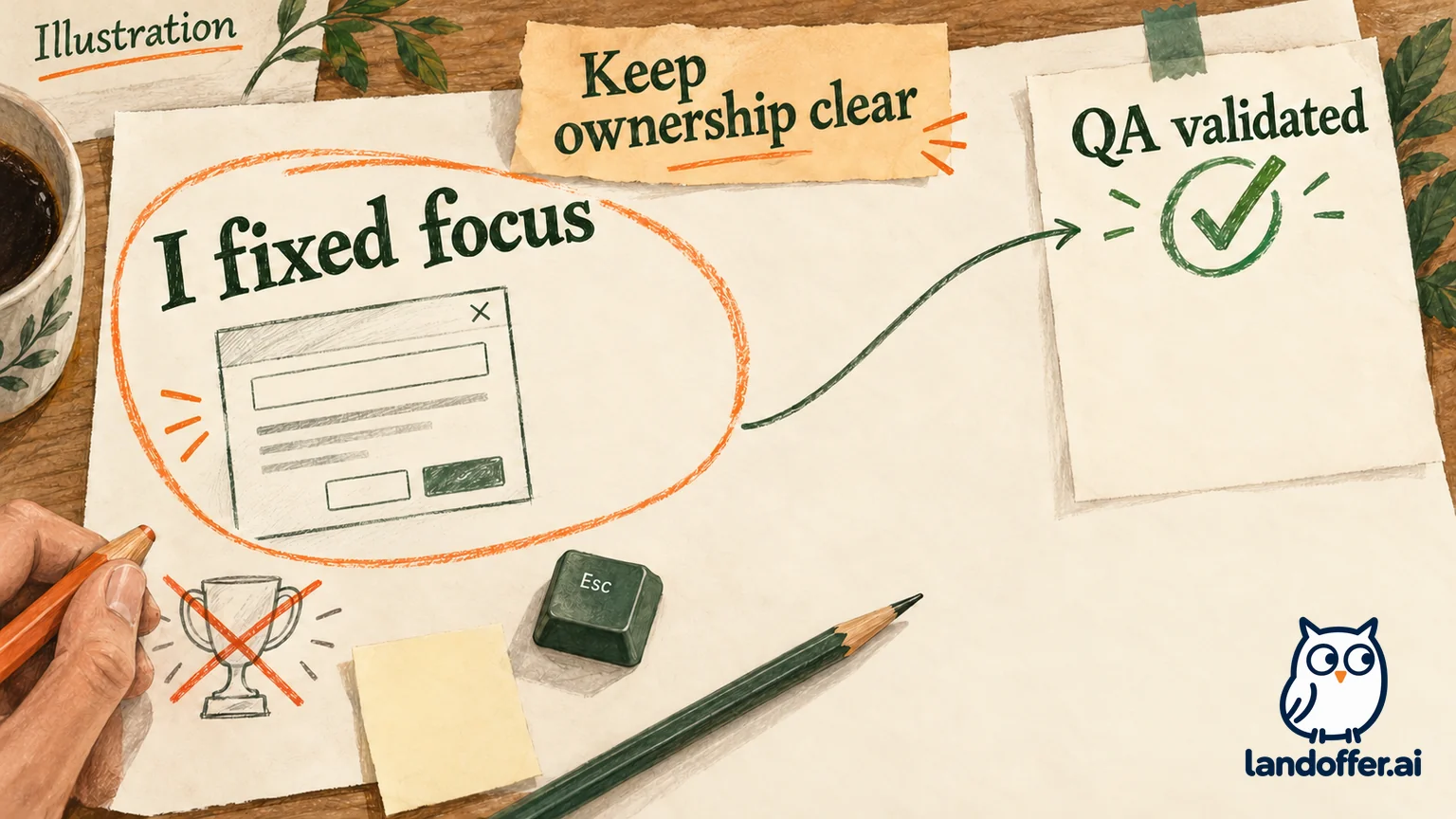
His fictional fact record is specific. During keyboard testing of a checkout modal, he found that focus could move behind the open dialog. He reproduced the problem, implemented focus handling and restoration, added component tests, and asked QA to validate the keyboard sequence. QA performed the broader validation. He did not own the entire checkout redesign and has no measured revenue or conversion result.
His first outline is weak: “We had accessibility problems, so I fixed the checkout. I worked with QA and improved the experience.” It hides the actual failure and makes his responsibility sound broader than the facts support. Adding confident adjectives would leave those problems intact.
A more useful spoken answer is:
During keyboard testing of our checkout modal, I found that focus could move behind the open dialog. A user pressing Tab could lose their place, which made the flow difficult to navigate without a mouse. My responsibility was the modal's focus behavior, rather than the whole checkout redesign. I reproduced the sequence, updated the focus handling, and restored focus to the trigger when the dialog closed. I added component tests for those transitions, then asked QA to validate the broader keyboard path. QA completed that validation. I can explain the behavior we corrected and the checks we added, but I do not have a conversion or revenue measurement for the change. The lesson I took forward was to include keyboard transitions in the component's acceptance criteria.
That is a proposed answer to rehearse, not a timed recording. Nikhil should speak it naturally and adjust its length without adding achievements. If he cannot explain a test or focus transition under questioning, he should correct the example before polishing its delivery.
| Review dimension | What the revised answer contains | Next check |
|---|---|---|
| Problem | Focus moved behind an open checkout dialog | Can a listener describe the keyboard failure? |
| Ownership | Candidate implemented focus handling; QA performed broader validation | Keep “I” and “QA” attached to the correct actions. |
| Evidence | Reproduction, component tests, and a validation handoff | Prepare to explain one test condition without exposing employer code. |
| Result | A bounded behavior correction; no measured commercial impact | Remove any invented conversion claim, even if a sample answer suggests one. |
| Delivery | The story now has a clear sequence | Listen for rushed transitions and unclear references after rehearsing. |
This matrix separates an improved answer from a more polished performance. A confident recording could still misstate ownership. A technically accurate answer could still leave the listener unsure what changed. Nikhil needs to check both.
If an AI suggestion produces a stronger-sounding result than his evidence supports, he should reject that addition. The purpose of an optimized sample is to help him see a possible structure; it cannot supply facts about his employment. He can revise the sequence while preserving uncertainty and giving collaborators proper credit.
For his next rehearsal, Nikhil chooses one follow-up: “How did you verify focus returned correctly when the modal closed?” His answer should name the trigger and the expected focus transition. A peer who understands frontend testing can challenge that explanation. A comment about pacing cannot establish whether closing the modal returned focus to the correct trigger. That requires checking the expected behavior and the test.
He would count this session as useful if a listener can identify the failure, his contribution, and the evidence without asking him to restart. If those are clear, he can move to another story. Once the story is accurate and understandable, another follow-up may be a better use of his practice time than repeating it solely to raise a medal.
Recordings need their own plan
The October 2026 general FAQ says practice videos are saved in My Videos and can be shared for review, but there is no direct recording download button. It also distinguishes ordinary practice from completing the correct instructor assignment. A practice recording is not automatically an assignment submission. Organizational AI features are optional upgrades, and a recording showing Retry Upload has not been successfully saved.
Those details affect your preparation routine. Before relying on an important rehearsal, confirm it appears as saved and can be reopened. Keep a separate outline and action notes that you control. If you need a portable video archive, resolve the export limitation before committing to this workflow. A sharing link lets someone review a hosted recording; it does not give you an independent video file to keep if access ends.
The terms specify a recording storage limit of 1 GB and allow removal of recordings not accessed for more than 12 months. That makes lifetime access different from an unconditional promise to preserve every recording indefinitely. Review your own recordkeeping needs rather than assuming the platform is your permanent archive.
The privacy policy describes storage and processing of practice content, including third-party AI and transcription services. For institution-provided access, account information, practice activity, and content can be shared with the institution under its agreement. Your designated reviewer and your program's administrators may therefore have different access from someone receiving a link you send.
Use a sanitized story and remove customer names, internal links, and private code. Before sharing a recording, understand who receives it and whether your institution has additional review rules. We did not test recipient access, link revocation, deletion, or retention behavior. The policy's deletion practices include backup and legal-retention qualifications; they should not be read as immediate erasure from every system.
When Big Interview is a sensible purchase
Consider it if you need guided lessons plus repeated rehearsal and will use the recordings or enabled feedback features to make concrete changes. Start with existing institutional access when it covers the work. Confirm the named AI feature, allowance, and access period before paying to fill a gap.
Keep your current tools if you already have a reliable practice routine and useful human feedback. For coding correctness, architecture tradeoffs, or detailed technical probing, continue the domain-specific preparation that tests those skills directly. This review does not establish Big Interview as a substitute for those tasks.
Choose one story you can defend and rehearse it. Compare the recording or your notes with a factual outline before deciding whether another feature would help. To connect that work with your search, explore LandOffer.ai and use one relevant role's responsibilities to choose your next practice question. You will still need to review your answer's accuracy yourself.