LandOffer
Job search
Wellfound vs. YC Work at a Startup: Compare Company Coverage and Founder Access
Choose a YC-focused or broader startup search and evaluate founder-contact promises separately from actual role fit, with a completed overlap example and two different reader decisions.
Use YC Work at a Startup as your starting channel when you deliberately want to work at a YC company. Use Wellfound when you want a broader startup employer search shaped by company stage, size and role conditions. Add the second board when it contributes suitable new openings or useful context. Founder access is a contact route to evaluate, not a promise of a reply, an interview or a better employer.
LandOffer publishes this comparison and offers job-search tools. You can compare discovered openings with recent roles on LandOffer.ai. We reviewed official public documentation and YC's public jobs page on October 12, 2026. No candidate account, founder conversation or application was tested. The overlap ledger and candidate choices are explicitly fictional, not a measured coverage comparison.
Decide whether YC membership is a requirement
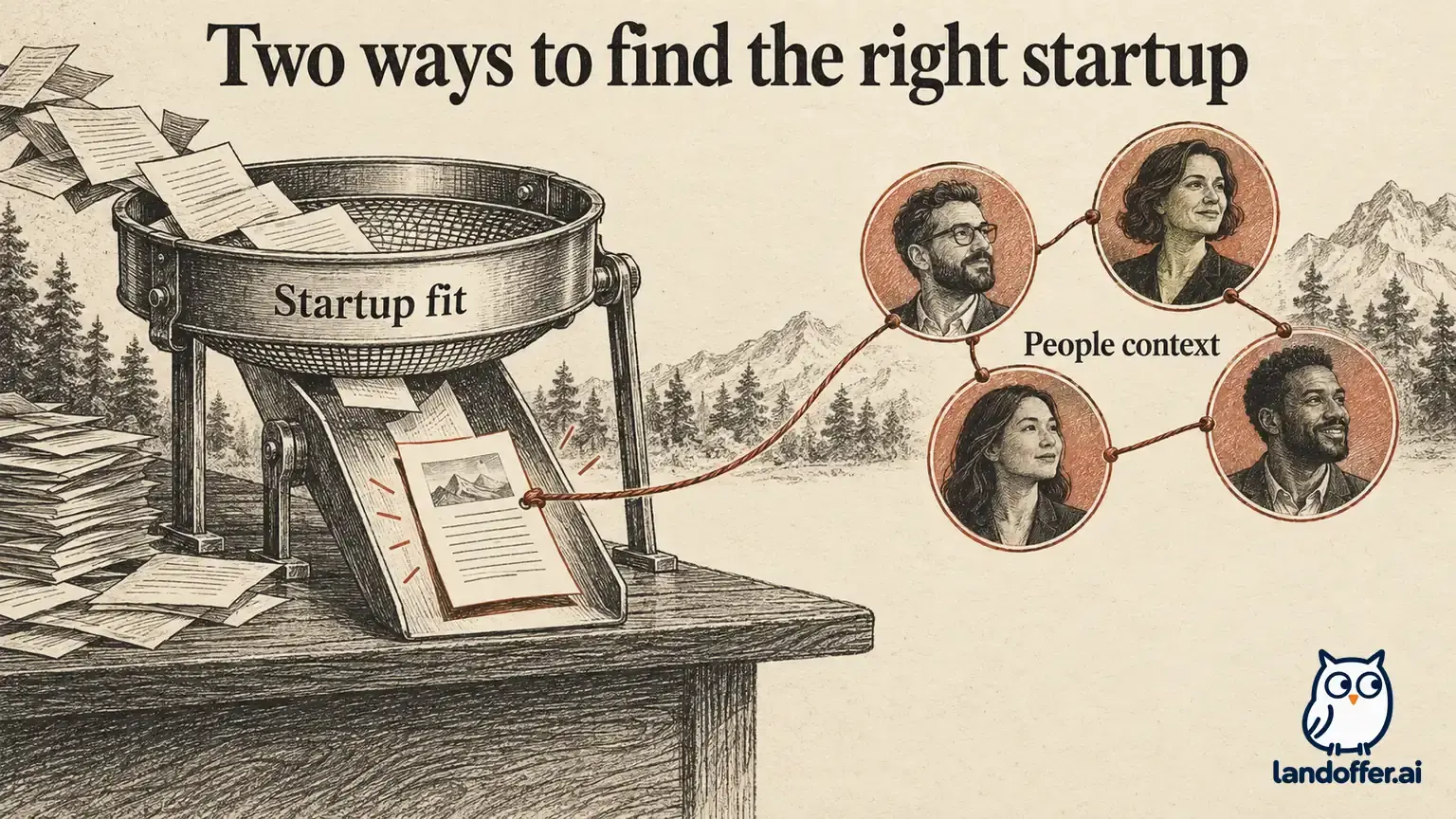
There are two different reasons to open a startup board. You may want to search a particular group of companies, or you may want a particular kind of engineering work. Those preferences sometimes overlap, but they are not interchangeable. A candidate seeking YC companies has a focused discovery task. A candidate seeking remote developer-tools work should not exclude a suitable employer merely because it belongs to a different investor network.
Write the requirement before browsing. “YC companies only” is a deliberate boundary. “Product engineering at a small company with an established review process” is a work-and-team brief. The second brief could fit YC companies, other venture-backed companies or a startup with a different funding history. Let the brief determine which universe you investigate first. The separate YC and company-page guide explains the employer-dossier workflow after discovery.
Also define where you can work and the responsibility you want. Neither an accelerator label nor a broad startup category establishes remote eligibility, work authorization, compensation or the depth of independent ownership. Keep those conditions visible when an interesting product or founder biography attracts your attention.
Do not treat either source as a complete census of suitable startups. A platform shows the companies and roles available through its own publishing and discovery processes. An employer's direct careers page can add context or reveal a changed opening. Your aim is to find enough appropriate employers to act on, not to prove that one board contains the entire market.
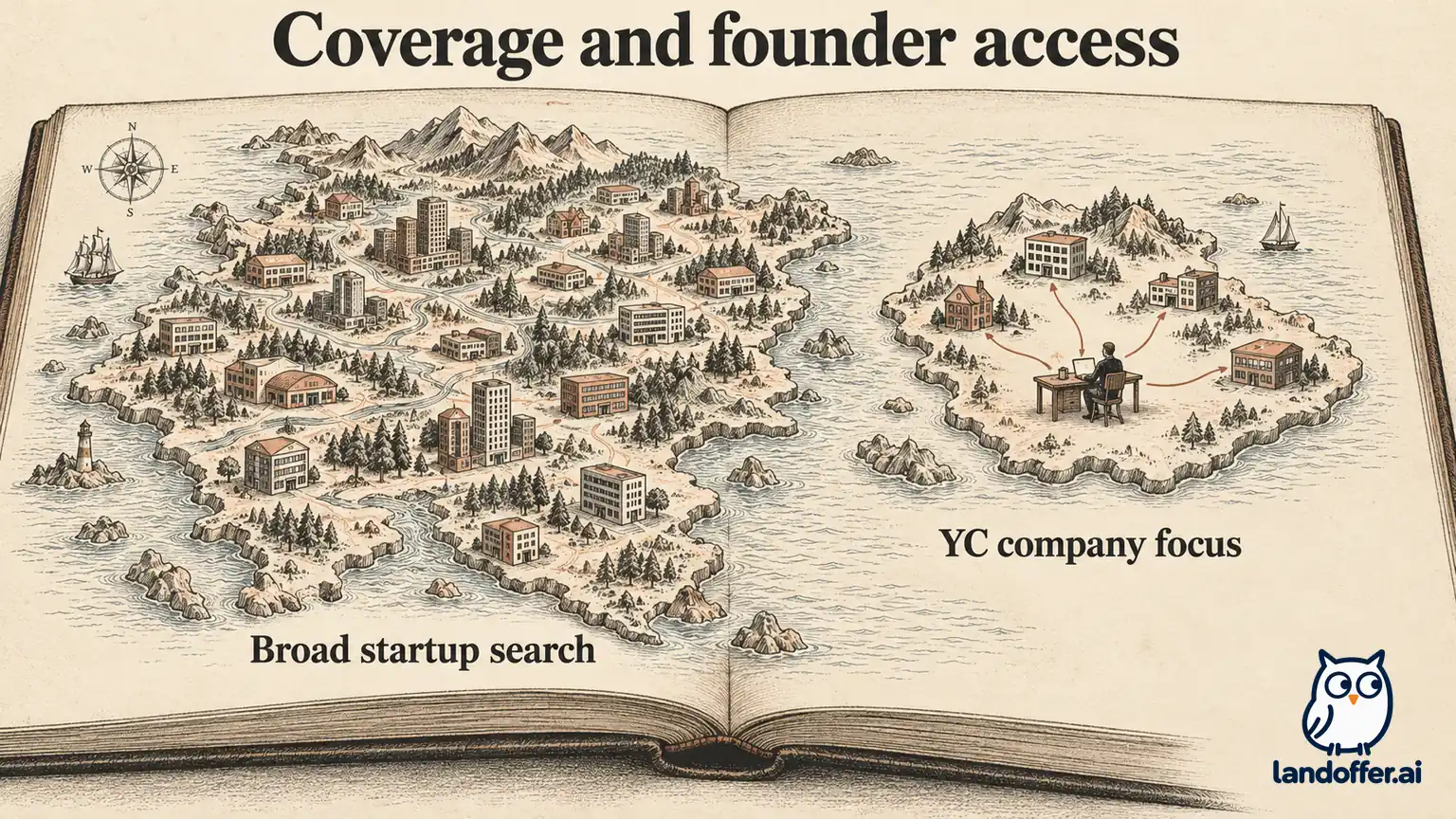
Compare the documented company universes
YC's jobs page states that its startup jobs are at YC companies. It describes a shared-profile application route and the option to let founders contact you or browse privately. Those are public product descriptions; they do not establish who will view your profile or how quickly anyone will respond.
Wellfound's search documentation organizes discovery around startup attributes including investment stage and employee count. Its public jobs page presents startup roles beyond a YC-only proposition. That gives a candidate with no YC-only requirement a reason to investigate additional employers. It does not establish how many suitable companies are unique to either board.
YC membership and current operating stage answer different questions. A batch label identifies a company's YC cohort; it is not a current funding-stage field or a statement about today's team size. A company from an older cohort may still have a small team. A current stage or size label also needs a date and role-level context before it can inform your decision.
The practical consequence is a different starting search. If YC membership itself matters, begin in the focused universe and assess roles within it. If company size, work scope and location matter more, use those constraints to discover employers, then retain YC affiliation as background information rather than a gate.
Founder access does not settle application fit
YC's invitation to founder contact can be valuable for someone comfortable explaining a specific contribution to a small team. But access and attention are separate. A profile may be available for discovery without being reviewed by the founder of every company you like. A listed contact route may be handled differently as the company grows.
Prepare evidence of the work you can do before choosing an outreach route. An engineer seeking application-service work might describe a service they maintained, the customer problem it solved and how they handled a relevant constraint. A generic statement about loving startups provides less information, regardless of who reads it.
Wellfound also supports a role-specific application note in its application guidance. The documentation says sending an application allows the company to see the candidate's profile and uploaded resume. It does not say that a founder personally reads every note. Tailor to the stated work, not to an imagined guaranteed audience.
Before making your profile discoverable, read the current visibility choices and the information you are sharing. Private browsing and an application are distinct actions. Do not assume that a platform's general privacy phrase covers every later submission or contact. For an employer-specific decision, the relevant question is what that action exposes and to whom.
Use the same role conditions on both boards
The matrix below combines official descriptions with editorial decision guidance. It does not score employer quality or compare response rates. The same location and responsibility brief should control both searches.
| Criterion | Wellfound | YC Work at a Startup | What changes your choice |
|---|---|---|---|
| Company universe | Startup discovery beyond a YC-only proposition | Jobs page states only YC companies | Whether YC membership is a deliberate requirement |
| Company screening | Documents stage and employee-count controls | Cohort identity is visible context, not a current-stage equivalent | Whether you need stage/size screening or a focused company network |
| Contact proposition | Role application can include a note and profile | Public page offers founder discovery/contact or private browsing | How you want to present your fit; neither guarantees attention |
| Location | Headquarters differs from hiring-from region | Individual public cards display location and remote variants | Whether the actual role permits your work location |
| Compensation | Employer ranges, estimates and missing data have different meanings | Read the selected role's range, currency and terms | Whether you have comparable evidence for your budget |
| Candidate access | Official help says candidate use is free | This review examines the public discovery page, not a paid-account workflow | No purchase is needed to begin the public-source research shown here |
For Wellfound, remote-search documentation explicitly distinguishes company headquarters from Hires Remotely From. Its salary documentation distinguishes employer-provided numbers from platform estimates. Apply those distinctions when copying conditions into your shortlist.
On the YC public page reviewed for this article, engineering cards included office locations, Remote (US) and Remote (CA) variants. That is a public-page observation, not a test of candidate eligibility or an inventory guarantee. A role marked Remote (CA) should not become “remote anywhere” in your notes. Open the individual description and the employer's current route before applying; a geographic label alone does not establish your work authorization.
A completed overlap ledger: six cards, four roles
The following fictional sample demonstrates how to judge a second source without inventing platform-wide statistics. Priya is searching for US-hiring backend product roles. Her first pass produces three YC cards. Her second pass produces three Wellfound cards. Two cards in each set identify the same underlying openings.
| Distinct invented opening | Source cards in the example | Fit check | Completed decision |
|---|---|---|---|
| Cedar Flow CF-301, Backend Product Engineer | YC and Wellfound | US remote; application-service scope fits | Keep one lead with both sources |
| Juniper Build JB-302, Platform Engineer | YC and Wellfound | Requires independent platform ownership outside Priya's target scope | Exclude once; do not reconsider merely because it appears twice |
| Finch Notes FN-303, Backend Engineer | YC only in this sample | Office-based in a location Priya cannot accept | Exclude for location |
| Lantern Tools LT-304, Product Engineer | Wellfound only in this sample; non-YC employer | US remote; relevant product work | Keep as one additional suitable lead |
The two duplicated openings each appear on both boards, so the six cards represent four distinct openings. Two survive Priya's constraints, and the second board adds one suitable lead in this invented exercise. That result justifies retaining the broader source for Priya's search. It does not establish a real overlap percentage, a response advantage or a general coverage ranking.
The ledger also separates “not found in this pass” from “not available on this platform.” Priya did not search every query, company name or date range. A board might surface a role under another title or at another time. Keep your own observation narrow enough to support the scheduling decision you need to make.

The useful output is the two retained role records, not the six original cards. Each retained record contains the employer, identifier, allowed region, relevant duties and current application destination. A duplicate card can contribute information, but it does not become another application or another chance to satisfy the same opening's requirements.
Let two different candidates reach different choices
Fictional candidate one: Mateo specifically wants a YC company where he can work closely with a small founding team. He is open to several product domains and can explain broad product ownership from his previous role. He starts with YC because it satisfies his deliberate company-universe constraint, then checks team structure and engineering scope rather than assuming founder access proves either.
Mateo uses Wellfound only when it adds context or surfaces another role at a company already within his chosen universe. If his short list is sufficient, he can reasonably keep a single primary board. Once he has enough relevant openings to prepare for, he can spend the next session on accurate materials instead of adding another discovery pass.
Fictional candidate two: Priya cares about backend product work, US remote hiring and a team that already has operational support. She has no accelerator preference. Her completed ledger retains Cedar Flow and non-YC Lantern Tools. She uses Wellfound first for broader startup screening and adds YC for focused discoveries that meet the same conditions.
Priya does not change her hard location requirement to improve a board's apparent performance. Mateo does not broaden beyond YC merely because another board has more names. Both choices are coherent because each follows a different brief. Their examples do not predict what an actual employer will do with an application.
Make a company-specific note, then verify the route
For a retained role, write one sentence connecting your evidence to its problem. Priya's invented note for Cedar Flow says: “I maintained customer-facing API services and built recovery checks for delayed events; CF-301's service-reliability work is the part of your posting most relevant to that experience.” It names work she can substantiate without claiming the company's exact architecture.
Then identify the unresolved question that would change your decision. For Mateo it may be whether the founder is the engineering manager and who reviews designs. For Priya it may be whether the role joins an existing on-call rotation. Keep that question distinct from a request for an interview or a demand for confidential business information.
Check the employer's current role description and application destination before submitting. If the same opening appears on both boards, preserve both source links but follow the employer's instructions for the chosen route. Do not automatically submit twice to compensate for uncertainty about founder attention. A profile, a note and a completed application are separate records.
Start with the company universe your brief actually requires. Add a second board when it contributes a suitable distinct opening or resolves a concrete question. Before applying, retain one current role record and its verified employer destination. If you need more openings, browse recent roles on LandOffer.ai for another discovery pass. Investor affiliation and contact access do not guarantee job stability, application compatibility or hiring outcomes.
Sources and Further Reading
- YC jobs — company universe, shared profile and founder-contact/private-browsing description; public role cards inspected October 12, 2026.
- Wellfound jobs — public startup-discovery positioning.
- Wellfound search controls — stage, size and role constraints.
- Wellfound candidate cost — official candidate-access statement.
- Wellfound remote search — headquarters and hiring-from region.
- Wellfound salary data — estimates versus employer ranges.
- Wellfound application guide — profile, note and submission visibility.