LandOffer
Product & Project Delivery
Test Your Riskiest Product Assumption Before Building the Feature
A complete fictional studio-booking case ranks six assumptions, tests the coordinator authority prerequisite, and stops an instant-commit feature. An authored six-record review separates task behavior from compliments and preserves the limits of qualitative evidence.
Before building a feature, identify the belief that would most change your investment decision if it proved wrong. Write that belief as something observable, examine the evidence you already have, and choose a small test that could change the plan. A prototype that attracts compliments can still leave the central product assumption unanswered.
This LandOffer.ai guide uses a fictional studio-booking service to show the complete sequence: rank assumptions, set a decision rule, inspect contradictory evidence, and stop the proposed solution. All people, sessions, observations, and decisions in the case are invented teaching material. No user research was conducted, and the counts are not a product benchmark.
Start with the decision the evidence must change
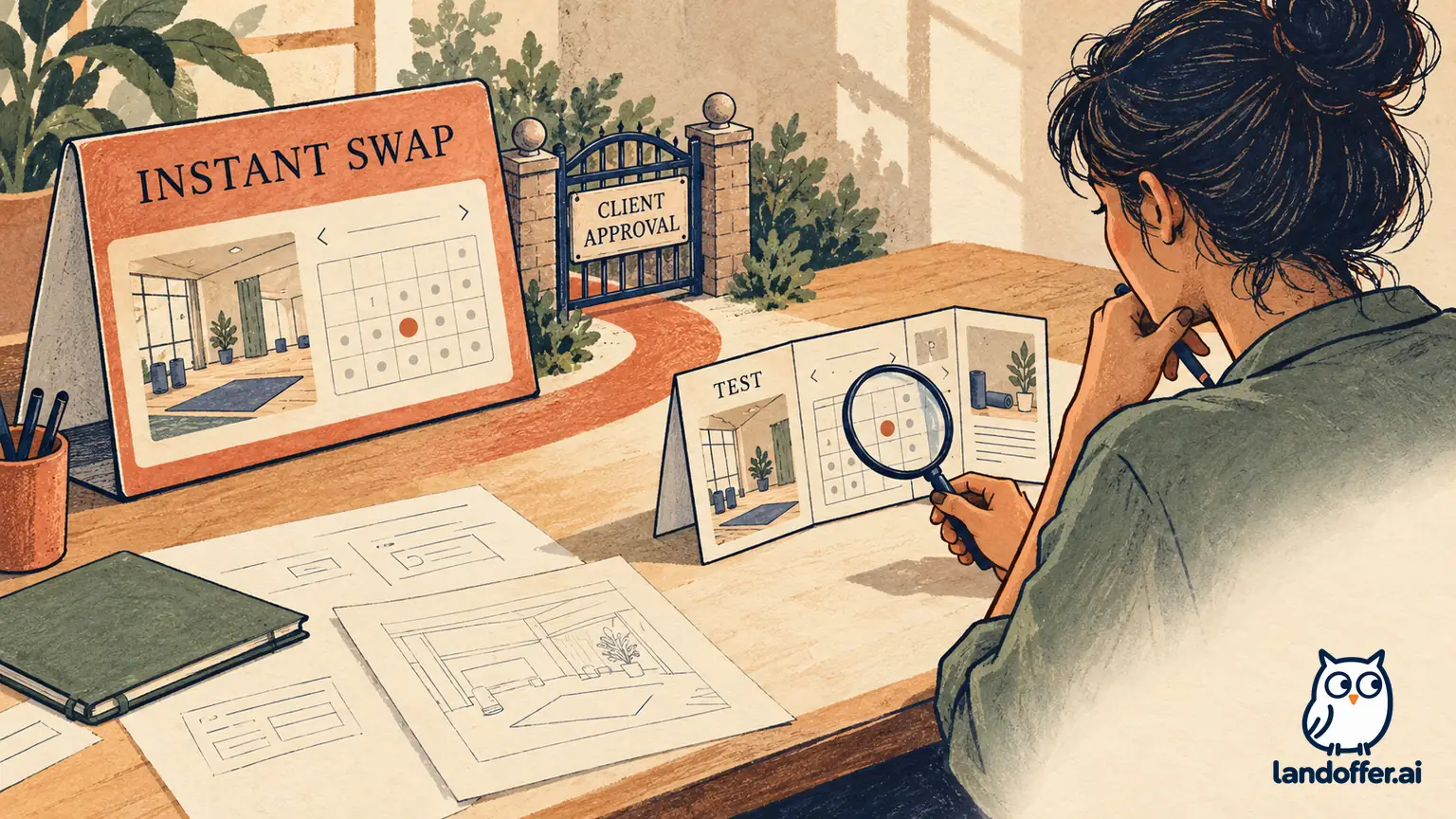
“We should let customers change their booking themselves” bundles several beliefs together. Customers may want fewer phone calls, yet still need someone else to approve a replacement date. The team may be able to build a calendar editor while lacking the authority to confirm a change.
Separate the feature you want to fund from the belief that must hold for it to work. For the fictional service, Harbor Rooms, the investment is an instant date-swap feature for commercial studio rentals. The critical belief is: the coordinator requesting a change can identify an acceptable alternative and authorize that change without waiting for another person.
That wording tells the team what it needs to learn. “Customers like self-service” does not explain which part of self-service would work, for whom, or under what constraints. Technical feasibility alone would not establish that this workflow solves the customer's problem.
Teresa Torres's original assumption-testing guide recommends examining the assumptions beneath an idea rather than testing the whole idea at once. It distinguishes desirability, viability, feasibility, usability, and ethical assumptions. Use those categories to broaden the questions you ask; arguing about the perfect category adds little to the decision.
A separate technical spike might examine whether booking updates can be applied safely. A premortem might surface ways a launch could fail. This exercise asks an earlier question: does the proposed instant-commit workflow fit the circumstances of the people expected to use it?
Completed asset 1: a risk and evidence map
Harbor Rooms product lead Priya and operations lead Owen make the following map before approving development. Their starting records are also fictional: a request log contains repeated date-change requests, but does not record who held final approval. The team has a sketch, not a deployed feature.
They rank the beliefs by the decision each could overturn and the weakness of its evidence, without manufacturing precise risk scores. A belief receives immediate attention when being wrong would invalidate the proposed workflow and the available evidence does little to establish it.
| Assumption | Evidence available in the fictional case | Consequence if wrong | Next decision |
|---|---|---|---|
| Coordinators want less back-and-forth when changing a date | Requests mention repeated messages; no measured cost or representative frequency | The problem may deserve less investment than assumed | Keep the problem provisional; investigate alongside the critical task |
| Requesting coordinators can authorize a replacement date | Request log names the requester, not the approver | Instant commitment could bypass the client's decision | Highest priority: observe an approval-aware date-change task |
| Coordinators understand what an available slot includes | Sketch uses “available” without explaining equipment and room constraints | A seemingly successful selection could be unsuitable | Probe the selected slot and the participant's interpretation |
| The booking system can prevent conflicting changes | No implementation investigation completed | A usable flow could still be unsafe to operate | Separate technical assessment remains required before delivery |
| Operations can support exceptions without displacing urgent work | Owen has not estimated exception volume or handling capacity | The service could transfer work rather than remove it | Keep operating cost unresolved; do not claim savings |
| The flow will not pressure someone to act outside their authority | The sketch encourages immediate confirmation | A convenient interface could produce an unauthorized commitment | Critical boundary: stop an attempted commitment when authority is absent |
The map distinguishes evidence of a problem from evidence for a solution. A request log can justify asking about date changes. It cannot establish that the person typing the request can approve a new date, or that an instant swap is the right response.
Priya records the current decision: do not allocate implementation work yet; investigate the authority assumption first. Owen accepts responsibility for explaining existing booking constraints during preparation, without presenting those constraints as already understood by customers. A developer's separate feasibility assessment remains unstarted.
The priority could change. If the service could not legally or technically change dates at all, that constraint might deserve attention before a prototype session. The GOV.UK alpha guidance describes using limited prototypes to investigate the most consequential uncertainties, including integration and other constraints. Its government delivery process is context, not a required timeline for every product team.
Design a test that permits an inconvenient answer
The team prepares a disposable date-selection sketch. It shows room, equipment, price difference, and a final commitment step. It does not connect to bookings, take payment, reserve a room, or send notifications. The facilitator can examine the decision without creating a real obligation.
For a real study, recruitment should match the people and circumstances the assumption describes. Recruiting only account owners could hide problems faced by coordinators working on behalf of clients. Privacy, consent, accessibility, and appropriate handling of research records also need an actual plan; the fictional case provides no authorization to contact anyone.
The task prompt is neutral: “Your client's shoot can no longer use the original date. Work out what you would do next with this booking.” The facilitator asks what would need to happen before a replacement became final. They do not say, “Use this feature to confirm a new date,” which would supply the behavior under investigation.
The GOV.UK moderated-testing guidance recommends credible tasks with clear goals that do not reveal the answer, together with observation and neutral follow-up. That supports the task design. It does not make this fictional exercise real research or turn a small qualitative round into a population estimate.
Before examining the authored observations, Priya writes an illustrative rule: continue investigating instant commitment only if at least four of six coordinators can select a suitable alternative and explain their authority to commit without facilitator coaching, with no attempted commitment outside their authority. If fewer than four qualify, or anyone attempts commitment without authority, pause instant commitment and identify the failed prerequisite. Four of six is this fictional team's investment gate, not a validated sample-size rule or a universal success threshold.
They also record an interpretation rule. A person who cannot locate the date picker has a usability problem; a person who locates it but needs client approval exposes a different workflow constraint. Neither should be rewritten as “not interested” without further evidence.
Completed asset 2: observations, interpretation, and a stop decision
The six authored records below form a completed teaching example. They were written for this article rather than obtained from participants. Each separates the task evidence from a positive opinion.
| Record | Authored task observation | Authority and disposition |
|---|---|---|
| C01 | Finds a suitable slot and explains that the client delegated date changes within the stated budget | Can commit within that delegation; continues without coaching |
| C02 | Finds a suitable slot but says the client must approve any replacement | Pauses before commitment; wants a shareable proposal |
| C03 | Likes the shorter flow, then asks whether the photographer has agreed to the date | Cannot finalize yet; needs another party's availability |
| C04 | Finds a suitable slot and identifies a current delegation covering this change | Can commit within that delegation; continues without coaching |
| C05 | Selects a slot, then says approval is usually requested afterward | Attempts commitment without current authority; facilitator stops the fictional task |
| C06 | Initially mistakes a room-only slot for a room-and-equipment booking; after clarification still needs client approval | Both a usability issue and an approval dependency; does not qualify as uncoached success |
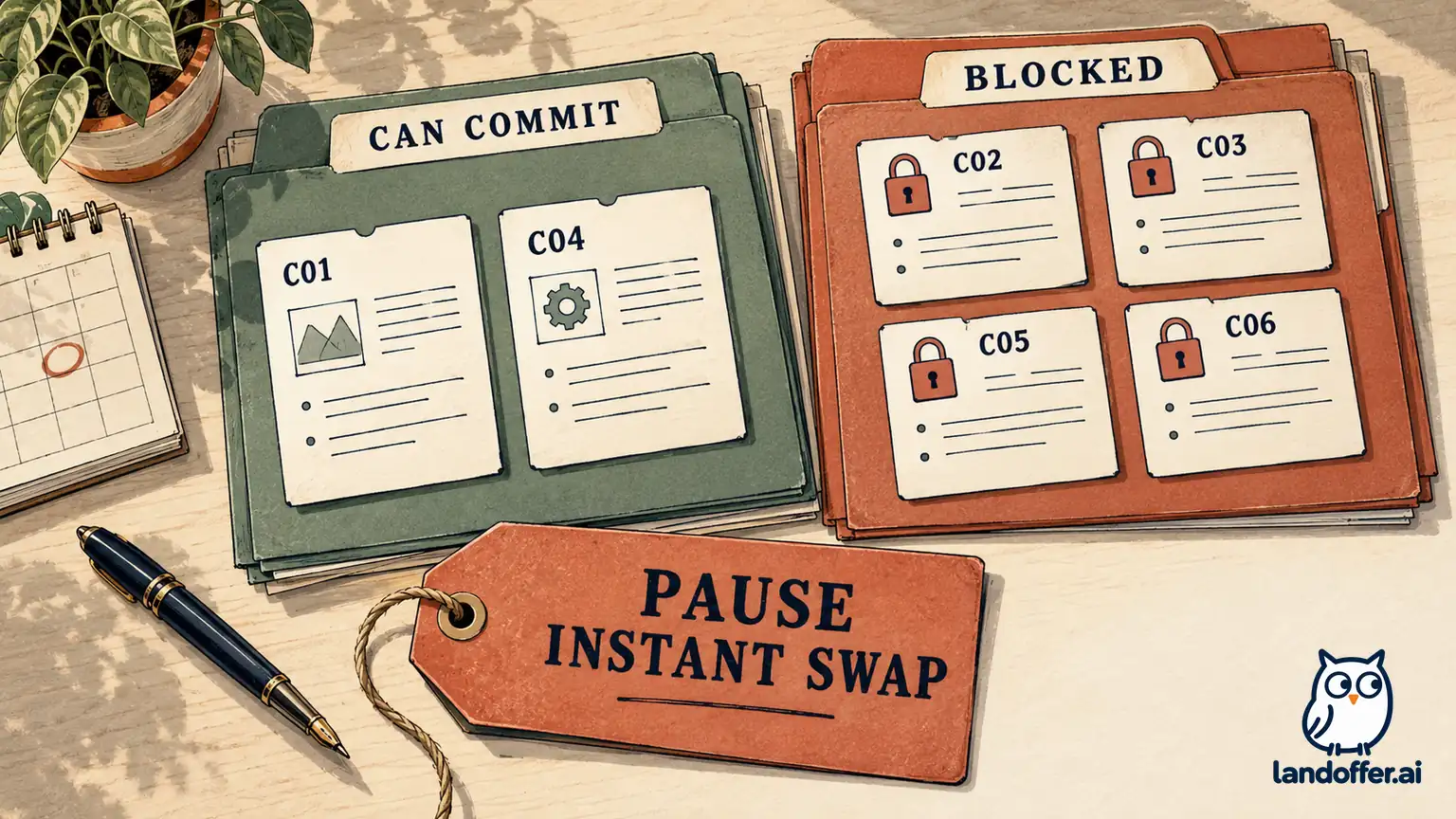
Two records meet the complete selection-and-authority condition. Four do not. One of those four includes an attempted unauthorized commitment; another contains an additional usability issue. These categories overlap, so adding “four failures plus one authority issue plus one usability issue” would double-count people.
The executed local Python check counts these authored classifications; it does not execute a prototype or verify participant behavior. Two out of six is not a conversion forecast, and the exercise cannot establish how common this pattern is among customers.
Priya's completed decision record reads:
Decision: stop the instant date-swap feature in its current form. The illustrative four-of-six gate was not met, and C05 exposed the authority boundary we agreed not to cross. Positive reactions to fewer messages do not resolve that boundary.
Evidence retained: C01 and C04 show a potentially relevant delegated-authority segment. C02, C03, and C06 need an approval or availability step; C05 needs a safeguard against premature commitment. C06 also leaves the slot description unclear.
Next work authorized within this fictional plan: Priya will prepare an alternative that creates a proposed date for review rather than confirming a swap. Owen will check which constraints and approval roles that proposal must represent. This is preparation for another decision, not approval to build or launch it.
Unresolved: demand across segments, real willingness to use the alternative, operating cost, technical consistency, and an accessible end-to-end experience. No delivery date or savings claim is approved.
Owen's recorded response is specific: “I support pausing instant commitment. I can review the approval path, but I cannot promise the proposed-date alternative will reduce exception work.” Priya accepts that limit and removes the feature from the proposed implementation allocation. The alternative remains untested: preparation does not authorize implementation, and a later investment decision still needs evidence.
Keep the learning without overstating the verdict
Record exactly which investment is paused and what the evidence leaves open. Here it applies to instant commitment under the assumed coordinator workflow. It leaves open a delegated-authority segment and a proposal-and-approval alternative. Neither is automatically a good product investment.
Do not rescue the original feature by changing the gate after seeing the records. If the rule was poorly chosen, document why, keep the original result, and design the next inquiry. Reclassifying C05 as success because the person clicked the button would erase the exact risk the exercise was meant to reveal.
Equally, do not discard a whole opportunity on the strength of a single small round. Torres's guidance cautions against making an entire decision from one test. Examine the result alongside other evidence and the critical assumptions of alternative solutions. This fictional decision pauses a particular investment; it does not claim a market has been disproved.
Keep a short record of the assumption, intended audience, method, decision rule, observations, interpretation, decision owner, and unresolved questions. Separate what the team decided from what a future test may show. That makes a later revisit possible without turning a sketch, a compliment, or an internal vote into evidence it never supplied.
For your next feature proposal, write the one belief that could make the planned workflow inappropriate, then name the evidence that would cause you to pause it. Use the completed map and decision record here as working examples. More workplace guides are available from LandOffer.ai.