LandOffer
Product & Project Delivery
Retire a Product Feature Without Leaving Customers Without a Path
A fictional workshop-roster retirement follows sixteen affected workspaces through verified replacements and six unresolved paths. The completed migration plan, internal notice draft, residual-dependency register, and hold decision keep access, retention, support, and rollback claims bounded.
Retire a feature by proving how affected customers will complete the underlying task afterward, then checking who still lacks that path before you switch it off. A replacement link, an export button, and a sent notice are different milestones. None alone proves that customers can continue their work or that their existing information remains usable.
This LandOffer.ai guide uses a fictional workshop-management product to build a migration plan and a completed retirement hold decision. All workspaces, customer records, communications, and checks in the case are authored examples. No real customers were contacted, no account or feature was changed, and no production data was exported, migrated, or deleted.

Retire the capability, not your understanding of the need
The fictional product, Workshop Harbor, wants to remove its legacy printable roster pack. The feature combines participants from several workshop sessions into a grouped PDF. The proposed replacement is a new roster export with a simpler maintenance model.
Product owner Dev initially describes the change as “remove the old button.” Support lead Mina asks what customers do with the pack. Some print a straightforward session list. Others need a combined, deduplicated view across sessions. One workspace relies on an accessible reading order. A few use it only for quarterly workshops and do not appear in the latest activity window.
Define the retirement boundary as stopping new legacy-pack generation, while separately deciding historical-information access and verifying alternatives for the affected workflows. That does not automatically authorize deleting old files, changing paid entitlements, or treating every new export as equivalent.
GOV.UK's service-retirement guidance starts with how the user need will be met afterward, then addresses communication, old entry points, and protecting information. Its government-specific procedures and time periods are not universal rules for a commercial feature. The underlying question remains useful: where will this customer go, and what can they actually accomplish there?
Keep the retirement rationale beside, rather than inside, the record of customer-transition evidence. Maintenance cost may explain the proposal, but it does not establish that the new output works, that an infrequent user no longer needs the feature, or that a contract permits the planned change. Relevant commercial, privacy, and accessibility questions need the appropriate owners' review.
Completed asset 1: a customer migration plan
Dev and Mina inventory the fictional population before drafting a switch date. Workshop Harbor has 40 workspaces. Twelve generated a legacy roster pack within the last 90 days. Four other workspaces used it for quarterly events during the preceding year and are absent from that recent-use group. The known affected population is therefore 16 distinct workspaces, not merely the 12 recently active ones.
That inventory is a starting boundary, not proof of completeness. Saved links, support cases, historical exports, and workarounds can expose dependencies that a single event counter misses. Record uninstrumented use as unknown: otherwise a missing event can incorrectly remove a dependent customer from the transition plan.
The completed migration plan assigns each known group a task-specific path and evidence owner:
| Known group | Required customer task | Proposed replacement and evidence required | Owner and checkpoint status |
|---|---|---|---|
| Eight recent single-session workspaces | Produce the current session list with the required columns and readable printed output | New roster export, with a customer-task check of fields, ordering, and print result | Mina records eight verified paths in the authored checkpoint |
| Three recent multi-session workspaces | Combine selected sessions without listing the same participant twice | New grouped export, compared with the customer's selected sessions and deduplication need | Engineering lead Jules and Mina record two verified paths; one grouped-layout gap remains |
| One recent workspace using assistive technology | Read the roster information in a meaningful sequence | Accessible alternative and an appropriate task check; a visual screenshot is insufficient | Jules owns remediation; reading-order check remains unresolved |
| Four quarterly workspaces | Prepare the next quarterly workshop pack | Confirm the next use and required output before choosing a replacement | Mina owns follow-up; all four remain unconfirmed |
“Verified” in this table is part of the fictional case record, not an observation from an actual account. It means the required task and evidence are recorded as checked for that workspace. It does not certify all export variations, accessibility, or future customer success.
The team's proposed sequence is Day 0 for a reviewed notice, Day 7 for assisted task checks, Day 14 for a retirement review, and Day 21 for a conditional switch. These are illustrative planning checkpoints, not a recommended notice period. Customer obligations, support capacity, and unresolved dependencies can require a different schedule.
Dev owns the final scope decision. Jules owns replacement defects and the technical switch procedure. Mina owns each workspace’s task-verification record, quarterly-user follow-up, and the support team’s readiness. The data owner must separately approve historical-file handling and retention instructions before those details can be communicated as commitments.
Draft a notice customers can act on
A useful notice identifies what stops, what remains available, what the customer must do, and how to obtain help. Avoid saying “nothing changes” when output format, access, or workflow changes. Do not describe a proposed date as unconditional while the team is still assessing critical gaps.
The following completed notice is a fictional draft for internal review, not a message sent to customers:
Proposed retirement of legacy printable roster packs
We plan to stop generating new legacy roster packs after the transition review. The proposed switch is Day 21 of the reviewed migration plan; we will confirm the applicable calendar date before an approved notice is sent. The new roster export is the proposed route for future workshop lists.
Before switching, please check whether you need a single-session list, a combined roster across sessions, or a particular reading or printing format. A downloaded file alone does not confirm that your required output works. If the replacement does not meet your task, contact the support route in the approved notice so we can record the gap and arrange a next step.
Historical-file availability, retention details, and any required export action are still under internal review. We will provide confirmed instructions rather than assume that an old bookmark or saved file will remain usable indefinitely.
That draft deliberately leaves unapproved policy details unresolved. Mina cannot send it as a final operational notice until the calendar date, real support destination, historical-data commitments, and relevant reviews are complete. A draft's existence is not notification evidence; a delivery record would still not prove comprehension or successful migration.
A real retirement notice can also distinguish access loss from end of support. Microsoft's Publisher retirement guidance differentiates Microsoft 365 access removal from perpetual-version support ending. It also warns that PDF-to-Word conversion can change layout. Those product-specific details illustrate why “exported” and “equivalent working replacement” are different claims; they are not instructions to execute a conversion here.
Completed asset 2: residual dependencies and a hold decision
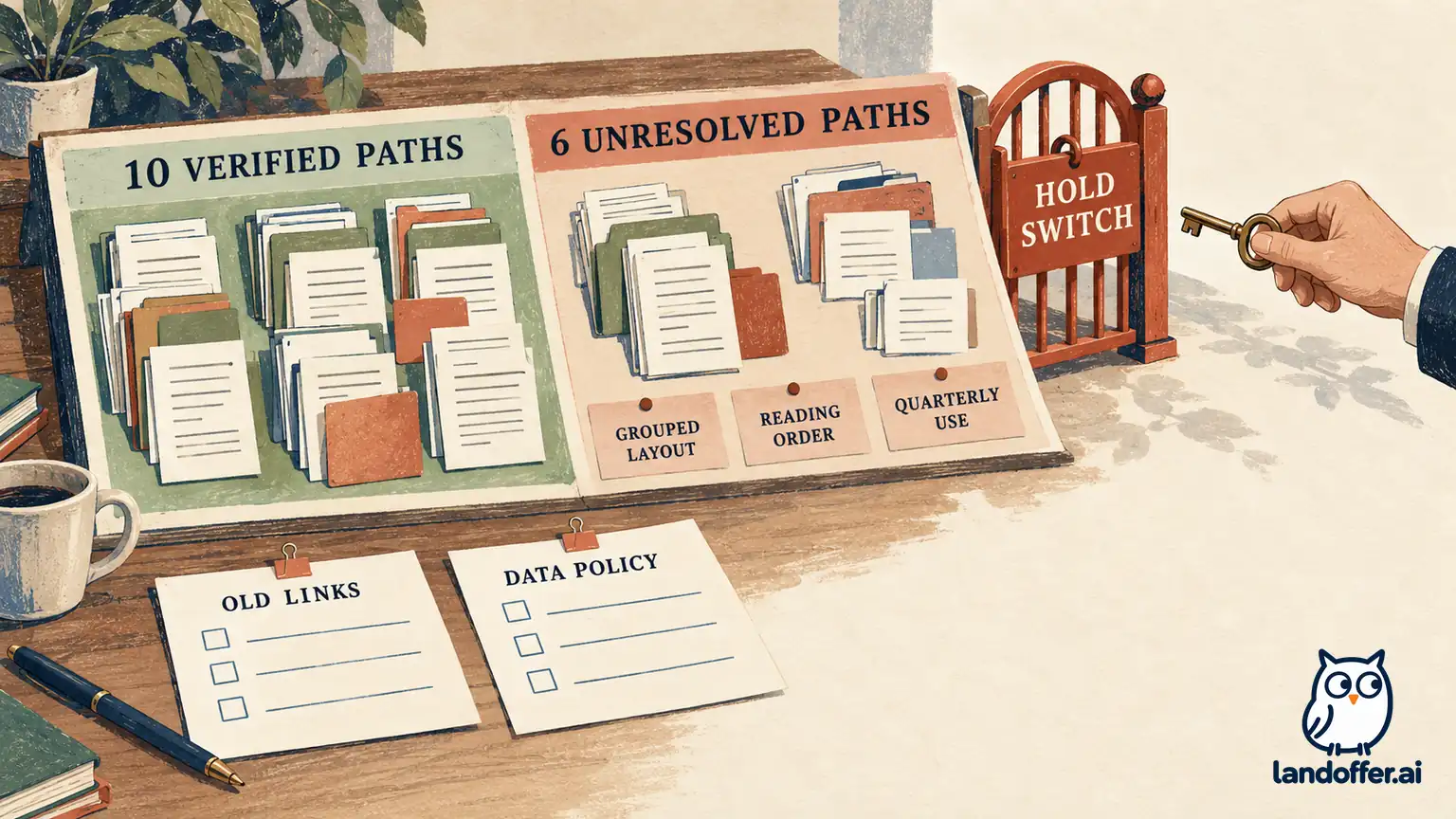
At the authored Day 14 review, ten of the 16 known affected workspaces have a verified replacement task: eight single-session workspaces and two multi-session workspaces. Six lack that evidence: one grouped-layout gap, one unresolved reading-order check, and four quarterly workspaces whose needs remain unconfirmed.
The team uses a dependency register instead of announcing that most people are migrated:
| Residual dependency | Evidence still missing | Condition and owner | Recorded decision |
|---|---|---|---|
| Remaining grouped roster | Replacement produces the required grouping without duplicate participant rows and with a usable layout | Jules supplies corrected output; Mina confirms the workspace's task | Hold retirement for that unsupported path |
| Reading order | Appropriate user-task evidence for the alternative, including the relevant assistive setup | Jules coordinates remediation and review with authorized participants | Keep unresolved; do not substitute a visual review |
| Quarterly use | Confirmation of next use, required format, and workable route for four workspaces | Mina follows up and records nonresponses separately | No-response does not mean no dependency |
| Old entry points | Agreed behavior for legacy bookmarks, help pages, and retained downloads | Jules and Mina review replacement destinations and explanatory content | Do not silently redirect every old link to a generic dashboard |
| Historical information | Approved retention, access, and any export deadline with clear ownership | Data owner reviews policy; Dev confirms what can be promised | No deletion or indefinite-access promise authorized |
Dev's completed decision is: do not perform the proposed Day 21 switch on the current evidence. Ten verified paths do not resolve the other six, and the data-handling and old-link conditions remain open. He authorizes remediation and follow-up, with another review after the missing evidence is available. He does not announce a new customer deadline.
Mina's recorded response is: “I can own the follow-up and keep the unresolved workspaces visible. I cannot classify a nonresponse as acceptance or promise a support workaround that our team cannot operate.” Jules accepts ownership of the two replacement issues, while keeping their resolution and verification pending.
The executed local Python check counts the authored workspace groups and unresolved states, with IDs retained to detect overlaps. It does not inspect customer telemetry or execute a migration. Ten out of sixteen is a description of this invented register, not a success forecast or a recommended percentage gate.
Plan recovery before a switch becomes irreversible
Before switching, record how the team will respond if a verified replacement path fails. In this fictional case, Jules proposes keeping the legacy generation capability available behind an authorized operational switch during a defined transition window. That proposal requires a real reversibility check and approval; the article does not claim that a rollback has been built or tested.
The recovery record names triggers: a confirmed inability to produce a required roster, an unresolved access failure, or a loss of required information. Mina records the affected task and routes it to Dev and Jules. Dev decides whether to pause the transition; Jules assesses whether the approved legacy path can be restored safely. A supported alternative or assisted path may be necessary if restoration is unavailable.
Restoring an old interface is not automatically data recovery. New changes may not exist in the old system, deleted information may not be recoverable, and parallel write paths can diverge. Record these limits before anyone promises to “just turn it back on.” Data deletion and infrastructure teardown need their own decision after the transition evidence supports them.
Historical vendor migrations show why exceptions matter. GitHub's Projects (classic) sunset notice described migration exclusions, including projects disabled at organization level and cards not updated within the specified period. That historical announcement is not a migration procedure to run today. It demonstrates that an automatic-migration label can still have scope limits requiring an inventory and reconciliation.
Return the retirement decision to its authorized owner with customer-path evidence, unresolved exceptions, support readiness, old-entry behavior, and approved information handling; keep the switch pending until that review supports it. Preserve the evidence and the date of the decision. A removed menu item is an implementation event, not the whole transition.
For your next feature retirement, start with the customer task that will outlive the button. Fill in its replacement, owner, evidence, and unresolved boundary before committing to a switch date. More practical workplace guides are available from LandOffer.ai.