LandOffer
Job search
Robotics Software Jobs: Compare Controls, Perception, and Planning Before Applying
Classify robotics roles by subsystem output, physical deployment evidence and handoffs, then match your experience without turning a simulator demo into full-stack readiness.
Choose a robotics software role by the subsystem you would own and the physical evidence you can show. Controls, perception and planning share code, mathematics and debugging tools, but they produce different outputs. A C++ background or a working simulator alone does not establish readiness for every job containing robotics.
LandOffer publishes this guide and offers recent tech-job discovery. We inspected five current Maven Robotics role descriptions and their employer links on October 20, 2026, including rendered requirements. This is a bounded comparison within one industrial-robotics employer, not a market census. We did not apply, operate a robot or contact a company. The candidate routing exercise is fictional; its small coordinate check was executed locally.
Start with the output and its failure modes
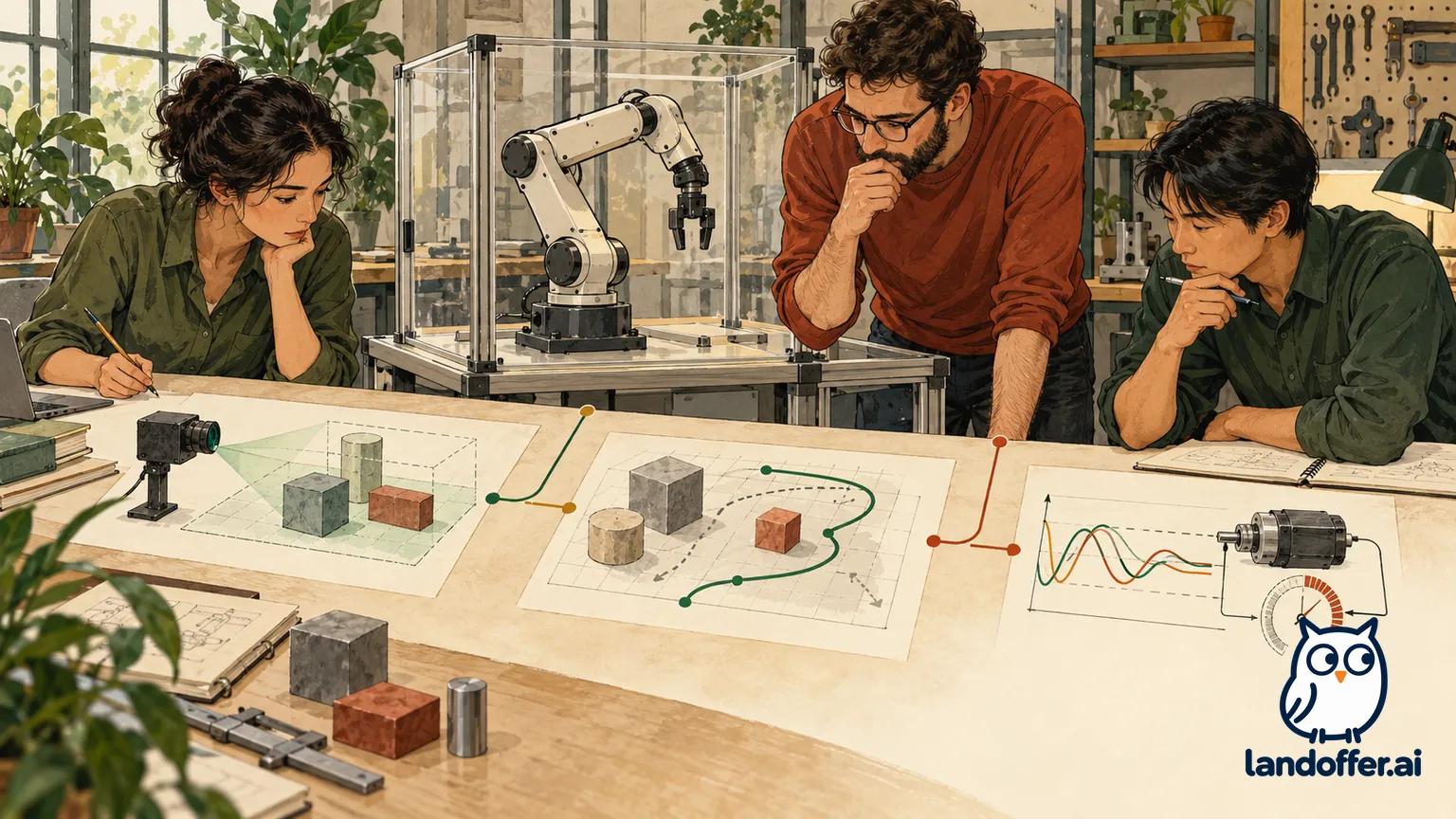
For controls, ask what commands the software produces and how it uses feedback to make the physical system follow the intended motion. Relevant work can include modeling, estimation, actuator limits, tuning and evaluating tracking behavior under changing loads. Strong evidence connects an algorithm to measured motion rather than showing only that a command was published.
For perception, ask what representation downstream software receives: object detections, poses, tracks, maps or another estimate. Data quality, sensor calibration, coordinate frames, uncertainty and deployment latency can matter alongside model accuracy. A useful portfolio explains where the estimate fails and how that failure affects a robot’s next decision.
For planning, ask how goals become actions, paths or trajectories while respecting constraints and handling failure. Task ordering, behavior transitions, collision constraints, recovery and multi-robot coordination may all appear. A path found in a clean simulated scene is evidence of one capability; it does not establish reliable behavior when sensors are stale, hardware limits change or another robot occupies the route.
These boundaries overlap. A planner can optimize a trajectory while a controller solves an optimization problem too. Perception may include state estimation, and an autonomy engineer may own several layers. Classify the role by its component handoff and evaluation criteria; the controls, perception and planning labels can overlap.
Worked audit: five descriptions with different ownership
We used Maven’s employer career index to compare controls, perception, autonomy, integration and simulation. The table classifies the dominant responsibility in each inspected description. It does not rank the jobs or prove that these five descriptions represent other employers’ organization charts.
| Actual role inspected | Main output or responsibility | Evidence that distinguishes it |
|---|---|---|
| Motion Planning & Controls Engineer | Motion stack from optimization-based planning and control to motor torque control | Kinematics, dynamics, servo architectures and practical tuning |
| Machine Learning Engineer – Robot Perception | Detection, pose estimation, tracking and scene understanding deployed on robots | Sensor fusion, calibration, real-world perception and onboard performance |
| Robot Autonomy Engineer | Task, behavior, path and trajectory planning above the controller | Hardware-deployed planning, recovery architecture and field performance |
| Robotic System Integration Engineer | Full-system integration, debugging, tests and field deployment | Field buses, commissioning actuation and hardware/software fault isolation |
| Modeling and Simulation Engineer | Robot/environment models and simulation assessment infrastructure | Mathematical modeling, fidelity-versus-compute tradeoffs and test integration |
The Motion Planning & Controls description explicitly combines planning and control. It reaches from an overactuated system’s optimization problems down to individual motor torque control and asks for practical servo tuning. Calling it only high-level path planning would conceal much of the required electromechanical work.
The Robot Autonomy description draws a different boundary: ownership above the controller, ending at trajectories handed to motion control. It includes task allocation, behavior architectures, recovery and coordination in shared facilities. It asks for classical motion planning carried onto hardware, rather than experience left entirely in simulation.
The two descriptions draw different boundaries around motion planning. Two descriptions can both mention motion planning while assigning different lower-level responsibility. Before applying, identify the component’s output and downstream owner so you can explain which part of a failed physical task you would investigate.
Perception includes the sensor and deployment chain
Maven’s Robot Perception role asks for object detection, pose estimation, tracking, scene understanding and fusion across cameras, depth sensors, IMUs and tactile feedback. It also asks for hardware experience setting up and calibrating sensors and optimizing models for onboard deployment. Training a good image classifier addresses only part of that description.
Separate offline model evidence from deployed-system evidence. A held-out dataset result can support a claim about that evaluation set. It does not, by itself, establish calibration quality, time synchronization, robustness in changing scenes or behavior on the target compute platform. State which part you measured and which dependencies someone else owned.
The application chain needs its own check. The older perception Greenhouse URL redirected to Maven’s career index during our native inspection, while the employer’s role page still displayed the description and an Apply link. We used the employer page for responsibilities and did not claim that a completed application path or a current seat had been verified. The employer description supports this scope comparison; its redirected intake link leaves current application availability unverified.
In a screening conversation, make your ownership precise: “I collected and labeled the evaluation data and deployed the model,” or “I integrated an existing detector and investigated frame errors.” Those describe different contributions. Neither should quietly become a claim that you designed the full perception stack.
Planning is more than finding one path
The inspected autonomy role includes task planning, behavior planning, path planning and trajectory planning. It describes retry, recovery and operator handoff instead of allowing a task to stall. It also describes fleet separation and deconfliction, plus simulation, recorded-log replay and testing on real robots.
Read the algorithms in context. A*, sampling methods and trajectory optimization identify possible techniques; the role still needs an architecture that handles changing inputs and makes its failures inspectable. An engineer showing a search implementation should name the state representation, modeled constraints and response when a plan cannot be executed.
The description includes integrating language or vision-language models with verification and fallbacks. That is not evidence that prompting alone replaces planning expertise. Its stated boundary concerns which decisions a learned model may make and what must be checked before execution. Treat that as a systems-design responsibility rather than a list of model names to add to a resume.
For a portfolio, document the scenario limits: static or moving obstacles, known or estimated geometry, single robot or shared workspace, and how failure is represented. Keep the claim as narrow as the experiment: one successful video does not demonstrate operation across untested scenes or failures.
Integration and simulation offer adjacent routes with real prerequisites
The System Integration role emphasizes power, actuation, networks, sensing, lab and field deployment. Its must-have list includes industrial field buses such as EtherCAT or CANOpen, commissioning actuation systems and detailed test plans. ROS 2, Docker and Ubuntu appear as nice-to-have experience. Familiarity with middleware therefore does not substitute for the role’s stated hardware and commissioning work.
The Modeling and Simulation role focuses on mathematical models, simulation requirements and assessment integrated into development. It includes balancing fidelity against computational complexity. This is a distinct engineering output: making a simulator useful for design and regression testing, rather than merely running a robot in an existing environment.
Simulation can expose regressions and support controlled comparisons. A simulated success still depends on the model’s assumptions about sensing, contact, timing and the environment. The inspected autonomy role explicitly requests hardware experience, so a simulator-only portfolio should retain that gap. Conversely, simulation infrastructure can be a strong specialty when the job asks you to build and validate those models.
These particular controls, perception, autonomy and simulation descriptions request an MS or PhD in relevant fields; integration lists a bachelor’s or master’s. Those are the inspected employer’s requirements, not universal degree rules for robotics. Review each role’s current qualifications and the work arrangement separately. The California locations do not establish remote eligibility, sponsorship policy or willingness to waive a listed requirement.
Worked routing: an imaging engineer finds a specific gap
Nora is a fictional engineer with a computer-science master’s, five years in industrial computer vision, C++ and Python experience, camera calibration work and edge-model deployment. She has not tuned motor servos, commissioned field buses or deployed a robot planner. She wants to move toward robotics while representing her existing work accurately.
Her completed routing record is:
| Role family from the audit | Nora’s relevant evidence | Decision and unresolved gap |
|---|---|---|
| Perception | Calibrated cameras, deployed vision models and analyzed inspection failures | Investigate first; real-world robot perception and multisensor experience still need substantiation |
| Controls | C++ and applied mathematics | Do not present these as servo tuning, dynamics or control-loop evidence |
| Planning/autonomy | Small search experiments in simulation | Treat as preparation; no claim of planning carried onto hardware |
| Integration | Experience debugging camera connections | Insufficient evidence of field buses and actuation commissioning |
| Simulation | Uses a simulator for experiments | Has not demonstrated building validated dynamic models |
Nora has selected perception as a direction to investigate while retaining its unmet robot-specific requirements. Her master’s and deployed vision experience address specific published criteria. They do not erase the remaining requirement for hands-on robotics perception. She would clarify that boundary before investing heavily in an application.
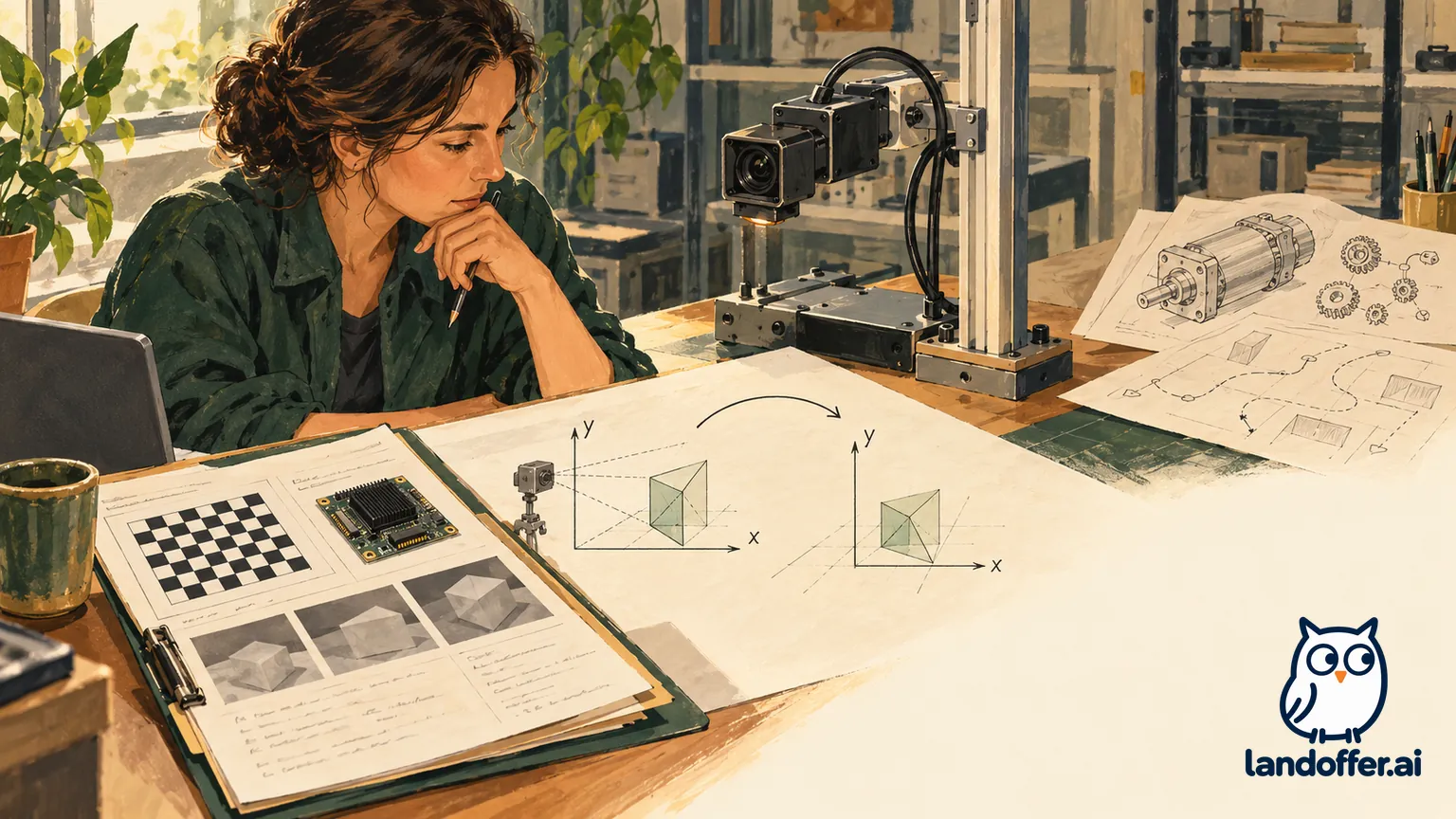
To make her explanation concrete, this article includes an original planar coordinate check. Assume a camera-frame point at (0.4, 0.1) metres, a counterclockwise ninety-degree rotation in the plane and a camera origin at (1, 2) metres in the base frame. Rotating the point first gives (−0.1, 0.4); adding the translation gives the base-frame point (0.9, 2.4).
We executed four synthetic forward checks, including the origin and the two unit-axis points, plus four inverse round trips: eight checks passed locally. Reversing the order for the example—adding the translation before rotating—would instead produce (−2.1, 1.4), which represents a different transform. Naming the source frame, destination frame, units and operation order makes the disagreement visible.
This is a small arithmetic fixture, not calibration of a physical robot, a complete three-dimensional transform system or proof of safe motion. Nora can use such a check to explain frame conventions, then show the real calibration procedure, data and ownership she actually has. She cannot call the fixture evidence of servo tuning or hardware-deployed autonomy.
Her final note reads: “Prioritize perception descriptions that value deployed vision and sensor setup. Show my camera calibration and edge inference work with its measured limits. Mark robot-specific sensor fusion and closed-loop deployment as gaps. Do not rebrand simulation search or camera debugging as controls, planning deployment or full-system commissioning.”
Read the test environment before choosing an application
Before applying, identify the subsystem output, must-have physical experience, degree wording and deployment environment. Ask whether evaluation uses offline data, simulation, replay, bench hardware or field robots, and which of those you would own. Keep results attached to the conditions under which they were obtained.
Robotics teams need strong software engineers across many layers, but the useful transition begins with evidence rather than a broad title match. Search for the role whose handoffs and failure modes resemble work you can explain, then name the remaining gap. Use LandOffer.ai alongside employer career pages to discover roles, and compare their actual scope before treating controls, perception and planning as interchangeable paths.