LandOffer
Job search
SCADA and Controls Software Jobs: Check Industrial Protocols, Site Work, and Commissioning Experience
Industrial protocols, lab/HIL evidence, and site or commissioning responsibilities must be read separately; a web dashboard does not establish power-domain experience.
A SCADA or controls-software role is defined by the system it controls, the interfaces it owns and the setting where it is validated. Read for the plant or device, protocols, test environment, and site or commissioning duties—not just the programming language. A role can use current software practices and still require substantial industrial-control or power experience; a web dashboard alone does not establish that background.
LandOffer publishes this guide. Use recent roles on LandOffer.ai to identify a target, then read the employer's full description. Official employer and technical sources were checked on October 13, 2026. The job example is a responsibility sample, not a continuously verified vacancy list; the candidate records below are fictional and do not describe testing performed for this article.

Start with the plant, controller and operator
Ask what the software connects and what a failure means in that environment. A controls job might concern an industrial machine, a distributed energy site or an operator's supervisory interface. The work can involve both application code and behavior across devices. Those responsibilities are not resolved by seeing Python, C++ or a familiar development process in the description.
Mainspring Energy's Staff Software Controls Engineer — Site Control provides a concrete example. It describes site-control software integrating generators with microgrids, distributed energy resources and power infrastructure. Responsibilities include industrial communications, SCADA and HMI work, and unit, integration and hardware-in-the-loop validation. The posting lists substantial industrial or energy-project experience and an onsite Menlo Park arrangement.
The same sample names PLCs or PACs, IEC control-language experience and industrial protocols. These details make the domain central. They are not a decorative list surrounding an otherwise ordinary web role. A candidate should be able to explain which controller, device or operating context their experience actually covers.
This does not mean every controls-software opening has the same requirements. The sample is a senior role with a particular energy setting. Use its specificity to improve your reading of other postings, rather than transferring its level, experience threshold or site arrangement to the entire market.
Turn protocol names into evidence questions
The Mainspring description names OPC UA, Modbus, MQTT and DNP3. Treat that list as a set of experience questions. Did you configure an existing connection, implement a client or server, investigate communication failures, or validate the exchanged information against the device's behavior? The protocol name alone does not explain the task.
The OPC Foundation's overview describes OPC UA as a platform-independent architecture for interoperable information exchange. That explains why it may appear across different industrial systems. It does not make all OPC UA work equivalent, nor establish that familiarity with an unrelated API is a substitute for industrial integration experience.
For each required protocol, write one evidence sentence with the endpoint, purpose, your contribution and how you checked it. “Configured an OPC UA connection for a training rig and compared tag values with simulated inputs” describes bounded lab work. “Owned industrial interoperability across production plants” would need a much broader record.
Also distinguish reading data from controlling equipment. A project that displays telemetry may support a useful monitoring example. It does not automatically support claims about control logic, equipment behavior or production commissioning. Identify the actual boundary before deciding which role to pursue.
If you have adjacent networking or backend experience, explain the transfer precisely. Debugging timeouts, validating interfaces and writing tests may be relevant skills. The industrial system, controller workflow and site responsibilities can remain meaningful gaps. Calling those gaps “just another protocol” makes the application less credible.
Validation environments are different kinds of evidence
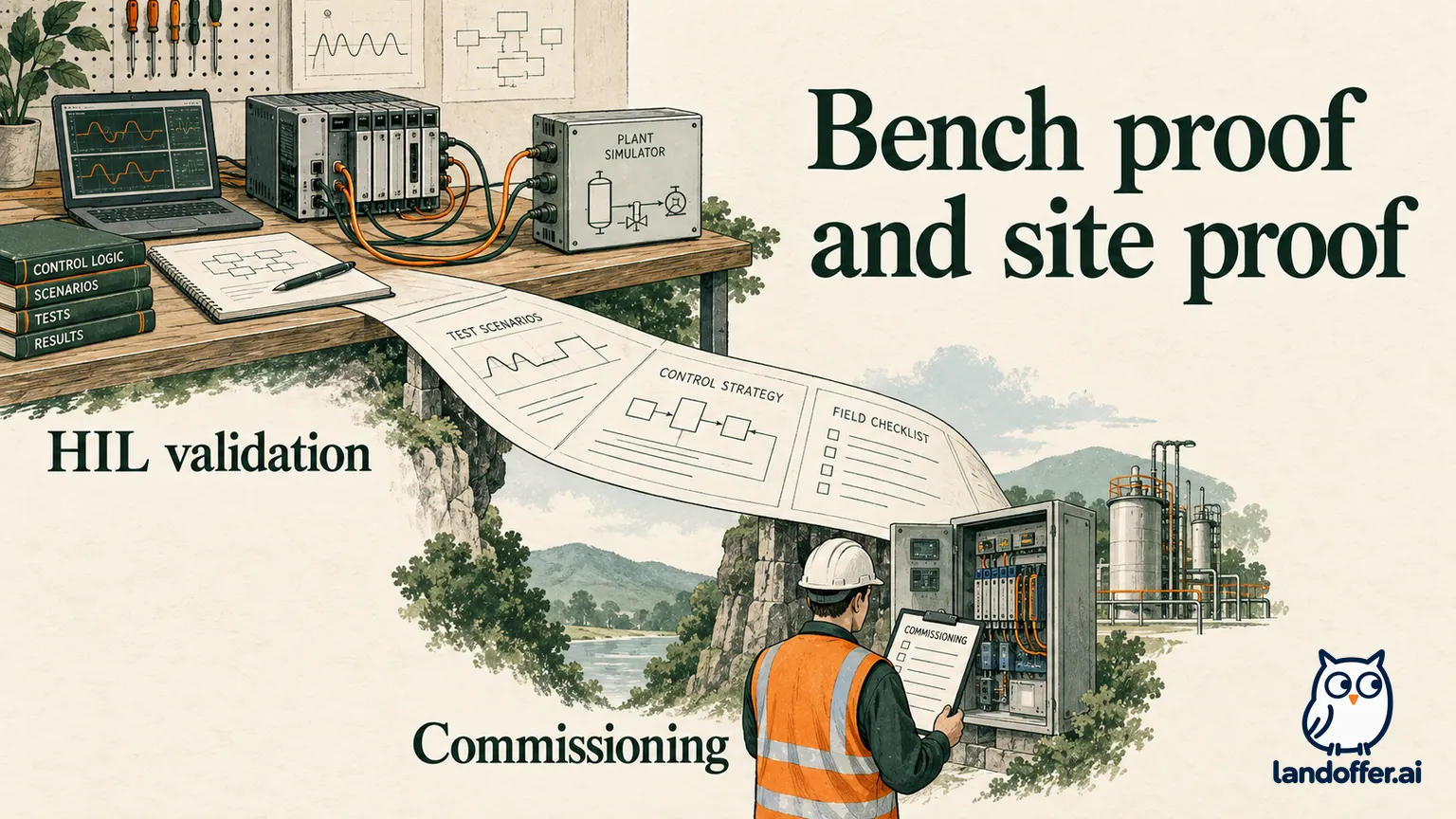
Unit tests, integration tests, a hardware-in-the-loop bench and a commissioned site establish different observations. A description that names several of them expects more than a broad statement that you “tested the software.” Explain what was connected, what behavior was checked and which conditions remained outside the work.
Hardware-in-the-loop (HIL) testing combines real hardware with simulated parts of a system. In an application, name the hardware, simulated components, behavior you checked and your contribution. A bench result documents that setup; it does not establish how the complete system behaved at a customer site.
NIST's Guide to Operational Technology Security treats operational technology in the context of systems that interact with the physical environment and have particular performance, reliability and safety considerations. That supports careful distinctions between software testing and operating context. It does not supply an employer's hiring requirements or authorize a candidate to perform site work.
Commissioning concerns putting a system into its intended operating context under the responsible organization's procedures. A posting can expect commissioning experience, occasional support to a commissioning team, or no field commissioning at all. Identify which wording appears. An onsite office requirement also differs from travel to customer plants.
The Mainspring sample supports onsite work and HIL responsibilities, but it does not establish a universal travel schedule. If field travel determines your decision, ask about it. Do not convert a site-control title into an invented percentage of time spent away from home.
A completed reading of a controls-software opening
Consider Owen, a fictional software engineer comparing a controls opening with his own work. His records include a laboratory controller integration, a telemetry viewer and automated checks using simulated inputs. He has written application code and investigated communication errors. He has not commissioned a power site or owned grid-interconnection compliance.
He annotates the employer's description before tailoring his resume. The completed map combines duties from the inspected posting with Owen's fictional evidence. It is a candidate-side reading aid, not an employer evaluation.
| Responsibility area | Owen's evidence | Completed reading |
|---|---|---|
| Industrial communication interfaces | Lab connection and communication-error investigation | Relevant bounded integration experience; production scale unproven |
| SCADA or HMI work | Telemetry viewer for the laboratory rig | Explain operator information and limits; do not rename it a deployed plant SCADA system |
| HIL and integration validation | Simulated-input checks involving the controller | Describe the setup and checks, without claiming site acceptance |
| Industrial or energy-project depth | No commercial power-project record | Significant gap for this particular staff-level sample |
| Site or commissioning work | No field commissioning record | Keep absent; clarify whether another role offers supervised entry into that work |
Owen decides not to make this staff-level sample his primary application. He looks for integration or controls-software roles whose requirements match his laboratory and development evidence. That is a completed prioritization decision, not a conclusion that no industrial employer would consider him.
The decision preserves useful strengths. Owen can explain a real communication problem and a test arrangement in detail. He simply cannot use those records to claim the energy-project depth that this description makes central. A narrower target can produce a more coherent application than attaching every protocol keyword to his resume.
Separate bench validation from site commissioning
Owen initially writes, “Validated industrial controls for production deployment.” His notes support a smaller claim. The lab controller received simulated input sequences, the viewer displayed expected values and a communication interruption produced a recorded error. No customer equipment was commissioned.
He completes two evidence columns instead of trying to make the project sound larger.
| Question | Completed bench record | Site record |
|---|---|---|
| Environment | Laboratory controller and simulated surrounding inputs | No customer-site work performed |
| Personal contribution | Implemented the connection, viewer checks and error logging | None claimed |
| Observed result | Stated inputs and the interruption produced the recorded expected behavior | No production acceptance result |
| Approval boundary | Supervisor reviewed the lab demonstration | No authority to approve a plant release |
| Remaining work | Explain broader integration and failure conditions in a future role | Requires employer-directed training and responsibilities |
His final resume bullet reads: “Implemented a controller connection and telemetry viewer for a laboratory rig; checked displayed values against simulated inputs and recorded communication-interruption behavior.” The sentence gives a reviewer a concrete technical discussion without implying commissioning, grid compliance or full-system safety validation.
The distinction also improves an interview answer. Owen can discuss why he selected those checks, what failed and what changed. He can then state that the work stopped at the lab boundary. That is more informative than using “production-ready” and hoping no one asks what production meant.
Check working conditions before investing in the application
Read the physical and organizational context alongside the technical requirements. Is the role based at a factory, office or customer site? Does it involve travel, scheduled commissioning periods or recurring support? Which team is responsible when equipment is unavailable or a site change needs approval?
Ask for the missing detail that could change your decision. “Where does this engineer normally perform integration validation?” is more useful than asking whether the job is remote-friendly in general. “Does the role support commissioning under another lead or own the commissioning plan?” distinguishes two different responsibilities.
Do not treat an industrial job as unsuitable merely because it includes site work. For someone with relevant experience and availability, the physical-system connection may be the appeal. The purpose of the check is to make the tradeoff visible, including the time and setting in which you would use your software skills.
Similarly, a primarily office-based controls role can still require industrial expertise. A favorable work arrangement does not remove the domain requirement. Keep location, technical readiness and authority as separate entries in your decision notes so one attractive detail does not conceal another material constraint.
Notice the operator's part of the system
For an operator-interface requirement, describe which states an operator needed to distinguish and how you checked them. In Owen's fictional lab viewer, a current reading was separate from an unavailable connection, and the error was recorded. That supports a specific interface example; it does not show a production alarm strategy.
When you review your own work, name the user, the information displayed and the validation context. A polished screen alone does not show that its states matched the connected system. Keep control authority and site acceptance out of the claim unless your records support them.
Present the strongest relevant record accurately
Choose a project that contains the type of evidence the opening needs. For protocol work, prepare the interface and failure investigation. For operator-facing work, explain the information shown and how it was checked. For HIL, explain the real and simulated parts. For commissioning, use an actual site record and state the responsibility you held.
These are preparation suggestions, not a request to disclose customer systems or a universal portfolio requirement. A sanitized diagram can show relationships without revealing site addresses, credentials, device configuration or private operating data. Preserve the engineering decision and the limits of your result.
Avoid adding unsupported standards expertise because a posting names a standard. Reading a standard, implementing a requirement, supporting a review and holding approval responsibility are different claims. Use the one your work record supports. If a requirement is new to you, record the gap and determine whether the employer expects it at entry.
Owen will lead with his controller integration and lab checks, then target roles that match that evidence and ask who supervises field work. He keeps this staff-level energy posting as a future benchmark; he does not rewrite his lab record to imply site experience.
Browse recent roles on LandOffer.ai, choose one controls description and separate its protocol, validation and site requirements. Compare each with an experience you can explain, including where that experience stops.
Sources and Further Reading
- Mainspring Staff Software Controls Engineer — Site Control: a specific industrial-energy role and its onsite, protocol and validation requirements.
- OPC Foundation: OPC UA: official interoperability background.
- NIST SP 800-82 Revision 3: operational technology context, including its distinctive operating considerations.