LandOffer
Job search
Robotics Portfolio: Let a Reviewer Replay Your ROS 2 Experiment Without the Robot
Package an actual synthetic rosbag2 recording, trace a timing and frame error, and distinguish offline evidence from ROS 2 middleware or physical robot validation.
A robotics portfolio becomes easier to review when someone can inspect the recorded messages, reproduce one calculation, and see exactly where the evidence stops. Give the reviewer a small bag, the message definitions and environment, an expected result, and a failure that your analysis explains. A video of a robot moving cannot provide those checks by itself.
This article includes an actual local experiment using original synthetic data: standard ROS message payloads were serialized into a rosbag2 SQLite recording and read back without a robot. ROS 2 middleware was unavailable, so no ros2 bag record or ros2 bag play command was executed. The completed evidence demonstrates offline file inspection and debugging, not robot performance. Use recent roles on LandOffer.ai to decide which responsibilities your portfolio should demonstrate.

Decide what the reviewer should reproduce
Choose a narrow question with a verifiable answer. For this example: can the reviewer recover the declared topics and identify why differentiating position in recorded order produces a misleading result? That question requires a real message container and an explanation of time and frame conventions. It does not require a robot, a photorealistic world, or a trained policy.
The official ROS 2 rosbag2 documentation describes recording communications and publishing recorded messages during playback. Its Jazzy branch documents both SQLite3 and MCAP storage, with MCAP as the default. Our deliberate SQLite choice should therefore appear in the environment record rather than being presented as the universal ROS 2 default.
Separate three claims in your README: reading stored messages, publishing them through ROS 2, and observing a system respond. Each needs different evidence. A reader that decodes every payload establishes the first. A middleware replay needs subscriber observations and runtime configuration. A robot behavior claim additionally needs the actual platform, conditions, and measured response. Name the completed layer in the project description so a reviewer can connect each claim to its saved result.
Build a package with a clear data contract
The local package used Python 3.12.14 and rosbags==0.11.9 in an isolated environment. Ternaris documents Rosbags as a third-party Python library that can read and write bags without the ROS software stack. Its Writer produced version-9 rosbag2 metadata and a SQLite database; its Reader recovered actual CDR-encoded payloads. CDR is the binary message serialization used here.
The type store was explicitly ROS2_JAZZY. The Jazzy type store supplies message definitions; it does not start Jazzy nodes or establish a native ROS runtime. Record both the schema choice and the actual runtime. The generated metadata identifies its producer as rosbags; we did not alter that field to imply a native Jazzy recording.
| Recorded topic | Declared type | Completed contents |
|---|---|---|
/demo/position |
geometry_msgs/msg/PointStamped |
Eight points with a header timestamp and frame identifier |
/demo/tracking_ok |
std_msgs/msg/Bool |
Three authored flags, each with a bag timestamp and no message header |
The PointStamped definition contains a Header and Point. Its Header definition supplies timestamp and frame fields. Neither field proves that a physical sensor generated the values. Our contract declares invented coordinates in meters, synthetic seconds near 10, and frames named demo_map and demo_camera.
The generic Bool type is retained only as a tiny teaching payload. Its official definition recommends a semantically meaningful message instead. A real project should document what “tracking okay” means, who produces it, and when it is valid; our invented flags establish none of those operational properties.
Worked asset one: an actual recording and readback
The first completed asset is the bag package and its readback log. The writer registered the two topics, serialized messages using the pinned type store, and wrote them in ascending bag-timestamp order. The reader then deserialized all eleven messages from disk. A separate read-only SQLite query confirmed eight position rows and three flag rows, and the database integrity check returned ok.
The first message is a flag at synthetic time 10.005 seconds; the last is a position at 10.710. Their span is 705 milliseconds. This is a difference between authored timestamps, not a measured recording or execution duration. The Reader’s exclusive end timestamp is one nanosecond after the last message; the package retains that detail instead of rounding it into a contradictory duration claim.
Each log entry retains its topic, bag timestamp, serialized-payload hash, and decoded content. Position entries also retain header time and frame. Hashes are useful for identifying the exact bytes under review. They do not establish that the bytes describe a real environment or that a recording captured every message originally published.
Two actual fresh-process executions produced identical saved result hashes. Both also compared the existing metadata and database hashes before and after reading and found no change. The rerun script reads the saved bag rather than deleting and silently regenerating it. Reusing the saved bytes lets a reviewer verify the same recording, instead of unknowingly accepting a regenerated dataset with the expected answer.
The completed package includes the authored inputs, bag directory with metadata.yaml and .db3, pinned dependency record, writer/reader script, JSON results, and one-line-per-message replay log. This is an offline replay log: messages are read in stored time order without a wall-clock pacing guarantee. No DDS publication, subscriber delivery, or real-time playback rate was measured.
Worked asset two: diagnose the time and frame failure
The second asset is a completed independent review of that recording. A separate script opened the SQLite database read-only, selected stored messages directly, and decoded CDR payloads. It did not import the producer’s result JSON or replay log. Both scripts share the same pinned serialization library, so this checks a separate extraction and analysis path, not an independent implementation of CDR.
The reviewer found one header-time inversion and one point in a different frame. The critical samples are shown below; times are synthetic seconds and x values follow the authored meter convention.
| Bag time | Header time | Frame | x |
|---|---|---|---|
| 10.210 | 10.200 | demo_map | 0.2 |
| 10.405 | 10.400 | demo_map | 0.4 |
| 10.410 | 10.300 | demo_map | 0.3 |
| 10.510 | 10.500 | demo_camera | 5.0 |
| 10.610 | 10.600 | demo_map | 0.6 |
The 10.300-header point is deliberately late in the authored recording order. Subtracting successive recorded x values produces a step from 0.4 to 0.3 over five milliseconds, an apparent slope of −20 m/s. That number comes from our actual calculation, but calling it robot velocity would discard the timestamp contract.
The maximum bag-minus-header difference is 110 milliseconds. It is a constructed difference, not an observed sensor or network delay. The example makes the debugging problem visible without pretending to measure transport behavior.
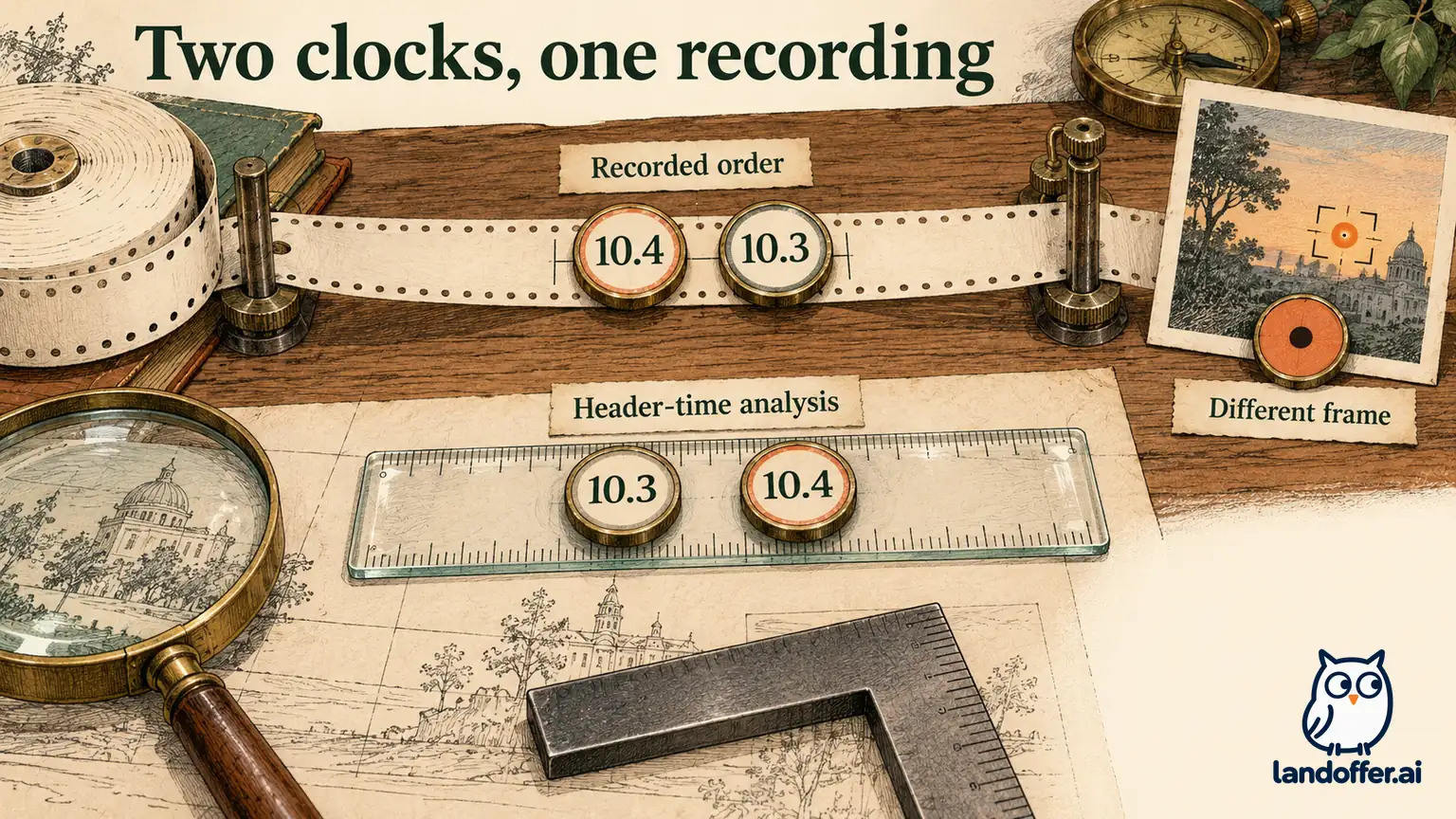
The review preserved the original bag, excluded the demo_camera point from the map-frame calculation, and sorted the retained finite series by header time. Seven map-frame points remained. Their six successive slopes were all 1 m/s, including the 200-millisecond interval across the excluded sample. Both extraction paths reached that result.
This is a completed offline analysis policy, not a demonstrated online buffering strategy. A controller cannot necessarily wait indefinitely for a late message. The packet needs a deadline and stale-data policy before it can claim anything about online behavior.
No transform topic was recorded. The camera-frame point was not relabeled or converted into demo_map. The review also kept the three Bool flags on their bag-time axis: without header timestamps, they cannot establish source-time alignment or explain why a position arrived late.
Make the failure states visible to a reviewer
Treat a requested topic that is absent from the inventory as missing evidence, rather than accepting a zero-message result as a completed experiment. Our inventory identifies /demo/velocity as absent; an empty selection must not be described as a successful velocity replay. A missing topic is a different result from a present topic whose decoded values fail an assertion.
Use the saved package to distinguish the next diagnostic step. If SQLite opens but CDR decoding fails, inspect the declared type and type-store version before changing plotting code. If counts match but a chart spikes, compare bag time, message time, and frame identifiers. If middleware publishes but a subscriber sees nothing, inspect its topic, type, and QoS configuration separately from the offline checks.
The official rosbag2 README documents per-topic QoS overrides. Our bag stores no tested offered-QoS profiles, so it cannot substantiate a compatible live subscriber configuration. The README also describes recording with simulation time from /clock. This example has no /clock topic and did not run that recording mode. Calling its invented timestamps “simulation time” would imply machinery that was never exercised.
The completed review traces the misleading slope to recorded-order differentiation and excludes the other-frame point under an explicit analysis rule. It is not that every anomaly disappears. Frame conversion, online timing, and subscriber behavior remain separate tasks with their own acceptance criteria.
Give the reviewer a short, bounded replay route
Put a read-first page beside the evidence. It should name the one calculation, the expected topic counts, the intentional anomalies, and the output files before asking the reviewer to install anything. Include a dependency lock and exact interpreter path for your own run, plus instructions for recreating an isolated environment. Use a separate environment and disclose the pinned dependencies. The supplied offline review does not require installing ROS 2, opening a network connection to a robot, or changing a global Python installation.
Offer a read-only review command first. In this package, review_bag.py reads the existing database and writes a separate analysis report. The original local evidence also retained a writer/reader command; the public companion includes the saved bag and the read-only reviewer, rather than the producing runner. A reviewer can compare the saved hashes before and after either route.
A compact table of decoded records makes the experiment inspectable even if the reviewer does not run Python. The table does not replace the actual serialized bag. Retain both the convenient view and the bytes it represents. Keep diagrams labeled as illustrations rather than screenshots of a tool you did not run.
If you later add native ROS 2 playback, preserve it as an additional test record. Name the distribution, storage plugin, subscriber, selected topics, rate, clock behavior, and QoS settings. Record observed subscriber counts and errors. Do not replace the offline receipt with an unexecuted command copied from documentation or imply that native interoperability has already passed.
Describe the contribution accurately when applying
A defensible project description for this experiment is: “Created a synthetic rosbag2 SQLite/CDR dataset, reproduced message decoding through two extraction paths, and diagnosed a header-order and frame-selection error while preserving the original recording.” It names work that actually happened and leaves room for a reviewer to inspect it.
Avoid claiming robot control, simulator fidelity, physical accuracy, or safety validation. Those require evidence outside this experiment. Likewise, identical output hashes support repeatability for these inputs and this environment; they do not establish coverage of other bag formats, custom messages, middleware implementations, or corrupt recordings.
Use LandOffer.ai’s recent job listings to choose a role whose required evidence you can explain. Before applying, open the package as a reviewer would, confirm the expected counts and the deliberate failure, and state the next untested boundary in one sentence. That gives an interviewer a concrete engineering decision to discuss.
Download the worked example files
Download the curated educational companion. Read PUBLICATION-README.md after extraction for the public file layout, replay commands and requirements. This is an archival source-and-fixture companion with external runtime requirements; its dependency-based execution was not rerun for publication. The earlier local report and commands describe the original evidence environment; use the companion README for the portable layout. No whole evidence directory, credentials or compiler binaries are included.
Sources and Further Reading
- ROS 2 rosbag2 Jazzy README: official recording, playback, time, storage, and QoS documentation; these commands were not executed in our experiment.
- Ternaris Rosbags documentation: third-party Python tooling without a ROS installation.
- Rosbags Reader and Writer API: serialized payloads, nanosecond timestamps, metadata, and versioned storage.
- Rosbags type system: distribution-specific type stores and CDR serialization.
- ROS 2 PointStamped, Header, and Bool: exact message definitions and generic Bool limitation.
Official documentation and the original local synthetic experiment reviewed October 23, 2026. No robot, simulator, ROS 2 middleware, or real telemetry was used.