LandOffer
Job search
Do Not Remember Your Employment Dates? Reconstruct Them Before Applying
Match employment dates to the events records actually prove, distinguish final payment from separation, and preserve uncertainty when exact days remain unknown.
Reconstruct employment dates from records before putting precise dates on an application. Check actual-start and separation records, use payroll documents to corroborate them, and ask the former employer to confirm unresolved details. Keep an estimated month distinguishable from a verified day. A final paycheck or a year of reported wages does not, by itself, establish your last day of employment.
Start with a role from recent jobs on LandOffer.ai and inspect how much date detail its application requires. LandOffer publishes this guide. Official sources were checked October 12, 2026; the records and candidate below are fictional. The method helps you make an accurate work-history record, but it does not predict what a particular employer or screening service will verify.

Find out which dates the application actually requires
Some applications request only a month and year. Others require exact days, separate employer and assignment periods, or a complete history over a stated interval. Read the instructions before deciding that the dates on your resume are sufficient.
A resume can emphasize relevant experience, while an application may request every employer within a particular period. Follow the application's scope. Do not assume that a role omitted from a selective resume can also be omitted from a question asking for complete employment history.
The Department of Labor-sponsored CareerOneStop document checklist recommends gathering employer details and employment dates, including the day when possible because some applications require it. That is a preparation recommendation, not permission to invent the missing day.
Identify the endpoint the field asks for. “Last day worked,” “employment end date” and “assignment end date” can differ. Leave, notice, paid nonworking periods and staffing arrangements may create several legitimate dates. Record the question's wording alongside the answer so you do not resolve an ambiguity simply by choosing the latest date you can find.
Build a small evidence record for each employer
Make one private record per employment period. Include the employer's legal or payroll name, public company name if different, job title, likely period, sources checked and unresolved questions. This keeps an old brand name or payroll entity from looking like a separate unexplained employer.
Search your own email and files for onboarding confirmations, revised start notices, employment agreements, separation correspondence and payroll records. Use distinctive employer names, job titles and words such as onboarding or separation. A calendar entry can help you locate documents, but the memory it triggers still needs corroboration.
An offer letter states a planned start. If the start was delayed, the original letter may be accurate as an offer and inaccurate as evidence of when employment actually began. Look for the final confirmation or a personnel record that reflects the actual event.
Similarly, a resignation email might state a proposed last day. A later acceptance or separation record may confirm a different effective date. Preserve both rather than deleting the inconvenient document. The discrepancy tells you what to ask the former employer.
Keep source references privately so you can explain a date correction without attaching your entire payroll history. The record can say “revised start confirmation, February 16” or “HR employment-period reply” without exposing pay, account details or another person's personal information.
Use evidence according to what it proves
There is no universal ranking that makes one document conclusive in every case. Match the source to the fact. A direct employer confirmation of recorded employment dates may answer an application question more precisely than an old calendar or your first deposit.
| Record | What it can help establish | What still needs care |
|---|---|---|
| Final onboarding or actual-start confirmation | The date employment or work actually began, as described | Confirm whether it superseded an earlier planned start |
| Separation or employment-period confirmation | Recorded employment end or service period | Distinguish effective separation from last active workday |
| Pay statement with pay-period dates | Work or pay associated with a defined payroll period | The first or last period may be partial; payment date is different |
| Offer or resignation letter | Planned dates and the parties' original communication | Plans may have changed |
| W-2 or annual earnings record | Employer and wages associated with a year | Usually not exact hiring or separation days |
| Calendar, old resume or memory | Search clues and an initial estimate | Corroborate before presenting precise dates as verified |
These distinctions prevent a common error: using whichever source has the most precise-looking date. A bank deposit has an exact day, but that day describes a payment. An exact payment date still does not tell you the employment end date.
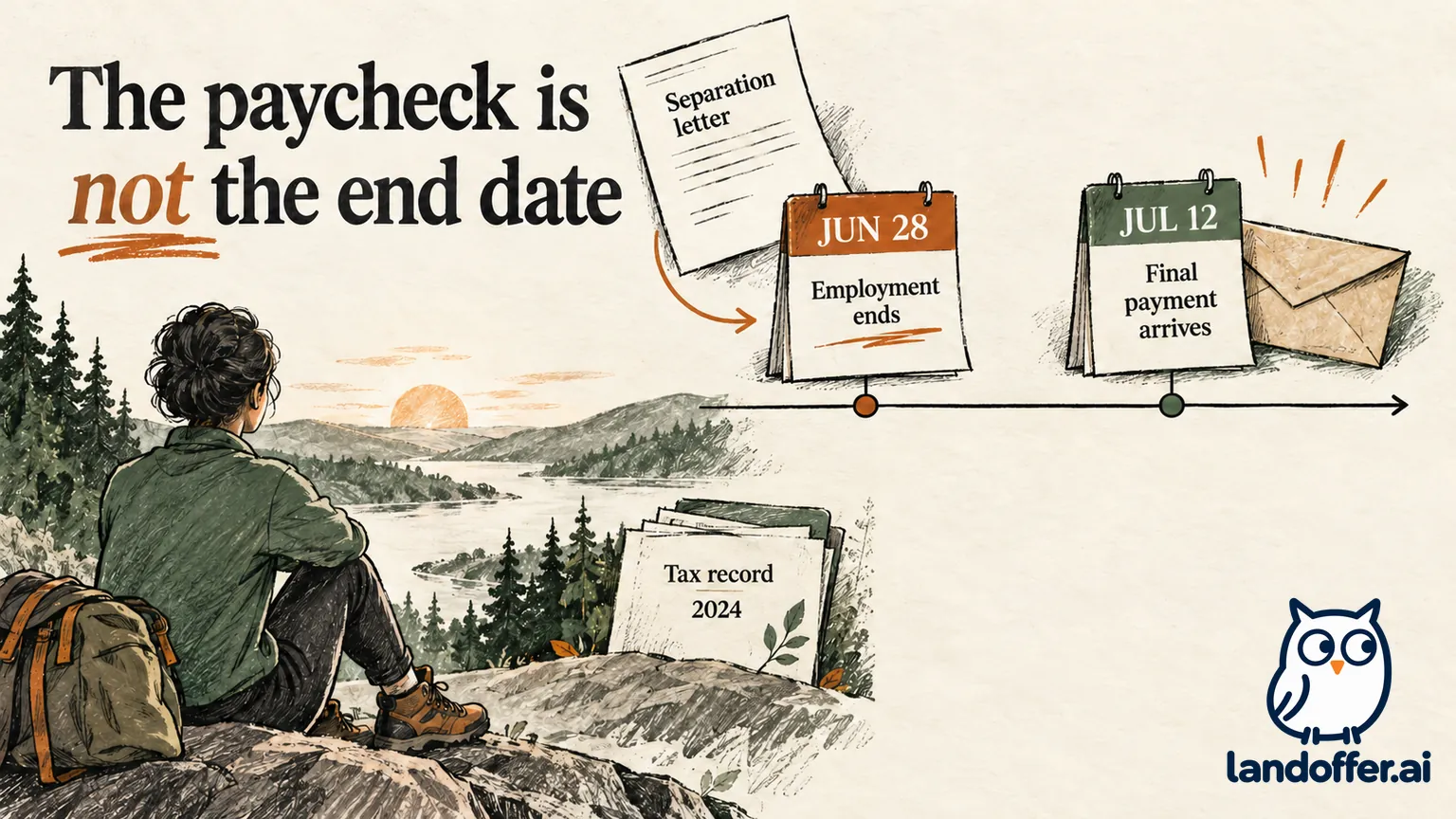
If two sources conflict, write down both event labels. “Last active work June 14; employment ended June 28; final payment July 12” is a coherent sequence. It becomes confusing only when those dates are compressed into one undefined end date.
A completed reconstruction with a delayed start and later payment
Consider Sam, a fictional support engineer reconstructing employment at fictional Harbor Systems. Sam's old resume says February 2022–July 2024. The application asks for month and year of employment, while a later verification stage may ask for exact dates.
Sam finds an offer dated January 20, 2022, proposing February 14 as the start. A February 16 email confirms that onboarding was delayed and the actual employment start will be February 21. A first pay statement covers February 21–March 6, with payment on March 11.
At the other end, a separation letter identifies June 28, 2024, as the effective employment end. The final statement includes a July 12 payment date. Sam remembers finishing the last active handoff on June 14, which explains another date in the calendar but does not replace the separation date.
Sam then asks the former HR team to confirm the recorded employment period. In this fictional example, the invented HR reply confirms February 21, 2022–June 28, 2024. These dates are stipulated for this teaching case. The completed evidence record is:
| Item | Sam's completed record |
|---|---|
| Employer | Harbor Systems, using the payroll name shown in the documents |
| Actual employment start | February 21, 2022; revised confirmation and HR reply |
| Employment end | June 28, 2024; separation letter and HR reply |
| Final payment | July 12, 2024; recorded separately as a payment event |
| Month/year application answer | February 2022–June 2024 |
| Old resume correction | Replace July 2024 with June 2024 |
| Remaining uncertainty | None for the requested employment period within this invented record |
The reconstruction changes Sam's July end month to the supported June end month. Sam does not extend employment into July merely because money arrived then, and does not use the first offer's February 14 date after finding the revised start.
If an application instead asks for the last day actually worked, Sam must answer that specific question from the appropriate evidence. The confirmed employment period does not automatically resolve every differently worded question.
Use tax and Social Security records for the right level of detail
An old W-2 can help identify an employer you have forgotten or corroborate that wages were reported for a year. The IRS W-2 transcript guide explains how wage and income transcript information can be obtained and notes availability and completeness limits. It does not turn that information into an exact employment timeline.
The Social Security Administration's earnings-review page concerns yearly income records. Its detailed-earnings FAQ distinguishes free yearly totals from itemized or certified records requested through SSA-7050, for which fees can apply. Check the current instructions before ordering anything.
Use those records when the missing issue is employer identity or a year of earnings. They can narrow your search. Do not infer that every month of the year was worked, that a listed year's first day was your hire date, or that a later payment extended employment.
Before paying for a record, ask whether a former HR team, payroll portal or your own files can answer the actual question. A detailed annual statement may still leave the precise dates unresolved. Buying more detail is useful only when that detail bears on the missing fact.
Ask the former employer a question it can answer
A focused request is easier to handle than “please send my entire history.” Identify yourself through the employer's accepted process, give the approximate period and ask for the recorded start and separation dates. Do not send identity documents to an unverified address found in an old forwarded email.
Sam's unsent example request could read:
I am reconstructing my employment history for an application. I worked as a support engineer around February 2022 through June 2024. Could you confirm the employment start and end dates in your records, and indicate if the recorded end date differs from the last day actively worked? Please let me know the approved process for verifying my identity.
The request distinguishes the two end-date concepts. It also avoids asking a former manager to improvise a personnel record from memory.
If the employer has closed or changed ownership, use whatever legitimate successor or verification route is available. Record the date, contact route and precise employment-period question for unanswered requests. A former colleague may help locate a document, but their recollection should not silently become a verified HR date.
For staffing work, identify whether you need the staffing company's employment period or the client assignment period. Keep both if the documents support both. A change of client may not be a change of employer, and the application's instructions should determine how it is represented.
When the exact day remains unknown
If you can substantiate only a month, do not convert it to the first or last day of that month without an authorized instruction explaining the convention. A date picker requiring a day creates a precision problem; it does not supply missing evidence.
Use an available approximation label or explanation field if the employer permits one. Otherwise, contact recruiting with the exact field requirement and the level you can support. Ask how they want an estimated date recorded, and retain the instruction with your application.
A useful note is: “I can verify employment during May 2021, but the exact start day remains unconfirmed. I have requested confirmation. How should I complete the mandatory day field?” This states the limit and the action already taken without pretending the date is known.
If the employer permits an estimate, label it as such wherever the process allows. Keep the original uncertainty in your private record and replace it only when better evidence arrives. An accepted estimate is still an estimate, not a historical fact established by successful submission.
Correct discrepancies before they spread
Once a date is reconstructed, update the active resume, application draft and saved profile that use it. Find any old answer that depended on the mistaken date. Updating one document does not prove the others changed.
For an already submitted application, identify the existing job reference, field and supported correction so the employer can connect the revision to the original record. If a third-party background report contains an error, the FTC's applicant guidance explains report access and dispute rights. Correcting a report is separate from correcting your own application.
For your next role from recent jobs on LandOffer.ai, choose one uncertain employment period and reconstruct it to the precision the form requires. Record the source, event and supported precision, then enter only the detail the application asks for and the evidence can sustain.
Sources and Further Reading
- CareerOneStop: gather your documents — employment information to prepare for applications.
- IRS: transcript or copy of Form W-2 — obtaining wage information and its limits.
- SSA: review your earnings record — yearly income records.
- SSA: detailed earnings statements — itemized and certified requests.
- FTC: employer background checks and your rights — third-party report corrections and applicant protections.