LandOffer
Pay & Benefits
A Prescription Needs Prior Authorization Under Your Work Plan: Find the Responsible Team and Next Step
A completed fictional eight-event authorization log and pharmacy/prescriber scripts identify who owns each handoff. The guide separates notification, request receipt, missing-information response, coverage review, and dispensing while preserving plan-specific timing and clinical urgency boundaries.
If a pharmacy says your prescription needs prior authorization, identify the plan's review team, confirm whether your prescriber's office actually submitted a request, and find the next missing action. Record the plan’s request reference and receipt date, the current status, and who owns the next action. “The pharmacy sent a message” and “the plan received the authorization request” are different facts; neither means the prescription is approved or ready to collect.
This LandOffer.ai guide addresses administrative coordination under a U.S. work health plan. Public sources were checked October 27, 2026; no patient record, account, pharmacy transaction, or authorization request was accessed. The completed case below is entirely fictional. Medication choices, treatment changes, and the clinical consequences of waiting belong with your treating professional, not an employer or this article.

Confirm the issue before opening another request
HealthCare.gov defines prior authorization as plan approval that may be required before a service or prescription is covered. First ask the pharmacy to explain the exact message for your prescription. Do not infer the reason from a generic “insurance problem.” A membership mismatch, refill timing issue, or authorization requirement needs a different next question, even when all three stop a fill from proceeding.
Use the current member card and plan documents to verify where pharmacy-benefit questions belong. The administrator handling drug coverage may be different from the team you usually call about medical claims. Ask the member-services contact to confirm that you have reached the appropriate pharmacy-benefit team and how the prescriber should submit information for your specific plan.
Check the prescription details privately with the pharmacy and prescriber's office. In your real record, retain the actual medication, formulation, strength, quantity, and prescribing clinician where needed. The teaching case uses “prescription P” to avoid inventing medical criteria or suggesting a drug choice. Do not post those details in a workplace chat to crowdsource coverage advice.
An informal question about whether a drug requires review is useful, but it may not itself be a filed benefit claim. Ask whether a request exists rather than assuming every call started the same process. Keeping one confirmed reference helps each team locate the same request instead of chasing duplicate records with different statuses.
Ask the team that owns the missing action
Aetna's current prior-authorization guide describes in-network providers submitting requests and its clinical team reviewing them against plan benefits and guidelines. For pharmacy-benefit drugs it points members to their plan's drug list; out-of-network situations may require different member action. This is a documented provider example, not a guarantee that every employer plan uses Aetna's workflow or portal.
Use four distinct conversations:
- Pharmacy: What exact obstacle appeared for this prescription? Which office or review team was contacted? After any decision, what still prevents dispensing, and what price would apply?
- Prescriber's office: Who handles authorizations, has the request been sent, and who will answer the specific clinical questions or missing-information notice?
- Plan or pharmacy-benefit review team: Was the request received, under which reference and date, what status does it have, and what action or notice comes next?
- Employer benefits contact: Which plan and service route apply, and where can you obtain plan documents or resolve an enrollment-routing problem?
The benefits contact can help locate the right process without being the clinical reviewer. Keep your diagnosis and medical history out of a routine employer-routing request. Ask the plan or provider for the appropriate confidential channel when clinical information is actually needed.
The useful output of a call is an owner and an action. “We are working on it” leaves you unable to distinguish an unsent form from a submitted request waiting for review. Ask for the smallest concrete clarification that would distinguish those states.
Worked asset: one request, eight documented events
This case, including all names, organizations, references, dates, and responses, is fictional. It is not an Aetna member story or a test of a real pharmacy system. Nia is enrolled in a fictional employer pharmacy benefit administered by Cedar Benefits. Her actual clinical situation and medication are intentionally unspecified.
Nia keeps a private log for prescription P. “CASE-P17” is a teaching reference, not a realistic credential or a code to use with any provider. All times below are local Eastern time in November 2026.
| Event | Confirmed fact and remaining gap | Next owner and recorded action |
|---|---|---|
| November 2, 09:10 — pharmacy | The pharmacy reports that P requires prior authorization. It says it sent the prescriber an electronic notification; no plan request reference is available. | Nia contacts the office's authorization desk to confirm receipt and submission. |
| November 2, 11:00 — prescriber desk | The desk received the notification but has not submitted a plan request. | Desk owner Jo accepts responsibility for assembling the plan-specific request. Nia records “not submitted,” not “pending plan review.” |
| November 2, 14:20 — member services | Cedar confirms the appropriate submission route and identifies the pharmacy-review team. | Nia passes the routing detail to Jo. No clinical decision or approval has occurred. |
| November 3, 10:05 — office | Jo reports submitting P through that route and gives CASE-P17. | Nia asks the review team to confirm receipt using the same reference. |
| November 3, 10:40 — review team | The team confirms receipt at 10:12 that day. It has requested a specific formulation clarification from the office. | Jo owns the clinical clarification. Nia asks the plan what its notice says about timing and further information. |
| November 3, 15:30 — office | Jo says the prescriber supplied the requested clarification under CASE-P17. | Nia records “office reports supplied”; plan receipt remains unconfirmed. |
| November 4, 09:15 — review team | The team confirms receiving the clarification November 3 at 15:52. It reports that review remains open and gives a November 5 follow-up checkpoint. | Review team owns the decision; Nia keeps the notice and will check the stated checkpoint if no update arrives. |
| November 4, 09:40 — pharmacy | The pharmacy confirms it has no dispensing-ready outcome. | Pharmacy will check the existing prescription after the review outcome. Pickup timing and member cost remain unknown. |
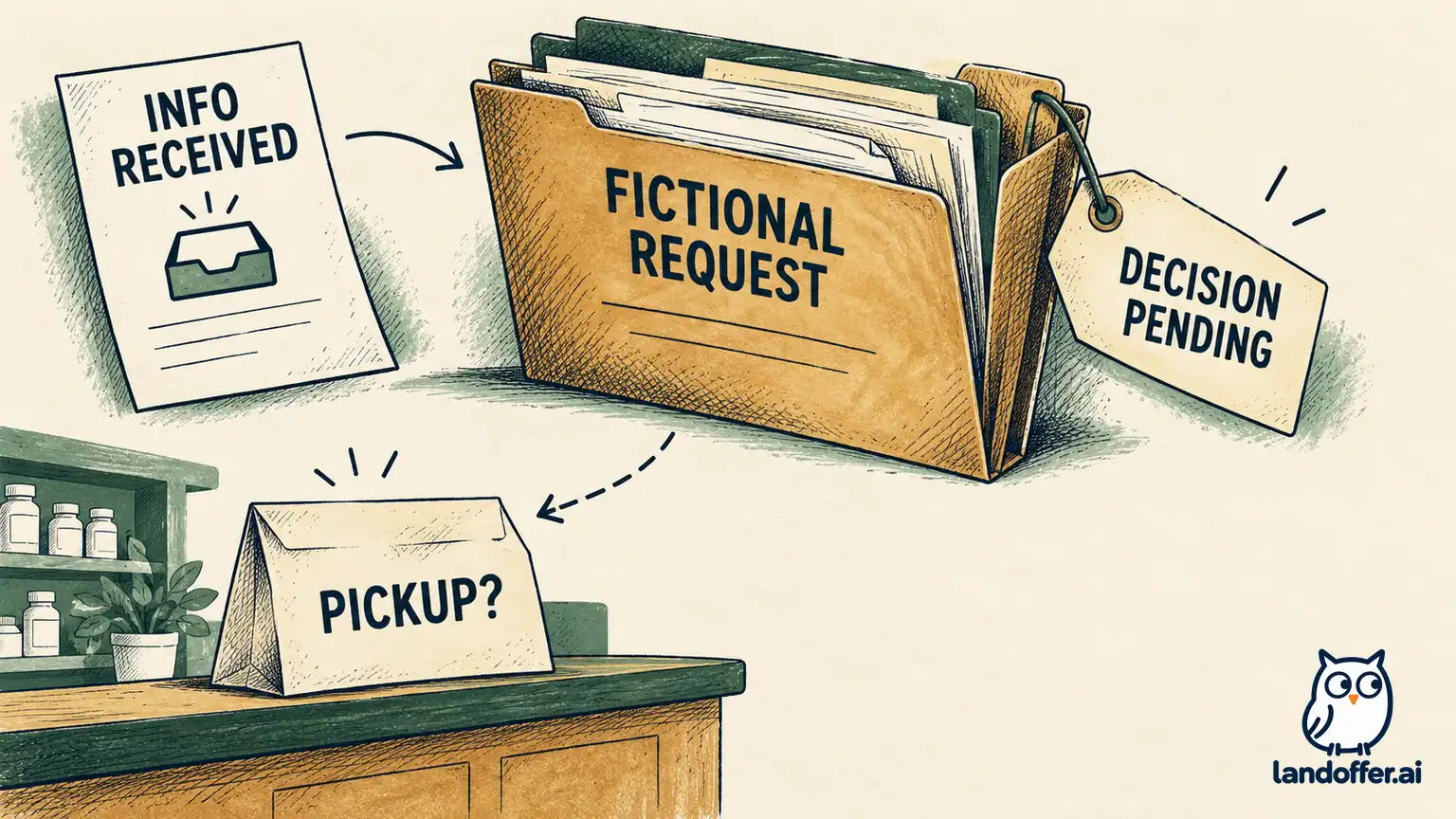
The log identifies the completed handoffs and the review still open. One submitted request exists; one clarification has been received; the coverage decision is pending. Nia does not start a second request to make the record appear active, and she does not label a prescriber's submission receipt as the plan's decision.
The November 5 checkpoint is a fictional service follow-up, not an invented legal deadline, a claim-clock restart, or an assurance that medication will be available then. Nia also asks her treating office promptly about any clinical concern caused by the interruption, separately from chasing the administrative reference. The case makes no assumption that waiting until that checkpoint would be safe for a particular patient.
Worked asset: a closed-loop pharmacy and office exchange
Nia's first pharmacy conversation is narrow enough to establish the problem without asking the pharmacist to decide the authorization:
Nia: “Please confirm the message for prescription P. Is prior authorization the obstacle, or is another issue stopping this fill? Which office did you notify, and when? I am trying to establish whether a plan request has actually been submitted.”
Pharmacy: “The message is prior authorization required. We notified the prescribing office this morning. We do not have the plan's request reference.”
Nia's readback: “I will ask the office about submission. I will keep this as a pharmacy notification, with authorization not yet confirmed, rather than recording a denial or approval.”
She then contacts the prescriber's authorization desk:
Nia: “The pharmacy reported a prior-authorization requirement for P and said it notified your office. Who owns that work here? Have you submitted the request to my current pharmacy-benefit plan? If so, please give the reference and submission time. If not, what action is needed and who will take it?”
Jo: “I have the notification, but the request has not been sent. I will confirm the correct plan route and assemble the submission. Clinical answers must come from the prescriber.”
Nia's readback: “Jo owns the submission; it has not yet reached plan review. I will confirm the route with member services. Please keep clinical information between your office and the designated review channel.”
After the missing-information notice, her follow-up avoids guessing the answer:
“The review team linked a formulation clarification to CASE-P17. Can you confirm that the prescriber has received that specific question and which team member will send the response? Please use the existing request reference and let me know the submission time so I can verify receipt.”
When Jo reports sending it, Nia follows up with Cedar: “Please confirm whether the requested information arrived under CASE-P17, the current status, and the next notice or action. What decision timeframe and missing-information instructions apply under my plan?” She records Cedar's receipt confirmation separately from Jo's earlier account of sending it.
The exchange produces a responsible desk, a single request reference, a confirmed response receipt, and an open review status. It does not ask Nia to invent a diagnosis, supply the prescriber's clinical judgment, or pressure the pharmacy to treat an unresolved request as approved.
Ask about timing without inventing a countdown
For an ERISA-covered group health plan, DOL's participant guide explains different procedures for urgent, pre-service, and post-service claims. Not all employer plans fall under ERISA; government and most church plans are among its exceptions. Request your own Summary Plan Description and claims procedures rather than applying a generic internet deadline to every plan.
Ask which claim category and rules apply, the recorded receipt date, and how any missing-information notice affects the next step. The current claims regulation, paragraphs (f)(4) and (m), makes filing under reasonable plan procedures important and does not make receipt of every supporting item a universal starting condition. Its timing provisions include specific extension and missing-information rules. Do not assume that an incomplete request has no running clock, or that every additional upload resets it.
If delay could threaten health, contact the treating professional promptly and ask about the plan's expedited process. DOL's guide explains the role of a knowledgeable physician in identifying an urgent pre-service claim. Wanting a faster administrative answer does not by itself establish the urgent-care classification. Ask the plan and treating professional about that process rather than treating a routine callback as medical advice.
Distinguish a decision from dispensing and payment
Aetna's guide says members and providers receive a decision and directs them to the decision communication for next steps. If the request is not approved, obtain the actual reason and applicable process; do not assume a pharmacy notification is that formal determination. A request for information and an adverse decision require different follow-up.
If there is an adverse determination, retain the notice and its receipt date, identify the stated reason and plan provision, and follow the applicable review instructions. Do not assume that informal calls or submitting another request preserves an appeal deadline. DOL's guide describes notices and appeal rights; a full appeal requires its own organized evidence and process.
After an approval, check the authorization's actual scope and dates with the responsible team, then ask the pharmacy whether the prescribed item can be dispensed and what member cost applies. Do not equate authorization with a zero-cost fill, available stock, or a promise that every later prescription will have the same status. If the pharmacy reports a different obstacle after authorization, record its exact message and next owner alongside the decision, rather than labeling the same authorization unresolved.
Your next action is to identify the missing handoff: notification, submission, receipt, requested information, decision, or dispensing. Use the scripts to confirm the next owner and action, then update the private record when that team confirms receipt or issues its decision. LandOffer.ai publishes this administrative guide; it does not review prescriptions, determine coverage, or contact a plan on your behalf.
Sources and Further Reading
- HealthCare.gov: Prior authorization glossary — basic coverage-approval definition; checked October 27, 2026.
- Aetna: Prior Authorization Process and Guidelines — current member/provider process and employer-plan FAQ, not evidence of an individual plan outcome.
- DOL: Filing a Claim for Your Health or Disability Benefits — plan documents, claim types, urgency, determinations, and review procedures within its stated scope.
- eCFR: 29 CFR 2560.503-1, Claims procedure — current public regulatory body checked October 27, 2026; displayed Title 29 current through October 26, 2026.