LandOffer
Job search
Form I-9 vs. Job Application Work Authorization: Keep the Stages and Documents Separate
Separate job application authorization questions from Form I-9 onboarding, including accepted-offer timing, document choice, and verified delivery.
An application asks whether you are authorized to work in the United States. Later, an onboarding message asks you to complete Form I-9. These steps concern related facts, but they ask you to do different things at different stages. Keep the application answer and Form I-9 completion separate; identity documentation alone does not determine every future sponsorship answer.
Identify the exact question, job country, and whether an offer has been accepted before answering or uploading a document. This guide covers the U.S. process at a general level; it cannot determine an individual's immigration status or eligibility. LandOffer publishes this guide and offers a place to browse recent job listings. The fictional examples below show how to organize the steps without sending identification documents with an ordinary application.

Identify the stage before choosing an answer or attachment
A form can ask several questions that sound similar: whether you can work in the country, whether you will need sponsorship now, and whether you might need it later. Read each sentence separately. Do not assume a yes to current authorization determines the answer to a future sponsorship question. If your answer depends on status, employer, work arrangement, or timing, verify those facts with a qualified immigration adviser before submitting an uncertain statement.
The Department of Justice's employer and worker FAQs explain that employers generally may ask applicants about their legal right to work in the United States and the need for employment visa sponsorship. That general explanation is not a determination of your circumstances, nor does it make every differently worded question interchangeable.
Record three items in your application notes: the question you answered, the facts supporting that answer on the submission date, and any clarification you requested. You do not need to copy sensitive document numbers into that note. Its purpose is to prevent a later application from repeating an answer that was specific to another employer or time.
Know when Form I-9 enters the process
Under the USCIS Form I-9 instructions, an employee completes Section 1 after accepting an offer and no later than the first day of employment. The employer ordinarily completes Section 2 within three business days of that first day. These are onboarding requirements; an application checkbox does not replace them.
Keep the start date distinct from the date you signed an offer or opened a portal. If the start date changes, confirm the onboarding schedule with the employer rather than copying an earlier calendar reminder. A saved portal draft is also separate from a completed form.
If your name differs between an application and an onboarding record, explain the difference through the employer’s verified process. Ask which supporting context it needs instead of changing an identity document or treating a preferred-name field as a completed identity check.
The Tennessee Department of Human Resources timing guidance illustrates the ordinary schedule with a Monday start and a Thursday Section 2 deadline. Employment lasting fewer than three business days has a first-day completion requirement for Section 2. Check the current official instructions and your employer's process rather than extending an ordinary example to an unusual schedule.
If an application upload field requests identification before an offer, pause to establish what the request is for. A payroll, background-check, professional-license, or location question may involve a different process. Ask the verified employer contact to identify the purpose and secure delivery method. Do not label an unexplained request as an I-9 requirement just because it mentions employment eligibility.
Worked example: Mina keeps her application and onboarding records separate
Mina is a fictional U.S. citizen applying for a U.S. office role. The application asks two separate questions: whether she is legally authorized to work in the United States and whether she requires employment visa sponsorship now or in the future. For the facts specified in this example, her answers are yes to authorization and no to sponsorship. The example does not establish answers for someone with a different status.
Her application also has an optional attachment field labeled “Additional information.” Mina does not use it to upload a passport or Social Security card. Nothing in these fictional instructions asks for those documents at this stage. She saves the submitted application receipt and the question wording, then waits for the employer's next step.
| Step in Mina's example | Completed action | What remains separate |
|---|---|---|
| Application authorization question | Answered yes based on the stated citizenship and U.S. job facts | Form I-9 has not been completed |
| Application sponsorship question | Answered no for the circumstances given | Another candidate's status cannot be inferred from Mina's answer |
| Optional additional attachment | Left empty because there was no relevant requested attachment | Identification is not added as persuasive application evidence |
| Offer accepted | Recorded the accepted offer and confirmed start date | The employer's onboarding instructions are now reviewed |
| Form I-9 onboarding | Completes Section 1 and follows the employer's verified document-review process | Application receipt remains an application record |
Mina’s sequence tells her which task is complete and which onboarding task still remains. She has answered the application accurately without treating an unused upload box as a request for identity records. After accepting the offer, she opens the actual onboarding instructions and follows that process. A recruiter saying “your application is complete” would not tell her that her I-9 is complete.
Let the employee choose among acceptable documents
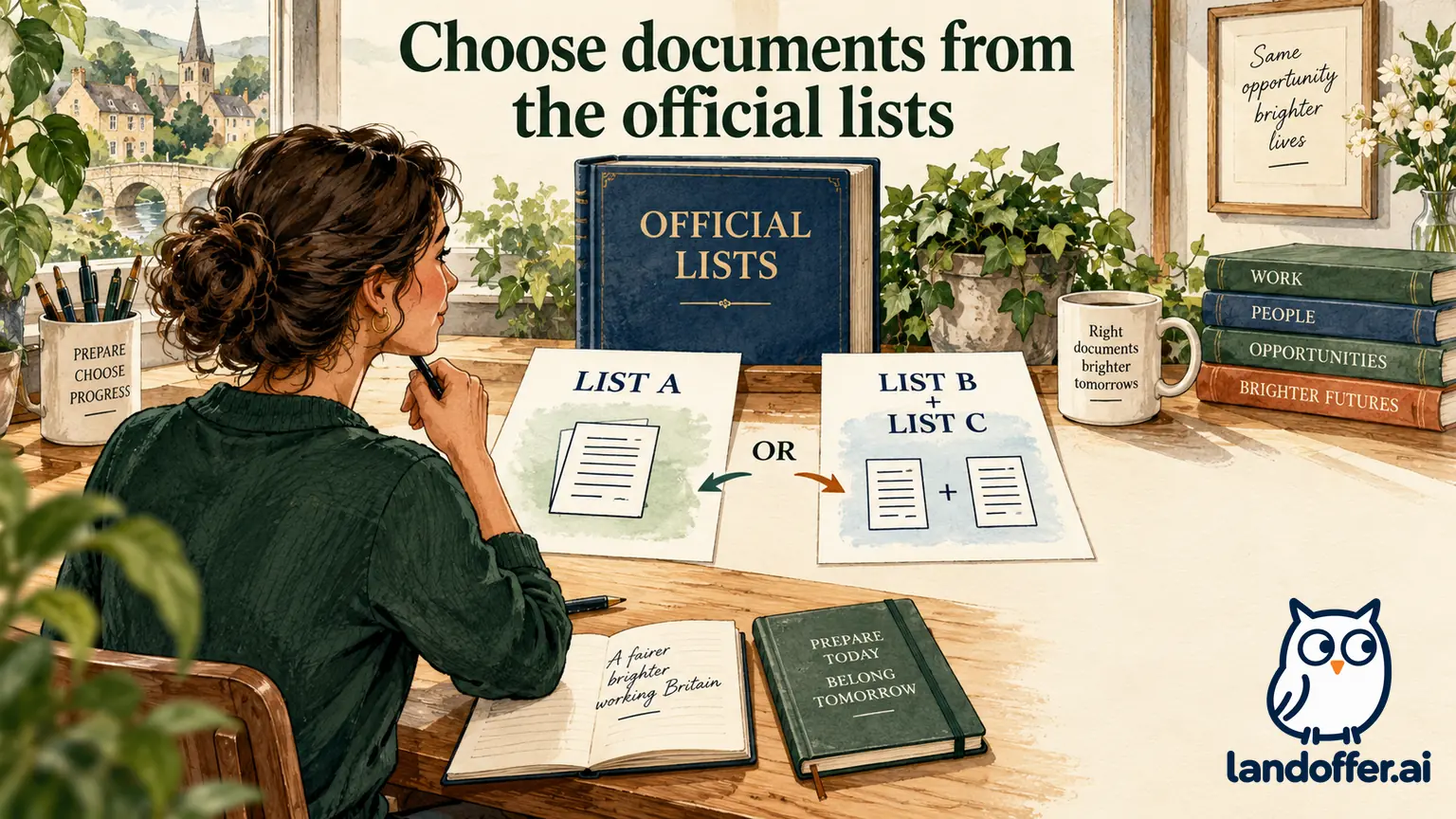
The DOJ FAQs describe the Form I-9 choice as one acceptable List A document, or one acceptable List B document together with one acceptable List C document. They also explain protections against unfair documentary practices, including certain demands for more or different documents based on citizenship, immigration status, or national origin. Consult the official lists and instructions for document-specific conditions.
Do not build a personal checklist that says every new hire must present a passport. Likewise, do not infer that any document bearing a photograph meets the relevant list. The official list entries, restrictions, and applicable rules matter. A familiar-looking card is not a substitute for checking those instructions.
This article does not resolve receipt rules, automatic extensions, or reverification questions. Those situations need their current official guidance. If an employer specifies a particular document and you believe another permitted choice applies, ask the onboarding contact to explain the requirement and consult DOJ's worker guidance when appropriate. Preserve the request so you can describe what happened accurately.
Worked example: Leo asks about an early passport upload
Leo is a second fictional applicant. Before any offer, he receives an email requesting “passport for I-9” through a generic file-sharing link. He has not verified the sender or received onboarding instructions. His next step is a clarification, not an upload and not a legal conclusion about the sender.
He contacts the recruiter through the established company address from his application correspondence. His message reads: “I have not yet accepted an offer. Could you confirm the purpose and stage of this document request, whether it is part of Form I-9 onboarding, and the company's verified secure submission process? Please also provide the applicable document-choice instructions.”
| Issue in Leo's request | Completed response | Evidence he keeps |
|---|---|---|
| Pre-offer message says “I-9” | Asks the verified contact to clarify the stage | Original email and his clarification |
| Message names only a passport | Requests the applicable official document-choice instructions | Employer's response, if received |
| Unfamiliar upload link | Does not transmit identity records while the destination is unverified | The stated delivery method, without opening a new sharing permission |
| Later accepted offer and Monday start | Adds Section 1 on Monday and ordinary Section 2 by Thursday to his onboarding plan | Confirmed start date and actual employer instructions |
The final row assumes an ordinary business week and a job lasting more than three business days. It is a planning example, not an extension rule. Leo checks the employer's instructions for the actual schedule. His clarification does not mean a form has been completed or a suspected request has been officially adjudicated.
Remote work still requires the correct process
A remote role can make the stages feel less visible: the application, offer, and onboarding may all arrive as links. Their purpose still differs. The fact that a job is remote does not mean emailing a photograph of a document completes Form I-9. Follow the employer's applicable verification procedure and the current official requirements.
Before an appointment or upload, establish who is conducting the review, what instructions apply, and how you will receive confirmation of completion. Do not improvise a document-review method from an online example. This guide does not determine whether an employer qualifies for a particular alternative procedure or whether a representative arrangement is valid.
If your start location changes, revisit the application's country and work-location wording as well. “Remote” is a work arrangement; it is not a country or an immigration permission. Tell the employer about a material change through the appropriate channel, and obtain individual guidance when it affects authorization or sponsorship. Preserve the updated answer rather than silently relying on a prior submission.
Review the whole answer before certifying it
Read the saved application once more before submitting. Check that an autofilled answer belongs to the current question and job country. A profile field called “work authorization” may have been populated for a different position. Review the exact wording of any future sponsorship question instead of accepting the nearest-looking saved answer.
For an unclear required yes/no field, identify the unresolved fact: which date, location, employer relationship, or sponsorship condition is unresolved? Ask the employer about its question and a qualified adviser about your individual status. Do not use a free-text explanation to disguise a checkbox you know is inaccurate, and do not invent a status to get past validation.
After submission, record whether the task was an application, an accepted offer, an onboarding invitation, or completed onboarding. If a confirmation is unclear, request clarification using that same vocabulary. “I submitted my application on October 8” gives a contact a different starting point from “I uploaded the requested onboarding document on October 12.”
Keep a small, secure record of each stage
Your job-search tracker can hold the role, employer, country, submission date, question wording, and next action. Sensitive identity documents belong only in the appropriate verified process, not in a broadly shared spreadsheet or an ordinary portfolio folder. Record where you submitted a requested document without duplicating its numbers throughout your application notes.
If you discover an application answer was wrong, contact the employer with the correction and identify the affected application. A later I-9 submission does not automatically correct an earlier application statement. Conversely, correcting an application does not complete the employer's onboarding requirements. Track each acknowledgment separately and avoid treating a generic automated receipt as a decision on the underlying issue.
The practical goal is a sequence you can explain: accurate application answers, a confirmed accepted offer, and correctly completed onboarding through the employer's process. While evaluating your next applications, browse recent jobs on LandOffer, then review the current job country and each separately worded authorization or sponsorship question before submitting.