LandOffer
Job search
Game Programmer Portfolio for Applications: Code, Playable Builds, and Your Contribution
A practical portfolio workflow with two completed fictional contribution and release audits, grounded in official employer and platform guidance.
A game programmer portfolio should connect three things: a specific system you implemented, code that explains its important decisions, and a practical way to inspect the resulting behavior. A polished trailer can introduce a project, but it cannot establish who wrote the controller, how a reset works, or whether the supplied build matches the source.
Choose the work example around the role's actual responsibilities. Compare recent jobs on LandOffer.ai, then select the project that best supports the programming work you want to discuss. Provide a readable contribution summary even when you also offer a playable version.
Start with the employer's actual submission requirements
We checked official employer and artifact-platform documentation on October 20, 2026, including native public browser reads of Ubisoft Toronto NEXT and itch.io's access and HTML5 guidance. We did not upload a project, change permissions, download or execute an unknown game build, inspect a private repository, or observe a recruiter reviewing a portfolio. The completed examples below are fictional planning exercises, not tested game releases.
Requirements vary by opportunity. Ubisoft Toronto's current NEXT competition page specifies a programming challenge using C++ and a supplied API. It also describes separate eligibility and individual-submission rules. Those requirements apply to that competition. They do not establish C++, individual authorship or identical packaging as universal application requirements.
The studio's 2026 winners article describes a programming challenge involving many simulated entities and recognizes well-structured code alongside technical ambition. Its technical-animation section describes a different challenge. Keep the discipline and year attached to such examples rather than combining them into an invented universal rubric.
For a regular vacancy, read its language, engine, platform and requested-material requirements first. A gameplay example may support one application while a tools or rendering role needs different evidence. Follow the stated application format rather than forcing every artifact into a portfolio link.
Make one programming responsibility easy to inspect
Select a system whose behavior and implementation you can explain. Possible subjects include character movement, checkpoint restoration, an editor tool, enemy navigation or a rendering feature. A bounded example gives the technical discussion a specific behavior and source location to examine.
Connect the behavior to a bounded source location. Explain what calls the system, which state it owns, and what it delegates to the engine or another component. Include the important assumptions, such as single-player operation or a fixed level layout. Do not imply that a short excerpt establishes networking, concurrency or performance properties it does not address.
For code review, give the reader a starting file and the reason to inspect it. “Start with the checkpoint-restoration function and its state snapshot” is more useful than linking to a repository root containing unrelated experiments. A screenshot can show the result, while a short technical explanation identifies the decision behind it.
Avoid unsupported benchmark language. A captured frame-rate counter is not automatically a controlled comparison. State the scene, hardware, build configuration and measurement method when you have actually measured them. Without that evidence, describe the implementation and its limits rather than inventing an optimization percentage.
Worked contribution selection: a team game with a narrow claim
Consider fictional applicant Priya and her three-person game-jam project, Switchyard Courier. Assume the team has agreed which materials may be shared. Priya wrote the player-state and checkpoint logic; a teammate created the levels and another supplied art and sound. The following is a completed evidence-selection exercise, not an inspected repository or real release.
| Available material in this fictional project | What it would support | Priya's completed choice |
|---|---|---|
| Team trailer showing the whole level | Context and visible gameplay; individual authorship remains unclear | Keep a short excerpt as orientation, with team credits |
| Checkpoint state code and an explanation of restoration order | Priya's handling of player position, held parcel and checkpoint state | Make this the main code-reading route |
| A tutorial-derived menu with changed colors | Familiarity with that exercise, with limited original system design evidence | Exclude it from the lead example and retain attribution if mentioned |
| A broad claim that she built the engine | No supporting ownership evidence in the stated facts | Remove the claim entirely |
Her corrected contribution paragraph reads: “I implemented the player-state snapshot and checkpoint restoration for our three-person game-jam project. On restart, the system restores the saved player position and parcel state before enabling input. My teammates created the level layouts, artwork and audio. The project uses an existing engine; I did not build the engine or those assets.”
The selected demonstration is specific: collect a parcel, cross a checkpoint, drop the parcel, then restart. The intended behavior is restoration of the checkpoint's saved parcel state, rather than preservation of the later dropped state. That is the project's proposed behavior in this fictional example, not a runtime result we verified.
Priya's technical note explains why input stays disabled during restoration: it prevents a new input event from changing state halfway through the reset sequence. She also records a limitation: the example does not demonstrate multiplayer synchronization or persistence across application sessions. Those omissions are honest boundaries, not reasons to inflate a small game into a production system.
Distinguish a playable route from a source route
A playable build offers a route to explore behavior without assembling the development environment. Source lets someone inspect implementation, subject to access and permissions. Neither automatically replaces the other, and an employer may specify which materials it accepts.
A browser build can reduce installation steps when the project supports that target. itch.io's HTML5 documentation describes single-file HTML uploads and multi-file ZIP projects with an index.html entry point. This is platform packaging guidance, not proof that your engine export works, every browser is compatible, or a desktop project can be converted without changes.
If you provide a native build, identify its intended operating system, version and prerequisites. Identify the launch file, essential controls and the short sequence that exposes your selected mechanic. Do not ask a reader to disable security protections to open an unfamiliar executable. A readable explanation and permitted capture remain useful when the recipient chooses not to download anything.
Connect artifact versions so a reviewer can relate the behavior to the implementation. A recording from one revision, source from another and an unlabeled executable make a bug or design discussion ambiguous. Use a release label or revision reference consistently, and say when the source sample omits parts of the full project.
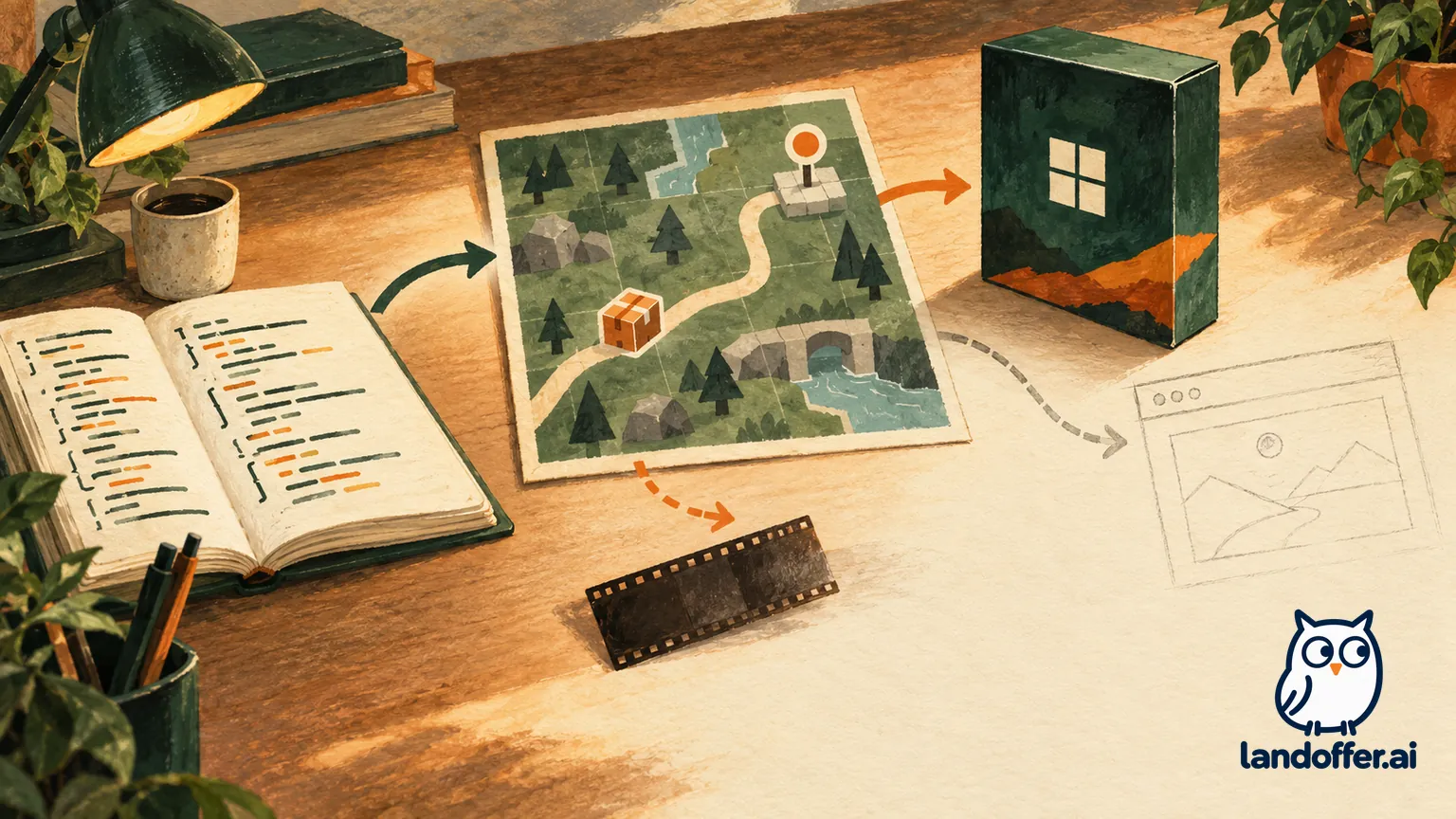
A version note should also distinguish source inspection from rebuilding. If a reviewer can read a function but cannot reconstruct its dependencies, say so. Record the engine version and dependency instructions you actually maintain, and leave any clean-machine result unverified until that specific check has been performed. Documentation alone is not execution evidence.
Worked release audit: what is ready and what remains unverified
Priya now audits a fictional package called switchyard-demo-0.3. All conditions in this table are assumed inputs. We did not open its links, compile its source or run its executable. The exercise shows how to turn incomplete evidence into accurate application materials.
| Assumed package condition | Decision for this application | Remaining boundary |
|---|---|---|
| Contribution page explains checkpoint behavior and team credits | Use it as the first reading destination | Its actual access still needs checking before a real share |
| A Windows x64 build is labeled version 0.3, with controls documented | Describe it as an optional Windows build | No macOS, Linux or recruiter-device compatibility claim |
| Repository contains the reset code, but rebuilding from a clean environment has not been checked | Offer source inspection with an explicit reproduction limitation | Do not label the repository a verified reproducible build |
| An HTML5 export is planned but has not been produced or checked | Omit the browser-play link | Platform support does not establish project readiness |
| A capture shows version 0.2's older restart behavior | Exclude that capture from the version 0.3 demonstration | A new capture would need to match the selected artifact |
Her resulting entry offers three ordered destinations: the contribution page, the relevant source sample, and the optional Windows build. It omits the planned browser version and outdated capture. The short description says exactly which mechanic to inspect and which system Priya wrote.
Her proposed manual check is also concrete: start a fresh session, collect the parcel, reach the checkpoint, drop it, restart, and compare the restored state with the documented checkpoint snapshot. A second proposed check restarts before any checkpoint exists to examine the initial-state path. These checks are a future verification plan, not completed test results.
Before an actual application, she would still need to verify that the shared destinations open for the intended audience and that the stated build behaves as described. The completed decision here is to retain those items as unresolved rather than convert filenames and documentation into claims of execution.
Check visibility and permission separately
itch.io's access-control documentation distinguishes Draft, Restricted and Public project visibility. It warns against using Draft for distribution because other people cannot download or purchase the project through that mode. Restricted access and public discovery are separate choices; sending a page URL alone does not establish the reader's access to the intended files.
Use only an authorized sharing route. A project page may open while a download remains restricted, and a code link may require repository access. Describe each limitation beside the relevant artifact. Do not broaden permissions on a former employer's repository merely to make a portfolio easier to review.
Code publication and reuse rights also differ. GitHub's repository licensing guidance explains that making code open source requires an appropriate license; a public repository alone does not grant unrestricted reuse. Check the actual permissions for your code and for incorporated material rather than treating visibility as a license.
A game can contain separately governed art, music, fonts, plugins and engine components. Record credits and sharing permissions for the materials you include. If some material cannot be distributed, use a permitted explanation or your own replacement example, and identify the change. Do not present a sanitized recreation as the original shipped project.
Prepare the technical conversation the artifacts support
Your portfolio entry should give you a defensible conversation: the problem, your ownership, one design decision, one behavior to inspect, and the limits of your verification. Be ready to explain what you would change with more time, using the actual code rather than a memorized feature list.
If a contribution was shared, describe the collaboration precisely. Distinguish proposing a design, implementing it, reviewing a teammate's changes and integrating an existing library. A commit count alone cannot explain those responsibilities, and a team game's overall polish does not establish individual ownership of every system.
Keep the first route readable even when a playable artifact is unavailable. Then match that evidence to the next relevant opening through recent roles on LandOffer.ai. Use the vacancy’s requested format and label each artifact’s platform, your contribution and what you have actually verified.