LandOffer
Job search
Game Engine vs. Gameplay Programmer Jobs: Match Systems Work and Player-Facing Features
Compare game engine and gameplay programmer jobs by shared system ownership, player-facing features, technical requirements, and portfolio evidence.
A game engine programmer builds or improves technology that many game features depend on; a gameplay programmer turns design ideas into controls, mechanics, and player-facing behavior. The boundary varies by studio, so compare the system you would own, the code and tools you would use, and the result the team expects. An Unreal Engine project can support either application, but the engine name alone does not prove fit for another team’s codebase.
A current Roblox Engine Infrastructure listing, for example, emphasizes C++ subsystems, client-server data sync, streaming, device resources, and server capacity. Uplift Games describes gameplay work as taking features from concept through implementation, polish, testing, and deployment, including controls, UI, VFX, and camera work. These are examples from distinct teams, not a universal job taxonomy. Use recent roles on LandOffer.ai to find a target, then read its actual ownership verbs and requirements.
Compare the layer of work, not the title
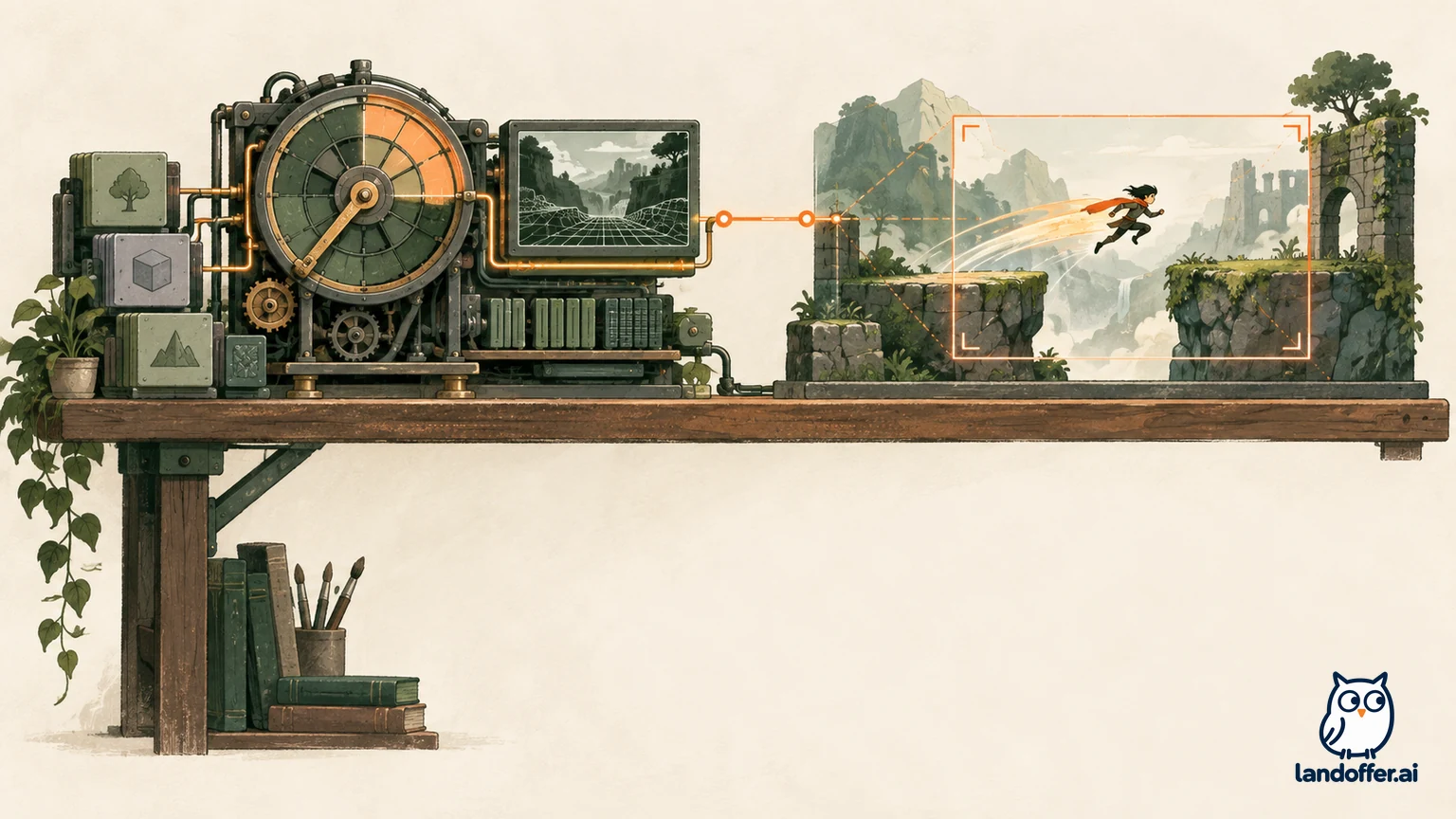
An engine role usually owns technology that supports multiple mechanics or projects: rendering, physics, animation runtime, memory, threading, networking, build systems, developer tools, or editor workflows. Its output might be a renderer change, a reliable subsystem, an editor capability, or a performance improvement. Some engine teams work inside a studio’s proprietary technology; others develop a commercial engine or platform used by many teams.
A gameplay role usually owns a feature players can feel or use: how a character moves, how an ability behaves, how a camera responds, how an enemy reacts, or how a game mode progresses. Its output may combine code with configuration, animation, effects, interface work, and tuning. The job may also include prototyping, playtesting, debugging, and collaborating with design and art.
The work overlaps. A gameplay programmer may investigate physics, networking, or animation to make a mechanic work. An engine programmer may build a feature-facing tool or change a system for a game team. In a small studio, one engineer may do both. Ask instead: “Which layer and result will this team hold me responsible for?”
| Engine-oriented evidence | Gameplay-oriented evidence |
|---|---|
| Main users: Other engineers, artists, designers, tool users, or several game teams | Main users: Players, game designers, content creators, or one feature team |
| Typical deliverables: Runtime subsystem, renderer or physics change, editor/tool workflow, profiling or reliability improvement | Typical deliverables: Controls, mechanics, character behavior, camera, game mode, UI or feedback feature |
| Common verbs: Architect, optimize, maintain, profile, extend, diagnose, support | Common verbs: Prototype, implement, tune, playtest, polish, iterate, ship |
| Evidence to show: System design, measured trace, test, tool, code change, compatibility or maintenance notes | Evidence to show: Playable mechanic, before/after capture, state flow, tuning choices, edge-case tests |
| Important caveat: Some engine posts focus on backend scale, content tools, or a narrow subsystem | Important caveat: Some gameplay posts require strong systems knowledge, multiplayer work, or engine-level debugging |
Use the table as a reading aid. “Gameplay systems” may mean reusable mechanics or one studio’s specific feature. “Tools” could belong to an engine team or a content pipeline group. Read the responsibilities and ask who uses the output.
What engine postings ask you to own
Roblox’s Engine Infrastructure listing describes work on engine C++ subsystems, including threading, memory, physics, and scripting. It names client-server data synchronization, game-aware streaming, adjusting resource use for devices with different CPU and memory capabilities, and scaling the server fleet. The role asks for C++ and experience with scalable distributed backend systems. This posting shows why “engine” does not automatically mean graphics programming: its duties also include client-server data sync, streaming, device resource use, and server-fleet scale.
Bohemia Interactive’s senior Enfusion Engine Programmer posting describes ownership of engine systems from design through maintenance. It also calls out developer tools and workflows, difficult codebase bugs, collaboration across departments, and performance-conscious C++. That is a senior Prague role on a proprietary engine. Use it to recognize one systems-and-tools role; do not treat its seniority, location, or requirements as universal.
Before applying, identify the engine sub-area; it determines which portfolio sample to lead with. Rendering roles may emphasize graphics APIs and GPU profiling; physics roles, simulation and collision; editor teams, creator workflows; runtime and infrastructure, memory, scheduling, streaming, networking, or build reliability. Shared fundamentals still require different proof.
Do not infer the specialty from “Unreal” or “Unity.” One Unreal role may need gameplay framework and Blueprint work; another may expect C++ internals or graphics. A proprietary-engine team may value performance and large-codebase work while expecting you to learn its APIs. Match each requirement to an artifact.
What gameplay postings ask you to own
Uplift Games’ Gameplay Engineer description covers gameplay features, UI, visual effects, and content updates. It describes end-to-end feature ownership from concept and implementation through polish, testing, and deployment, with attention to controls, feedback, and user experience. Its team also works with artists, QA, producers, and designers. The listing comes from a Roblox/Luau studio and describes a broad role; a larger studio may split those responsibilities among specialized teams.
Sony Interactive Entertainment’s Team ASOBI Gameplay Programmer listing centers on player controls and related mechanics. It describes rapid prototyping and iteration, design judgment, and working with systems programmers, designers, and artists to bring a prototype to final quality. The listing also names C++ and familiarity with game mechanics. This is a useful reminder that “player-facing” does not mean shallow engineering or work without engine knowledge.
For gameplay, identify the named mechanics—locomotion, combat, camera, interaction, AI, progression, UI, or multiplayer—and the expected iteration loop. Does the engineer prototype with design, tune after playtests, integrate animation, or own a feature through release? Lead with a sample that shows those actions.
Worked example: one dash bug, two different investigations
Consider a fictional third-person game prototype. A player presses the dash button; the character moves, but the input feels late and there is no clear sound or visual cue. This is an illustrative case, not a report from a real game or a performed test.
The gameplay programmer first makes the feature reproducible. They record the expected dash state, cooldown, cancel window, camera response, animation, and confirmation effect. In a small test matrix, they try the action while standing, moving, landing, and near an obstacle. Suppose the fictional build shows that the state change is correct but the animation cue is missing after landing. The gameplay fix is to adjust the transition and feedback, then verify each state in the build. The useful portfolio evidence would be a short playable capture, a state diagram, the code or Blueprint contribution, and a note about the cases checked.
The engine programmer would investigate a different possibility if profiling showed that input processing or frame scheduling causes delay across several unrelated actions. They might trace input-to-frame timing, inspect a shared subsystem, reproduce the issue in a minimal test, and compare behavior before and after a change. The evidence would be a profile or trace, the bounded reproduction, the system change, and regression checks on affected actions. A single missing dash animation does not by itself justify an engine rewrite.
This distinction can change after investigation. If the gameplay test finds a shared input queue issue, the engine team may own the fix while the gameplay engineer validates the feature. If the frame trace is healthy but the dash state machine is wrong, the gameplay implementation is the likely boundary. Good candidates explain the observed symptom, the test that narrowed it, and what they personally changed. They do not claim an engine-level result from a feature-only fix.
Match your evidence to the role
A gameplay portfolio should make the feature easy to inspect: a short build or video, the design problem, your implementation boundary, key state transitions, and one change made after testing. For team work, label your code, assets, and decisions. Epic gives similar early-career guidance, specific to its applicants.
An engine portfolio must make system work inspectable. Pair a focused code sample or plugin with a reproducible profile, one edge-case test, build or compatibility notes, and the engineer or creator who benefits. If source is proprietary, use a clean-room reproduction.
Worked asset: translating one Unreal prototype into two evidence paths
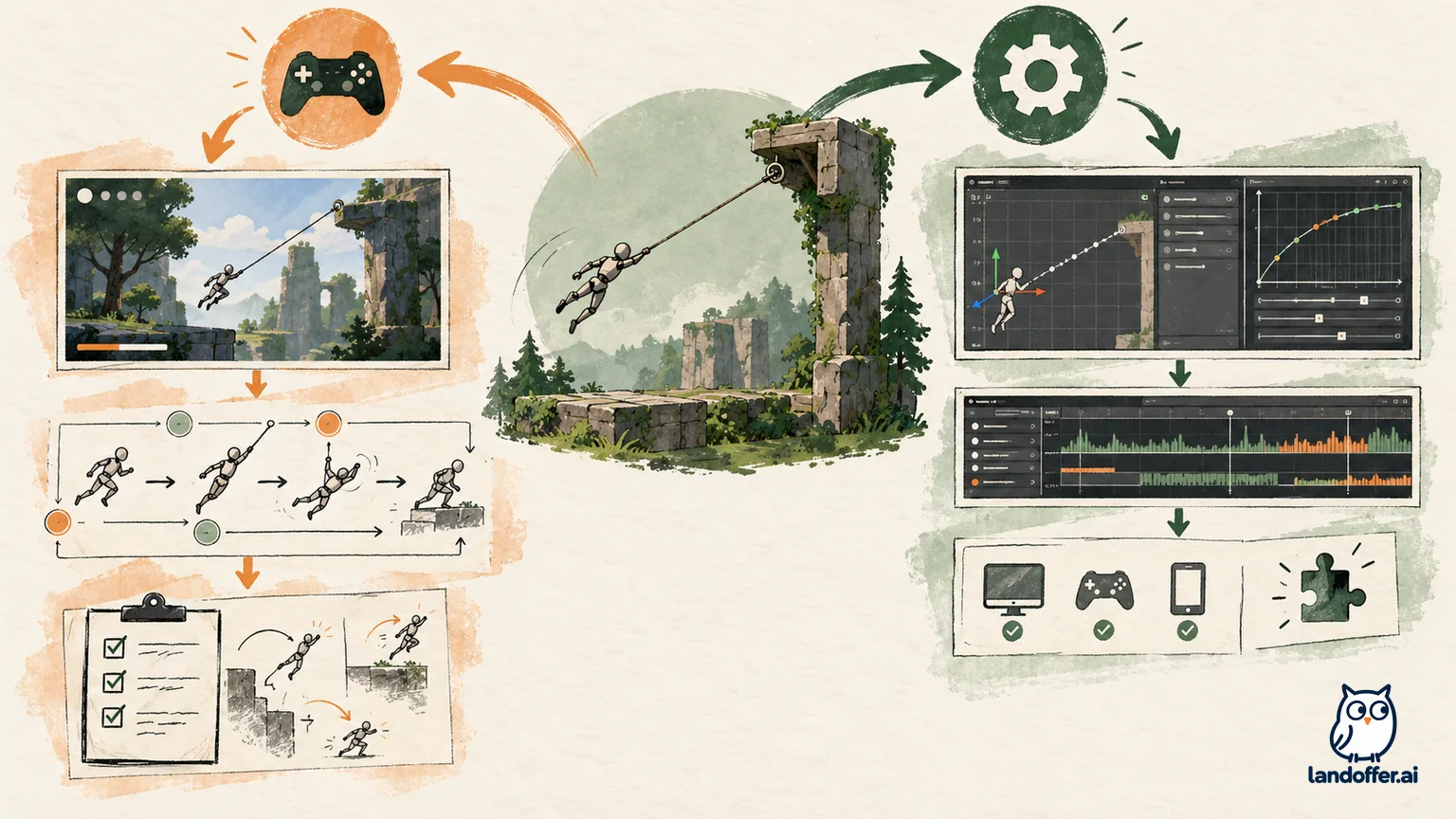
Imagine a fictional Unreal prototype with a custom grappling hook. The candidate created the input mapping and gameplay state, tuned the pull and release behavior, added camera feedback, and fixed a case where releasing near a ledge left the character in the wrong state. They also built a small Unreal Editor utility that plots the pull-speed samples from a scripted test.
For gameplay, the package leads with the playable hook: a short capture, state diagram, ledge-release case, exact contribution, and one tuning change. The editor utility is supporting evidence.
For engine tools, lead with the utility’s users and limits: supported Unreal version, input data, what the plot reveals, and a test that reproduces an edge case. The tool’s code and compatibility notes carry the evidence.
The same project can support both applications because it contains two different contributions. It does not prove that the candidate knows a studio’s proprietary engine, has shipped a production engine, or is proficient in every Unreal subsystem. The candidate should state those limits and connect transferable concepts—profiling, state, memory, testing, or tool design—to the target posting only when the project actually demonstrates them.
Does Unreal experience transfer to another engine?
It can provide relevant context, but transfer is not automatic. Unreal’s official Gameplay Framework documentation describes classes such as Game Mode, Game State, Player State, Controller, and Pawn, and notes that many can be customized in C++, Blueprint, or both. A candidate can use that experience to explain how they represented a mechanic or separated player input from character behavior. A different engine may use different class models, lifecycle rules, network authority, editor workflows, or language conventions.
For engine jobs, Unreal demonstrates large-codebase, performance, rendering, physics, memory, or tooling work only if you performed and can show it. Gameplay code does not establish C++ engine internals; using an editor does not establish tool development. Name the subsystem and contribution.
For gameplay jobs, a playable Unreal feature can show mechanics and iteration, but a Roblox/Luau or proprietary-engine role may require different APIs. Show your process, name unfamiliar tools, and compare the gap with required versus preferred qualifications. Unreal experience alone does not prove readiness for every engine.
Decide whether to apply
Make a short responsibility map before you spend time tailoring materials:
- Copy the role’s main deliverables into a list. Mark each as shared technology, player-facing feature, or mixed; add one line naming the expected user of the output.
- Circle the first two required qualifications that would be tested in the work. Separate those from preferred qualifications and broad culture language.
- Match each key requirement to one artifact or experience. State what you built, the part you owned, how you checked it, and the result you observed.
- Mark gaps honestly. If the gap is a different API or editor, identify a small way to learn it. If the gap is graphics optimization, networking, or engine architecture, do not disguise it with unrelated gameplay work.
- Check studio, location, seniority, work authorization, portfolio, and application requirements in the live listing. These can determine fit independently of role family.
Consider applying when the core work interests you and your evidence supports the central requirements, even if some preferred items are missing; the employer’s stated requirements control. Pause to build a focused sample when the posting requires a specialty you have not demonstrated and the role is not entry-level. Deprioritize it when the day-to-day ownership is not work you want or a stated requirement clearly does not fit; do not infer a hiring outcome from this checklist. A job title alone is not enough reason to self-reject or to assume you are qualified.
The practical distinction is ownership. Engine programmers improve shared systems and tools; gameplay programmers create and refine what players do. Actual teams blend them, and technical depth matters in both. Read the responsibilities, find the decision boundary, and show a finished artifact that makes your contribution easy to verify. For your next step, compare a few recent LandOffer.ai roles against this map, then tailor one portfolio link to the role’s real requirements.
Sources and Further Reading
- Roblox — Software Engineer, Engine Infrastructure: current team description of engine subsystems, streaming, resources, client-server synchronization, and server systems.
- Bohemia Interactive — Senior Engine Programmer: current Enfusion role describing engine ownership, tools, workflows, and performance-conscious C++.
- Uplift Games — Gameplay Engineer: posting describing gameplay features, end-to-end ownership, controls, polish, and cross-disciplinary work; posted April 28, 2026.
- Sony Interactive Entertainment — Team ASOBI Gameplay Programmer: current role description for player controls, mechanics, prototyping, and collaboration.
- Unreal Engine — Gameplay Framework: official documentation of framework concepts and classes; not a comparison with other engines.
- Epic Games — Career Paths: early-career advice on completed work, contribution clarity, tailoring, and programming specialties; specific to Epic.
Employer descriptions and documentation checked October 13, 2026. The fictional dash and Unreal portfolio examples are teaching cases, not observed game tests or candidate outcomes. Role boundaries and requirements vary by team and may change after this review.