LandOffer
Job search
UX Research Portfolio for Applications: Show Study Design, Findings, and Decision Impact
Show the reasoning behind a UX study and the decisions it informed, with two completed fictional evidence and publication-selection examples.
A UX research portfolio for applications should show how you turned a question into a defensible finding and helped a team decide what to do next. Include enough study design, evidence and context for a reviewer to assess your reasoning. State whether the evidence shows a recommendation, an implemented change or a measured outcome.
Start with the responsibilities in the role you want. Compare recent roles on LandOffer.ai, then read the employer's own requirements and portfolio instructions. A study that demonstrates careful moderation may support a different claim from one that demonstrates survey design or research leadership. This guide uses public professional guidance and wholly fictional teaching cases; no participants were recruited, interviews conducted or private research materials inspected.
Make the study's reasoning easy to inspect
Nielsen Norman Group's researcher-portfolio guidance recommends showing study artifacts, explaining your role and team, summarizing important findings and acknowledging constraints. The article is dated March 2019 and remained publicly available when checked in October 2026. It is professional advice, not a universal hiring rubric or evidence that a particular format wins interviews.
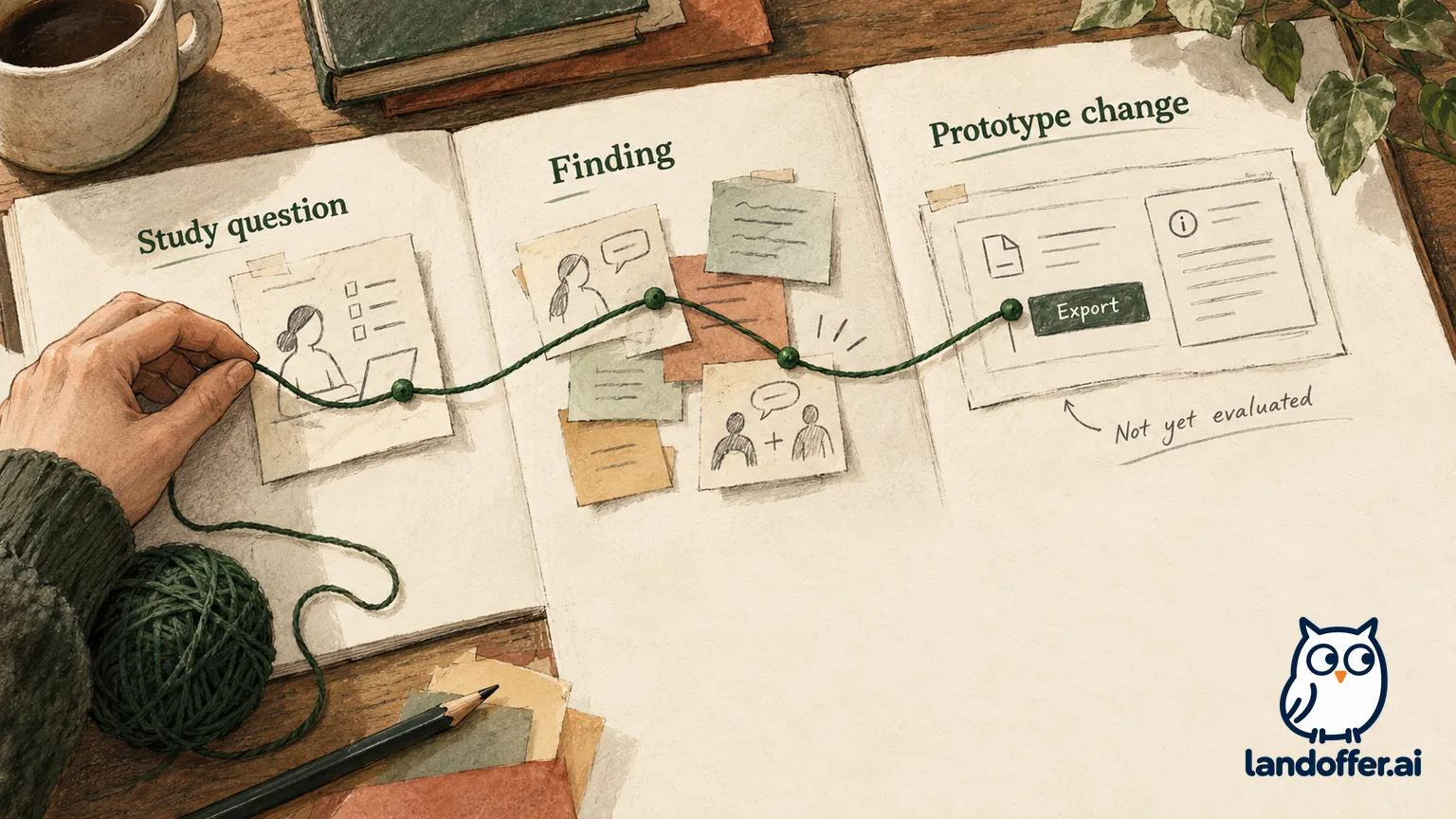
Choose a case that lets you explain a consequential research decision. Why did you investigate this question? Why did that method fit? What did you observe, and what interpretation followed? What did the team actually do with the finding? These answers matter more than reproducing every slide in the original report.
A useful opening names the product context, research question, your responsibility, one important finding and the decision it informed. Point readers to the study plan, selected finding and decision evidence so they can inspect the reasoning behind the summary. Save detailed task wording, analysis notes and alternative interpretations for the sections where they help evaluate the claim.
Choose artifacts that help the reviewer evaluate a specific claim. A discussion guide should demonstrate how you avoided revealing the answer in the task. A recruitment summary should explain whose experience the study covers. A decision excerpt should show what changed or remained unresolved. A wall of sticky notes without an explanation does not make the reasoning accessible.
Explain why the method fits the question
The GOV.UK research-planning guide connects research questions, user groups and method choice. Its current page includes October 2026 updates. Apply that connection to your case description: show what the team needed to learn and why the activity could provide relevant evidence. Government delivery practices are context, not mandatory rules for every private-sector portfolio.
For example, watching people use a prototype can reveal how they interpret a control during a task. That study alone cannot establish long-term adoption or the prevalence of a problem across an entire market. A stakeholder interview can reveal an internal constraint without being evidence of end-user behavior.
Describe recruitment in terms the reviewer can use. Say whether participants were new or experienced users, how they were found, which environments were included and who was absent. Explain how those choices limit the finding. Do not present a convenient sample as representative merely because it contains several people.
If the project used multiple methods, explain their different jobs. Avoid listing interviews, surveys and usability testing as badges of completeness. A reviewer needs to know which question each method answered and whether the evidence justified the decision you describe.
Worked example: audit a study from question to decision
Amara is a fictional researcher preparing a case about a volunteer-coordination dashboard. In this invented prototype, Download list exports every record even when the visible table has been filtered. The team wants to learn whether occasional coordinators understand the export's scope before making changes. All participants, observations and project records below are stipulated for teaching; they are not research conducted by LandOffer.
The fictional study uses moderated desktop sessions with six occasional coordinators recruited through one organization. Four have not used this prototype; two have seen an earlier version. Amara writes the task guide, moderates four sessions and leads analysis. A colleague moderates two sessions; a designer owns the prototype and a product manager owns prioritization.
The task asks participants to prepare a list for the volunteers assigned to one upcoming event. It does not tell them which export button to choose or explain what the filter does. The completed evidence audit is:
| Link in the case | Fictional evidence | Claim the portfolio can support |
|---|---|---|
| Research question | Can occasional coordinators tell which records Download list will include after filtering? | A bounded question about understanding export scope |
| Method and sample | Six moderated desktop sessions through one organization, with mixed prototype familiarity | Task-based observations in this setting; not a market-wide prevalence estimate |
| Observation | Four participants proceed to Download list expecting only the visible filtered rows; two ask what the download contains | Expectations differ from the prototype's all-record export behavior |
| Interpretation | The current control does not make its scope clear to this group during the task | A scope-communication issue worth addressing, not proof that every user has the same problem |
| Recommendation | Make the all-record scope explicit and investigate a separate filtered export | An actionable proposal, with the second capability still requiring feasibility work |
| Team decision | The designer adds an explicit scope label and a pre-download summary to the next prototype; the product manager defers filtered-export implementation | A documented prototype decision and an unresolved feature request |
| Outcome boundary | No follow-up sessions or production measurements are available | No claim of improved comprehension, reduced errors or business impact yet |
This chain prevents the case from jumping directly from six sessions to a success metric. The stipulated fictional expectations justify investigating scope communication in this example. They do not establish that the proposed summary solves the issue. The next research question is whether people understand the revised control and summary, including people outside the original organization and on other devices.
Show the difference between evidence and interpretation
The GOV.UK analysis guide separates recorded observations, findings and actions. In Amara's case, “four participants expected filtered rows” is the stipulated observation. “The control's scope is unclear in this task” is an interpretation. “Add a scope summary” is a proposed action. Label the observation, interpretation and proposed action separately, even in a short case summary.
Her fictional decision log also records an alternative explanation: familiarity with other tools may have shaped expectations. The study did not isolate wording from every other aspect of the prototype. She keeps that uncertainty rather than calling the button label the proven sole cause.
The completed case summary is:
I designed the task guide, moderated four of six sessions and led analysis with the team. In this desktop prototype study, participants expected or asked about filtered-export scope. Our findings informed an explicit scope label and summary in the next prototype. A designer made those changes, while the product manager deferred a separate filtered-export feature. We had not evaluated the revision or measured production outcomes.
The scope of this fictional statement is deliberate. Amara owns the research work she performed and explains the team's response. She does not claim to have designed the interface, shipped a new export capability or demonstrated a reduction in real-world errors.

Describe impact at the level you can substantiate
Impact can include a documented change in a team's decision. Show the link between the finding and that decision using a permitted planning note, report excerpt or before-and-after prototype. Be clear when the evidence shows adoption of a recommendation rather than a validated improvement for users.
If the team did not act, explain the constraint and what happened to the recommendation. Perhaps the finding changed a later research question, clarified a risk or remained unresolved because another priority took precedence. Those are different outcomes. Describe a deferred proposal as deferred and explain the decision behind it.
Where measurements exist, identify the measure, period, comparison and your contribution. A business metric changing after a release does not by itself establish that your study caused the change. If that connection was not evaluated, describe the sequence without claiming causation.
For Amara, the evidence stops at a prototype revision. Her next-step discussion can explain how she would investigate comprehension, but it must remain a proposed study. Future work is useful reasoning; it is not a substitute for a completed outcome.
Choose material you are allowed to show
Research evidence can contain participant information, employer intellectual property and confidential product plans. Treat the right to use each artifact separately from your desire to demonstrate the work. Password protection limits access; it does not create permission to share participant or employer material.
GOV.UK's research-data and privacy guidance distinguishes the purpose and audience covered by consent, anonymized extracts and restricted sharing where people remain identifiable. It is UK government guidance, not a legal determination for your project. Use your organization's applicable agreements and review process to resolve what may be shown.
Removing a name alone does not establish that a clip or quote is anonymous. A distinctive job, voice, screen, organization or situation can still reveal identity. Participant permission also does not automatically release employer-owned interface designs or client information. Check both kinds of constraints before selecting evidence.
When real materials cannot be shown, a clearly labeled reconstruction may explain your method if it is permitted and does not reveal protected information. Do not fabricate participant quotes or replace confidential results with invented findings presented as real. A hypothetical exercise should remain visibly hypothetical.
Worked example: select a publishable case and credit the team
Amara has three fictional case candidates. The permission records below are assumptions within this teaching case, not approvals obtained from any real organization or participant. She completes the selection before building a public page.
| Candidate material | Fictional permission and ownership record | Completed selection |
|---|---|---|
| Client study with session clips and internal roadmap | No public-use approval; participant consent covers only the internal project audience | Exclude from the public portfolio; a password does not change that decision |
| Volunteer-dashboard study described above | Assume a completed review permits a redrawn dummy-data prototype, aggregate findings and a scoped team-role description; raw recordings and identifiable extracts remain excluded | Select this limited case; use only the specifically permitted reconstruction and summary |
| Independent inspection of a public interface | Amara's own critique, with no recruited participants or observed sessions | Optional supplement labeled heuristic review; do not present it as user research findings |
She chooses the volunteer-dashboard case because its permitted material can show the study question, reasoning and prototype decision. Her publication set contains a reconstructed task screen with dummy records, the aggregate evidence audit and her scoped contribution statement. It excludes raw session clips, participant details, original private notes and an unapproved roadmap.
Before release, she checks the page's captions and downloadable attachments against that same permitted set. The reconstruction label stays beside the screen, and the study's fictional status remains clear in this article. A screenshot should not silently switch from an approved dummy screen to an original confidential artifact during editing.
The heuristic review can demonstrate another kind of reasoning, but she keeps it separate. Personal inspection, participant research and stakeholder feedback answer different questions. Clear labels let a reviewer assess the work on its actual basis.
Finish with a defensible application description
Read the case as someone who has never worked on the product. Can they identify the question, sample, method, finding, your contribution and the team's decision? Can they tell what remains uncertain and which materials are reconstructions? Remove decorative artifacts that do not help answer those questions.
Follow the employer's requested format and access instructions. Choose a case whose evidence you can explain and are permitted to share, then describe its outcome accurately. Use LandOffer.ai to continue comparing roles against the research work your portfolio actually demonstrates.
Sources and Further Reading
- Nielsen Norman Group: Portfolios for UX Researchers — March 10, 2019 guidance on artifacts, roles, findings and constraints; publicly rechecked October 20, 2026.
- GOV.UK: Plan user research for your service — research questions, user groups and method choice; page displays October 2026 updates.
- GOV.UK: Analyse a research session — observations, findings and actions; dated May 24, 2016, currently available.
- GOV.UK: Managing research data and participant privacy — purpose, audience and public-sharing boundaries; published November 5, 2018, currently available.