LandOffer
Pay & Benefits
Expense Report Approved but Not Paid: Reconcile Receipts, Status, and the Payment Route
Reconcile employee-paid versus company-card expenses, approval and audit states, payment route and remittance before following up on a missing reimbursement.
If an expense report is approved but you have not been paid, reconcile the individual items before asking finance to resend anything. Confirm which expenses were employee-paid, what approval stage is complete, whether finance has released payment, and which route should deliver it. A manager’s approval, a payment schedule, a remittance record, and money received in your bank account are different pieces of evidence.
This guide from LandOffer.ai uses current public employer and platform documentation plus a fictional three-item report. It does not access an expense account or determine your employer’s payment deadline. The goal is a precise inquiry and a usable follow-up record, including a clear pending state when bank receipt has not been confirmed.

Establish the amount you should actually receive
Start with the report ID, item IDs, original receipts, payment method, submitted amounts, approved amounts, and reimbursement currency. Separate money you paid personally from a company-card charge or a vendor invoice paid by the employer. Calculate the employee-paid reimbursement separately from total business spend on the report.
Check whether an expense was reduced, split, returned for information, or excluded from employee reimbursement. If a card charge and a manually entered receipt describe the same purchase, do not count both as money owed to you. Resolve a possible duplicate against the original transaction rather than submitting another report.
Also identify the employing or paying legal entity and your applicable policy. An employer may use an expense platform for one group, payroll for another, and accounts payable or another provider for a different route. Your location alone does not establish which route applies.
If the report and payment currencies differ, retain both amounts and ask for the approved conversion basis and any relevant deductions. Do not infer a short payment solely by comparing an original foreign-currency receipt with a deposit in another currency. The fictional case below uses only USD so that currency conversion does not obscure its status problem.
Translate the status into a specific event
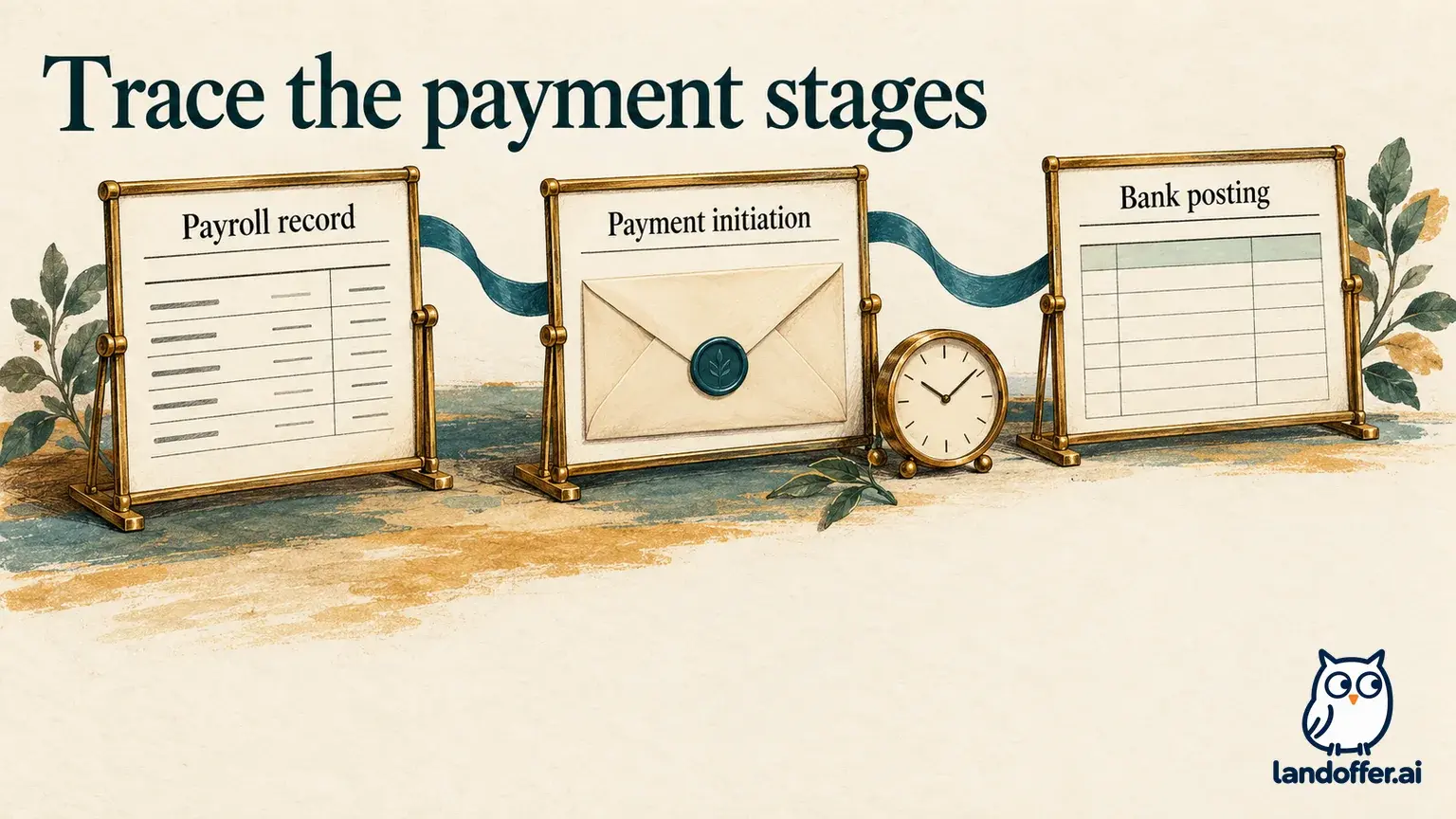
Record each status label with its source and timestamp. Then ask what it establishes. Submitted may mean the item entered review. Manager approved may establish business approval. Finance audit complete may establish readiness for payment. Scheduled identifies a planned payment event. Remitted indicates a claimed release of funds. Bank received requires evidence from the receiving side.
These are analytical distinctions, not a promise that every system uses those words. A platform can combine stages, and a company can pay outside the platform. Preserve its actual terminology while describing the underlying event in your inquiry.
GitLab’s public accounting handbook provides a concrete employer example: its final-approval description includes both manager approval and an accounts-payable audit. Its end-user guide distinguishes submitted, scheduled, deposited, and rejected transactions. Those descriptions explain why an earlier approval can coexist with unpaid or still-pending work; they are not universal definitions for your employer.
Platform labels also need route context. Expensify documents a Pay elsewhere option that records a report as paid while the actual transfer occurs outside Expensify. A paid label in that arrangement is not evidence that Expensify itself sent a bank transfer. Ask the responsible payer for the external payment details instead of repeatedly searching the wrong platform for an ACH trace.
Worked asset: reconcile a three-item approved report
Every company, person, receipt, approval, payment, and response in this case is fictional. Employee Kellan submits report ER-614 to Aster Systems US LLC for a project workshop. The report contains three USD items totaling $390. Manager Livia’s July 6, 2026 email says the report is approved. Kellan initially expects $390 in his bank account.
The item-level review on July 8 reveals a different employee-payment amount.
| Item | Original spend and evidence | Who paid | State on July 8 | Expected personal reimbursement |
|---|---|---|---|---|
| E1 train ticket | $144; itemized ticket R-11 and personal-payment reference | Kellan’s personal card | Manager approved; finance audit complete; scheduled for July 13 batch B-55 | $144 planned, not yet remitted |
| E2 taxi | $36; card slip R-12 shows payment but trip detail is missing | Kellan’s personal card | Manager approved; finance requests replacement trip receipt | $36 potentially reimbursable in the story; held pending review |
| E3 hotel | $210; hotel folio R-13 matched to company-card transaction | Employer’s company card | Business expense accepted; company-card route | $0 to Kellan; card settlement is separate |
The report total is $144 + $36 + $210 = $390. The two employee-paid items total $180. At the July 8 checkpoint, $144 is finance-cleared and scheduled for July 13; the other $36 employee-paid item remains on a documentation hold. The $210 company-card item explains why neither $390 nor a later $180 deposit would mean Kellan is missing the hotel amount.
This is a completed reconciliation, not a ruling that every taxi or train purchase is reimbursable. The fictional policy and reviewers control the example’s disposition. In real work, use the actual approved amounts and eligibility decisions rather than importing these assumptions.
Kellan’s evidence index links ER-614, the three item IDs, receipt versions, the manager email, and the July 8 finance status. It records USD and Aster Systems US LLC as the entity named in the fictional policy. It leaves bank receipt blank because no funds have arrived. Keep the approval email beside the item-level hold so finance can reconcile business approval with the remaining receipt review.
Find the missing receipt or payment prerequisite
Ask finance which item is blocked, the missing fact or payment prerequisite, and who owns its resolution. Missing itemization, an unresolved policy exception, a sync problem, an incomplete payee profile, and an unreleased batch require different owners and evidence.
GitLab’s public expense policy includes a missing-receipt affidavit process. That is an example of a particular employer’s alternative-document procedure, not permission to create your own universal substitute for a receipt. If your employer accepts a declaration, use its required form and approval route. Otherwise, request a replacement from the merchant or ask finance what evidence it accepts.
In the fictional case, Kellan obtains a replacement taxi trip receipt on July 10 showing the date, route, provider, and $36 total. Finance accepts it and clears E2 for the same July 13 batch. The card slip is retained as a payment cross-reference; it is not rewritten to add trip details that its issuer never supplied.
The bank route needs a separate check. Ask whether the required payee setup is complete in the designated system and whether finance sees a rejection or return. Use the employer’s authenticated channel for sensitive setup information. Do not send account numbers in a general group thread or change bank details merely because a payment is late.
In this story, finance confirms that Kellan’s existing reimbursement profile is verified and names an external expense-payment processor using a USD bank-transfer route. That is a fictional confirmation. It does not establish your route or imply that changing a bank connection is the right remedy for your report.
Worked asset: a filled finance inquiry and follow-up record

Kellan’s unsent July 8 inquiry is specific enough for finance to investigate without reconstructing the report from scratch:
“Please review ER-614 under Aster Systems US LLC, USD. Livia approved the report on July 6. E1 is $144 employee-paid; E2 is $36 employee-paid with the card slip attached and trip detail still missing; E3 is $210 company-card spend and is not a personal reimbursement request. Please confirm the finance-review state of E1/E2, any remaining document or payee blocker, the payment route, and whether the July 13 batch is scheduled or already released. Please provide a case ID and payment reference if available. No duplicate payment is requested.”
His separate unsent July 10 update reads: “For FIN-882 and E2, the replacement trip receipt R-12 version 2 is now attached to the existing report. The amount remains $36. Please confirm whether this resolves the document hold and whether E2 can join E1’s planned payment. This is supporting evidence for the existing item, not another expense submission.”
The following is the completed fictional follow-up record. It stops with bank receipt pending rather than inventing a successful deposit.
| Checkpoint | Filled reply or evidence in the story | Recorded conclusion and next owner |
|---|---|---|
| July 8 inquiry | Finance opens case FIN-882; E1 cleared; E2 trip detail missing | Manager approval confirmed; finance review incomplete for $36; Kellan obtains receipt |
| July 10 document review | Replacement taxi receipt accepted; E1/E2 approved total $180 | No remaining receipt blocker stated; finance owns payment release |
| July 10 route check | Existing payee profile verified; USD transfer via named external processor | Route identified in fiction; no bank-setting change requested |
| July 13 schedule | Batch B-55 includes E1 $144 and E2 $36 | Planned amount $180; schedule alone is not a remittance |
| July 13 release update | Finance supplies remittance reference PAY-18 for $180 | Finance says funds released; no receiving-bank credit yet evidenced |
| July 14 recipient check | Kellan records no matching posted credit in the fictional bank review | Bank receipt pending; finance will investigate PAY-18 if still unmatched at the agreed July 16 follow-up |
July 16 is a mutually recorded follow-up point in this invented exchange, not an employer-wide or legal deadline. The inquiry and all replies are authored examples; no message was sent and no bank account was inspected for this article.
The open issue is now narrower than “my approved $390 report was never paid.” It is “finance reports a $180 release for the two employee-paid items, but recipient receipt remains unconfirmed.” That distinction changes the next evidence needed: a payment trace, return status, or receiving-bank reference rather than another copy of the hotel folio.
If the eventual payment arrives, reconcile its amount, currency, date, and reference to the items. If a processor sends separate deposits, reconcile those separately rather than assuming one deposit must equal the report total. Record which items each credit covers and leave the remainder pending until its own receipt is reconciled.
Use employer examples without importing their deadlines
GitLab’s public pages describe entity-dependent routes and timing. At the time of review, its policy, accounting instructions, and end-user guide also contained different timing or batching descriptions. Confirm the applicable current instructions with the responsible team before relying on a published interval.
The useful transferable question is which event starts the relevant process: submission, manager approval, final finance approval, a batch cutoff, payroll processing, or actual release. Record the applicable policy reference and finance’s explanation for your case. Do not apply GitLab’s timing to another employer or treat a platform’s typical processing description as a guaranteed arrival date.
When a release cannot be matched, ask whether it failed, was returned, went through payroll, used another currency, or belongs to a different payment record. Follow the official expense, payroll, or accounts-payable escalation route for that unresolved fact. A persistent discrepancy may need additional employer-specific review; this article does not decide reimbursement rights or legal consequences.
For your next follow-up, send one reconciled packet with the employee-paid amount, actual approval stage, missing evidence, and named payment route. Keep the bank-received field pending until you have receiving-side evidence. More workplace guides are available through LandOffer.ai; this guide does not initiate or resend a payment.
Sources and Further Reading
- GitLab: Global Travel and Expense Policy — Employer-specific receipt alternatives, legal-entity routes and payment setup. Last modified September 13, 2026; checked October 25, 2026.
- GitLab: Accounting and Reporting — Manager versus final finance approval and payment-record handling. Last modified March 18, 2026; checked October 25, 2026.
- GitLab: Navan Expense End Users Guide — Employer guide to transaction categories, review states and reimbursement routes. Last modified September 13, 2026; checked October 25, 2026.
- Expensify: Reimbursement Payment Methods — Direct reimbursement versus Pay elsewhere; platform recording does not necessarily process the transfer. Undated; checked October 25, 2026.