LandOffer
Pay & Benefits
Payday Passed but Direct Deposit Is Missing: Coordinate Payroll and Bank Records
Two fictional missing-payday cases separate payroll initiation from bank receipt, pending status, posting, and availability without inventing a deadline.
If payday has passed and your direct deposit is missing, ask payroll to confirm the actual payment status and ask your bank to check the receiving side using the available payment details. Label the pay statement, payroll status, and receiving-bank observation as separate evidence. A generated paystub, a reported payment submission, a pending entry, and available funds describe different stages.
This LandOffer guide is for a US employee investigating an established payroll deposit. It uses two fictional coordination records, not anyone's financial information. We reviewed official sources on October 25, 2026; we did not access payroll or bank accounts, contact an employer, initiate a payment, or verify a personal claim. Your employer's process and your bank's account-specific information govern the investigation.
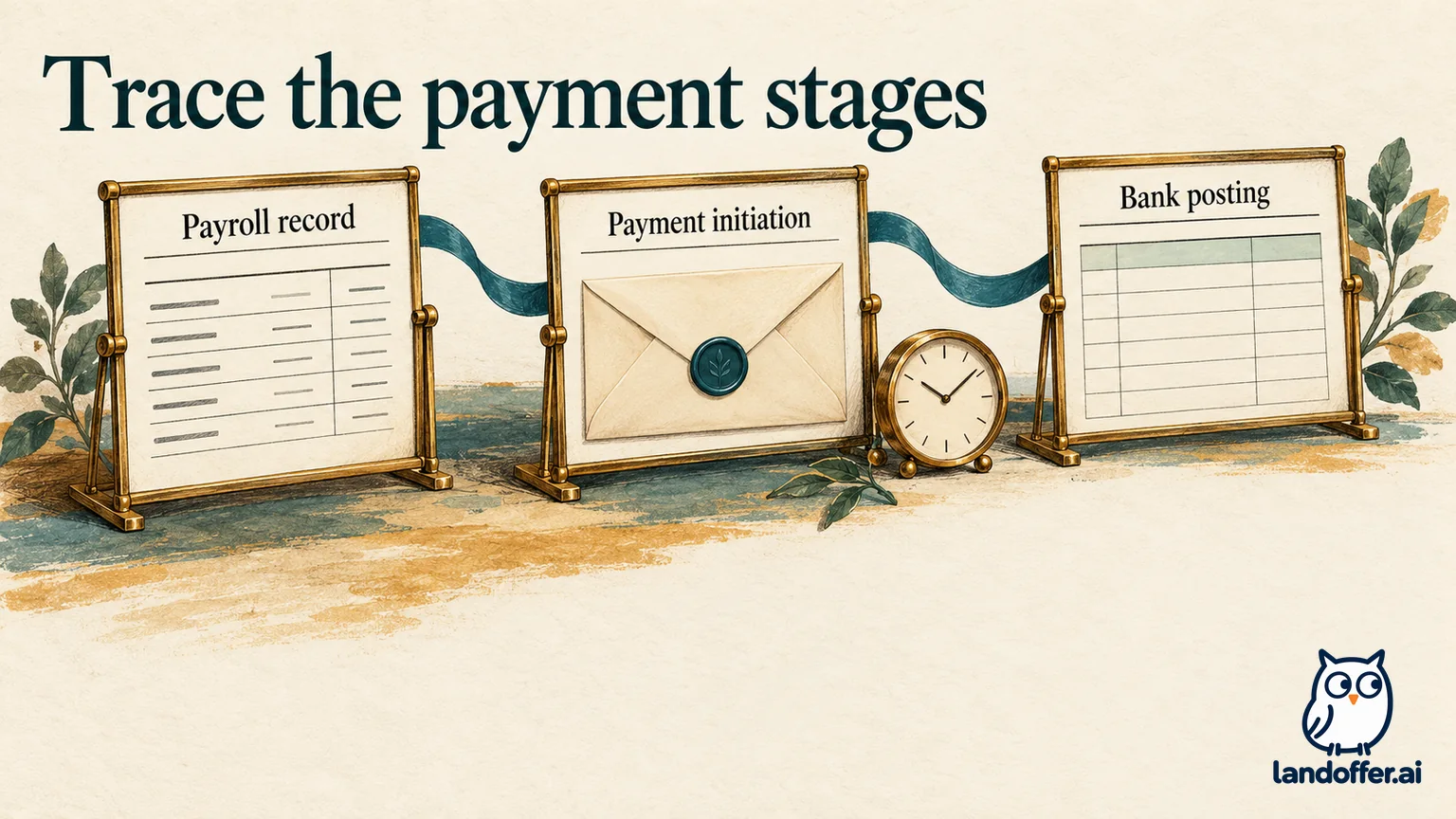
Confirm the expected payment before assigning a cause
Check the scheduled payday, pay period, employer identity, and expected net payment. Distinguish the official payday from an earlier date when your bank has sometimes made funds available. A previous early arrival does not establish that every future payment must appear at the same time. If the amount is split between accounts, identify the particular portion that is missing.
Look for a pay statement in the correct employer's payroll record. It can help identify the pay period and net amount, but it does not by itself establish that the payment was submitted, settled, or posted to your account. Record what you can actually see instead of converting the existence of a statement into a conclusion about the transfer.
Then check your own receiving account through the bank's normal authenticated route. Note whether the expected deposit is absent, pending, posted, or shown with a separate availability status. Those observations should include the time and timezone. Look for the matching deposit entry and its availability status rather than relying only on the balance.
For employees of its clients, ADP directs missing-paycheck and direct-deposit questions to the employer's payroll department. That is a provider-specific example of why the employer is a useful first contact. Use your actual employer's payroll route rather than assuming a payroll vendor can discuss or correct your individual payment directly.
Ask payroll about the payment, not just the statement
Identify the pay run for payroll with employee reference through the approved channel, pay period, scheduled payday, and the relevant net amount or split. Ask whether the payment was only calculated, whether the payment instruction was submitted, and what current status payroll or its provider can substantiate.
If payroll says it was sent, request the relevant payment date, destination institution confirmation, masked account detail, and a trace or payment reference if available. Ask which detail the bank should use to locate the incoming payment. Keep that reference in an appropriate private channel; there is no need to publish it in a team chat.
A response such as “payroll completed” may describe an internal process rather than the receiving bank's posting. Ask what the status means and what evidence supports it. If the employer or provider has an outstanding investigation, record its case reference, owner, and next update. Do not assume the employee must diagnose the employer's payment file.
If payroll cannot confirm submission, keep the receiving-side question open. A bank saying it cannot see a deposit is useful information, but it does not resolve whether payroll submitted the right payment or whether it reached the receiving institution. Ask payroll to own the originating-side check and explain the next action.
Ask the bank what it has actually received
Nacha's consumer FAQ points people with individual ACH questions to their financial institution or the organization initiating the payment. Nacha itself does not process individual payments or locate a person's deposit. Its FAQ also explains that a pending entry can reflect advance notice before the bank receives the funds.
When you contact the bank through its official channel, describe the expected payroll deposit, amount, relevant date, and sender information. Supply an available payment reference through the bank's accepted process. Ask whether it can identify a matching incoming item, what its displayed status means, and what information is still needed from payroll.
The CFPB's direct-deposit availability guidance, last reviewed December 18, 2024, says a bank or credit union must provide access to the deposit by the next business day following the business day it receives that deposit. Ask your institution about its account-specific policy and when it actually received the payment. The stated rule starts from bank receipt, not paystub generation, a sender's initiation notice, or an employee's expected arrival time.
Ask the bank to explain receipt, posting, and availability for the particular item it can identify. A pending notification is not interchangeable with confirmed settlement or usable funds. A support representative's inability to locate an item at one moment is not proof that it was never initiated. Preserve the qualified answer and the time of the check.
If the bank gives you a case reference, add it to your coordination record and ask what it needs next. A reference helps reconnect the investigation; it is not proof of receipt or a promise of resolution. There is no need to guess a settlement date from general ACH descriptions when the parties can investigate the actual payment.
Completed case: payroll confirms initiation, bank status remains open
All dates, amounts, names, references, and responses in this example are fictional. Employee Imani expects a $2,180 net payroll deposit on November 20, 2026. At 11 a.m. Eastern, the payroll statement is visible, but the receiving account has no matching posted entry. Imani has not changed deposit instructions and reports no known split payment.
Here is the completed three-stage evidence record:
| Stage | Fictional evidence recorded | What remains unconfirmed |
|---|---|---|
| Payroll calculation | Statement for the expected pay period shows net pay of $2,180 | Statement alone does not establish submission or bank receipt |
| Payment initiation | Payroll case PAY-41: owner Jo confirms a payment instruction was submitted with the intended pay date; a payment reference is supplied privately | Receiving-side settlement and posting are not confirmed by this response |
| Receiving bank | Bank case BNK-73: at 12:10 p.m. Eastern, representative requests the sender reference to investigate; no matching posted deposit is identified | Receipt, pending status, posting, and availability remain under investigation |
Imani sends this completed request through the employer's approved payroll channel:
For the pay period shown in my current statement, the scheduled payday is November 20 and the net amount is $2,180. I do not see a matching posted deposit as of 11 a.m. Eastern. Please confirm whether the payment instruction was submitted and its current status, rather than only whether the statement was generated. If submitted, please provide the relevant date, masked destination confirmation, and any reference my bank can use. Please give me a case owner and next update time. I will verify account details only through the approved secure process.
In the fictional reply, Jo confirms that the payment instruction was submitted and provides the private reference; bank receipt and posting remain unconfirmed. Jo owns the originating-side follow-up under PAY-41 and agrees to an update by 3 p.m. Eastern. That is this fictional team's communication arrangement, not a statutory deadline or a network guarantee.
Imani's completed bank request is separate:
I am investigating an expected $2,180 payroll deposit dated November 20. My employer's payroll team has supplied a payment reference through its secure channel. Please tell me how to provide that reference safely, whether you can locate a matching incoming item, and whether any visible status means notice only, receipt, posting, or availability. Please record the next information needed and a case reference. I do not have confirmation that the funds have reached you.
The bank adds the reference to BNK-73 and continues investigating in the fictional example. Imani sends payroll the bank's requested next information through the existing case. The payroll initiation check is recorded, while the receiving-side receipt, posting, and availability checks remain open. Neither party's case number is substituted for a deposit entry, and no arrival time is invented to make the example feel complete.
Second case: the masked destination does not match

In a different fictional case, employee Luis expects a deposit into the established account whose private record ends in 4821. Payroll's masked destination confirmation shows 7390. These are invented suffixes, not full account numbers. Luis has not authorized a recent change and reports the mismatch through the employer's approved private payroll route.
Nacha's FAQ directs a person whose deposit went to the wrong bank or account to contact the sender, which is positioned to locate the payment. Luis therefore asks payroll to investigate the instructions actually used, their effective date, and the appropriate correction process. He does not assume that changing future deposit settings will retrieve a payment already initiated.
The completed response-coordination record reads:
| Owner and reference | Fictional response or assigned action | Status boundary |
|---|---|---|
| Payroll, PAY-58 | Confirms the submitted destination suffix differs from Luis's expected account; investigates the instruction record with its provider | Wrong destination suspected from the mismatch; final payment location unresolved |
| Luis's bank, BNK-81 | Confirms no matching posted item in the expected account at the recorded check time | Does not establish where the payment went |
| Payroll owner, Margo | Owns the sender-side investigation and will explain any proposed corrective or replacement payment procedure | No recovery or replacement is represented as completed |
| Luis | Supplies required verification through approved channels and preserves both references | No full account details shared in the coordination summary |
Report a destination mismatch promptly and keep its cause unconfirmed until the authorized investigation establishes it. If the instructions may have been changed without authorization, use the employer's payroll-security process and the bank's official reporting route. Do not accuse a colleague, send credentials to an unverified contact, or ask another person to inspect an account that is not yours.
Keep the pending original payment distinct from any proposed replacement. Ask payroll how it will identify the original item's status and coordinate the next authorized action. A replacement proposal is not proof that the original cannot arrive. The employer and its payment provider need to manage that uncertainty through their process; the employee should retain the explanations and references.
Keep follow-up factual and protect the information trail
Use one short coordination record containing the pay period, scheduled payday, amount, observation time, masked destination confirmation, payroll case, bank case, and each party's next action. Keep the underlying statements or sensitive identifiers in approved locations. A broad email thread rarely needs full account numbers, routing details, login credentials, or an unredacted bank statement.
If a response conflicts with another response, quote the specific status and ask which evidence would reconcile it. “Submitted” and “not posted” can both be true at a particular point; they are not necessarily contradictory. “Bank received” and “payroll calculated” are different claims requiring different records.
Before closing the investigation, confirm the matching deposit is available and record its amount, date, and any remaining discrepancy. If it remains missing, preserve that state and use the employer's escalation route and the bank's complaint or investigation process as appropriate. Applicable wage-payment requirements depend on the jurisdiction and circumstances; this workflow does not set a legal deadline for your case.
Start with what payroll can confirm about initiation and what the bank can confirm about receipt and availability. Keep the owners connected without spreading account details. LandOffer's workplace guides cover related administrative communication; the task here is an accurate payment record and a clear next action until the missing deposit is resolved.