LandOffer
Job search
DataLemur Review: SQL Hints, Data Interview Questions, and Premium Access
Choose SQL hints and data questions by practice needs, then separate Premium content from the coaching and book bundle.
DataLemur is worth considering when you need SQL interview exercises with help available as you get stuck, plus conceptual data questions. Start with its free material. Upgrade when a specific resource you cannot access is holding back practice, and choose the access period around work you will actually do. The coaching and book package is a separate purchase decision: paying for questions does not automatically buy personal critique.
This review combines current public descriptions with a limited, logged-out inspection on October 13, 2026. We opened SQL and machine-learning questions, revealed their first hints, and observed a sign-in gate for a SQL solution. We did not purchase Premium, submit an answer, run vendor code, or attend coaching. LandOffer publishes this review; you can browse recent roles on LandOffer.ai to identify which data skills your target roles request before choosing practice material.

What you can inspect before paying
The public question catalog lists SQL, statistics, probability, machine learning, and Python questions. The catalog exposed difficulty and category controls. We inspected the listings rather than testing every filter or topic. Company labels describe how DataLemur presents the material; they do not establish that an employer will use the same question in your interview. A familiar company name is a browsing aid, not a reason to memorize a single answer.
On the Second Highest Salary page, the logged-out view displayed the prompt, schema, example input and output, and an editor labeled PostgreSQL 14. Clicking Gimme a Hint revealed a first hint. Clicking Solution opened a sign-in dialog while the Question tab remained selected. That observation establishes a login boundary on that action; it does not establish which solutions a free signed-in account can access.
This gives you a practical starting point for a first session. You can inspect how a problem communicates its requirements and whether its initial assistance addresses your sticking point. You should still distinguish opening a prompt, revealing a hint, viewing a full solution, and saving a solved submission. Those are different activities, and one accessible page does not prove an unlimited free allowance across the catalog.
DataLemur also publishes a free SQL tutorial organized into basic, intermediate, and advanced material, including filtering, aggregation, joins, distinct values, and ranking. If you cannot explain what a grouping operation returns, work through that foundation before adding a subscription. More interview prompts can expose the same missing prerequisite repeatedly without teaching it in the order you need.
Use hints to recover your reasoning
A hint is most useful when it lets you resume a specific line of thought. Before opening one, write the result you are trying to produce and the assumption that is blocking you. For example: “I need one distinct score, but sorting individual rows may count a tie twice.” That sentence identifies a problem you can investigate. “I do not know SQL” gives a hint little useful context.
After reading help, make a new attempt without copying the full solution. Record whether you needed help to interpret the requirement, choose an operation, or fix syntax. These are different practice needs. Requirement errors call for restating the output with examples; operation errors call for tracing the query; syntax errors may call for a dialect reference. That record tells you what to practice next.
The inspected editor's PostgreSQL 14 label also matters if an assessment uses another database. Date functions, casts, and supported syntax can differ. We observed that label, not a successful cross-database test. Rehearse in the required engine when the employer specifies one, and explain your assumptions when it does not.
Run Code and Submit appeared as separate buttons on the SQL page. We did not operate either. Treat an execution result, a judged submission, and your ability to explain the query as separate evidence. Even a passing answer would not show how much assistance you used to reach it.
Worked example: a tie changes the answer
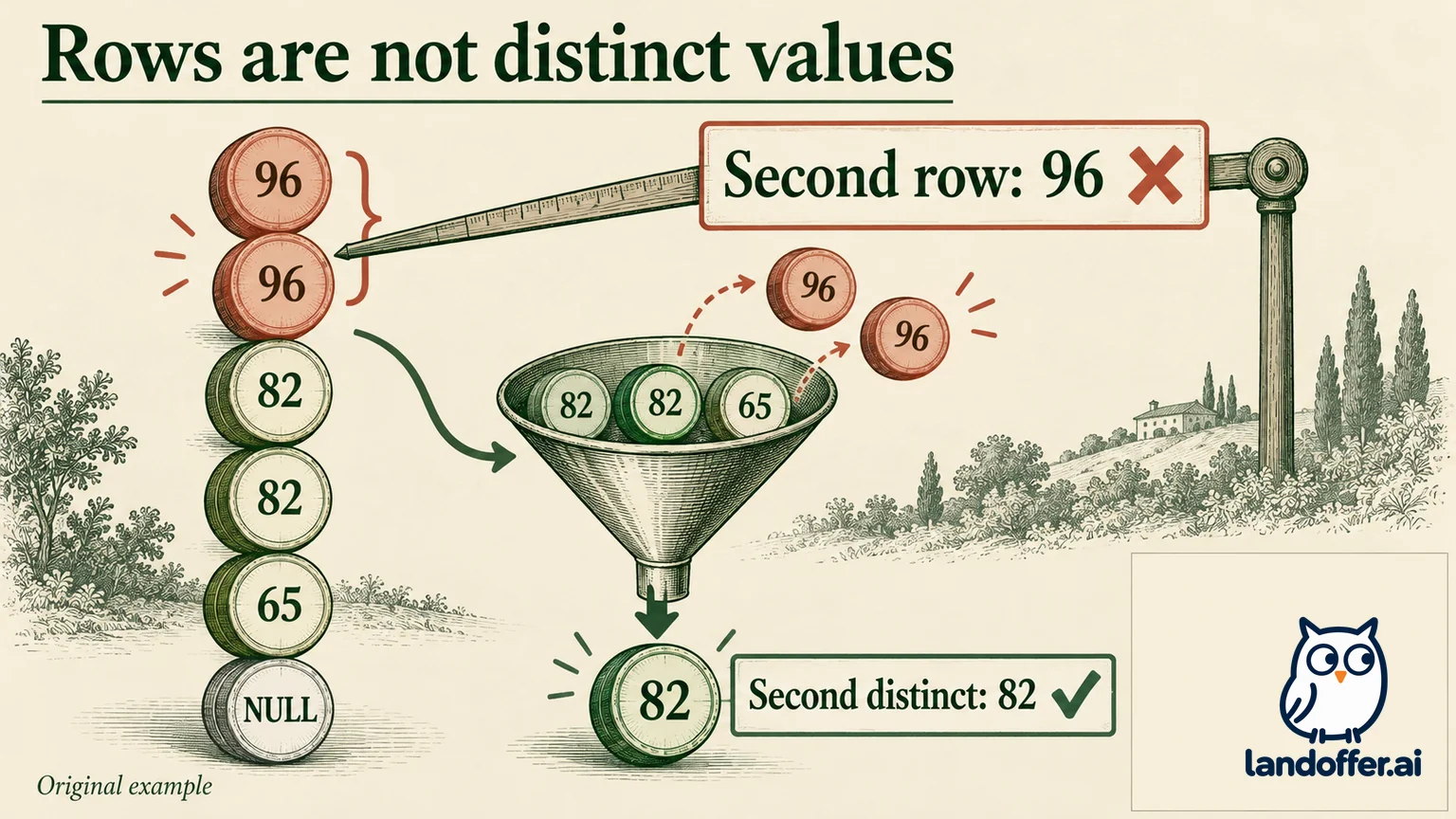
The following is an original teaching exercise, not a DataLemur question or paid solution. A fictional practice table, scores, contains the values 96, 96, 82, 82, 65, and NULL. The task is to return the second-highest distinct, non-null score once. Those words determine the result before you choose SQL syntax.
A first attempt sorts non-null rows descending and takes the second row:
SELECT score
FROM scores
WHERE score IS NOT NULL
ORDER BY score DESC
LIMIT 1 OFFSET 1;
The output is 96. The query runs, but it answers “What is the second sorted row?” The two 96 entries occupy the first two positions. The required distinct values are 96, 82, and 65, so the correct answer is 82. This is a useful error to catch because adding more practice questions will not fix a misunderstanding of what is being ranked.
An original hint for this exercise would be: “Which values remain if you exclude the maximum?” It points toward a decision without displaying the complete answer. One correction is:
SELECT MAX(score) AS second_score
FROM scores
WHERE score < (SELECT MAX(score) FROM scores);
The inner maximum is 96. The filter retains 82, 82, and 65; the outer maximum returns one 82. NULL does not become a competing score. A local SQLite run of our invented data confirmed the wrong result of 96 and the corrected result of 82. This validates the worked trace in that engine; it is not a test of DataLemur's PostgreSQL runner.
Now cover the hint and change the data to 91, 77, 77, 40, and NULL. Both queries return 77. That agreement is deceptive: the wrong query passes because the maximum no longer has a duplicate. Restore a duplicate 91 and it returns 91 again, while the corrected query still returns 77. For this query, duplicate the maximum during a retest. Changing only the lower values would leave the tie error unchallenged.
Finally, try 50, 50, and NULL. There is no second distinct score. Our aggregate query returns one row containing NULL. That is the convention for this exercise; another prompt could require an empty result or another representation. Ask what the output contract requires instead of treating your preferred query as universally correct.
The completed practice record includes the tie error, one conceptual hint, the correction, the misleading easy retest, and the missing-value check. A false sense of progress is easier to catch when those steps are visible. You have evidence about what you learned. A single “solved” badge would hide that history.
Concept questions need a different practice method
We also opened Precision/Recall Tradeoff. Its logged-out page displayed a conceptual prompt, a first hint after a click, and a text answer editor with Submit. This differs from the SQL editor: you are building an explanation rather than producing a result table. We did not submit text, so we cannot report the grading method, feedback quality, or whether any personal review follows.
For a conceptual question, prepare a short answer that includes a definition, a numerical example, and the decision the example informs. Here is an original rehearsal example: a fictional alert model raises 20 alerts, 12 of which correspond to real incidents. There are 30 real incidents overall. Precision is 12/20, or 60%; recall is 12/30, or 40%. The remaining 18 incidents were missed. These numbers are invented, not employer data or DataLemur's answer.
Now explain the operational consequence. A team overwhelmed by false alerts might care about precision; a team worried about missed incidents might care about recall. A threshold change needs evaluation against a new set of predictions. You cannot infer the new percentages merely by announcing a different threshold. This is the kind of reasoning an answer library should help you rehearse, beyond remembering two formulas.
Keep this practice private and use synthetic examples. If your answer contains confidential workplace data, replacing company names alone may leave sensitive details intact. You do not need a production incident log to demonstrate that you understand a denominator.
Premium access and the separate bundle
The current public pricing page displayed these offers during our inspection. Amounts are advertised US-dollar prices, not a completed checkout.
| Offer | Displayed price | Advertised access |
|---|---|---|
| Monthly | $15 | SQL help and solutions; data science questions |
| Yearly | $60, shown as $5 per month | Subscription content plus the job-hunting video course |
| Coaching, signed book, lifetime access | $300 once | Yearly content, lifetime access, a signed paperback, and one hour with Nick Singh |
The bundle FAQ says a scheduling link follows purchase; appointment availability was not tested. It describes flexible coaching topics. Select one deliverable for that hour, such as critique of two attempted answers, instead of assuming you can fit a resume review and a full technical mock into the same session. The signed book is a physical delivery, distinct from platform access. The monthly offer does not advertise that bundle.
Our recommendation depends on the resource you are missing. If free prompts still let you practice the required skills, keep using them. Identify the exact unavailable material before paying; the public offers are not a refund-backed trial. If a specific unavailable solution or conceptual topic blocks useful practice, a subscription may remove that access constraint. It does not remove the need to attempt, explain, and retest your work.
Two learners, two purchase decisions
Consider Tessa, a fictional analyst with a SQL screen in 20 days and a $30 preparation budget. She already understands joins but has trouble translating tie and null requirements. She schedules six 45-minute attempts and three 30-minute closed-hint retests: six hours in total. She starts with the free tutorial and visible prompts. If a needed resource is locked after she checks her account's access, one $15 month fits her budget. The $60 year and $300 bundle do not.
Tessa's decision is free first, monthly only for a named constraint. Her acceptance criterion is completing the changed score exercise and explaining why the second row differs from the second distinct value. Buying access without doing those retests would leave her central problem unresolved.
Luis, another fictional learner, has a five-month preparation horizon, a $70 content budget, and recurring SQL plus statistics study sessions. Five monthly payments at the displayed rate would total $75; the displayed yearly price is $60. If his required content is actually included and he intends to use it throughout those months, yearly access fits his stated budget. Four $15 months equal $60, so the cheaper choice depends on how long he needs access, not the monthly-equivalent label alone.
Suppose Luis instead has $350 available and his central problem is that he cannot explain his reasoning aloud. More written answers may not address that gap. The $300 bundle becomes a possible choice only if the one-hour session can target that weakness and a suitable appointment is available. He can also keep free material and arrange practice elsewhere. A larger budget does not require a larger purchase.
Renewal, cancellation, and your next session
The published terms distinguish free accounts from a paid free trial, which they do not offer. Subscription fees are generally non-refundable, with legal exceptions and discretionary review. Cancellation stops renewal and leaves access through the current paid period; it does not ordinarily refund that period. We did not test account cancellation. Verify the renewal date and available cancellation control in your own account before relying on them.
The terms also say there are no discounts, while the pricing page displays a struck-through yearly amount beside $60. We use the visible offer and do not infer an additional coupon or eligibility rule. Confirm the final charge and terms at checkout. Lifetime wording does not establish an offline archive or an unlimited commitment to future features.
Choose your next practice session before choosing a plan. Write one target skill, attempt a relevant question, record the smallest help you needed, and retest with a case that breaks your first assumption. If your role requirements are still unclear, browse recent roles on LandOffer.ai and use their stated SQL or data responsibilities to select that exercise. Job discovery supplies context; your own attempted work shows the preparation gap.