LandOffer
Job search
Data Engineer Resume Examples: Data Contracts, Recovery, and Platform Cost
Show data contracts, pipeline recovery, lineage, and platform cost on a data engineer resume with clear evidence and accurate ownership.
A data engineer resume should show how you handled a schema change, recovered a late pipeline, traced downstream impact, or weighed cost against freshness. A list of warehouses and orchestration tools tells a reader what you touched, not what you owned. Build each bullet from an action, scope, evidence, and a result you can explain.
Use a job description to decide which evidence deserves space. A data platform role may emphasize availability, lineage, and infrastructure costs; a warehouse-focused role may ask about model contracts, backfills, and consumer trust. LandOffer publishes this guide and offers job-search tools. You can browse recent roles on LandOffer.ai and compare the role’s work with data you can discuss accurately from your own projects.
Every employer, system, date, count, and cost below is fictional. The examples are teaching cases, not candidate histories, product tests, or hiring outcomes. Replace their details with your records; omit any metric you cannot verify or safely disclose.
Turn pipeline work into evidence a hiring team can inspect
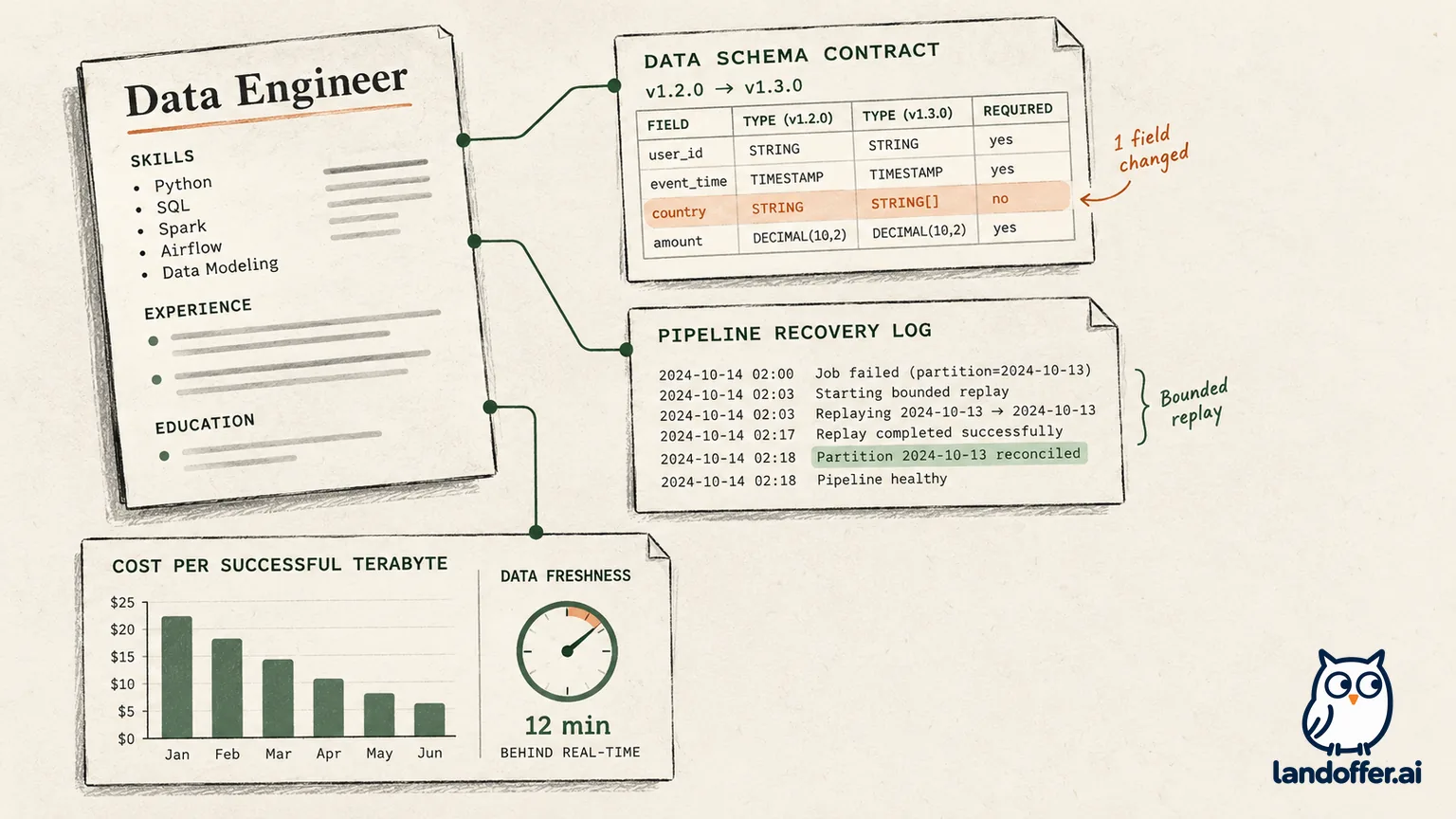
When a pipeline fails at 2 a.m., the hard part of the resume bullet is describing what you actually restored without claiming ownership of the entire platform. Show four things: what changed, the system or data scope, how you checked it, and the bounded result. “Built ETL pipelines” hides whether you added ingestion, changed a schema, or recovered someone else’s production system.
A stronger line might say: “Added a versioned contract and compatibility checks for three event producers; blocked incompatible changes before the finance model refresh.” If you have a measured result, add it only after confirming the baseline, period, and what counted as a failure. If not, a concrete control or workflow can still show your contribution.
Data contracts, lineage, recovery, and cost are useful evidence categories, but products implement them differently. For example, dbt documents model contracts and constraints, while noting that constraint enforcement depends on platform and model configuration. A contract on a modeled output does not prove that every raw source record is valid. Likewise, OpenLineage defines metadata around runs, jobs, and datasets; that standard does not establish which lineage fields a particular team captures.
List tools only when they clarify your hands-on experience. Put the technologies a posting requires in a compact skills section; use experience bullets to show where you applied them, what failed or changed, and which decision you made.
Show how you made a data contract useful
A schema change is only one kind of data contract. The consumer may also depend on field meaning, nullability, update cadence, uniqueness, or compatibility expectations. Start with the problem: a producer changed an event field, two downstream models interpreted it differently, or a late-breaking column change caused a refresh to fail.
Name the action and the boundary: you might agree on a versioned schema with a producer, add a contract check at a model boundary, document a deprecation window, or stage data before publishing a curated output. Say which layer the check covered. A downstream model contract does not prove that every raw source record was clean.
The dbt constraints documentation separates constraints a platform can enforce from those it can only define, with prerequisites such as supported materializations and an enforced contract. Use that distinction in a bullet: name the model, the check that ran, and what the build did when the check failed. Include the adapter or materialization when it changes that answer.
Evidence can include a schema-change proposal, contract test, deployment check, model documentation, or incident report. Describe the artifact without exposing private schemas or customer data.
Describe recovery without claiming perfect uptime
Recovery work often involves more than a retry. You may have identified a failed stage, restored source processing state, replayed a bounded interval, protected the sink from duplicates, or changed the alert so the correct owner saw the failure. A useful resume bullet explains which part you handled and what recovery meant: freshness restored, records reprocessed, a duplicate prevented, or a backlog cleared.
Be precise about replay semantics. AWS Glue bookmarks track processing state for supported sources and can help process new data incrementally. AWS also explains that rewinding or resetting bookmark state does not clean target files. That is why “reset the job and rerun” may not be a complete recovery story. Candidates who worked on another stack should explain that stack’s actual checkpoint, replay, and sink behavior instead of borrowing Glue terminology.
Use a bounded metric only when its source defines the window and denominator. “Restored six hours of delayed records within 40 minutes” is useful if the run log records the delay start and recovery end. Recovery time alone does not show correctness; pair it with a deduplication check or reconciliation against expected partition totals.
For customer or regulated data, omit private dataset names, payloads, and identifiable impacts. A resume can describe replaying a late partition under an approved retention window without exposing the underlying records.
Make lineage and downstream impact concrete
“Added lineage” can mean a catalog edge, transformation graph, column-level mapping, or run event. Name the level you worked at and how it helped another person: find an upstream source, identify affected dashboards, audit a transformation, or route an incident to the owning team. Avoid claiming a complete lineage graph if some jobs or manually maintained tables were missing.
The OpenLineage specification models a run event, a job, and datasets. That vocabulary is useful if it matches your system. A resume line could mention which job emitted metadata, how a consumer searched it, and what the information clarified. It should not imply that a metadata standard automatically provides complete lineage or data quality.
If lineage is confidential, describe its purpose and coverage rather than reproducing internal names. “Mapped dependencies for 14 production models and documented three manual inputs” is more credible than “built end-to-end lineage” when those inputs sit outside the automated graph. Tie counts to an inventory date.
Explain platform cost as a trade-off, not a savings slogan
A data platform cost bullet needs a denominator. Cost per processed terabyte, per successful run, or per daily active consumer can be more interpretable than a raw monthly bill, but only if the numerator and workload are stable. Explain the baseline period, data volume, freshness target, and any material capacity change. Separate measured usage from actual invoice totals when discounts or shared services affect billing.
Google Cloud’s Dataflow estimated-cost guidance says its estimate uses resource-usage metrics and list prices and may differ from actual billing. Its cost optimization guide asks teams to consider throughput, latency, SLOs, and late-arriving data. The lesson for a resume is to state what you balanced, not to imply that one tuning change always lowers costs.
For example, a fictional comparison could hold 50 successful TB and a six-hour freshness target constant while cost per successful TB falls from $24.80 to $16.40 across two comparable months. If runtime or volume changed, explain the effect; do not attribute an entire bill reduction to code alone.
Completed fictional evidence map
This invented case shows how operational records could become resume evidence. The names, tools, dates, counts, and outcomes are illustrative only. The sample is not a target benchmark; its dollar amounts do not represent expected savings.
| Work area | Fictional record | Engineer’s action | Resume-ready example | Boundary to keep |
|---|---|---|---|---|
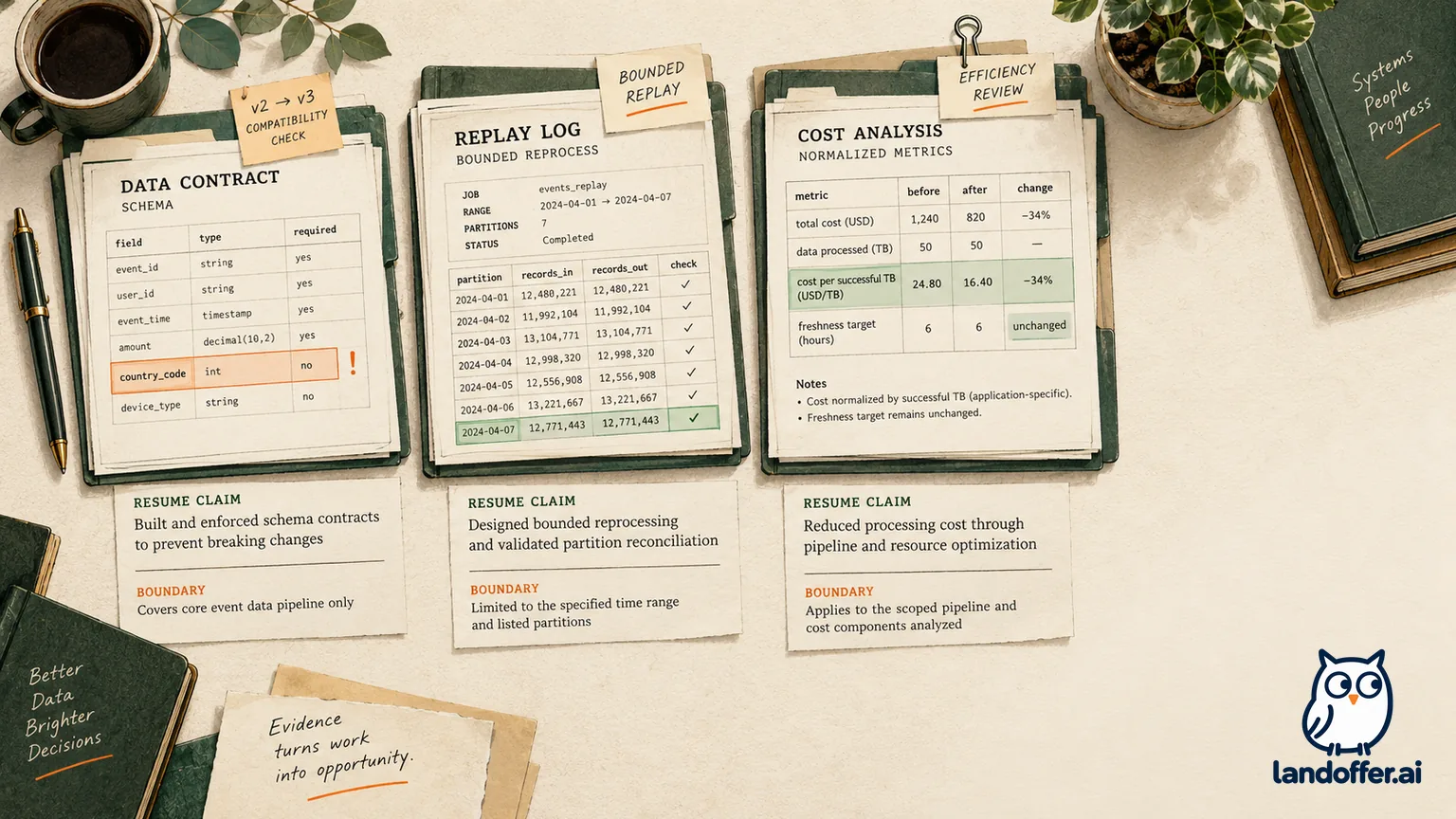
| Contract | Three producers publish an order event; a versioned schema review and build check flag one incompatible field | Added a compatibility test at the curated model boundary and documented a two-release deprecation window | “Added versioned schema checks across three order-event producers; blocked one incompatible field change before it reached the curated finance model.” | The check protected the modeled output; it did not validate every source event or set producer policy alone. |
| Recovery and lineage | A bookmarked batch replays a six-hour window; target partition totals differ before reconciliation | Added a staged replay and idempotent merge check, then linked the run ID to upstream and downstream datasets | “Replayed a six-hour late-data window with a staged merge and reconciliation check; restored the expected partition total without duplicate output.” | Name the observed period and count; do not promise zero future data loss or universal exactly-once behavior. |
| Cost | Two comparable months each process 50 successful TB; resource metrics and billing exports show compute and shuffle spend | Compared normalized cost per successful TB while keeping the six-hour freshness target constant, then reviewed worker settings with platform partners | “Reduced fictional cost per successful TB from $24.80 to $16.40 across two comparable months while meeting the six-hour freshness target.” | All figures are invented; compare workload and period, and note that platform discounts may change the invoice. |
The map is useful because each line starts with a record, identifies one engineering action, and states the limit on the claim. The supporting visual traces those three separate paths to resume bullets. In a real job search, replace the sample evidence with your own non-confidential pull requests, run logs, contracts, cost reviews, or incident notes.
Two complete fictional resume entries
All organizations, dates, volume, and results below are invented. These entries show different scopes; neither is a real candidate’s history. Keep only the tools and outcomes that match your actual experience.
Data Engineer, Analytics Platform — Meadowline Health Market, 2022–2025
- Built and maintained batch ingestion for three order-event producers, documenting schema ownership and downstream consumers for the curated finance model.
- Added a versioned compatibility check at the model boundary; the fictional build gate blocked one incompatible field change before production and provided a two-release deprecation path.
- Implemented run-level lineage metadata linking an orchestration job to its input and output datasets; documented two manual sources outside the captured graph.
- Partnered with analytics and finance on a six-hour late-data replay; staged the load, reconciled the expected partition total, and merged without duplicate output in the fictional case.
- Wrote recovery notes for the on-call rotation, including the bookmark/reset boundary, sink behavior, and checks required before reopening the downstream model.
Senior Data Engineer, Data Platform — Alder Current Commerce, 2023–2026
- Owned daily and streaming ingestion for 18 fictional source tables, setting freshness targets with product analytics and documenting the escalation path for delayed partitions.
- Compared job resource metrics with billing exports across two comparable months at 50 successful TB; fictional cost moved from $24.80 to $16.40 per successful TB while the six-hour freshness target held.
- Reworked a replay path to stage late partitions before merge and reconcile row totals; recorded the run ID and downstream model impact so support could trace the recovery.
- Coordinated a contract change with two producer teams and three consumers; documented the new field meaning, a deprecation window, and the downstream check owner.
- Reported one incomplete lineage segment for a manually maintained table rather than marking the inventory as end-to-end coverage.
The first entry emphasizes contract checks and a carefully bounded replay. The second emphasizes platform-level cost measurement, cross-team change, and lineage limitations. In both, shared data-platform and producer work stays shared; the engineer does not claim billing ownership, team-wide policy, or perfect pipeline reliability.
Choose numbers you can explain and protect private data
Before adding a metric, write down its source, formula, baseline, period, and denominator. For a recovery time, define the start and end event. For cost per terabyte, define which billed resources and successful output count. For a contract test, state the model or interface scope. If those definitions changed during the comparison, choose a different result or describe the change without a percentage.
Use internal artifacts to refresh your memory, but omit customer identifiers, proprietary table names, and confidential dollar amounts. If policy permits, use a rounded value or range; otherwise describe a verified control. A replay reconciliation check can be a credible accomplishment without a before-and-after percentage.
A resume bullet should prepare you for follow-up questions. If you cannot explain what you implemented, which people made the decision with you, or where the result came from, narrow the verb or remove the claim. One reliable detail often gives more signal than several unexplained numbers.
Data engineer resume checklist
- Does each bullet name an action you performed rather than a tool the team happened to use?
- Have you said whether the contract applies to a source, staging model, or curated output?
- Does a recovery example explain replay scope, sink behavior, and the correctness check?
- Can you define the denominator and baseline behind a cost or reliability metric?
- Have you shown the lineage coverage that exists and any known manual gap?
- Do the dates and outcomes distinguish your work from the shared platform result?
- Have you removed confidential schemas, customer details, and unsupported performance claims?
These fictional cases do not predict hiring results. Use the recent roles search to review data engineering openings, then compare each posting’s responsibilities with evidence you can verify from your own work.
Sources and Further Reading
- dbt model constraints and contracts — contract requirements and platform-dependent enforcement.
- AWS Glue job bookmarks — processing state, rewind, and reset behavior.
- OpenLineage specification — run, job, dataset, and event concepts.
- Dataflow estimated cost — resource estimates and billing limitations.
- Dataflow cost optimization — freshness, throughput, latency, and cost trade-offs.
- Harvard College Guide to Creating a Strong Resume — general guidance for fact-based resume language.