LandOffer
Job search
Security Engineer Resume Examples: Investigations, Mitigations, and Safe Disclosure
Turn security investigations, mitigations, and response work into resume evidence without exposing sensitive details or overstating ownership.
Security engineer resume examples work best when they show what you investigated, what you changed, and how you verified the result. A useful bullet traces a finding to a bounded action, such as validating a report, coordinating a fix, or confirming that a control behaves as intended. It does not need to reveal the system, customer, exploit path, or confidential incident behind that work.
Start from the responsibilities in the opening you want. “Security engineer” can mean application security, cloud and infrastructure security, detection engineering, vulnerability management, or a mix. Then choose examples you can explain with evidence: your contribution, the people or systems involved at a safe level, the check you performed, and the result that check actually supports.
The examples below use fictional candidates and invented work records. They are teaching examples, not real incidents, employer claims, or measured security outcomes. LandOffer publishes this guide and offers recent roles to review; use an actual opening to decide which evidence belongs first.

Choose the security work the posting actually describes
Read the responsibilities before matching yourself to a title. One application security role may review design changes and help teams fix code. Another may focus on secure development tooling. A detection engineer may build alert logic and investigate its behavior. A vulnerability management role may coordinate asset scope, prioritization, remediation owners, and retesting.
The NIST NICE Framework offers shared language for cybersecurity work through work roles, competency areas, and task, knowledge, and skill statements. Its April 2026 v2.2.0 update adds a supply-chain risk management work role and updates competency areas including DevSecOps. Treat that framework as a reading aid, not a universal list of job titles or a credential. Employers organize the same work differently.
Make a short responsibility map from the posting. Highlight recurring verbs: assess, investigate, design, detect, mitigate, remediate, validate, or coordinate. Then select two or three examples that demonstrate those actions. A skills list containing Python, SIEM, cloud platforms, scanners, and frameworks cannot show whether you configured a tool, evaluated a finding, or made a change that another team adopted.
Keep your historical title accurate. If your title was software engineer and you spent part of the role improving dependency checks, describe that contribution under the real title. The work can show a security direction without rewriting your employment history as “Security Engineer.”
Build a private evidence record before writing bullets
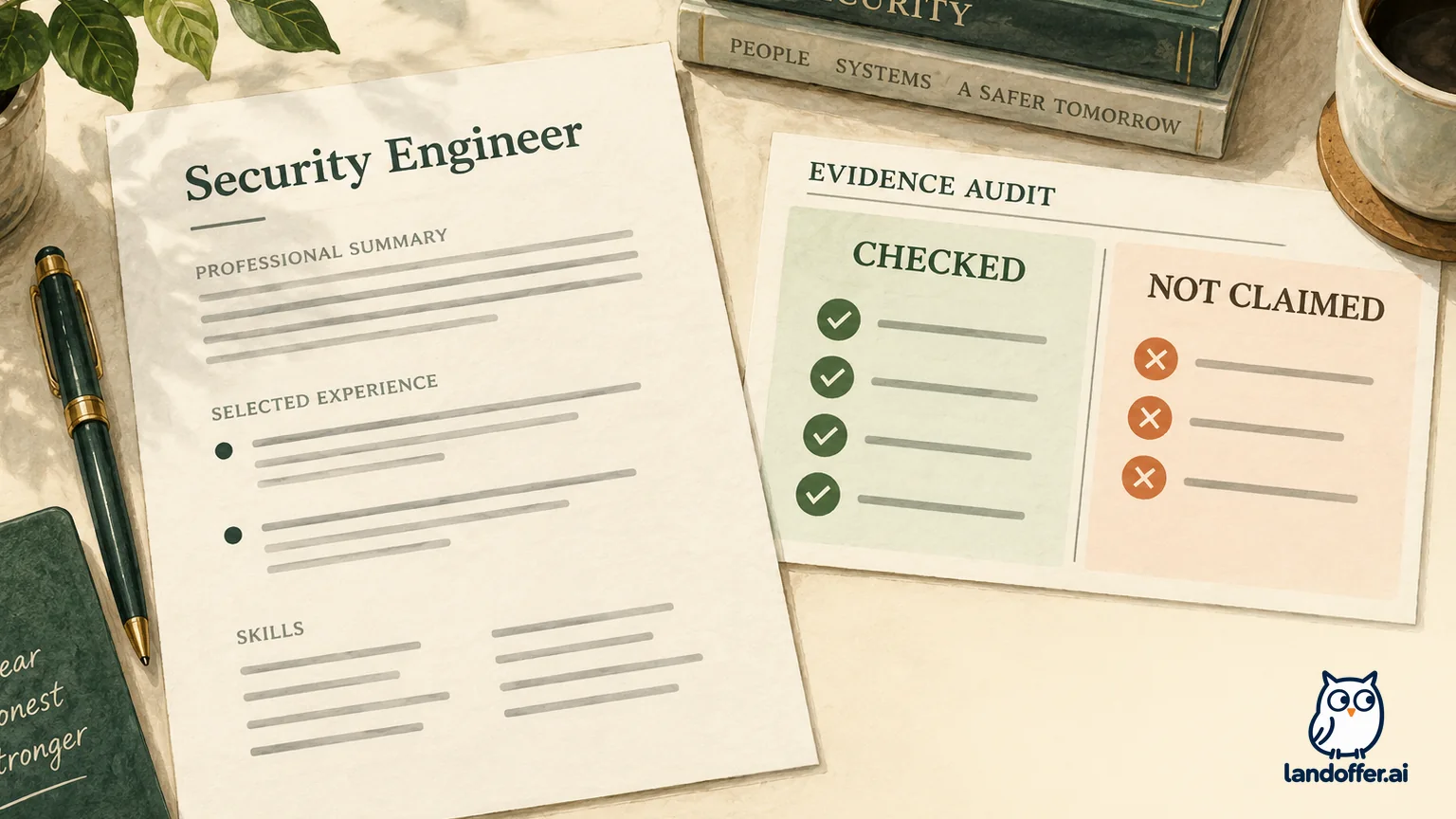
For each candidate example, make a private note with five fields: the question or finding, how you validated it, the action you personally owned, how you checked the change, and the result’s scope. Add the date range or project context only if you can share it. Keep supporting details in employer-approved records. A resume should not reproduce a ticket, incident report, or vulnerability submission.
Maya Chen is fictional. She worked as an application security engineer at Alder Harbor Software. A product team asked her to investigate whether an authorization check behaved consistently across two account states. Maya reproduced the behavior in an approved test environment, documented the affected component privately, and worked with the service owner on a server-side permission check. She added a regression test and reviewed the fix with that owner. The record does not establish customer impact, a public vulnerability, or a reduction in overall company risk.
| Evidence step | Maya’s fictional record | Resume boundary |
|---|---|---|
| Question | A permission check might differ between two account states | Do not name the endpoint, tenant, or sensitive workflow |
| Validation | Reproduced the behavior in an approved test environment | Do not imply testing outside the authorized scope |
| Action | Partnered with the service owner on a server-side check | Do not claim sole ownership of the product fix |
| Verification | Added and reviewed a regression test for the case | Do not claim every authorization path was proven secure |
| Result | The named case passed the regression check after the change | No unsupported claim of prevented breach or customer loss |
Her bullet can say: “Investigated an authorization edge case in an approved test environment, partnered with the service owner on a server-side permission check, and added a regression test for the corrected path.” It names the technical contribution and verification while leaving sensitive implementation details out.
This is more useful than “Responsible for application security” because a reader can ask what Maya checked and how she worked with the product team. It is also more defensible than “Prevented a major breach.” The fictional record contains no breach, exploit, customer impact, or counterfactual evidence showing what would otherwise have happened.
Separate a finding from severity and impact
A scanner alert, investigation, confirmed vulnerability, severity rating, remediation, and verified fix are different states. Keep them separate in your notes. A finding can be a false positive, accepted risk, duplicate report, configuration issue, or confirmed flaw. A high severity label may be a preliminary assessment rather than the final disposition.
Name the stage you completed. If you triaged alerts, say triaged. If you reproduced a behavior, say reproduced within the authorized environment. If another team deployed a fix and you retested it, say you retested the fix. “Eliminated vulnerabilities” suggests a coverage and durability claim that a single assessment rarely establishes.
Numbers can show scale, but define what was counted and when. “Reviewed 140 dependency alerts” describes workload if the count comes from a reliable record. “Cut critical exposure by 60%” needs a defined asset population, severity rule, comparison dates, treatment of reopened findings, and a clear account of your contribution. Without those, use the verified count or describe the process change without a percentage.
Avoid equating a closed ticket with reduced risk. A ticket can close because an owner accepted the risk, the asset left scope, a duplicate was linked, or the issue was fixed. Your wording should reflect the actual disposition and verification, not the status label alone.
Describe incident work without claiming the whole response
Security engineers may prepare controls, detect activity, investigate alerts, coordinate response, implement containment, restore services, or complete follow-up work. Those actions can belong to different people. Use the verb that matches your part and credit the shared process where it matters.
NIST SP 800-61 Rev. 3, published in April 2025, places incident-response recommendations within the risk-management activities of the NIST Cybersecurity Framework 2.0 and supersedes Rev. 2. It provides organizational guidance; it does not establish that any individual owned the full response lifecycle. A resume should make that distinction visible.
If you investigated an alert, describe the analysis and handoff. If you executed an approved containment step, say which type of action you performed at a non-sensitive level. If you owned a follow-up change, state what you delivered and how it was checked. Avoid naming the affected customer, internal host, detection gap, or attack sequence unless your employer has approved that detail for public disclosure.
Jon Bell is a fictional detection engineer. During a tabletop exercise—not a real incident—he tuned a noisy alert rule with the incident-response lead, replayed a set of approved test events, and documented a handoff condition. His bullet reads: “Refined a detection rule with the response lead and replay-tested approved scenarios, documenting when alerts should escalate for analyst review.” It does not claim that the rule stopped an attacker or improved production detection rates.
If your evidence includes a measured change, state the measurement conditions. A lower alert count is not automatically better detection; it might reflect a narrower rule. A faster triage time needs a defined queue, start and stop events, comparison period, and enough context to attribute the change. When those details are not available for public use, a completed control or test may be the stronger evidence.
Keep vulnerability disclosure inside the approved boundary
Do not put a private vulnerability report, customer environment, exploit instructions, credentials, internal dashboard, or unreleased incident detail in a resume or portfolio. Even a sanitized description can identify an organization when it combines a product name, unusual timeline, technical symptom, and public rumor. Remove or generalize details rather than assuming that changing one name makes the account safe.
The CISA and FBI Product Security Bad Practices guidance recommends that software manufacturers publish a vulnerability disclosure policy with an in-scope product, a reporting channel, a good-faith policy, and a coordinated disclosure approach. The document describes nonbinding guidance for manufacturers, especially those supporting critical infrastructure and national critical functions. It is not a blanket authorization or legal safe harbor for every kind of security testing.
CISA’s BOD 20-01 announcement concerns federal civilian executive branch agencies. Its requirements should not be generalized to every employer or system. For any work you reference, follow the authorization, employer policy, disclosure process, and public attribution rules that actually applied.
If an employer has published an advisory and approved your attribution, you may be able to point to that public record. Check that the record names your contribution and that you have permission to connect it to your employment. A CVE number or closed report alone does not grant publication rights. If permission is uncertain, describe the category of work without naming the vulnerability or product.
Turn a fictional investigation into a finished resume section
Jon’s second fictional work record concerns a set of noisy detection alerts. His team grouped recurring benign events, reviewed rule logic with the response lead, and replayed 24 approved test events after a change. In the stipulated teaching record, 21 events routed to the intended review queue and three produced an expected exception that remained documented for follow-up. These numbers are invented inputs, not an experiment conducted for this article or real product telemetry.
| Record item | Teaching input | Supported description |
|---|---|---|
| Work | Refined one detection rule with the response lead | Collaborated on a specific rule |
| Check | Replayed 24 approved test events | State the test set and environment if permitted |
| Result | 21 reached the intended review queue; 3 exceptions remained | Report the observed outcomes and exception |
| Boundary | No production incident or attacker outcome was measured | Do not claim prevented compromise or improved coverage |
His original resume entry says:
Security Engineer — Northline Systems
Used SIEM and Python to improve security. Led incident response and prevented threats. Reduced false positives by 70%.
The finished fictional version says:
Detection Engineer — Northline Systems | March 2022–present
Refined a detection rule with the response lead and replay-tested 24 approved scenarios; 21 routed to the intended analyst queue, while three documented exceptions remained for follow-up.
Investigated escalated alerts, summarized evidence for the incident lead, and completed assigned rule and runbook updates after review.
This rewrite removes the unsupported leadership and threat-prevention claims. It keeps a useful count because the teaching record defines the test set and preserves the exceptions. If a real candidate cannot share the count or the test details, the first sentence can instead say “replay-tested approved scenarios and documented the remaining exceptions.” Do not substitute a stronger metric simply because the job posting asks for impact.
The same audit applies to other security tracks. An infrastructure engineer can describe a hardened configuration and its validation. A vulnerability manager can explain how ownership and retesting moved through a defined process. A product security engineer can show a review or guardrail adopted by a team. In each case, say what you personally delivered and what the check covered.
Tailor the evidence without changing the facts
Reorder examples to match the role. For application security, lead with design reviews, secure coding guidance, or remediation collaboration you actually performed. For detection work, lead with investigation quality, testable rule changes, and analyst handoffs. For vulnerability management, explain asset scope, prioritization, owners, and retest status. For cloud or infrastructure security, connect the control to the configuration or operating task you changed.
Do not add a tool merely because it appears in a posting. A tool belongs in your skills section when you used it and can explain the task. Separate hands-on experience from familiarity, training, or a lab project. If a project is personal or academic, label it as such instead of making it sound like production work.
Use a resume bullet as a safe summary, not a substitute for private records. Keep an approved evidence trail where your employer permits it. Before submitting, check each sentence for four things: Is the work real? Is my role clear? Does the evidence support the result? Could any detail expose information I should protect? If one answer is uncertain, narrow the wording or get the appropriate approval.
Choose one recent opening from LandOffer’s job listings, mark its security responsibilities, and put your closest verified example first. Keep your actual title, preserve the boundaries around shared work, and leave sensitive findings out of the public application. A precise account of what you investigated and verified gives an interviewer something concrete to discuss without turning the resume into a disclosure.
Sources and Further Reading
- NIST NICE Framework Components v2.2.0: common language for cybersecurity work and capabilities.
- NIST SP 800-61 Rev. 3: incident-response recommendations within CSF 2.0 risk management.
- CISA/FBI Product Security Bad Practices: manufacturer guidance on vulnerability disclosure policies and coordinated disclosure.
- CISA BOD 20-01 announcement: federal civilian executive branch VDP scope.