 LandOffer
Job search
Backend Engineer Resume: APIs, Data, Reliability, and Ownership
Show the API contract, data invariant, checks and operating boundary you owned; quantify only evidence that establishes the stated result.
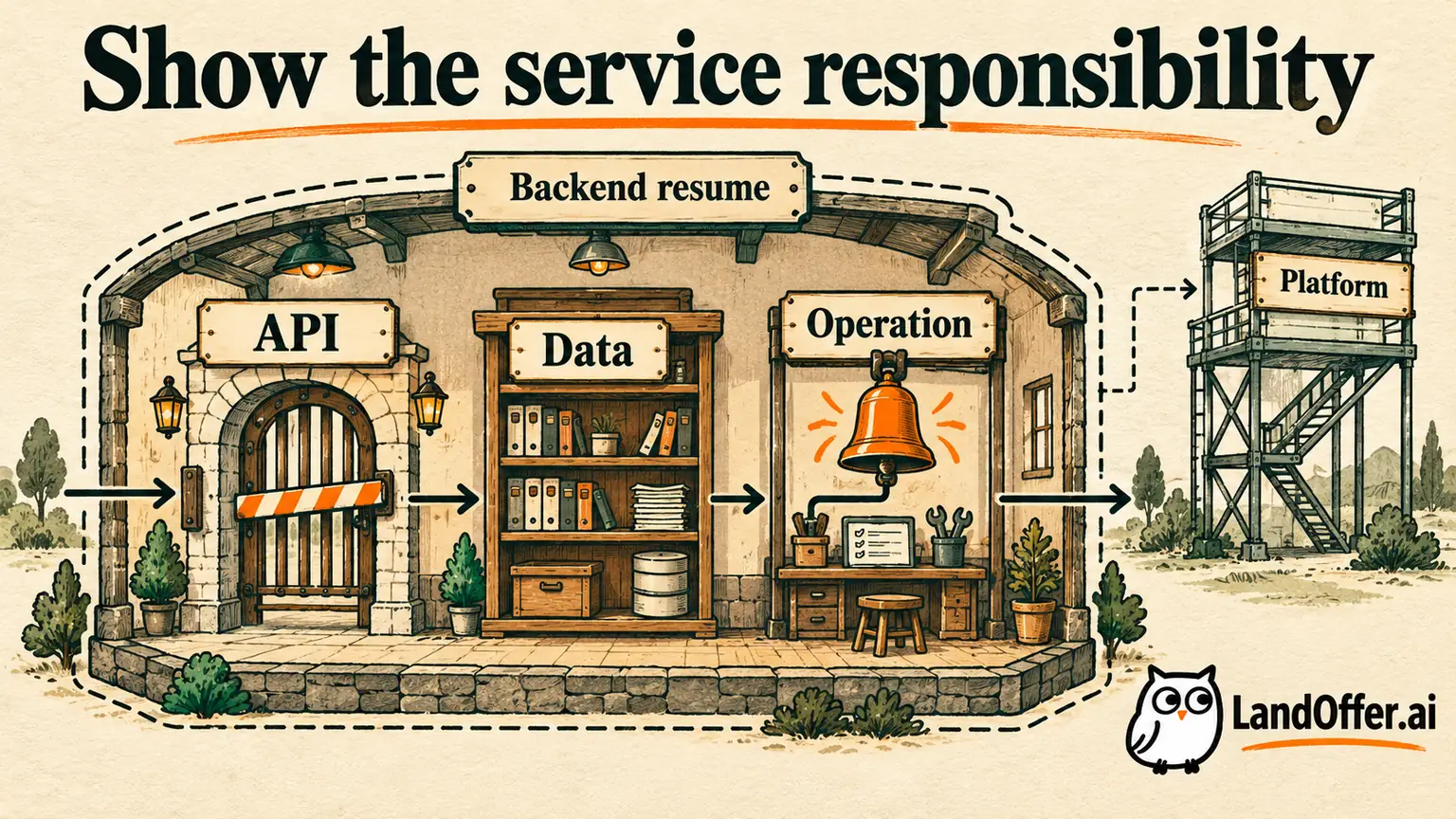
A backend engineer resume should connect APIs, data and operating work to a specific responsibility you carried. Name the contract you implemented, the failure or consistency problem you addressed, the checks you performed and the boundary of your ownership. Languages and frameworks help a reader understand the setting; they do not establish that you designed the system, operated it or improved its reliability.
Start with a relevant description from LandOffer's recent roles and select evidence for its responsibilities. LandOffer publishes this guide. Official technical and writing references were checked October 9, 2026. Elias Moreno, Alder Quay and all implementation records below are fictional teaching inputs, not observed tests, a candidate report or a hiring result.
Find the backend problem behind the stack
Read the role's verbs before assembling your skills section. Building customer-facing APIs, maintaining import workers and improving a database access layer all involve backend engineering, but they call for different evidence. Help the reader see that connection by putting the relevant backend problem beside the technology you used.
GitLab's backend engineering framework provides one company-specific illustration: different specialties emphasize different work, including APIs, integrations and operating responsibilities. It is not a universal definition of seniority or a current guarantee that a particular role is open. Use the specific employer description to decide which contribution belongs first.
For an API role, evidence might concern validation, authorization, compatibility or failure responses. For a data-heavy service, it might concern transaction boundaries, constraints or query behavior. For an operating role, it might concern signals, investigation and recovery. Select contributions that explain a decision and its consequences within your actual scope.
Before writing a bullet, note the system, the problem, your contribution, how you checked it and what the result actually covers. Write those before compressing them into a bullet. This preserves the details that broad phrases such as “built scalable microservices” often erase. You can then remove secondary implementation detail while retaining the reason the work mattered.
A completed evidence map for a reservation service
Elias's fictional team maintains a reservation API for equipment bookings. A client can retry after a timeout, so the team needs repeated requests with the same booking key to avoid creating another reservation. Elias implements the request path and database change, writes contract and integration tests, and updates the service runbook. The platform team owns deployment tooling and infrastructure; Elias supplies service release checks and runbook changes.
The teaching design stores the booking key and reservation together in one database transaction. The teaching schema requires a non-null booking key and a unique constraint, preventing two reservation rows with that key. An identical retry returns the existing reservation; a different payload using that key receives a documented conflict response. This describes the fictional design, not a complete prescription for every booking system.
| Evidence area | Elias's contribution in the teaching record | What the resume can support |
|---|---|---|
| API contract | Defined validation and documented retry/conflict responses with the team | Implemented a specific request contract |
| Data consistency | Added a unique booking-key constraint within the reservation transaction | Protected the stated row-level uniqueness requirement |
| Verification | Wrote tests for retries, conflicting payloads and concurrent creation | Checked named failure paths in the stated environment |
| Service operation | Added conflict/error signals and runbook guidance | Supported investigation for the service he changed |
| Infrastructure | Supplied release checks to the platform team | Collaborated on release; did not own the infrastructure platform |
The map makes the contribution useful without calling Elias the architect of the whole business. It also prevents a common overstatement: a unique row constraint does not establish exactly-once behavior across every downstream system. The fictional case contains no external payment operation, distributed transaction or proof about all possible failures.
The PostgreSQL constraints documentation explains unique constraints and their specific scope, including the treatment of null values. Technical precision matters in a resume because a short phrase can suggest a much broader guarantee than the implementation supports. Use the actual key definition and transaction behavior in your private evidence notes before choosing the public wording.
Turn the map into finished experience bullets
Elias's original experience section reads:
Backend Engineer — Alder Quay
Built scalable APIs using Python and PostgreSQL. Improved reliability and owned infrastructure. Worked on monitoring and tests.
This draft names a stack but leaves the API behavior, ownership and evidence unclear. “Owned infrastructure” conflicts with the teaching record. “Improved reliability” lacks a defined result. A reader cannot tell whether Elias implemented a handler, designed a contract or ran the deployment platform.
His reviewed experience section reads:
Backend Engineer — Alder Quay | September 2023–present
Implemented a Python reservation endpoint with booking-key validation and documented retry/conflict responses, coordinating the API contract with client engineers.
Added a PostgreSQL unique constraint within the reservation transaction to prevent duplicate booking-key rows; wrote integration tests for identical retries, conflicting payloads and concurrent creation.
Added service error and conflict signals and updated the runbook with investigation and escalation steps; partnered with the platform team on release checks.
The finished bullets describe APIs, data, verification and operation. They are not a checklist of every technology Elias encountered. A reviewer can connect each bullet to a contract, a data rule or an operating task, then ask about Elias's part in the work. The second bullet names the invariant it protects rather than claiming that all duplicate effects everywhere became impossible.
For a role centered on database work, Elias can place the second bullet first. For an API integration role, he can retain the contract bullet first and add a relevant client-compatibility contribution if his actual record supports it. Targeting changes the order and emphasis, not the ownership or underlying facts.
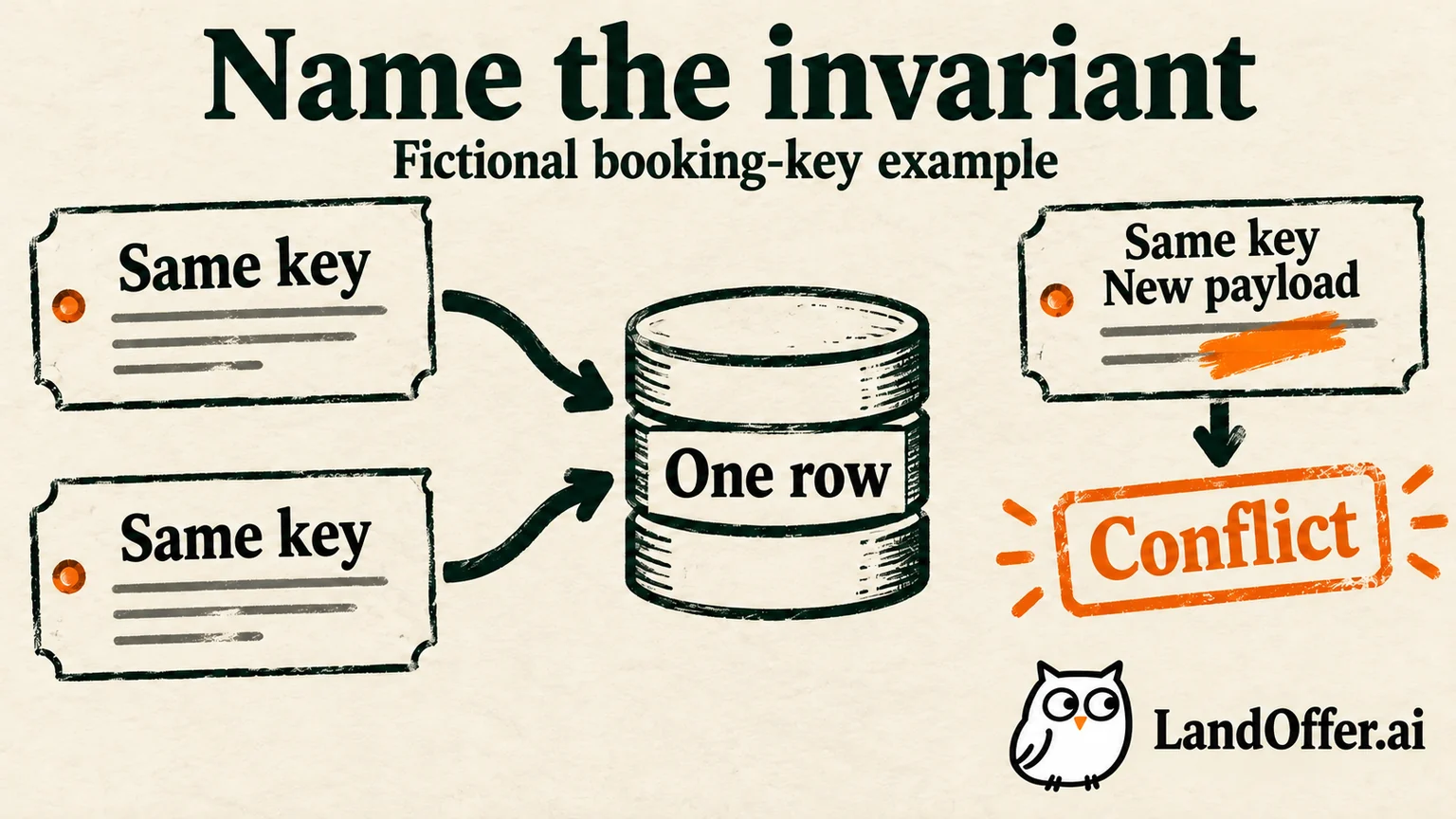
A completed test-to-claim audit
The second worked asset is a finished audit of what the fictional verification record establishes. The outcomes below are stipulated teaching inputs, not tests executed for this article. Naming the boundary makes the final wording more defensible than a general statement that the system is reliable.
| Teaching test record | Stipulated result | Supported wording | Unsupported extension |
|---|---|---|---|
| Repeat an identical booking request | Existing reservation returned | Tested identical retry behavior | Every external side effect occurs exactly once |
| Reuse the key with a changed payload | Documented conflict response returned | Tested conflicting-payload handling | All client misuse is impossible |
| Two concurrent creates with the same key | One reservation row retained under the case's constraint | Tested concurrent creation against the uniqueness rule | Proved correctness for every distributed failure |
| Malformed required input | Validation error returned | Tested malformed-input handling | Eliminated all production errors |
Elias retains the first three cases in his integration-test bullet and keeps malformed-input detail in his interview notes. He rejects “guaranteed exactly-once reservations across the platform.” That sentence would exceed both the system boundary and the verification record.
The completed decision is useful even without a percentage. It identifies what changed, why the change mattered and how the engineer checked it. If a real record only contains a design proposal, use “proposed” rather than “implemented.” If tests were written but not run, distinguish that state rather than copying this example's stipulated outcomes.
Describe data decisions without claiming every layer
A backend contribution often crosses an API and a database, but that does not make the engineer the owner of the whole data platform. Explain the actual change: a transaction boundary, a constraint, a query, a migration or a cleanup process. Keep the reason connected to the change.
For a query improvement, a credible evidence note identifies the workload, measurement method and comparison window. For a migration, it identifies compatibility, validation and recovery conditions. For a schema constraint, it identifies the invariant and how old or invalid data was handled. The resume normally needs only the strongest part, but the private note should support questions about the rest.
Avoid adding “optimized” when the work was primarily correctness. Elias's constraint protects a booking-key rule. His fictional record contains no before-and-after query benchmark. Calling it a performance improvement would change the category of the result and create a measurement obligation he cannot satisfy.
Also distinguish application behavior from infrastructure behavior. A service engineer might propose an index while a database specialist approves the operational rollout. Describe your contribution and coordination rather than claiming sole ownership because your pull request started the change. This can make a strong technical contribution easier to understand, rather than weaken it.
Show reliability work through signals and response
Google's SRE monitoring chapter discusses latency, traffic, errors and saturation as useful monitoring signals. That reference can help you name the operating problem precisely. It does not mean every backend engineer implemented a full SRE program or owned an organization's availability target.
Elias added error and conflict signals for the service he changed. A conflict response may reflect an expected contract outcome rather than a service outage, so he does not combine every non-success response into an unexplained reliability metric. His runbook tells the team how to distinguish retry conflicts from failures needing investigation.
If you participated in incident response, describe the symptom, your investigation or recovery contribution and the follow-through you owned. “Investigated queue growth and documented recovery steps” can be stronger than “improved uptime” when the record lacks a measured availability comparison. Keep customer names, credentials, internal hostnames and sensitive incident details out of the public document.
An on-call statement should reflect the actual arrangement. Shared rotation, secondary support and sole service ownership are different responsibilities. Do not imply round-the-clock ownership because you helped during one incident. You do not need to borrow the whole rotation's responsibility to explain a useful investigation you actually performed.
Quantify only a defined result
Numbers can describe scope, checks or outcomes. A count of supported endpoints is different from a performance change; a test-case count is different from defect prevention. Use the kind of number that the record actually establishes. There is no requirement to attach a percentage to every backend bullet.
For a latency claim, retain the environment, workload, percentile and comparison conditions in your evidence notes. A local benchmark does not establish customer-facing production latency. A production improvement observed after several changes should not be attributed entirely to your component without supporting analysis.
Elias's record contains no latency baseline, outage comparison or commercial outcome, so his final section contains no invented percentage. The specific booking-key invariant and failure-path tests carry the result. If he later obtains a valid measurement, he can add it with its scope rather than reinterpret the original work from memory.
The Harvard resume guide recommends specific, factual language. That principle supports both measurable results and precise non-numeric contributions. “Prevented duplicate booking-key rows” has a meaningful boundary; “revolutionized reliability” provides neither a result nor a way to assess it.
Select an experience section the role can use
For a backend application, put the most relevant service contribution before an unrelated project simply because that project uses a fashionable language. Keep a concise skills section whose terms appear in work, projects or education you can explain. Make the context explicit when a skill comes only from a personal project.
An early-career candidate can use the same structure with a smaller system: purpose, contract, data rule, check and limitation. A senior candidate should add the design decisions, coordination or operating duties they actually owned. Neither should rename a job title or inflate a project into commercial production work.
Choose one description from LandOffer's recent roles. Map its API, data and operating responsibilities to your real evidence, then write three bullets that state your contribution and its boundary. Keep private evidence notes behind the three bullets, remove sensitive system details and confirm every claim describes work you can explain.
Sources and Further Reading
- GitLab backend engineering framework: company-specific specialties and responsibilities.
- PostgreSQL constraints: unique constraints and their scope.
- Google SRE monitoring chapter: operating signals and monitoring reasoning.
- Harvard resume guide: factual, specific and readable writing.