LandOffer
Data & Decisions
Time Zones and Daylight Saving Can Break a Daily Metric
Reconcile UTC events with a named business calendar using complete 23-hour and 25-hour examples. Preserve repeated local instants, reject ambiguous intake, and document the difference between verified fixture arithmetic and a pending report correction.
Define a daily metric using the event’s actual instant and the business calendar’s named time zone. Convert each local midnight boundary to UTC separately, then include events at or after the start and before the next boundary. A business day can span 23 or 25 elapsed hours where daylight saving changes; a fixed offset or a fixed 24-hour window can assign valid events to the wrong date.
This LandOffer.ai workplace guide uses fictional completed-job events and a real, isolated Python check of those authored timestamps. It does not test a database, dashboard or production pipeline. The November 2026 scenario is a constructed future example, evaluated with the time-zone rules available in the local runtime on October 27, 2026.

Agree on what the date means before changing the chart
A timestamp, a calendar date and a chart label serve different purposes. The timestamp identifies when something happened. The business date determines which reporting bucket contains it. The label communicates that choice. A display that says November 1 cannot establish whether the query used UTC, a headquarters calendar or the viewer’s local zone.
In the fictional example, analyst Jules and operations owner Ren define the metric as distinct completed job IDs, using completed_at, for the America/Los_Angeles calendar day. They exclude retries that do not create a new completed job ID. They retain the original offset-bearing timestamp and its UTC instant; they derive the business date rather than overwriting the source value. This definition measures completions, not submissions or ingestion arrivals.
Their definition record also names the report’s data cutoff. A job completed before midnight but received later belongs to its completion date, although an earlier report may not yet contain it. Jules labels the first extract provisional and records its cutoff. Time conversion alone does not establish source completeness; Ren still has to approve when late-arriving completion records revise an earlier report.
Named zones describe rules that can vary over time. A manually entered minus-eight-hour adjustment cannot describe both offsets in the Los Angeles examples below. Keep the zone identifier with the metric definition, and record the runtime and time-zone data used for a reproducible check. A later rule update may require reassessing future boundaries rather than silently rewriting a previously issued report.
The Atlassian Analytics documentation illustrates the configuration layers: dashboard time zones, per-source conversion and source-specific timestamp support. Its documented UTC-offset option accounts for daylight saving as needed; that is different from a hand-coded constant offset. Inspect the actual tool’s generated query and column types before assuming its setting has the same effect as your intended business definition.
For a global product, the owner must also choose whether a single headquarters calendar or each customer’s calendar answers the question. “Daily completed jobs for operations staffing” can reasonably use one service calendar; “customers active on their own local date” needs a different definition. Do not silently combine both populations under the same daily label. The example below deliberately chooses one service calendar and makes no customer-local claim.
Inspect intake evidence before applying conversion. An offset-bearing completion timestamp can identify an instant, while a date-only billing field may represent a business convention without a time of day. Assigning midnight UTC to that date would invent information. Preserve the raw value and ask its owner what it means; do not route every date-looking column through the same repair. Keep both the source field’s semantics and the intended reporting calendar in the review record.
Worked reconciliation: five UTC-date jobs become four business-date jobs
Jules prepares seven synthetic events. Each row is a different completed job, so the table has no deduplication dispute. All timestamps below are explicitly UTC. The local values come from the isolated check, not an account readback.
| Job | UTC completion | Los Angeles completion | November 1 business day? |
|---|---|---|---|
| A | Nov 1, 00:30 | Oct 31, 17:30, UTC−07 | No: previous date |
| B | Nov 1, 06:59:59 | Oct 31, 23:59:59, UTC−07 | No: just before start |
| C | Nov 1, 07:00 | Nov 1, 00:00, UTC−07 | Yes: inclusive start |
| D | Nov 1, 08:30 | Nov 1, 01:30, UTC−07 | Yes |
| E | Nov 1, 09:30 | Nov 1, 01:30, UTC−08 | Yes: different instant from D |
| F | Nov 2, 07:30 | Nov 1, 23:30, UTC−08 | Yes: before next midnight |
| G | Nov 2, 08:00 | Nov 2, 00:00, UTC−08 | No: exclusive end |
The agreed November 1 window begins at 2026-11-01T07:00:00Z and ends at 2026-11-02T08:00:00Z. It lasts 25 elapsed hours and contains C, D, E and F: four jobs. Grouping by UTC November 1 instead returns A through E: five jobs. Starting at the correct local midnight but adding 24 elapsed hours returns only C, D and E: three jobs.
Jules records the differing job IDs alongside each total so Ren can review which completions moved. UTC-date grouping adds A and B and loses F relative to the agreed business day. The fixed-duration window loses F. Changing the chart label would leave those incorrect event memberships in the report. Nor should Jules subtract one from the total as a correction; another day’s event distribution could produce a different difference, including matching totals with mismatched members.
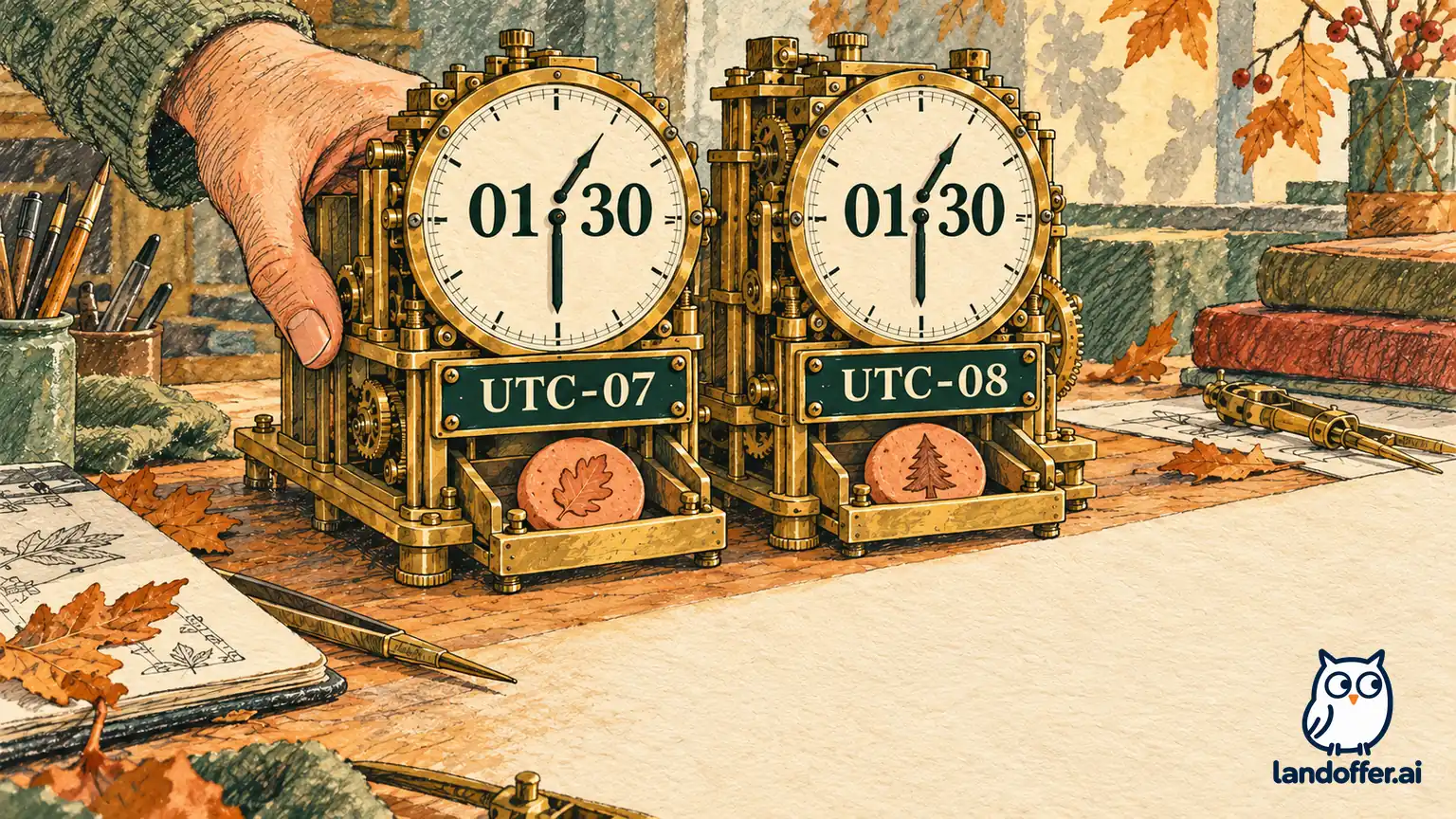
D and E make a second failure visible. Both display as 01:30 locally, but their offsets and UTC instants differ. Collapsing them by an unqualified local timestamp would discard a valid job. A timestamp string without an offset, such as 2026-11-01 01:30, cannot tell this example which occurrence was intended. Jules quarantines that input for source clarification instead of guessing the earlier or later occurrence.
The Python 3.12 zoneinfo documentation describes named-zone conversion and the fold distinction for repeated wall times. Here, converting the two known UTC instants supplies that distinction. Attaching a zone to an ambiguous input is not the same operation as recovering missing source information.
Test the short day as well as the repeated hour
A repair that passes November can still mishandle spring. For the same named zone, the authored March 8, 2026 business day runs from March 8 at 08:00 UTC to March 9 at 07:00 UTC: 23 elapsed hours. The next midnight comes sooner in elapsed time; it is still the correct calendar boundary.
Jules constructs a second fixture rather than extrapolating from the fall result. S1 completes at March 8, 07:59:59 UTC, just before the business day. S2 completes at 08:00, the inclusive start. S3 at 09:30 converts to 01:30 locally; S4 at 10:30 converts to 03:30. S5 completes at March 9, 06:59:59, just before the exclusive end. S6 at 07:00 and S7 at 07:30 belong to March 9 locally.
The correct March 8 count is four: S2, S3, S4 and S5. A fixed 24-hour window from the correct start also includes S6 and S7, producing six. The missing local 02:30 is not a zero-completion hour observed in this data; it is a wall-clock time skipped by the zone’s transition. The fixture starts with known instants and does not implement a parser for nonexistent local-time inputs.
Calendar-day counts and elapsed-time rates should remain separate. Four jobs in a 25-hour day is still four daily completions. If Ren also wants jobs per elapsed hour, that needs its own denominator and definition. Dividing every date’s count by 24 would quietly change the rate on transition days. Dividing by actual elapsed hours would answer a rate question, not prove a change in demand, staffing or system performance.
PostgreSQL’s date/time documentation explicitly distinguishes adding a calendar day from adding 24 hours across a daylight-saving transition. Its timestamp types and session settings also affect interpretation. These examples verify the calendar arithmetic in Python only; they do not establish that an uninspected SQL query, connector or dashboard implements the same semantics.
Build a bounded check that preserves the original events
The executed fixture uses Python 3.12.14 and the local system’s America/Los_Angeles zone file. Its saved evidence includes the zone-file path and SHA256, all event conversions, window endpoints and sixteen passing assertions. That records which rules were actually used without claiming that every environment has the same installed data.
The boundary method is deliberately small:
from datetime import date, datetime, timedelta, timezone
from zoneinfo import ZoneInfo

zone = ZoneInfo("America/Los_Angeles")
day = date.fromisoformat("2026-11-01")
start = datetime.combine(day, datetime.min.time(), zone)
end = datetime.combine(day + timedelta(days=1), datetime.min.time(), zone)
start_utc = start.astimezone(timezone.utc)
end_utc = end.astimezone(timezone.utc)
# Compare known UTC instants using start_utc <= instant < end_utc.
The adjacent calendar date is constructed before converting its boundary to UTC. Elapsed duration is then measured between UTC endpoints, avoiding a misleading same-zone wall-clock subtraction. This method is shown for the tested zone and dates; it is not a general resolver for every historical midnight transition or malformed input.
The completed checks cover both transition days, inclusive starts, exclusive ends, both repeated 01:30 occurrences and equivalent offset-bearing representations. They also partition the seven fall events across adjacent local dates: October 31 has two, November 1 has four and November 2 has one. Every authored fall event appears exactly once in that three-date partition; this does not establish completeness of any live feed. The naive timestamp rejection is an explicit intake policy in this fixture, not an assertion that every library rejects such input automatically.
Do not treat those passing assertions as a complete data-quality certificate. They do not inspect a real source field, join, event ID, ingestion delay or backfill. They do not exercise scheduled refreshes or a connector’s conversion. Their value is a reviewable expected result that the authorized implementation can later be compared against.
Complete the correction record before approving a daily report
In the fictional handoff, Jules records the proposed definition as version 2: completed-job instants grouped by America/Los_Angeles calendar date, with an inclusive start and exclusive next-midnight end. Version 1 used UTC-date grouping despite the business-day label. Ren accepts the proposed definition; this acceptance is part of the authored case, not a real workplace action.
The reconciliation attachment lists November 1 as UTC-date five, proposed business-date four and fixed-24-hour three, naming A/B/F as the membership differences. It lists March 8 as proposed four versus fixed-duration six, identifying S6/S7 as next-day events. Jules retains the original extracts and explicitly marks both results as synthetic fixture outputs.
Engineer Anika accepts investigation of the real transformation and connector settings in the scenario. Her accepted next step is to compare the real timestamp type, conversion layer and generated filter with the fixture; that inspection and any dashboard change remain unperformed. Ren reserves approval of any historical restatement until that investigation establishes the affected dates, consumer reports and agreed completeness cutoff. The record therefore approves a definition and test expectation, while keeping implementation and report correction pending.
The team also leaves one source problem unresolved: a separate feed supplies offset-free local completion strings. Its owner must establish the originating zone and how repeated or nonexistent local times were captured. No bulk minus-seven or minus-eight adjustment is authorized. Until that evidence exists, the affected feed is excluded from the proposed comparison with its absence disclosed, rather than presented as zero activity.
Carry the business zone, timestamp field, definition version and freshness cutoff into the report’s explanatory note. Before replacing an existing series, compare event membership on ordinary dates and both transition boundaries, then ask the metric owner to approve the intended definition and the separate scope of any historical restatement. Keep an explicit record when a UTC operational report intentionally answers a different question; consistency does not require every report to use one calendar.
For more workplace guides, return to LandOffer.ai. The practical next step here is a small preserved event set, two independently constructed midnight boundaries and a named owner for the unresolved interpretation. That makes a proposed repair reviewable before anyone relies on a changed daily metric.