LandOffer
Job search
How to Use CyberSeek Work Roles to Build Better Cybersecurity Job Searches
Turn CyberSeek and NICE work-role labels into practical cybersecurity job-search terms without treating framework labels as employer requirements.
title: "How to Use CyberSeek Work Roles to Build Better Cybersecurity Job Searches" description: "Use CyberSeek work roles to find cybersecurity job titles, connect your experience to real tasks, and build searches that match employer descriptions." summary: "CyberSeek’s work-role views can help you name the work you want. Convert each framework label into employer-facing titles, tasks, and skills, then verify the actual job description before applying." date: "2026-10-13" author: "LandOffer.ai Editorial" tags:
- Cybersecurity Jobs
- Job Search
- Career Planning cover: "/blog/images/cyberseek-work-roles-cybersecurity-job-searches-hero.webp" coverAlt: "A cybersecurity job-search map connects work tasks to employer titles and live postings" draft: true
CyberSeek can help you explore cybersecurity work, but a NICE Framework Work Role is not a job title and does not guarantee that an employer uses the same label. Use CyberSeek’s Career Pathway dashboard to explore role-related tasks, skills, certifications, and common job titles; then turn the tasks you actually want into several employer-facing searches. NIST explains that one job can include one or more Work Roles, or only part of a role, so the job description—not the framework label—decides whether the opening fits.
This guide uses public CyberSeek and NIST descriptions checked October 13, 2026. I did not test a personalized account or submit applications. For an additional source of current openings, you can browse recent roles on LandOffer.ai, then verify each employer’s requirements independently.

What CyberSeek and NICE Work Roles can tell you
CyberSeek presents itself as a source of cybersecurity labor-market insights and career pathways. Its public home page links to a Workforce Map, a Career Pathway Dashboard, and an education-and-training map. These answer different questions: where cybersecurity demand and supply are estimated, how a career path and role profile are described, and where learning providers are located. Keep the dashboard you are using clear because its filters and measures are not interchangeable. The dashboards are useful for exploration and market context; they are not a list of guaranteed openings or a substitute for employer career pages.
The NICE Framework gives the data a shared vocabulary. NIST defines a Work Role as a grouping of work for which an individual or team is responsible. An employer defines a job as a specific set of responsibilities. It may draw on one or more Work Roles—or only part of one. An occupation is broader still. That distinction matters because no hiring manager is required to title a posting “Secure Software Development” just because the duties overlap with that Work Role.
CyberSeek says its partner Lightcast analyzes job postings and career transitions and maps posting information—including tasks, skills, titles, and certifications—to NICE Work Roles. That mapping can help you notice patterns, but it is an analytical classification rather than an employer-authored label. It is not the employer’s own statement that a vacancy belongs to a particular Work Role, and it cannot prove that a specific role is open today.
Start with the tasks that interest you. A person who likes building secure developer tooling may be drawn to a different search from someone who prefers monitoring security alerts or investigating digital evidence, even if all three are broadly described as “cybersecurity.” The Work Role is a lens for describing work; your next step is to translate that lens into the language employers use.
Read a role profile as a starting point
CyberSeek’s Career Pathway dashboard describes the kinds of information attached to a selected role: common job titles, total job listings for a stated 12-month period, requested education, top certifications and skills, NICE Framework categories, and role tasks. Its page describes average advertised salary using a specific period—September 2023 through August 2024. Read the period and definition beside each metric before using it. A count or salary label can describe a historical window even while the dashboard remains available.
A useful reading sequence is:
- Choose the work, not the most impressive title. Open the role profile that seems closest to your intended duties. Write down two or three task statements you would want to do in a real job.
- Collect title variations. Note the common job titles the dashboard associates with that profile. Treat them as search ideas, not a complete list or a promise that those titles mean the same thing at every company.
- Separate skills from credentials. A frequently requested skill can suggest useful vocabulary for job searches and resume evidence. A certification listed in market data is not automatically a required credential for each vacancy. Check the employer’s minimum qualifications and whether a credential is required, preferred, or absent.
- Check the reporting window. Note the data period next to openings, salary, growth, or education values. If the period is old or missing, use the chart as background and base application decisions on current employer postings.
- Move to live vacancies. Search employer career pages and job boards with the titles and task phrases you collected. Compare responsibilities, location, level, eligibility, and application destination.
This sequence prevents a common mistake: treating a framework profile as a funnel that automatically ends in a job application. CyberSeek’s pages describe dashboards and role insights. The opening, hiring conditions, and application belong to the employer.
Translate one Work Role into searches
NIST uses Secure Software Development as an example of a Work Role that may apply to software engineers, coders, and application developers. That example is useful for a candidate whose security work happens inside a software team. It does not mean that every software engineer performs secure-development tasks, or that every secure-development opening uses the same title.
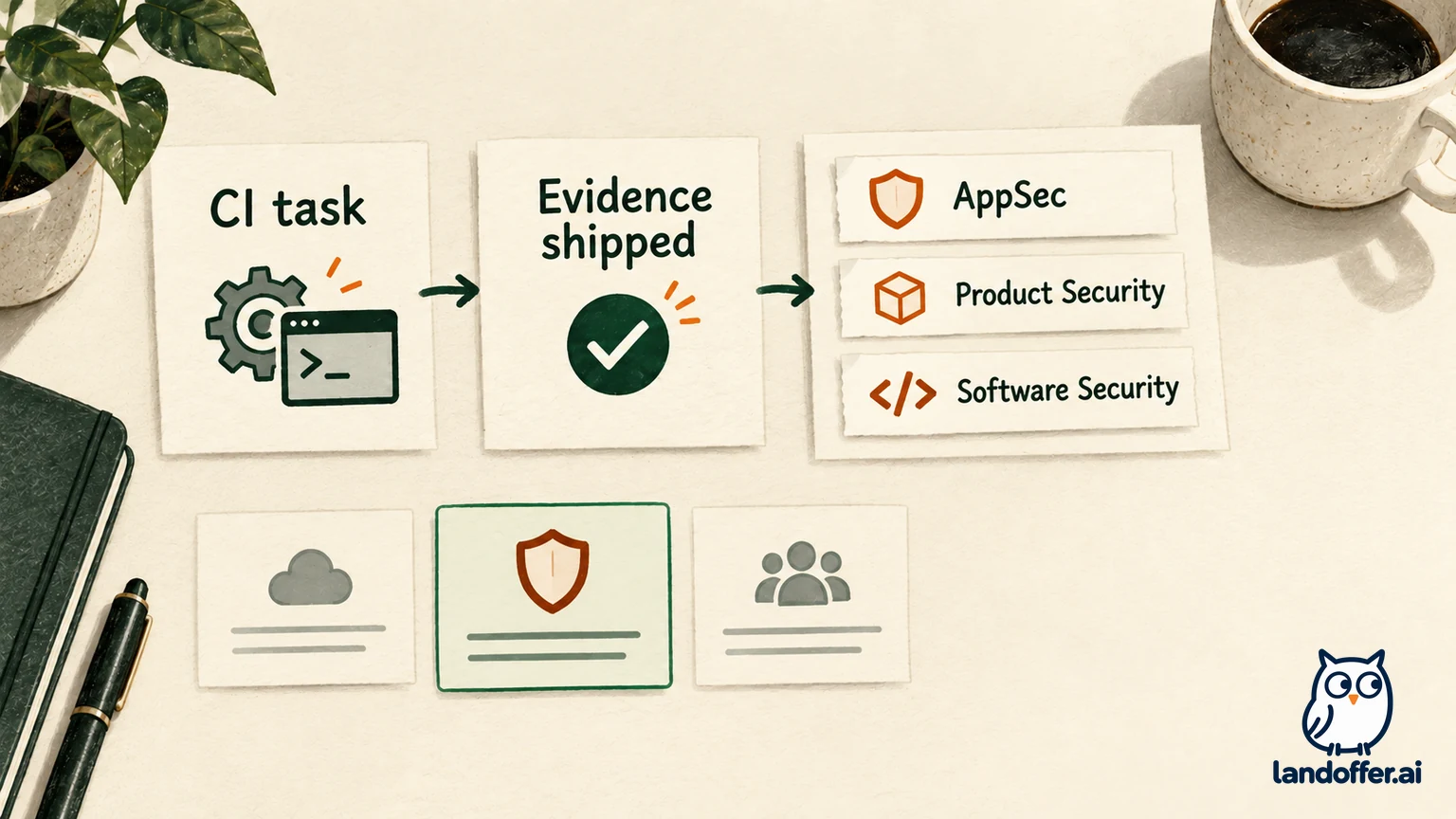
Consider a fictional application-security engineer who has introduced dependency checks in CI, added security review guidance for pull requests, and worked with product developers to remediate flaws. The candidate’s search should reflect those deliverables rather than copying the framework label into every query.
| What the candidate has done | Employer-facing search | What to inspect in the posting |
|---|---|---|
| Built dependency and static-analysis checks into CI | application security engineer secure SDLC |
Does the role own code-scanning workflows, or only receive reports? |
| Added secure code-review practices with product developers | product security engineer code review CI |
Is developer remediation a core responsibility or occasional consulting? |
| Created reusable security tooling for engineering teams | software security engineer developer tooling |
Does the team build and maintain tools, or primarily configure vendor products? |
These are query variants, not live listings. The candidate can run each phrase on an employer career site, a general job board, and a search engine. If the first search returns few results, widen one dimension at a time: replace “application security” with “product security,” remove a tool term, or add the employer’s platform language. Keep the core task visible so the search does not drift into any role that happens to contain the word “security.”
When a result appears, compare the actual duties with your evidence. A title can suggest a direction, but one role might spend most of its time writing policy, another may build developer workflows, and a third may review architecture. A useful resume or portfolio link should show what you personally delivered: the control you added, the developer workflow it changed, and the way you handled follow-up findings. Do not claim a certification or framework alignment that you have not earned or verified.
Triage results by task overlap
The same Work Role can point to several kinds of jobs. Decide whether each result deserves time by looking at its core work, not its broad category label. This completed fictional triage shows how the task crosswalk changes the decision.
| Hypothetical posting | Core work shown in the description | Decision for the fictional candidate |
|---|---|---|
| Application Security Engineer | Owns code-scanning workflows, partners with development teams on fixes, and improves secure software practices | Pursue if level and location fit. The candidate has direct examples for the main responsibilities. Confirm whether the role expects hands-on coding, product reviews, or both. |
| Platform Security Engineer | Builds cloud guardrails, infrastructure policies, and deployment controls | Inspect before applying. Some CI and developer-tooling experience transfers, but the candidate should check how much cloud architecture ownership is required. |
| Security Operations Analyst | Monitors alert queues, triages events, and follows escalation procedures | Skip for this search track. It may be a valid cybersecurity job, but its central work does not match the candidate’s preferred secure-development path. Revisit only if the candidate wants a SOC transition. |
A second Work Role may appear in the platform-security description. That is not a conflict: NIST explicitly allows a job to combine work from multiple roles or a portion of a role. The practical question is which tasks dominate the job and which ones you can demonstrate.
Use a short scorecard when two openings have similar titles. Give each a simple yes, partial, or no for (1) core task match, (2) evidence you can show, (3) required experience or credential fit, and (4) location and employment conditions. A “partial” is a reason to read further, not an automatic rejection. A “no” on a required credential or a hard location constraint may save time. Keep the scorecard beside the job URL so you can explain why you advanced or skipped it later.
Use counts and salary carefully
CyberSeek’s aggregate numbers are for workforce analysis, and its pages attach reporting periods to many measures. Its methodology page describes how posting details are mapped into the cybersecurity landscape and how supply and demand estimates are calculated. A posting can map to one or more NICE categories, so category totals should not be added together as if each were a distinct vacancy. A large national opening count also does not tell you that a particular employer is hiring in your location, that a role matches your level, or that the displayed pay is an offer you can expect.
For salary, use the dashboard as a prompt for questions rather than as a negotiation anchor on its own. Confirm whether the value is advertised salary, an average across multiple postings, a historic period, or a different estimate. Then compare the employer’s compensation range, geography, seniority, employment type, and any public benefits information. If a chart does not expose its sample period or definition clearly, leave the figure out of your decision rather than quietly treating it as current.
The same caution applies to certifications. CyberSeek can surface credentials that appear in postings associated with a role profile. That is a market pattern, not a universal gate. Read a vacancy’s actual requirements first. If a credential is preferred and you lack it, decide whether your related experience is strong enough to apply; if it is explicitly required, determine whether the role is still realistic before paying for training or an exam.
Build a repeatable search plan
Turn one role profile into a small set of searches instead of an unbounded list. Keep three columns in a search note: framework task, title/phrase variants, and evidence you can show. For the fictional candidate, that could be secure development tasks; “application security engineer,” “product security engineer,” and “software security engineer”; and a CI dependency control, developer-review process, and remediation example.
Run each title variant with one task phrase. Add a location or remote constraint only after the title/task query shows you the employer vocabulary. Save a relevant opening only after checking that its employer page remains active and that its role conditions match. Record the date you verified it, the exact requisition, and where the Apply control leads. These details help when the same job appears under a different title on multiple sites.
If a search stays empty, adjust the query deliberately. Remove an overly narrow tool name, try a neighboring title, or search for the outcome of a task such as “secure code review” or “cloud guardrails.” Do not infer that the market has no such jobs from one empty result page. Conversely, do not expand so far that a generic cybersecurity term floods your shortlist with jobs you would not accept.
Use CyberSeek to name the work and recognize adjacent paths, then verify the employer’s title, requirements, and hiring status. Save the requisition and the evidence that supports your fit. To broaden the shortlist, browse recent roles on LandOffer.ai and apply the same task and employer-page checks.