LandOffer
Job search
EarnBetter Review: What Earn Better by EarnIn Offers Job Seekers for Free
Review Earn Better by EarnIn’s free resume, job matching and interview tools, with current access checks and a worked example of consistent career materials.
EarnBetter now presents itself as Earn Better by EarnIn, with free resume help, job matching and interview preparation. The current offer is worth exploring if you want those tasks in one place and are comfortable using an EarnIn account. It is less certain as a last-minute replacement for an editable resume: the public pages do not establish every download format, and the web entry we inspected stopped at phone verification. This review covers current public documentation and that entry screen, checked October 19, 2026; we did not create an account or test generated results.
LandOffer publishes this review and also provides job-search tools. You can use LandOffer’s recently posted jobs to find a specific role before deciding what writing support you need. Neither service’s description establishes that a suggested role fits your circumstances or that generated text is accurate. For Earn Better, the useful questions are what the free offer covers, how current access works, and whether the same facts survive across your resume, application and interview preparation.

What the current free offer includes
The Earn Better product page describes resume building, job matches and interview preparation as free, with no subscription or credit card required. Its FAQ says you can upload an existing resume or create one from scratch. The EarnBetter homepage also describes tailoring materials to a role, interview cheat sheets and mock interview practice. These are vendor descriptions of available capabilities; we have not measured the quality of the writing or recommendations.
That is a meaningful offer for someone who needs help starting several career tasks and wants to avoid a recurring resume-builder subscription. It also changes the comparison with a tool whose main limitation is paid downloads. That lets you focus first on whether you can access the tools and use their output for your application.
The public free claim does not specify every operating detail. We could not verify a current Word export, a complete set of download formats, generation allowances or the current workflow for tailoring a resume to a job found elsewhere. Free resume help does not establish unlimited use, anonymous access or DOCX export. Each needs its own evidence.
Access and output details matter most when an application deadline is close. If your employer requires an editable file, a free writing assistant is useful only if you can carry the finished result into the required format. Keep your existing source document available while evaluating a new workspace.
Follow the current route, not an old EarnBetter tutorial
The brand transition matters because older search results can describe a different interface. At the time of review, the homepage identified the service as Earn Better by EarnIn, formerly EarnBetter. Its sign-in and getting-started links led to the current Jobs web destination. The product FAQ instead described finding Earn Better inside the EarnIn app.
We visited the Jobs web entry without signing in. After loading, it displayed “First, what’s your number?” and said it would text a code, alongside a phone-number field and a disabled Continue button. We entered nothing and requested no code. This observation establishes the entry boundary we encountered, not every onboarding requirement or the experience of an existing account holder.
We also checked an older EarnBetter help article about creating a resume for an external job. Its former instructions referred to a Documents area and a download workflow. The native browser visit returned “Not found.” Consequently, this review does not reuse that sequence as current instructions. An unavailable help article does not establish that tailoring has disappeared; it means those historical clicks are not reliable guidance for the current service.
Rowan’s completed access decision
Rowan is a fictional applicant who needs a laptop-editable resume for an employer deadline this afternoon. Rowan already has a working Word document and wants to know whether Earn Better can replace it immediately. Here is the completed evidence map, using the routes actually inspected for this review.
| Rowan’s question | Current evidence | Decision for today |
|---|---|---|
| Can I start anonymously from the website? | The inspected Jobs entry asks for a phone number and code. | Do not plan around an anonymous editing session. |
| Is there a current app route? | The product FAQ directs users to Earn Better inside EarnIn. | An existing EarnIn user can inspect that route; Rowan has not completed it. |
| Can I follow the old Documents tutorial? | The checked legacy help page returned Not found. | Do not spend the deadline reconstructing historical clicks. |
| Will I receive the required editable Word file? | Current public pages checked here do not establish that format. | Retain the working Word source for this application. |
Rowan’s decision is to finish the existing file and submit through the employer’s required process. Exploring the free career workspace can wait until it does not put the deadline at risk. This is a choice based on a specific access and format gap, not a finding that Earn Better cannot produce an editable file.
An existing EarnIn user with time to explore the current tools may reasonably make a different choice. The product FAQ describes access through the app; we have not verified which steps an existing account holder would encounter. A rewrite or match still needs review. The deciding question becomes whether the tool improves a task you actually need to complete.
Keep one evidence record across three career outputs
Resume writing, tailoring and interview preparation can support each other when they use the same factual account. They can also drift: a short resume sentence may imply a finished project, while a practice answer reveals that it was a class exercise. Compare the project status and scope across the finished documents before using them.
Consider Josie, a fictional applicant for a junior data-support role. The fictional posting asks for SQL joins, checks for duplicate records and clear communication of unresolved data issues. Josie’s evidence is a completed course project using synthetic support-ticket tables. She wrote joins, compared counts before and after a merge, and found duplicate ticket identifiers. She documented an exception list. She did not maintain a production pipeline, contact real customers or measure business savings.
The following packet is independently written for this article. It is an acceptance example for reviewing career materials, not output generated by Earn Better. Each piece uses that same evidence record.
Resume sentence: “Completed a SQL course project joining synthetic support-ticket tables, checking record counts and duplicate ticket IDs, and documenting unresolved exceptions for review.”
Short cover-letter paragraph: “Your junior data-support role emphasizes SQL joins and careful handling of data issues. In a completed course project, I joined synthetic support-ticket tables and checked counts and duplicate identifiers before documenting exceptions. That experience gave me a concrete process for explaining what I had checked and what still needed investigation.”
Mock interview explanation: “This was a course project with synthetic data. I compared row counts around the join and checked whether ticket IDs repeated. When I found duplicates, I recorded the affected IDs and the unresolved questions rather than assuming which row was correct. I can explain those checks, but I have not operated this workflow in production.”
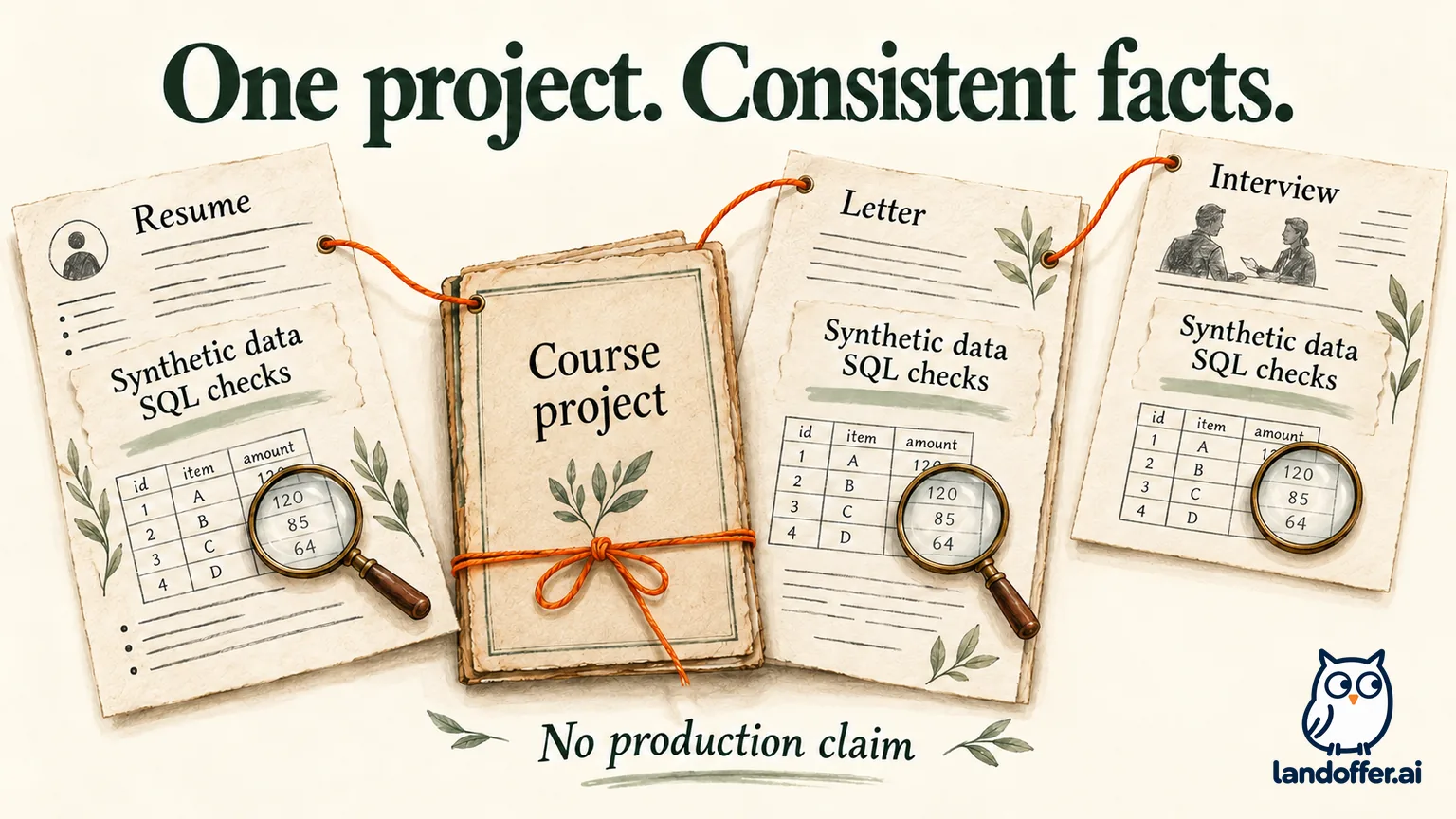
The result is consistent across all three outputs: completed coursework, synthetic data, specific SQL checks and a stated validation limit. The resume is shorter than the interview answer, but neither changes Josie’s responsibility. The letter connects the project to the posting without claiming that it proves production experience.
For Josie, tailoring should make the relevant evidence easier to find. It should not silently convert “documented unresolved exceptions” into “resolved customer incidents.” That change would require additional evidence, regardless of whether the wording came from a free tool, a paid tool or Josie herself.
A practice question about duplicate records can help Josie explain her reasoning. It cannot establish that this employer will ask that question. Preparation is useful when it strengthens an accurate explanation that survives follow-up questions, including the simple question of where the work happened.
Read matches, salaries and tracker labels in context
Earn Better’s Jobs terms, effective May 15, 2026, qualify how readers should use recommendations. They warn that filters and summaries can be inaccurate, salary information can be estimated, and tracker guidance does not determine an employer’s actual application status. The employer’s current posting and communications remain important sources of application facts.
Before acting on a recommendation, resolve the location, experience or pay condition that would change your decision. A remote label alone cannot settle whether a role permits work from your state. A salary figure does not resolve whether it describes base pay, an estimate or a different location. Read the underlying employer information for the condition that determines your decision.
Josie’s example illustrates the difference. A role mentioning SQL might look relevant to her project, yet require independent production support experience she does not have. Her packet helps explain a related skill honestly. It cannot remove an experience requirement. She should decide whether the employer allows an entry-level alternative before spending time polishing the application.
Likewise, a tracked opportunity is useful for organizing the search, but it is not an employer acknowledgment. Keep the employer’s confirmation email or portal record alongside your own notes. If a tracker label and the employer’s message disagree, resolve the status from the actual application record rather than inferring progress from a dashboard.
Account and document decisions come before uploading
The inspected phone-code screen does not mean Earn Better is mobile-only: a web entry exists. Nor does the free career-tool description establish what every account will be asked during onboarding. We did not proceed far enough to make claims about bank connections, other EarnIn services or account eligibility. Financial-product enrollment is outside this review.
Before uploading, choose a job-search copy of your resume that contains the information you intend to use for applications. Do not include reference contact details or private client records merely to give a writing tool more context. In Josie’s case, the synthetic project description is sufficient; there is no reason to upload a private dataset to explain her SQL checks.
EarnIn provides a full privacy policy, while the Jobs terms address application-related information sharing. Read the notices relevant to the account and action you choose. Saving a resume, sharing a resume link and applying to an employer are different actions; do not infer that one has occurred because another is available.
Who should explore Earn Better, and who should keep their workflow?
Earn Better is a reasonable service to explore when you want free help across resume writing, job discovery and interview preparation, and its current account route suits you. Its documented lack of a subscription or credit-card requirement gives a candidate a clear reason to investigate the career tools without first choosing a paid resume plan. The untested part is the usefulness of the actual output for your needs.
Keep your current workflow when it already produces the employer’s required file and you have an immediate deadline, as Rowan does. Also keep an independent factual record when your main challenge is explaining incomplete, academic or limited-scope experience. A writing interface can help express that record; it cannot supply missing work history or evidence.
Choose one recent job, identify the experience you can substantiate, and review one finished piece against those facts before relying on a broader set of materials. Josie’s three-output packet shows what that review should preserve. Keep the version whose project status, responsibilities and limits you can explain consistently.
Sources and Further Reading
- EarnBetter: current Earn Better by EarnIn homepage — current branding and advertised career tools.
- EarnIn: Earn Better product page — free offer, account route and resume FAQ.
- EarnIn Jobs web entry — observed phone-code entry, without proceeding.
- Earn Better by EarnIn Jobs terms — feature and application boundaries, effective May 15, 2026.
- EarnIn full privacy policy — account and service information practices.