LandOffer
Job search
ByteByteGo Review: Visual System Design, Digital Access, and Included Tools
Choose illustrated self-study for a specific reasoning task. Current plans, book and course boundaries, and a completed session-state example show what to evaluate.
ByteByteGo is worth considering when illustrated, text-based explanations help you understand a system-design decision you can then explain on your own. Start with a public chapter and turn one diagram into a request-and-failure trace before buying more access. Printed books and digital courses have separate entitlements, Ask Alex is advertised with the main course offer, and ByteByteGo Live is a separate membership. Book ownership alone does not establish access to those services.
This review uses official pages and native public pricing, FAQ, and chapter observations checked October 13, 2026. We did not buy a plan, use Ask Alex, access paid chapters, or attend a live course. The two worked cases are fictional, and the session-state trace uses local dictionary lookups rather than a production authentication system. LandOffer publishes this guide; recent tech roles can help identify a target, while the employer's actual interview instructions should define the preparation task.

Inspect the format before choosing the bundle
The main course FAQ describes text-based courses with detailed illustrations and public preview chapters. It also says books and courses are separate products: owning a book does not make the course free. That matters if you have a printed System Design Interview book and are considering the website mainly for a different reading experience or newer material.
The public System Design Interview curriculum includes estimation, an interview framework, rate limiting, hashing, key-value storage, notifications, chat, and other systems. The current pricing page lists broader tracks including coding patterns, behavioral interviews, object-oriented design, machine-learning systems, mobile systems, generative AI, and resume guidance. We inspected the outlines and offer, not the depth of every paid track.
A bundle can be useful when several of those tasks belong in your preparation. It can also distract from the one round approaching first. Someone preparing for a backend system-design discussion should name the relevant chapters and practice output before assigning value to every additional course. A long list of included titles is not a study schedule.
If you prefer learning through long videos, test whether the illustrated reading format holds your attention. If you already learn well from a book, identify what the digital course adds for your situation. Judge the presentation by a tradeoff you can explain after closing the page. A polished diagram gives you a starting point for that explanation.
Use free material to test the learning method
We read the public Scale From Zero To Millions Of Users chapter. It combines prose and diagrams while introducing web and data tiers, load balancing, replication, caching, and the placement of session state. This is a concrete sample of the format. It is not a hands-on assessment of the entire course or a benchmark of an architecture built from its diagrams.
For a useful reading session, stop at one design change. Write down the problem it addresses, the request path before and after, and a failure it leaves unresolved. Then close the chapter and explain that change from memory using your own small example. This separates recognizing a familiar drawing from reasoning about why its components exist.
The public Engineering Visual Guides index also organizes short explanations across topics such as APIs, storage, cloud systems, and security. We inspected this public index. We did not test the bundle-download function or establish that every linked resource has the same access rules. The index can help you find a narrow concept to sample before choosing a larger course.
Free material may be enough when your gap is one concept. A paid collection becomes more useful when you want a consistent treatment across several connected systems and have time to work through them. Keep your current book or course if it already supplies that treatment. You do not need a second explanation merely because it is presented in another format.
Worked entitlement choice: Elliot already owns a book
Elliot is a fictional engineer with a printed System Design Interview book, a $200 spending limit, and a backend interview window this quarter. He wants convenient digital reading and access to relevant newer course material. He also wants someone to challenge his answers, which is a separate need from reading.
He maps the possible purchases to those needs:
| Route | What the inspected evidence establishes | What Elliot should not assume | Decision |
|---|---|---|---|
| Continue with his printed book | He already owns that reading resource | Automatic digital-course or Ask Alex access | Use it for the baseline explanation |
| Main One Year Access offer | Displayed price $189; current digital course bundle listed | A verified renewal setting or a human mock interview | Consider for the named digital-content need |
| Main long-access offer | Displayed price $499, labeled Pay Once, Own Forever | Offline ownership of every resource or unchanged future tools | Exceeds his stated limit |
| ByteByteGo Live | Separate annual live-course product | Inclusion in the main $189 course offer | Does not address his immediate self-study purchase |
The $189 and $499 figures were observed after the main price cards loaded, with $399 and $999 struck through. We did not verify checkout taxes, currency handling, or future offers. Elliot's budget comparison assumes the displayed dollar amounts are the ones relevant to his purchase; he must confirm the final amount before paying.
He chooses to inspect the public digital chapter first and compare its explanation with his book. If digital reading and a specific current course add useful work, the observed year price fits his limit before any additional charges. If he mainly wants a person to assess his answer, neither the course list nor the Ask Alex label establishes that entitlement. He keeps the book for study and evaluates human feedback separately.
Elliot has not established the main year plan's automatic-renewal setting. The inspected public price card names an access period, while the main FAQ and terms did not provide a specific renewal rule for that offer. He therefore treats confirmation of billing and the exact end date as a condition of purchase. He does not infer the setting from a different product's annual membership.
This choice is about an entitlement gap, not a requirement to buy every format of the same explanation. Owning a print edition is useful evidence about what Elliot already has. For Elliot, the additional value would be reading a specific newer course and returning to its diagrams during his preparation window. Another copy of an explanation he already uses well adds less to his plan.
Worked design correction: trace where session state lives
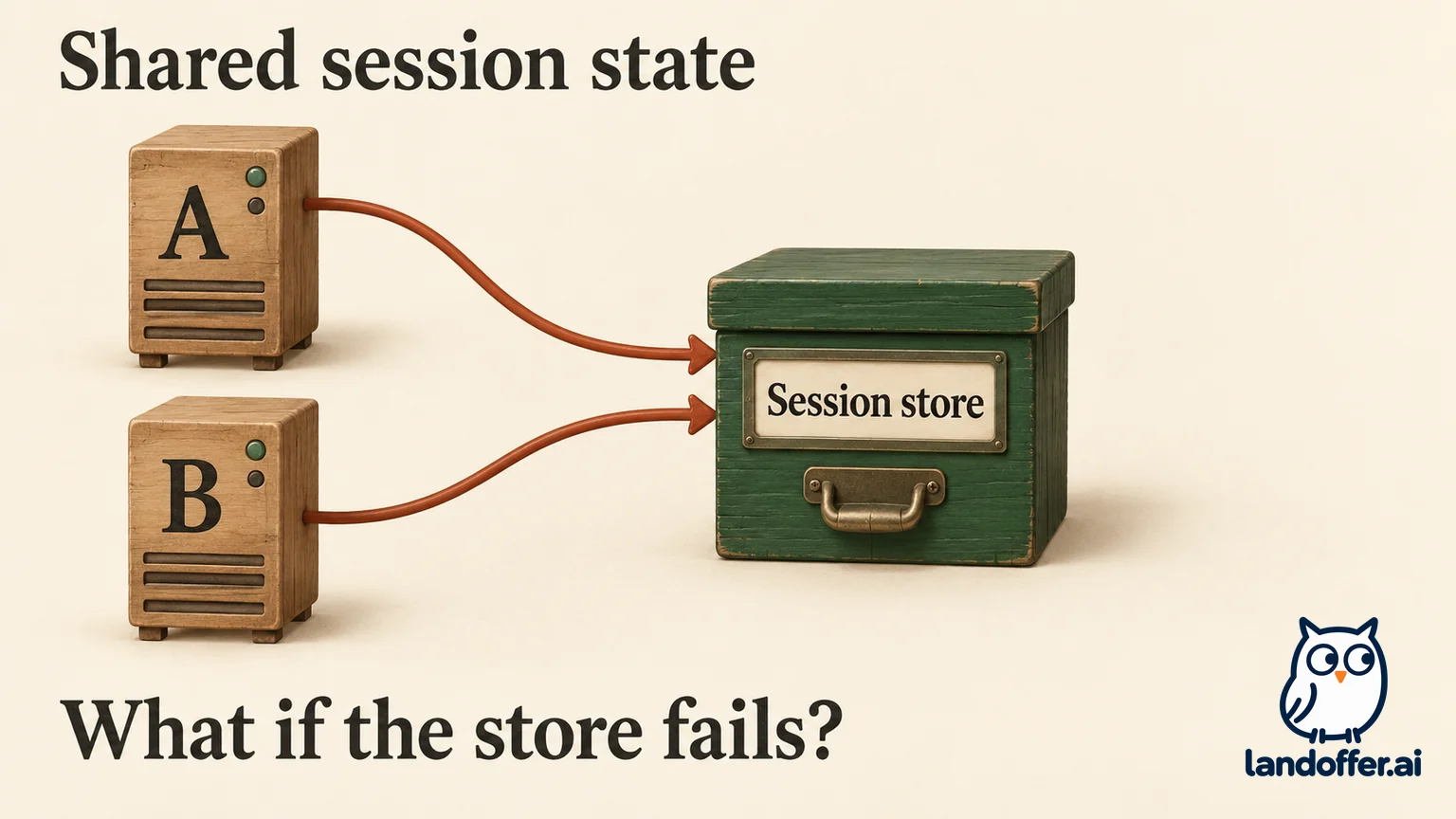
Lina is a fictional learner reading a load-balancer diagram. Her first explanation is: “Add a second application server and a load balancer, and logged-in requests will work on either server.” The missing question is where the state used to recognize the session is stored. Routing traffic is not the same operation as making that state available.
Use a small teaching model. Server A has a local mapping from an example session identifier to an example user. Server B has an empty local mapping. A client presents the same identifier on a later request, but the request goes to B. A successful lookup on A does not create a corresponding record on B.
| Step | State consulted | Result in the original local-state model |
|---|---|---|
| Session recorded by A | A's local mapping | Identifier maps to the example user |
| Next request reaches B | B's local mapping | Identifier has no matching record |
| Request goes back to A | A's local mapping | Original record can be found |
Lina revises the model so both application servers consult a shared session mapping. In the local teaching trace, looking up the identifier through either server now returns the same example user. Both lookups now consult one mapping rather than independently maintained A and B records. This teaching change addresses the missing-record result; it does not test replication or synchronization. It does not, by itself, make the shared dependency available when it fails.
Her revised explanation is:
“A load balancer chooses an application server. If the session record exists only on A, routing the next request to B can fail to find it. In this model, both servers consult the same session store, so changing the application server does not change which record they look up. I still need to decide how that store handles failure, expiry, and recovery. Adding it has moved a dependency; it has not eliminated every failure.”
We checked the original and revised lookup results locally with dictionaries. These are fictional identifiers and a minimal state trace, not HTTP requests, a deployed load balancer, secure-cookie handling, or a ByteByteGo product test. The example does not implement replication, revocation, timeout behavior, or an authentication protocol. Its purpose is to make one design assumption visible.
The follow-up is deliberately different: “What happens if the shared store is unavailable while both application servers are healthy?” Lina's answer must acknowledge the unresolved lookup dependency and identify the decision she would investigate next. A diagram with two application servers alone cannot answer it. Identifying that dependency gives Lina a focused next question. She can investigate recovery separately without treating an unfinished answer as evidence that she learned nothing from the diagram.
The public chapter helped identify a concept worth examining; the trace is our original worked example. We did not copy the vendor's diagrams or adopt every simplified claim in the sample as a production guarantee. A visual explanation is most useful when it leads to a defensible account of state, requests, and failure boundaries.
Understand what the advertised tools establish
The main pricing page lists Ask Alex as trained on ByteByteGo books and advertises regular content releases. That establishes the public description attached to the offer. We did not verify Ask Alex's response quality, model, citations, numerical allowances, or behavior after a year of access ends. Treat a generated explanation as something to examine, rather than a substitute for checking the design assumptions.
For Lina's example, a useful question would ask an assistant to identify where the session record is read and which dependency can fail. She would still need to verify the answer against the chapter and her own trace. This is a proposed learning use, not a report that Ask Alex answered that question successfully.
Likewise, a resume or behavioral course in a digital bundle is instructional content unless a separate service promises otherwise. Do not treat a course title as a commissioned resume rewrite, recruiter introduction, or personalized coaching hour. The inspected main offer did not specify those deliverables.
Content updates may give you more to read during access. They do not supply the hours to evaluate and practice it. Ask whether a new chapter connects to a problem you are preparing for, and keep a short record of the design decision it helped you explain. That is more useful than adding every new release to an already unfinished reading list.
Keep access, refunds, and Live membership separate
The main FAQ says course refunds are unavailable and points readers to free content before buying. We did not test a refund request. Treat the public sample as a way to evaluate fit rather than assuming a trial or money-back period for the self-study course.
ByteByteGo Live is a separate live-course membership. Its public description covers cohort sessions, recordings, and materials, with its own purchase and refund conditions. Those terms do not establish the conditions of the main digital-course offer. We inspected the distinction without registering for a cohort or assessing the instruction.
The main terms of service, updated February 19, 2026, describe the company's proprietary service content and the conditions for account access. A long-access marketing label does not, by itself, establish a downloadable PDF or ebook entitlement, permanent offline copies, or an unchanging future feature set. We did not test exports or downloads. Confirm any format you specifically need before assigning value to it.
For a year purchase, record the actual access end date and renewal preference shown for your account. For long access, save the current offer and its included content description. In either case, choose one public chapter, explain a design change and its remaining failure case, and identify the additional digital material that would help your next attempt. Before paying, confirm the actual charge, included tool access, end date or long-access entitlement, and any renewal setting. Keep the learning task small enough to complete during the period you choose.
Browse recent roles on LandOffer.ai, then use the role requirements and interview instructions to choose the design task you will practice next.