LandOffer
Job search
InterviewReady Review: System Design Courses, AI Practice, and Access Terms
Separate video course access, AI interview practice and design feedback before buying.
Consider InterviewReady if you want video-led system-design study, with separate material on AI engineering, low-level design and behavioral interviews. Choose the course by the gap you need to close and read its own access terms. System Design Simplified advertised one year of access, while the AI Engineering course advertised lifetime access. Neither description establishes unlimited AI interview practice or a human coach.
We inspected public course pages, expanded FAQs, legal policies and the AI interview setup on October 14, 2026. We did not buy a course, complete a paid lesson, record an answer or evaluate a generated feedback report. This review assesses the documented scope and observed public controls, rather than claiming the teaching or automated assessment produced an outcome.
LandOffer publishes this review. You can browse recent roles on LandOffer.ai to identify whether your next interview emphasizes system architecture, implementation design, AI systems or your past decisions before choosing preparation material.

Start with the system-design curriculum
System Design Simplified is described as a video course covering fundamentals, design concepts, interview examples and case studies. Its public curriculum names caching, consistency, networks, replication, observability and design trade-offs. Later sections include large-system examples and discussions of existing technologies.
That structure can help someone who understands individual backend components but struggles to connect requirements to a coherent design. Look for an explanation of why a choice fits a constraint, what it gives up and how a failure changes the result. After a preview, try defending one choice without replaying the explanation. A familiar company name in a case-study heading does not show that you can independently defend the design.
The page displayed 242-plus video lessons, 34-plus quizzes and 58-plus downloadable resources, with an October 2026 update label. These are provider descriptions, not our audit of every lesson or its freshness. The expanded duration FAQ suggested three to five weeks to complete the course. That is an estimate for study, separate from the one-year access offer; it is not a promise that a particular learner becomes interview-ready in that period.
We did not watch the course videos or judge their pacing, clarity or technical depth. Use the available preview to examine those properties yourself. Pay attention to whether you can explain the reasoning afterward, rather than deciding solely from the presenter's reputation or the number of videos.
Course names carry different work and different access
The current course catalog listed System Design Simplified and AI Engineering as paid offers, alongside low-level design and behavioral courses described as complimentary with a course purchase. The inclusion wording does not make their learning goals interchangeable.
| Course | Main task described | Access wording observed |
|---|---|---|
| System Design Simplified | Connect requirements, components and distributed-system trade-offs | One year |
| AI Engineering | Study vectors, LLM internals, optimizations and applications | Lifetime, with future updates stated in its FAQ |
| Low Level Design | Work through software-design principles and implementation structure | Lifetime; complimentary with a course purchase |
| Behavioural Interviews | Organize experience and explain competencies | Lifetime; complimentary with a course purchase |
The AI Engineering course included vectors, attention, inference optimizations and agent-related material in its public outline. It can address an AI-specific knowledge gap. Lifetime access to that course does not extend the system-design course's period or establish ownership of all future courses on the platform.
The Low Level Design course uses a game-engine example and software-design principles, with additional machine-coding topics. That concerns objects, responsibilities and implementation behavior. It can complement high-level architecture study, but the two require different practice artifacts.
The behavioral course discusses competency-based interviewing and structured accounts of experience. A prepared story is not evidence that an architecture survives a race condition. Likewise, a strong design diagram does not explain how you handled disagreement on a real team. Match the material to the task you expect to demonstrate.
What the displayed prices actually established
In our native-browser inspection, the system-design page offered access for $85 per year. AI Engineering offered lifetime access for $55. Their current canonical course pages and catalog supported those amounts. Taxes, checkout eligibility, payment currency details and future renewal charges were not verified.
Search results for older official subdomains still showed a $170 system-design offer. We did not establish why those versions differed. We use the amount actually observed on the current canonical page, with its access period, rather than treating an older search excerpt as a current quote or inventing a regional explanation.
The $85-per-year label describes a year of access at the displayed price. It does not by itself establish whether a saved payment method is automatically charged again. We did not verify a course-specific renewal mechanism, renewal discount or repurchase price. A plan to return after eighteen months therefore needs an answer about continued access before it relies on the first year's purchase.
Mara's completed course and time decision
Mara is a fictional backend engineer with six weeks and 32 hours available before a system-design interview. She can implement services but struggles to justify component boundaries and failure handling. She has no identified AI-engineering interview requirement. Her provisional allocation is 18 hours on selected fundamentals, eight hours producing her own designs and six hours rehearsing explanations.
These hours are her own budget, not the provider's expected workload or a promise that she can finish the catalog. The allocation leaves fourteen of her 32 hours for producing and explaining designs, so a long playlist cannot silently consume the entire preparation period.
| Purchase route | Observed amount | Fit with Mara's stated gap | Her decision |
|---|---|---|---|
| System Design Simplified | $85 for one year | Relevant curriculum and enough advertised access for six weeks | Provisional choice after preview review |
| AI Engineering alone | $55 for lifetime access | Does not address her central architecture gap | Decline despite the longer access label |
| Both paid courses | $85 + $55 = $140 | Adds an AI curriculum she has no current need to study | Defer the extra $55 |
The complimentary-course descriptions may make low-level or behavioral material available with her purchase, subject to the actual offer. She does not add more hours merely because more content is included. If an initial rehearsal reveals difficulty describing past decisions, she can reallocate some existing practice time to behavioral preparation.
Mara also wants to revisit system-design material eighteen months later. The one-year offer does not meet that longer requirement on its face. She records the future-access question separately instead of treating the AI course's lifetime promise as a solution. She cannot responsibly budget another $85 as a guaranteed future charge because we have not verified the future price or mechanism.
Her current decision is to consider the system-design course for the six-week task and resolve later access if it remains important. If a preview does not fit her learning style, keeping an existing book, free explanation or peer arrangement is a reasonable alternative. We have no paid-course test that would justify overriding that preference.
AI practice is a separate workflow to inspect
The public AI mock interview setup displayed system-design and behavioral choices when we inspected it. The system-design option described a 45-minute simulation; the behavioral option described 30 minutes. It also offered company and level selections, an optional interview date and microphone controls.
The homepage advertised a coding simulation too, but we did not see a coding choice in this setup. Do not plan around a feature merely because a broader marketing section mentions it. Confirm the route available to your account and the interview type you intend to use.
The observed company selection defaulted to Google and the level to Staff. Those were interface defaults, not evidence that we have an interview booked with Google or that the practice is calibrated to a particular company's current process. Company labels can frame practice without establishing employer endorsement.
We opened “How it works,” which displayed a video dialog describing choosing a requirement, building on a canvas and defending decisions. We did not complete that walkthrough or an interview. Session cost, included attempts, account restrictions, reset rules and any link between a course purchase and practice entitlement remain unverified. A course price should not be treated as an all-inclusive practice budget without those facts.
Bring a failure trace you can explain
Mara prepares an original exercise about reserving the last place in a small workshop. This is our fictional teaching example, independent of InterviewReady's questions, videos and scoring. The requirement is specific: two competing requests must not both receive confirmation for the single remaining place.
Her first sketch has each request read availability and then write a reservation. The completed trace exposes the problem:
| Step | Request A | Request B | Result |
|---|---|---|---|
| 1 | Reads one place remaining | Has not read yet | No reservation confirmed |
| 2 | Has not written yet | Reads one place remaining | Both believe a place is available |
| 3 | Writes a confirmed reservation | Has not written yet | A receives confirmation |
| 4 | Already confirmed | Writes a confirmed reservation | B also receives confirmation; the requirement fails |
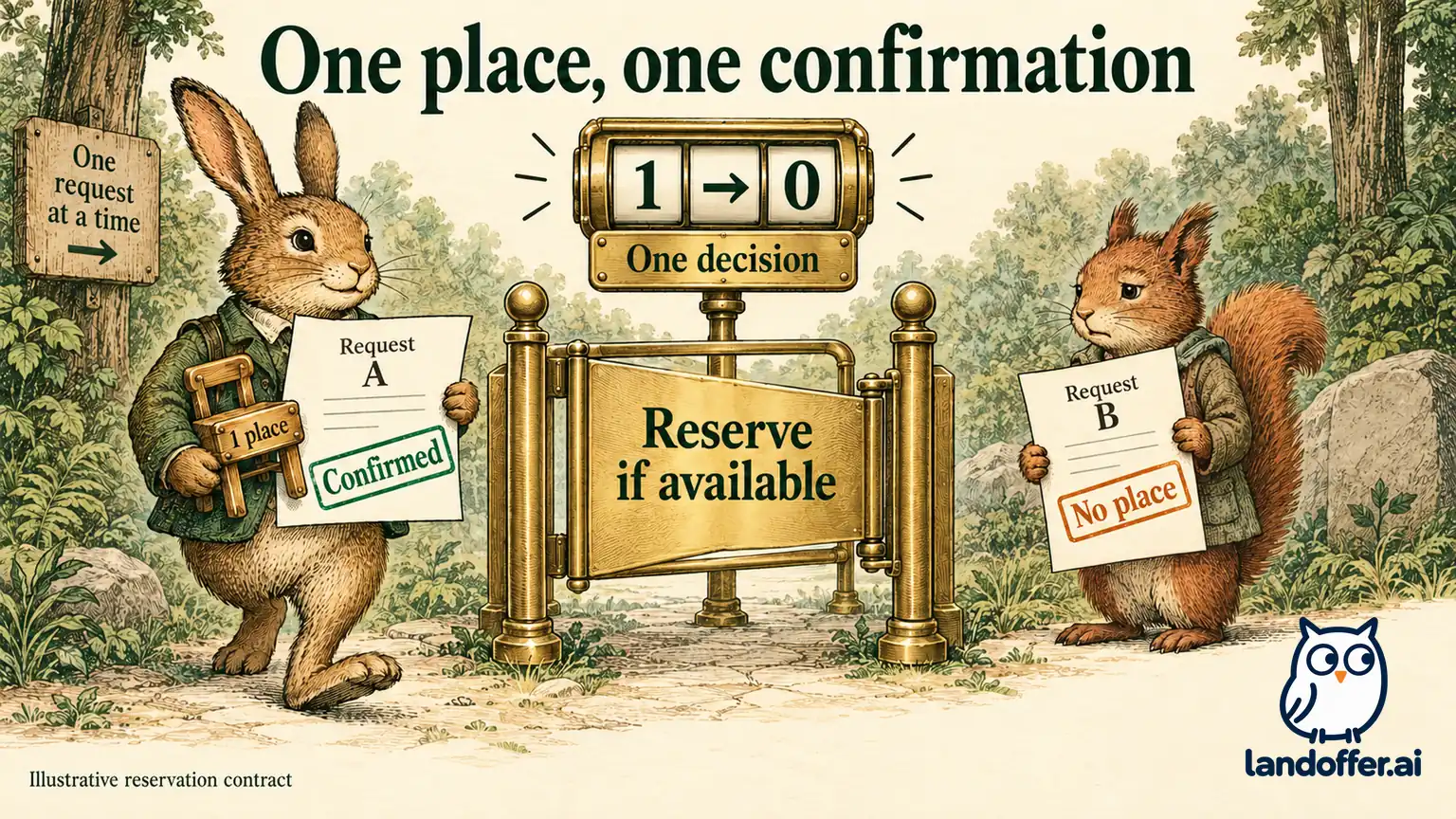
The issue is the gap between checking availability and creating the reservation. Adding another application server would not define how competing requests share that decision. Mara revises the operation's contract: reserve one place only if the authoritative remaining count is positive, with the check and decrement treated as one indivisible decision.
Under that proposed contract, A changes the count from one to zero and succeeds. B then sees no reservable capacity and fails. If B reaches the operation first, the winner reverses; the requirement is one success, not a preferred winner. This is a model of the required behavior, not an implementation we have deployed or a guarantee supplied by an unnamed database.
The revision leaves further questions. A repeated request after a network timeout needs a defined identity so a client can learn the original result without reserving again. If a hold lasts five minutes, Mara still needs to define who releases it at expiry and how that release avoids increasing capacity twice. A failed response does not necessarily mean the reservation failed. Mara writes those as unresolved parts of the design instead of announcing that the whole service is correct.
High-level design study can help her locate the authoritative boundary and explain the trade-off. Low-level work can clarify the operation's input, result and state transitions. A practice interviewer could challenge either explanation. We have not submitted this exercise to InterviewReady, received its feedback or established that an automated score would detect the race.
Refund and microphone wording have practical limits
The terms, updated September 5, 2026, state that purchases are non-refundable and non-transferable except where applicable law requires otherwise. They separately address a vendor-canceled purchase after payment. That is not a general trial period or satisfaction guarantee. Inspect the actual course and purchase terms before relying on a refund as your test strategy.
We did not book the advertised consultation or contact support. A consultation offer also does not establish ongoing coaching, private review of every design or a promised response time after purchase. Those would need their own scope and availability evidence.
The mock setup says microphone audio is sent when an answer is recorded and that audio and transcripts are not sent to product analytics. That is a specific data-flow statement, not a promise that the service never processes, retains or shares interview data for any purpose. We did not test recording or request microphone access.
The privacy policy, updated January 14, 2026, describes general service data handling. We did not verify interview-specific deletion controls, retention periods or model-training settings. Use invented examples when testing a practice tool rather than assuming a company's confidential design is appropriate to upload.
Choose InterviewReady when the named video curriculum fits the work you need to do and its access period fits your schedule. Before paying, inspect a preview and write one failure trace of your own. Confirm the named course's access period and the cost or allowance for any AI practice you plan to use. Use LandOffer.ai to connect that preparation to relevant roles, rather than collecting additional courses without a defined task.
Sources and Further Reading
- System Design Simplified: current canonical offer, curriculum and duration FAQ
- AI Engineering: curriculum, lifetime access and future-update FAQ
- Low Level Design: implementation topics and access description
- Behavioural Interviews: competency-based material and access description
- Current course catalog: paid and complimentary-course descriptions
- AI mock interview: observed public setup and microphone statement
- InterviewReady homepage: broader practice descriptions
- Terms and Conditions: refund and cancellation policy
- Privacy policy: general service data handling