LandOffer
Job search
Hello Interview vs. ByteByteGo: Guided Practice or Visual System Design Study?
Choose a practice structure or a visual explanation based on the design decision you cannot yet explain; current digital offers have separate terms.
Choose Hello Interview when step-by-step practice would help you organize a design answer and examine the reasoning at each stage. Choose ByteByteGo when illustrated, text-based explanations would help you understand a system's components and data flow. Both provide learning material and advertise AI assistance. Compare what their paid access adds to the reading and practice you already use. Try public content before paying; a readable diagram or a prompted answer is useful evidence about learning, but neither establishes independent interview performance.
This comparison uses official sources and public pricing and FAQ observations checked October 13, 2026. We did not buy access, run Guided Practice, query either AI assistant, or compare paid lessons. The two learners below are fictional, and the report-state trace was checked in local Python. LandOffer publishes this guide. Use recent tech roles and the employer's actual interview instructions to define your preparation task before choosing a resource.

Compare current digital learning products
Hello Interview's Guided Practice description presents design problems in steps, with AI feedback along the way. Its system-design track names requirements, entities, APIs, high-level design, and deep dives. That structure can be useful when you have relevant knowledge but lose the thread of an answer. We inspected the description, not the accuracy or usefulness of feedback on a submitted design.
ByteByteGo's FAQ describes text-based courses with detailed illustrations and preview chapters. The public scaling chapter combines prose and diagrams to introduce request paths, separated web and data tiers, load balancing, caching, and other concepts. We read this public sample; it does not establish the quality of every paid course.
Compare the same needs on both sides:
| Need | Hello Interview | ByteByteGo |
|---|---|---|
| Read a concept before practicing | Public guides and Premium explanations or videos | Illustrated text courses and public chapters |
| Work through an answer in stages | Guided Practice advertises prompts and per-step AI feedback | Inspected main offer emphasizes course explanations and a book-trained assistant |
| Try the format first | Free content and one Guided Practice problem advertised | Preview chapters and public curriculum |
| Current shorter access choices | One month $47 or one year $95 | One year $189 |
| Current long-access offer | Lifetime $319 | Pay Once, Own Forever $499 |
The Hello Interview figures came from its loaded main Premium page, and the ByteByteGo figures from its loaded main pricing page. Higher amounts were struck through; other Hello pages still displayed higher price cards. They are observations, not guaranteed future prices or verified checkout totals. A larger catalog does not automatically make the higher price useful. Choose the material and practice output that belong in your actual preparation window.
Hello Interview also teaches concepts, and ByteByteGo readers can practice independently after studying a chapter. The table does not imply that either owns a learning method exclusively. It distinguishes the workflow described by the inspected offers from a learner's own practice routine.
Keep guided steps, AI simulations, and human feedback separate
Hello Interview's official notice says its human mock interview and mentorship programs ended May 31, 2026, while Premium, Guided Practice, and free content continue. A comparison that lists those old human sessions as part of today's Premium purchase would describe the wrong service.
Hello Interview's Live Practice is a separate AI interview format with timed sessions, reports, replay, and credits. The current page lists one included interview with the month plan, two with the year, and four with lifetime. These are finite included runs, not unlimited human mock interviews. Guided prompts and an uninterrupted timed simulation ask the learner to do different work.
The main ByteByteGo offer lists Ask Alex as trained on its books. That is a product description. We did not establish its response quality, numerical allowances, citations, or whether it would recognize a particular design mistake. Its separate Live product is also outside the main self-study course purchase compared here.
If you need someone to observe how you handle an unexpected question, specify that need separately. A course, an AI response, and a human conversation are different deliverables. Their usefulness depends on the question you need answered; a product's feedback label does not by itself establish that it answers that question well.
Worked choice: Omar needs to organize an answer
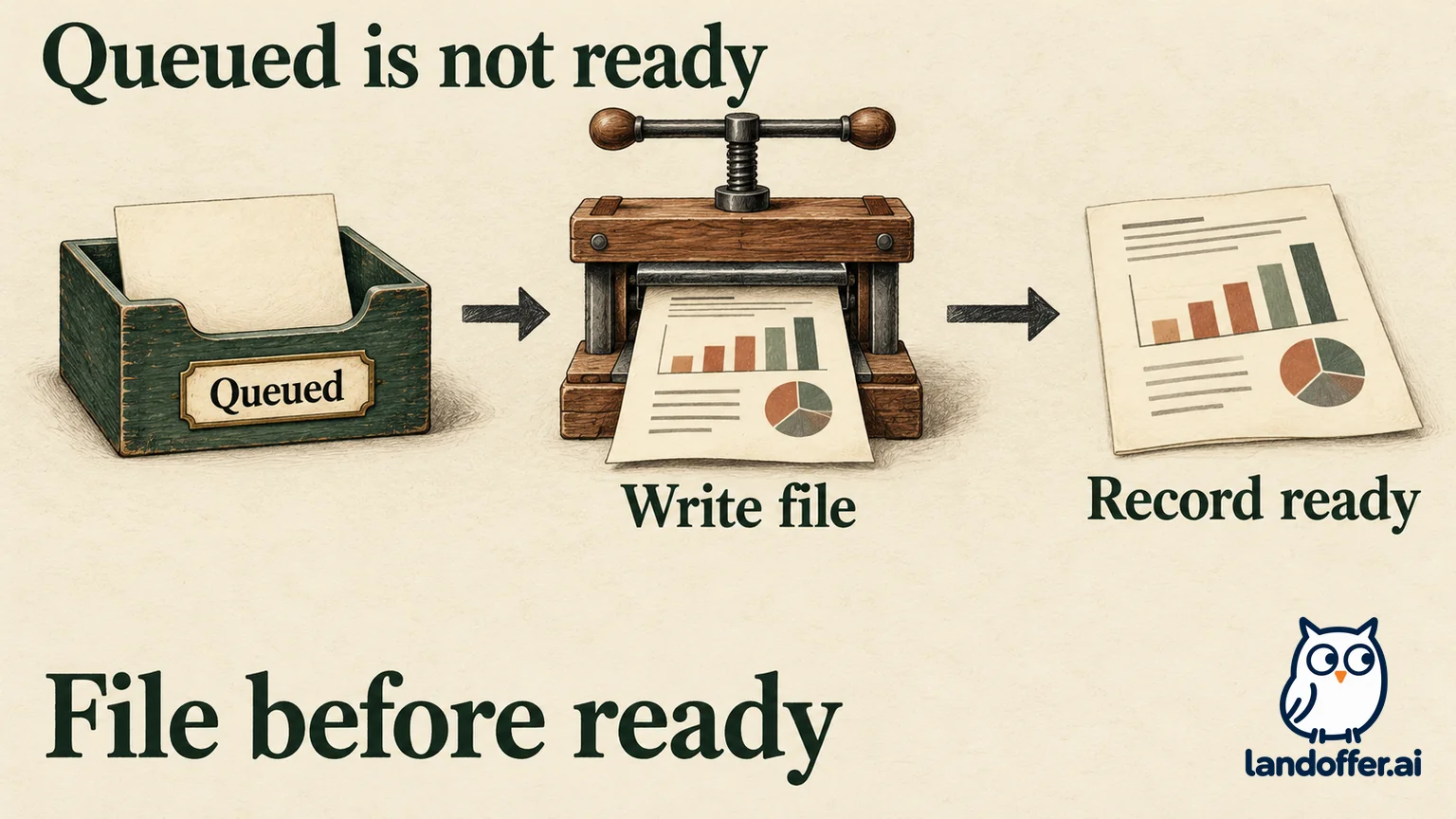
Omar is a fictional engineer with a system-design round in three weeks, twenty-four scheduled study hours, and a $60 budget. He can describe queues and storage, but he starts drawing components before saying what the user needs. His initial report-generation answer labels a job ready as soon as it enters a queue.
He sets an explicit requirement: the user should be offered a download only after the report file has been written and completion recorded in the model. A queue entry alone does not satisfy it. This requirement changes the meaning of his status response before he chooses a particular technology.
The public Hello Interview delivery framework starts with requirements and develops a baseline design before deeper discussion. Omar uses that public structure to organize his next attempt. He reserves six hours for reading and defining the task, twelve for attempts and revisions, and six for independent explanations. This is his fictional allocation, not the vendor's completion estimate or a claim that twenty-four hours establishes readiness.
The current $47 month offer fits his budget and three-week window. He considers it only if the public sample shows that prompted steps add useful structure beyond the free framework. The $95 year and ByteByteGo's $189 year exceed his limit. He does not buy a longer period simply because its monthly equivalent might be lower.
Omar's completed choice is a free framework first, then a month of Guided Practice access only for the identified structure gap. He keeps an independent redo in his schedule. A prompted answer may help him notice an omitted requirement; the redo asks whether he remembers to establish it without a prompt. If he omits it again, he has a specific step to revisit before adding more design topics.
Worked correction: queued does not mean ready
Use an original, small teaching model for Omar's report. A request creates job J. A worker will create report-J.csv. The user can inspect status and may download the file when the model reports ready. The model deliberately excludes retries, concurrent workers, authorization, and real storage durability so that one mistaken assumption is visible.
His initial state is ready with no file reference. A download request has nothing to retrieve. The design has confused acknowledging work with completing the result the user asked for.
| Event in the revised model | Status | File reference | What it establishes |
|---|---|---|---|
| Request recorded | Queued | None | Work exists; no report is available |
| Worker begins | Running | None | Processing has started |
| File write succeeds | Running | report-J.csv | The example result now exists |
| Completion recorded | Ready | report-J.csv | The model may expose the completed result |
We checked these states locally. Every ready state in the revised trace has a file reference. The assertion checks that reference in memory; it does not inspect file contents or establish that a real storage system can still serve them. A separate worker-failure-before-write case stays failed with no file. The initial ready-without-file case violates the stated requirement. These are six assertions about a fictional in-memory model, not tests of a durable queue, an actual file store, or either vendor's feedback.
Omar's revised answer is: “Recording the request gives me a job to track. It does not give the user the generated file. In this model, ready follows a successful file write and a completion record. If the worker fails first, I report failure rather than offer a nonexistent download. I still need to decide how retries and crashes affect that state.”
That last sentence matters. In a real system, a worker could write a file and fail before recording completion, or a file could become unavailable later. Our ordered trace does not resolve those cases. Omar now has a specific next decision about recovery and the relationship between the file and status record. His diagram also needs to identify which event changes the status and what happens if that event is not recorded.
This example shows how to combine the learning methods. A guided sequence can remind Omar to state the requirement and status behavior. A diagram can help him trace the worker's output and the user's read path. He then closes both resources and explains the states. We have not claimed that either product generated this correction or would grade it correctly.
Worked choice: Mara wants a connected visual explanation
Mara is a fictional engineer studying intermittently over six months with a $220 budget. She can structure a design discussion, but she struggles to explain where data moves between components when reviewing an unfamiliar architecture. She wants a consistent collection of illustrated explanations she can return to, rather than more prompts for arranging an answer.
She first reads ByteByteGo's public sample and redraws one request path in her own words. For each connection she names the input and output, then marks where state is stored and one dependency that can fail. The redraw gives her a specific explanation to check after closing the chapter. This is an evaluation task she can complete with free material. It is not a claim that attractive diagrams necessarily produce deeper understanding.
If the sample supplies enough explanation for her immediate gap, she keeps the free route. If she wants related paid chapters in the same format, the observed $189 year fits her window and limit before additional charges. The $499 long-access offer does not. Hello Interview's $95 year is cheaper, but a lower payment alone does not establish that its paid increment addresses Mara's particular reading need better.
Her completed choice remains tied to the format: free visual sample first, then a year of connected illustrated material only if she identifies chapters she will use. She does not add a Hello Interview month as an automatic companion. At observed prices, that combination totals $236, exceeding her budget. She can use Hello Interview's public delivery guide when a structure question arises.
If Mara already owns a relevant book, she compares the digital increment with that existing resource. ByteByteGo's FAQ says books and courses are separate products; owning a book does not make the course free. A separate entitlement is a purchasing fact, not a reason to buy the same explanation again. Keep the book if it already supports the work she needs to do.
Compare access conditions before choosing the period
The main Hello Interview FAQ says fixed access is a one-time purchase rather than automatic monthly or yearly billing. It offers free material and a sample instead of a Premium free trial. Refunds are generally unavailable, with exceptional consideration for users who have not consumed content. We did not test purchase, expiry, cancellation, or a refund request.
ByteByteGo's FAQ says course refunds are unavailable. Its public year price names an access period, but the inspected pricing, FAQ, and main terms did not establish the offer's specific automatic-renewal setting. Record that as an unresolved purchase condition. Do not copy a billing rule from another ByteByteGo product or another platform.
The long-access labels also need careful interpretation. Neither a label nor a promise of future content establishes permanent offline copies, unlimited AI usage, or an unchanging service. Hello Interview's terms and ByteByteGo's main terms govern their respective account and content access. Confirm the format you need rather than assuming a digital course purchase includes a printed book or downloadable edition.
Choose a learning output before comparing promotional savings: a requirement-first answer, a trace of state and data, or an independent explanation of a remaining failure. Then match the access window and total payment to that output. Browse recent roles on LandOffer.ai, identify the interview task, and work through one public sample. Write an explanation from memory and mark the unresolved decision. Before buying, name the paid material that addresses it and confirm the total charge, access dates, and any renewal setting.
Sources and Further Reading
- Hello Interview Premium offer
- Guided Practice description and sample
- Public system-design delivery framework
- Hello Interview Premium FAQ
- Human mock and mentorship sunset notice
- Separate AI Live Practice and included credits
- Hello Interview account and service terms
- ByteByteGo self-study plans and tools
- ByteByteGo format, book, and refund FAQ
- Public ByteByteGo scaling chapter
- ByteByteGo main service terms