LandOffer
Career Growth
Ask for a Raise in Your Current Role with a Documented Case
Prepare a current-role pay review with changed responsibilities, supported contributions, a specific request, and a follow-up that separates support from approval.
Ask for a raise in your current role by documenting what you now contribute, how your responsibilities have changed, and which compensation process can evaluate the request. Make a clear request, identify the evidence behind it, and agree on a decision or review date. A strong case supports a discussion; it does not establish an automatic entitlement to a particular amount or guarantee approval.
Start with the job you actually perform rather than a salary number copied from a different role. This guide from LandOffer.ai uses a completed fictional engineering case and follow-up record. It focuses on an internal pay review, with no competing offer, promotion application, or claim that LandOffer provides compensation advice or approval tools.

Find the right pay-review route before choosing the argument
Ask your manager when compensation requests must be submitted, who can recommend a change, who approves it, and what supporting material is needed. The submission deadline may be earlier than the date employees hear their results. If the ordinary review window has closed, ask whether another route exists rather than assuming an exception is available.
The reason for a request matters. Sustained performance, expanded duties within a role, an internal pay-equity concern, and a move to a higher-level job may follow different processes. Use your employer's terminology after confirming what it means. Calling every request a promotion can send an otherwise reasonable pay discussion down the wrong path.
MIT's Pay Guidelines distinguish several kinds of salary action and describe increased responsibilities that may not warrant a promotion. UC Davis's equity-adjustment guidance separates equity adjustments from its annual salary and bonus processes. These are examples from particular employers, not rules that determine your eligibility.
If you are covered by a collective agreement or a formal pay scale, use the applicable process and ask the designated HR or employee-representative contact about your options. A persuasive email cannot replace the governing arrangement. You do not need to determine that arrangement alone before asking your manager where a review belongs.
Build the case around responsibilities and sustained contribution
Collect a small set of records from the period since your last pay-setting decision. Your job description, assignment records, accepted deliverables, and feedback can help distinguish work that was already expected from a continuing expansion. Keep those records in an authorized location and share only what the reviewer should receive.
The New York State Department of Labor's Salary Negotiation Guide includes a section on raises in a current position. It recommends explaining responsibilities and how they have changed since the current salary was set. The guide also discusses timing, but its suggested intervals are not a universal employer policy or a reason to postpone an important scope discussion.
Describe the responsibility before the effort. “Worked many evenings” identifies strain but leaves the reviewer uncertain about the ongoing job. “Now coordinates compatibility decisions across three device lines” identifies a potentially relevant change in scope. Explain when the work began, whether it is temporary, which decisions you make, and which remain with others.
Include contribution without inflating causation. A release may succeed because engineers, operations staff, and product colleagues did their jobs together. Your case can explain the part you owned and why it mattered without assigning the team's entire result to you. If revenue, cost savings, or reliability effects were not measured, use supported outputs and decisions instead. That gives the reviewer something they can verify without asking you to defend a number you cannot substantiate.
Completed one-page case: a hardware-test role that expanded
The following person, employer, pay figures, dates, and records are entirely fictional. They are a teaching example, not a salary benchmark or a recommended raise percentage. No employee record or compensation system was accessed.
Mateo Ruiz is a Software Test Engineer at an invented device company. His annual base salary is stipulated as US$112,000. He asks to review it at US$118,000 because his continuing role now includes coordination and acceptance work across several device lines. He is not claiming a new title or presenting an external offer.
His completed case is headed: “Current-role base-pay review, prepared October 25; expanded responsibilities beginning May 1.” It asks the manager to confirm the appropriate compensation route and whether the company considers this work part of the existing classification.
| Evidence area | Completed account of Mateo's work | Limit retained in the case |
|---|---|---|
| Earlier responsibility | Through April, implemented fixture tests for one device line using an approved test specification. Fictional role record M1 describes that scope. | The original role already included reliable test implementation; routine completion alone is not presented as a changed duty. |
| Continuing expansion | Since May, coordinates the compatibility review for three device lines and maintains the acceptance checklist used by their engineering leads. M2 identifies the assignment and M3 the accepted checklist revisions. | Leads retain release authority. Mateo does not claim to manage the engineers or approve shipments. |
| Sustained contribution | May–September records stipulate five completed review cycles and two checklist revisions accepted by the leads. M4 identifies the cycles and review comments. | No financial saving, defect-reduction rate, or customer outcome was measured. Counts describe outputs, not causal impact. |
| Request and open question | Review annual base pay from US$112,000 to US$118,000 and confirm the applicable role range and approval process. | Requested amount is invented for this case; no market range, available budget, or approval is established. |
The case makes a specific request while leaving the role classification and salary decision to the employer. It does not claim that tripling the number of device lines should triple salary. The comparison concerns responsibility, decision coordination, and duration; counting devices alone would not establish the value or level of the role.
The evidence also supports a useful correction if the manager disagrees. Perhaps the coordination was intended only as temporary coverage. That would change the route and the question, not make the assignment record disappear. Mateo can ask whether the ongoing work should continue, be formally reassigned, or receive whatever temporary arrangement the company's policy permits.
Use market information only when the comparison is defensible
Market information can inform a request, but a headline salary is not a match simply because the title sounds similar. Record the source, retrieval date, geography, job responsibilities, level, and pay definition. Distinguish base salary from total compensation, advertised range from actual pay, and employee work from contract work.
A national estimate, a local job advertisement, and a crowdsourced compensation entry answer different questions. One posting does not establish a market median. A wide range can include several levels or locations. Do not select only its maximum while ignoring responsibilities or eligibility restrictions that make the role incomparable.
For Mateo, this article supplies no actual market data. His US$118,000 request is a clearly labeled teaching assumption. A real employee should explain the basis for a proposed figure using permitted internal range information and relevant, dated comparisons where available. If you cannot support the number, ask for a compensation review and range clarification rather than present an invented market conclusion.
Keep a pay-equity question distinct from assumptions about a colleague's situation. Ask the authorized compensation team to review appropriate comparisons through its process. You do not need to collect private payroll records or turn unverified salary rumors into allegations. Concerns about unlawful treatment require an appropriate advice or reporting route beyond this writing exercise.
Make the request in a scheduled discussion
It can feel uncomfortable to put a number on work you already care about doing well. Request time specifically for compensation, then provide a concise case your manager can review. A regular project meeting may not give the topic adequate attention. Ask which format works for the decision-maker and when it needs to arrive. A one-page explanation is our editorial choice, not a universal company requirement.
Mateo's completed fictional request could read:
I would like to discuss a base-pay review for my current Software Test Engineer role. Since May, I have coordinated compatibility reviews across three device lines in addition to implementing fixture tests. The assignment and accepted review records in my attached summary distinguish that work from my earlier single-line scope.
I am requesting review of my annual base salary from US$112,000 to US$118,000. I understand that the appropriate amount and route depend on our role range, internal comparisons, budget, and approvals. Could you confirm whether the current-role adjustment process applies and what additional information the compensation reviewer needs?
Can we review the case on November 4 and agree on the decision owner and next update date? If this cannot be considered now, I would like to understand whether the issue is the evidence, the pay structure, the budget, or timing, so that the follow-up addresses the actual constraint.
The request specifies base pay, the current role, and a proposed discussion date. It does not threaten departure or claim another offer exists. The manager can support submitting it without promising that compensation reviewers will agree. Keep that difference visible in any recap.
Record the answer so that “later” has a meaning
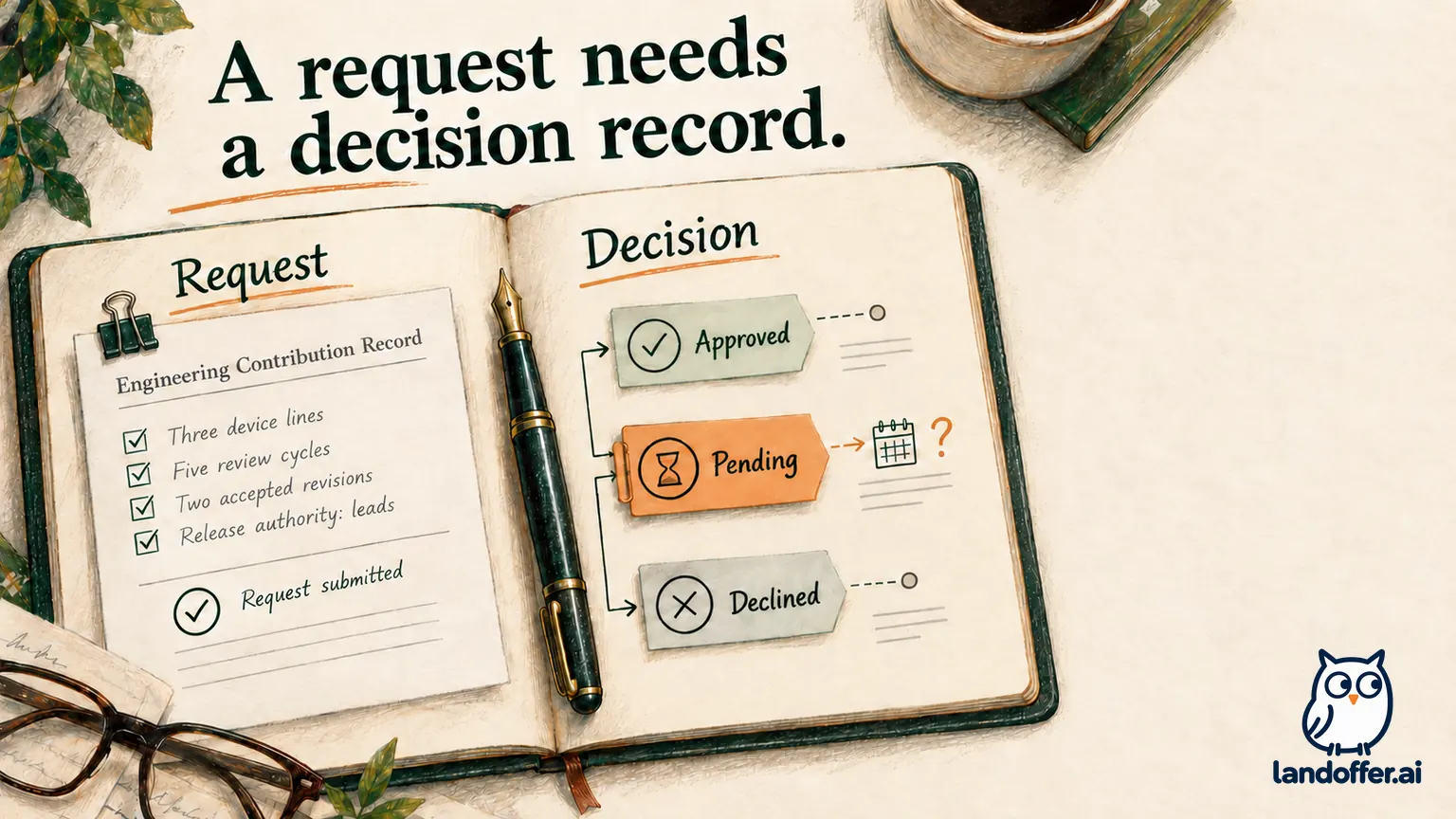
After the discussion, record what was decided, what is still pending, who owns the next step, and when you will hear more. Do not convert encouragement into approval. “I agree this is worth reviewing” is different from “the authorized change is effective on a specified date.”
In Mateo's fictional case, the manager supports a review but has not confirmed available funds. In this invented continuation, they agree that Mateo will send the M1–M4 summary on November 5; the manager will ask compensation which route applies by November 12; and they will meet on November 18 to review the response. No revised salary or effective date has been approved. These dates demonstrate a follow-up record, not an observed employer turnaround time.
The completed follow-up record says: “Pending process and budget review. Manager owns the compensation inquiry. Mateo supplies the agreed responsibility summary. November 18 is an update meeting, not a promised pay-change date.” This is more useful than writing “raise agreed, details to follow” and discovering later that no authorized decision existed.
If the answer is no because evidence is inadequate, name the missing record or comparison, who will provide it, and when it can be reviewed. If the answer is a budget constraint, ask when that constraint can be reconsidered and whether the case remains on file. More unrelated output may not solve a budget problem. If the role is at a pay limit, ask about the applicable options rather than assume a discretionary exception.
If a change is approved, confirm the written amount, pay component, effective date, and any conditions through the employer's normal process. A one-time payment is different from recurring base pay. This guide does not estimate taxes, take-home pay, benefits effects, or the legal consequences of a particular arrangement.
Leave with a clear next decision
You may decide to pursue the review, gather one missing record, revisit the scope of ongoing duties, or stop investing effort in an unclear promise. The useful result of the first conversation is clarity about the request and its route, not necessarily an immediate yes. Revisit the agreement if the reviewer, duties, or constraints change.
Start by writing the date your responsibilities changed, one accepted contribution, and the process question your manager needs to answer. Use those notes to request a dedicated conversation; keep the request separate from any assumption that approval or a new effective date already exists. This guide is from LandOffer.ai; your employer's compensation process determines whether, when, and how any pay change occurs.
Sources and Further Reading
- New York State Department of Labor: Salary Negotiation Guide — includes current-position raise preparation; general guidance does not replace employer policy.
- MIT Human Resources: Pay Guidelines — employer-specific salary-action distinctions and increased responsibilities.
- UC Davis Human Resources: Requesting an Equity Adjustment — an employer example separating equity reviews from annual salary and bonus processes.