LandOffer
Career Growth
Job Crafting in Your Current Role: Propose Changes to Tasks, Relationships, and Meaning
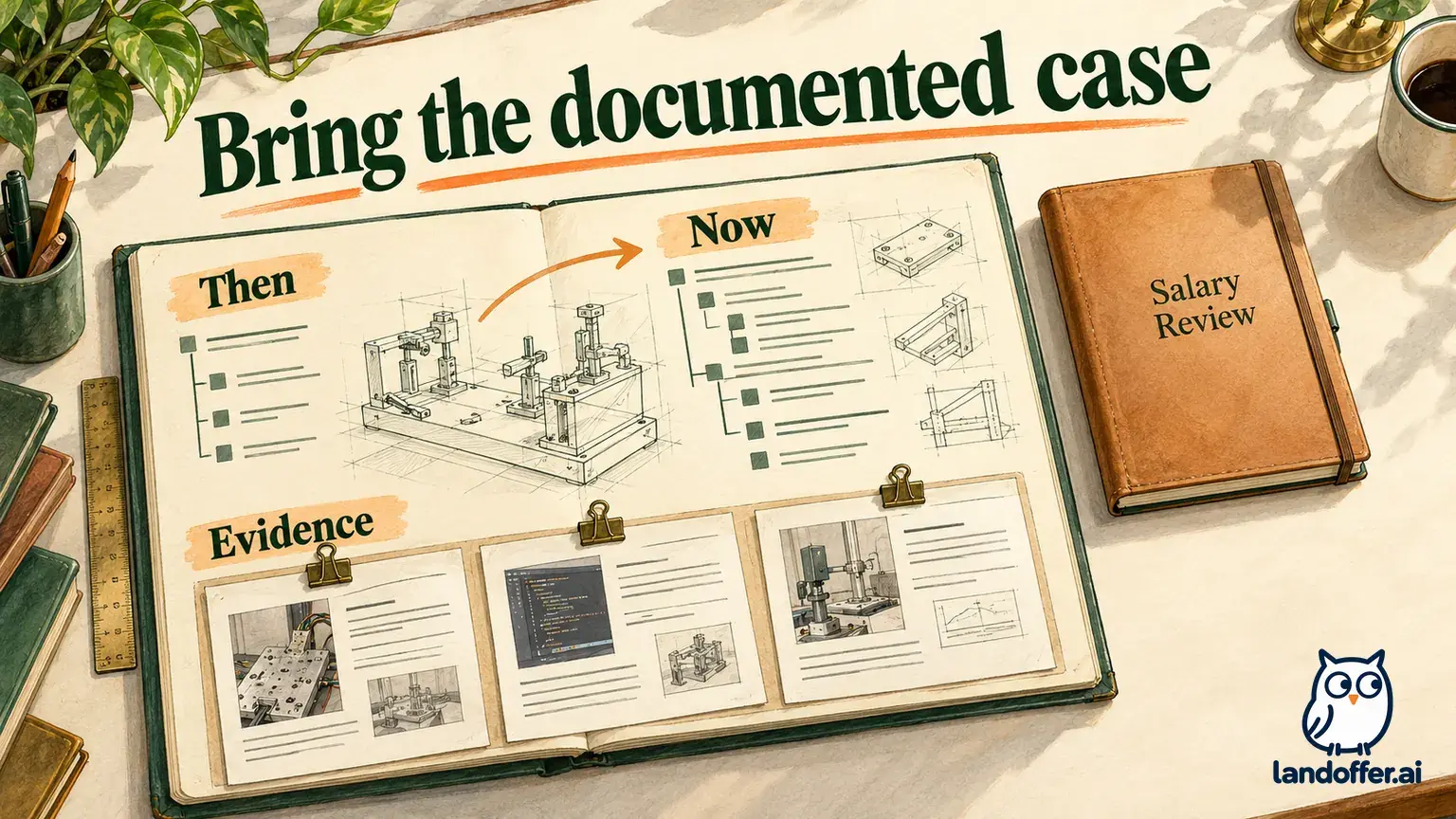
Propose a small current-role adjustment with an agreed time source, shared-work boundaries and a review decision. A completed fictional trial and before-and-after allocation retain core duties and explain why the next proposal becomes smaller.
Propose one small change to how you do your current job, explain where its time will come from, and agree how to review it. Job crafting can involve tasks, working relationships or the way you understand the work. A useful proposal preserves required outcomes and makes any change to shared responsibilities visible. Keep required work covered while testing a different way to contribute.
This LandOffer.ai guide supplies an original, completed trial plan and an employee–manager before-and-after record. Foldline, its people, future dates and work records are fictional. The arithmetic checks the example's time budget; no employee, employer discussion or improvement was observed. The materials are original teaching examples, not a reproduction of a commercial workbook.

Distinguish a work change from a career destination
You may want more explanatory work, a better handoff or a clearer purpose while staying in the same role. Start with a recent episode: a repeated explanation you enjoy making clearer, a handoff that leaves both sides guessing, or a routine whose purpose has become difficult to see. Describe the episode before naming the solution.
The University of Michigan's public Job Crafting Exercise overview presents work as adjustable building blocks considered against strengths, values and interests. Its commercial exercise is available separately. The public description establishes the approach; it does not show that a particular change will improve your performance or be permitted by your employer.
In their 2001 theoretical paper, Amy Wrzesniewski and Jane Dutton describe employee-initiated changes to task, relational and cognitive boundaries. These conceptual categories help separate possible changes; they are not results from a trial of this proposal. A useful plan may involve only one category. The paper does not supply a universal employer approval procedure.
For this article's practical approach, agree changes affecting deliverables, shared time or ownership with the relevant people. Private reflection about meaning is different from changing a support rotation. Follow your actual role's discretion and process rather than assuming either that every thought needs permission or that every work change is yours to make alone.
Translate each kind of crafting into observable work
Task crafting changes the activities or their scope and allocation. An engineer might propose turning repeated troubleshooting explanations into a maintained guide. Specify which existing activity shrinks to provide that time, which responsibilities remain, and who owns the new artifact afterward.
Relational crafting changes how you work with others. A short review with the engineer who receives escalations may replace a low-value status exchange. Agree the other person's time and the purpose of the review; your development goal does not automatically make someone else your coach or take away their own responsibilities.
Cognitive crafting changes how you understand the contribution. A support engineer might connect a careful reproduction record with helping customers recover their work, rather than seeing only a closed-ticket counter. That interpretation can guide which evidence they preserve. It does not change response obligations or require them to pretend that every frustrating condition is positive.
Keep the desired change separate from the claimed result. “Create one reviewed explanation of a recurring recovery step” is a deliverable you can inspect. “Make my role meaningful” is a personal aim that needs conversation and reflection; counting documents cannot establish it. Neither aim promises promotion, retention or greater job satisfaction.
Completed trial plan: preserve the queue, change one handoff
Lena is a technical support engineer at fictional Foldline, a diagram-collaboration service. She enjoys explaining difficult recovery steps but repeatedly rewrites the same escalation context. Her manager Omar wants the queue covered and accurate technical handoffs. Product engineer Celeste receives escalations; peer Anik shares triage coverage.
Lena first proposes adding a documentation project on top of her existing week. Omar asks which work would make room. They replace that proposal with the following bounded trial for November 2–13, 2026. These are future dates in a teaching case, not a trial that has happened at a real company.
| Trial field | Filled agreement in the fictional case |
|---|---|
| Problem and aim | Repeated recovery explanations lack a reusable, technically reviewed example. Lena wants more explanatory work within her existing role. |
| Task change | Move at most one hour a week from routine triage preparation into the existing documentation allocation, only when required triage work is covered. |
| Relational change | Replace one existing 30-minute weekly status slot with a joint recovery-guide review. Celeste agrees to that slot; it is not an additional meeting. |
| Cognitive reflection | Lena records whether connecting the guide with safe customer recovery helps her explain the purpose of her work. This is a reflection, not a performance score. |
| Required work retained | Ticket ownership, incident escalation, response expectations and Anik's agreed coverage remain unchanged. No new access or customer-data use is included. |
| Concrete output | One internally reviewed guide covering a recurring recovery scenario, with its technical limits and next owner recorded. Publication outside the team is not part of the agreement. |
| Review evidence | Weekly allocation record, coverage check, guide revision and short feedback from Lena, Celeste and Anik. Omar reviews trade-offs after the second week. |
| Pause condition | If queue or triage obligations need the time, use the original allocation and reduce guide scope. Do not borrow evenings or move work to Anik without agreement. |
The trial is small because its assumptions are still uncertain. Batching preparation might release an hour, but a busy week might not. Recording the source of time lets Omar protect coverage and Lena reduce guide scope before either person relies on a capacity gain that has not occurred. The plan makes the dependency visible instead of treating hoped-for efficiency as already available capacity.
Anik's agreement is specific: the existing coverage arrangement stays. It does not mean agreeing to absorb Lena's preparation when the queue grows. Celeste's agreement is similarly bounded to the replacement review slot and the selected guide. Broader mentoring or ongoing documentation ownership would need its own discussion.
Show where the time comes from
The second asset is a complete allocation and review record. The baseline below is an agreed planning allocation for this fictional role, not a universal support-engineer schedule. Hours describe work categories, not ticket throughput or quality.
| Weekly category | Baseline allocation | Proposed trial allocation | Fictional week 1 record | Fictional week 2 record |
|---|---|---|---|---|
| Ticket resolution and incident duties | 24 | 24 | 24 | 24 |
| Routine triage preparation | 6 | 5 | 5.75 | 5.25 |
| Existing documentation work | 4 | 5 | 4.25 | 4.75 |
| Existing meetings, including the replaced review slot | 4 | 4 | 4 | 4 |
| Administration | 2 | 2 | 2 | 2 |
| Total hours | 40 | 40 | 40 | 40 |
The proposed extra documentation hour is matched by one fewer triage-preparation hour. The meeting change replaces time inside the four-hour meeting allocation. Adding another half hour for Celeste's review would break this stated plan unless something else changed.
In the authored week 1 record, triage preparation needs 5.75 hours, leaving only 0.25 additional documentation hours. Week 2 needs 5.25 preparation hours and permits 0.75 extra documentation hours. Both weeks remain at 40 hours. The trial does not realize its full proposed shift in either week.
Across two baseline weeks, triage and documentation would receive 12 and 8 hours respectively. The fictional record gives them 11 and 9 hours. That is one hour reallocated across the fortnight, not two hours saved or a productivity increase. The same total time was allocated differently; the example provides no comparable case mix or counterfactual outcome.
The saved arithmetic verifies these totals and the replacement meeting's unchanged duration. It cannot validate the fictional coverage confirmations or the usefulness of the guide. Those remain authored case evidence, clearly separated from an actual workplace observation.
Complete the review even when the initial proposal only partly fits
Lena's fictional review note says: “I completed a draft guide and used Celeste's review to correct an ambiguous recovery step. The review conversation was useful to me. I still needed most of the triage-preparation allocation, so a standing five-hour documentation week is not yet supported.” No reduction in customer incidents or handling time is inferred from that note.
Celeste's fictional revision replaces 'use the recovery copy' with 'confirm the selected version and ask the incident owner before replacing shared work.' Her note accepts that wording for the chosen scenario and flags concurrent edits as an exception the guide does not cover. Anik confirms the stipulated coverage arrangement was retained in this teaching case. Omar does not treat those statements as evidence that the whole support process has improved.
| Review question | Completed fictional decision | Consequence |
|---|---|---|
| Adopt the proposed five-hour documentation allocation permanently? | No. Neither recorded week supported the full one-hour transfer. | Keep the baseline as the default rather than turn an aspiration into a standing obligation. |
| Keep the replacement review conversation? | Omar and Celeste agree to another limited cycle within the existing meeting slot. | No extra meeting time or ongoing coaching duty is implied. |
| Allow another task adjustment? | Trial at most 30 minutes of transfer in a week when triage coverage is confirmed; otherwise transfer none. | A smaller prospective limit replaces the original one-hour maximum. It is not backdated into the two records above. |
| Treat the purpose reflection as proof of success? | No. Lena's account is useful personal feedback, not a validated satisfaction measure. | Keep it alongside work evidence without converting it into a score or team-wide claim. |
| Who decides what follows? | Omar reviews workload; Lena reports fit; Celeste owns the technical review boundary; Anik can raise coverage concerns. | Continue, revise or stop from the stated evidence rather than quietly expanding the trial. |
This is a completed mixed decision: retain a bounded relationship change, reduce the task-change proposal and preserve the original duties. The recorded time constraints support a smaller next proposal. Lena's preference remains part of the decision, alongside the duties and relationships the trial must preserve.

Account for influence, constraints and the option to stop
A 2010 qualitative study by Berg, Wrzesniewski and Dutton, described in its publisher abstract as involving 33 employees, examines how perceived crafting challenges and adaptive responses differ with organizational rank. It supports taking social context seriously. It does not establish that Lena's plan will work, or that people with less discretion can overcome every barrier by changing their attitude.
Ask what is genuinely adjustable. Required controls, customer commitments and the work other people rely on may limit a proposal. A manager might identify another review partner or a smaller artifact; they might also say no because capacity is unavailable. Record the reason and revisit only when the relevant condition changes.
If the problem is an unresolved workload or resource decision, describe that problem directly. Do not repackage an impossible workload as a need for more positive thinking. A useful cognitive reflection can coexist with an accurate account of constraints and a request for organizational action.
Stopping the trial also needs a practical handoff. Preserve the current guide version, name who handles any remaining questions, restore the agreed allocation and tell the people whose meeting or handoff changed. A temporary arrangement should not linger as an unowned responsibility after the review date.
Before your next conversation, bring one recent work episode, one proposed adjustment and the exact obligation that must remain covered. Show its time source, the people affected and the condition that restores the original arrangement. Save who agreed to the trial and when they will review it before changing shared work. For further workplace guides, return to LandOffer.ai after saving the agreement, the observed limits and the next decision in your own work record.
Sources and Further Reading
- University of Michigan: Job Crafting Exercise — public tool overview and separate commercial exercise; reviewed October 27, 2026.
- Wrzesniewski and Dutton: Crafting a Job, 2001 — theoretical task, relational and cognitive framing; publisher abstract, not a workplace-outcome test.
- Berg, Wrzesniewski and Dutton: Perceiving and Responding to Challenges in Job Crafting, 2010 — first published January 22, 2010; qualitative abstract on rank and adaptive responses. Full study methods were not evaluated for this guide.