LandOffer
Job search
PMExercises Review: Question Libraries, Peer Practice, and Course Bundles
Choose PMExercises by the work you need: question access, reciprocal peer practice, interview instruction or separate AI coursework.
PMExercises is most useful when you want a large product-manager question library plus a way to rehearse answers with other candidates. Its paid choices serve different tasks: Lite buys question access, Interview Prep adds course material and peer practice, and the AI-native PM courses address a separate learning goal. The combined bundle earns its extra cost only when both tracks belong in your preparation plan.
This PMExercises review checks public pages and native browser behavior on October 20, 2026. We inspected the library, a category filter, pricing, peer instructions and terms without purchasing or booking a session. The examples below are our own teaching cases, not results from real candidates. To connect your preparation with actual responsibilities, browse recent roles on LandOffer.ai and read the employer's interview instructions separately.

What the question library gives you
The public interview-question library offers company, question-type and difficulty filters, search and a random-question option. We saw thousands of questions, answer counts and community signals. Some entries were marked Free; others showed an unlock control. That is evidence of mixed access, rather than a promise that every answer is available without paying.
In our signed-out browser check, selecting Analytical Thinking changed the URL to that category and the results list to relevant questions. The facet count and displayed result count differed slightly. We would use the category to find practice material, without treating its count as a precise measure of coverage. We did not test saving, completion tracking or access after registering.
Company labels can help assemble a preparation set, but they do not predict an employer's next question. Older prompts appeared alongside a recently updated library heading. An updated collection does not make each individual question newly asked, and popularity does not establish that an answer matches a current hiring rubric.
Read community responses as arguments to inspect. Before opening them, write your own objective, assumptions and proposed decision. Afterward, compare the reasoning: did an answer define a user, explain a trade-off or propose a measurable outcome you missed? Copying the most popular wording can make an answer sound polished while concealing your own uncertainty.
For a PM candidate, that distinction matters because follow-up questions often change the situation. Use a framework to organize the response, then test whether its assumptions fit the prompt. It cannot establish that one business recommendation is correct for every market, product or interview.
Choose the plan by included work
The current pricing page displays four options. Treat the annual totals as the purchase comparison: its rounded monthly labels do not establish a monthly payment option.
| Plan | Displayed price | Relevant boundary |
|---|---|---|
| Lite | $139 once | Core interview materials and question library; no course content or peer practice shown in the comparison |
| Interview Prep | $149 annually | Interview course, questions, recorded expert mocks and peer practice |
| Become an AI-native PM | $399 annually | Three AI courses; question library and peer practice are not included in its column |
| Interview Prep + AI-native PM | $499 annually | Both learning tracks, including interview resources and AI courses |
These are public descriptions, not entitlements verified inside a purchased account. Pricing and inclusion can change. Read the columns separately: the AI-only plan omits the interview library, while Lite omits reciprocal peer practice.
Interview Prep lists company-specific practice plans, community access and recorded material alongside its course. A recording of an expert conducting a mock is material you watch; it is not a private appointment in which that expert evaluates you. The site has a separate coaching service, and the terms describe coaching as charged by the hour. We did not obtain a coach quote or verify a particular coach's availability.
The $10 difference between Lite and the first Interview Prep year is small, but the commitments differ. A reader who only wants questions may value a one-time purchase. Someone seeking a course and peer rehearsals would leave those requirements unmet with Lite. Do not select a recurring plan merely because its first payment is close to the one-time alternative.
The two separate annual tracks total $548 at the displayed prices. The $499 combined offer is $49 lower, matching the advertised comparison. It still costs $350 more than Interview Prep alone. For an upcoming product-sense interview with no planned AI coursework, that extra purchase has no demonstrated role in the preparation brief.
Peer practice is reciprocal, not a guaranteed expert evaluation
The public practice page offers partner filters such as question type, PM experience and practice level. Its signed-out view showed scheduling controls but did not give us a completed partner match. We cannot infer how quickly a suitable person would respond or how reliable attendance would be.
The official mock-interview guide describes a one-hour exchange: five minutes to introduce yourselves and choose categories, twenty minutes for each interview, seven minutes of feedback after each, and one minute to close. Each person interviews and is interviewed. Budget the full exchange when comparing it with a paid coaching appointment devoted primarily to your performance.
Agree on the target before beginning. “Help with PM interviews” is too broad. “Challenge whether my metric measures user benefit, and ask one follow-up about a conflicting signal” gives the partner something observable to assess. Choose a category and level that let both participants contribute useful questions.
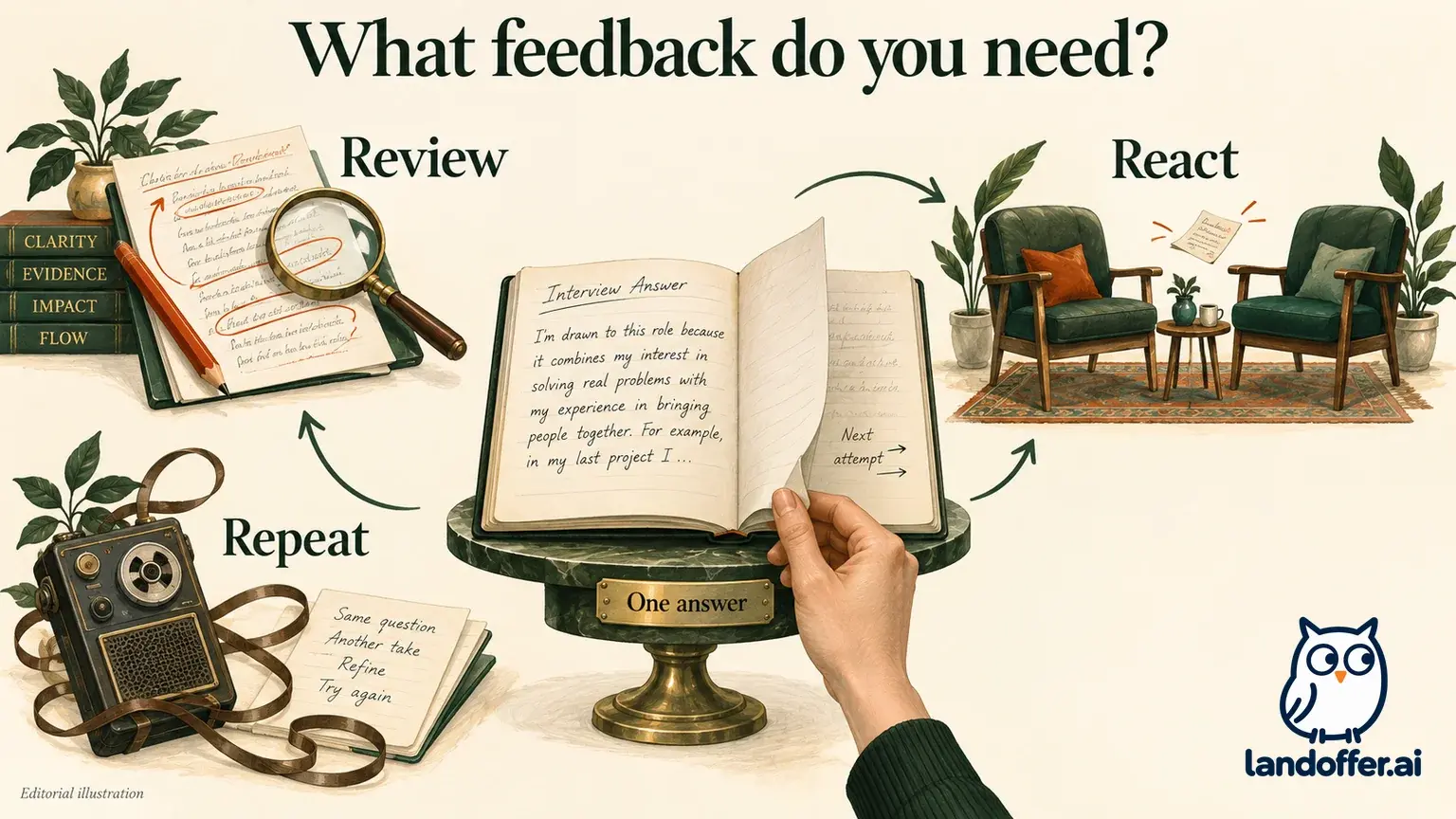
Feedback quality depends on the partner's preparation and judgment. An employer label, senior title or number of sessions is context, not proof that the person knows your upcoming rubric. Ask the partner to identify one sentence or decision in your answer and explain how to improve it. That gives your next attempt a specific target. If two peers disagree, return to the stated objective and assumptions rather than averaging their opinions into a score.
Worked example: a priority changes when confidence changes
Here is an original prioritization exercise for a commuter-alert product. The team can build either alternate-route suggestions after a disruption or quiet-hours controls to reduce unwanted notifications. The objective combines two needs: help subscribed riders act on relevant disruptions and avoid unnecessary interruptions. Choose between the proposals using the stated objective and evidence.
Use an explicit scoring model: estimated distinct riders reached per week × an impact weight × confidence, divided by person-weeks. This follows the reach, impact, confidence and effort structure in Intercom's RICE method. The inputs below are invented for teaching; they are not market research or PMExercises course output.
| Proposal | Weekly reach | Impact weight | Confidence | Effort | Score |
|---|---|---|---|---|---|
| Alternate routes | 800 riders | 2 | 80% | 4 weeks | 320 |
| Quiet hours | 2,000 riders | 1 | 50% | 5 weeks | 200 |
The first calculation is 800 × 2 × 0.8 ÷ 4 = 320. The second is 2,000 × 1 × 0.5 ÷ 5 = 200. Under those assumptions, alternate routes ranks first. Reach means distinct eligible riders in the same week for both options; counting notification events for one and people for the other would break comparability.
The impact weights express a judgment about the stated objective, not measured benefits. Confidence should reflect the evidence behind that judgment, rather than how strongly a stakeholder likes the feature. Here, effort means person-weeks across product, design and engineering. It must include a comparable delivery scope, including integrations and testing. Omitting the route-data integration from only one proposal would distort the ranking.
Now suppose a feasibility review reveals that the alternate-route data is incomplete. Reduce that proposal's confidence to 30%, leaving the other inputs unchanged. Its score becomes 800 × 2 × 0.3 ÷ 4 = 120, below quiet hours at 200. The ranking flips because one critical assumption changed.
The completed recommendation is to prioritize quiet hours under the revised assumptions and investigate the route-data limitation before committing to the larger-impact claim. At 50% confidence, alternate routes would tie the other score: 800 × 2 × 0.5 ÷ 4 = 200. The 50% tie point identifies a concrete research question: is route-data coverage strong enough to justify at least that confidence level?

The score does not establish business value or predict a successful launch. It exposes the assumptions supporting a recommendation. An interview answer can demonstrate reasoning by defending the initial choice, revising it after new evidence and identifying what would change it again. Memorizing the framework's initials would not demonstrate that judgment.
Worked peer debrief: turn a comment into a revised answer
Use that case in a completed, fictional one-hour exchange between Lena and Omar. Lena requests prioritization practice; Omar requests a product-design exercise. Their introduction fixes those categories and they agree not to record. The first twenty minutes examine Lena's feature ranking, including the new route-data limitation.
During her seven-minute debrief, Omar's first comment is “be more data-driven.” That is too vague to guide another attempt. He replaces it with: “You kept alternate routes first after I reduced confidence to 30%. Recalculate the score, explain which input changed and say whether the evidence still supports your recommendation.”
Lena rewrites her answer opening: “Alternate routes initially scored 320 against quiet hours at 200. With confidence reduced to 30%, its score falls to 120. I would now prioritize quiet hours and validate route-data coverage before restoring the first proposal's priority. The ranking depends on our estimates, not proven user impact.”
| Debrief item | Completed output |
|---|---|
| Specific observation | Initial recommendation survived a changed confidence assumption without recalculation |
| Preserved strength | Lena used comparable reach periods and stated delivery effort |
| Correction | Recompute the ranking and update the recommendation when the evidence changes |
| Follow-up variation | Quiet-hours effort doubles: recalculate and explain the new trade-off |
They switch roles for Omar's twenty-minute answer and seven-minute debrief, reserving the final minute for one next practice target each. The agenda totals sixty minutes: 5 + 20 + 7 + 20 + 7 + 1. Only twenty of those minutes place Lena in the candidate role. Her revised opening is the example's output; it does not establish improved interview performance or an eventual offer.
For the follow-up, doubling quiet-hours effort from five to ten weeks lowers its score to 100. Alternate routes at 120 would rank higher again. Lena must explain that this is a relative ordering under the revised assumptions, while the route-data concern remains unresolved. A peer's “great answer” would provide less useful evidence of learning than that defensible revision.
Check renewal, refund and recording terms before joining
The public terms carry a January 18, 2021 update label. The page states that paid subscriptions renew automatically, that renewal can be deactivated in settings, and that an initial subscription refund request must be made within seven days of payment. It excludes refunds for subsequent subscription periods. The simpler seven-day guarantee on pricing should be read with those limits.
The pricing FAQ tells members to use Billing under Settings to cancel or upgrade and to email for a refund. We did not test those account controls or process a request. Before paying, confirm the actual checkout amount, renewal date and how the current purchase falls under the policy; do not assume cancelling a renewal also requests a refund.
Recording deserves a separate decision. The mock guide suggests discussing whether to record. The terms contain broader language about recording and use of mock interviews or training, including promotional and paid-content purposes, and rights over contributed content. Do not infer confidentiality from a conversation with one peer. Clarify the session type and recording or reuse arrangements before sharing a sensitive work example.
Use a fictional product case or public information in practice. For behavioral examples, describe your contribution without exposing employer secrets. Our product-manager resume guide also explains how to present scope and results truthfully; a practice example should not become a fabricated work accomplishment.
Who should use PMExercises?
Use the free material first to see whether comparing answers reveals a specific gap. Choose Lite when the question library is the resource you need and you do not require course access or peer matching. Choose Interview Prep when you will use its instruction and reciprocal practice. Consider the AI course bundle only when that additional curriculum answers a separate, concrete requirement.
Choose another feedback route when you need a particular expert, guaranteed appointment terms or evaluation against a named role. A community library and peer exchange can support preparation without delivering those services. We did not measure placement rates, partner response times or learning gains, and vendor testimonials do not establish your likely outcome.
LandOffer publishes this review and offers separate job-search tools. To decide what to rehearse, browse recent roles on LandOffer.ai, select a relevant posting and turn its responsibilities into a practice brief. Turn one responsibility in the posting into a question category and a specific feedback target for your next practice session. The listing identifies responsibilities; it does not reveal the employer's exact interview questions.
Sources and Further Reading
- PMExercises question library — public categories, mixed access and question presentation.
- PMExercises pricing — annual plans, Lite and inclusion table.
- PMExercises peer practice — public partner-selection controls.
- PMExercises mock-interview guide — reciprocal session agenda and feedback guidance.
- Intercom RICE prioritization method — named framework used in the independent example.
- PMExercises terms — renewal, refund, coaching and recording provisions.
Public sources checked October 20, 2026. Illustrative metrics, participants and debriefs are independent teaching examples.