LandOffer
Product & Project Delivery
Use a User Story Map to Choose a Coherent First Release
Build a complete user story map and compare two equal-effort release slices. Follow ordinary and exception paths after removing conveniences, while keeping model coverage distinct from real usability, authorization, persistence and release approval.
Choose a first release by tracing one target user's complete task, then keeping the smallest set of capabilities that lets that task finish. A story map makes the sequence and missing links visible. Cut convenience and breadth before cutting the receipt, recovery, handoff, or outcome that the chosen user needs. A collection of highly ranked features can still leave the task unfinished.
This LandOffer.ai guide uses current primary guidance checked October 27, 2026 and an original fictional correction-request workflow. Its map, estimates, people, and walkthroughs are authored examples. We checked the model's story coverage and arithmetic locally; no user study, working prototype, software deployment, or real release was performed.

Name the user, the outcome, and the release boundary
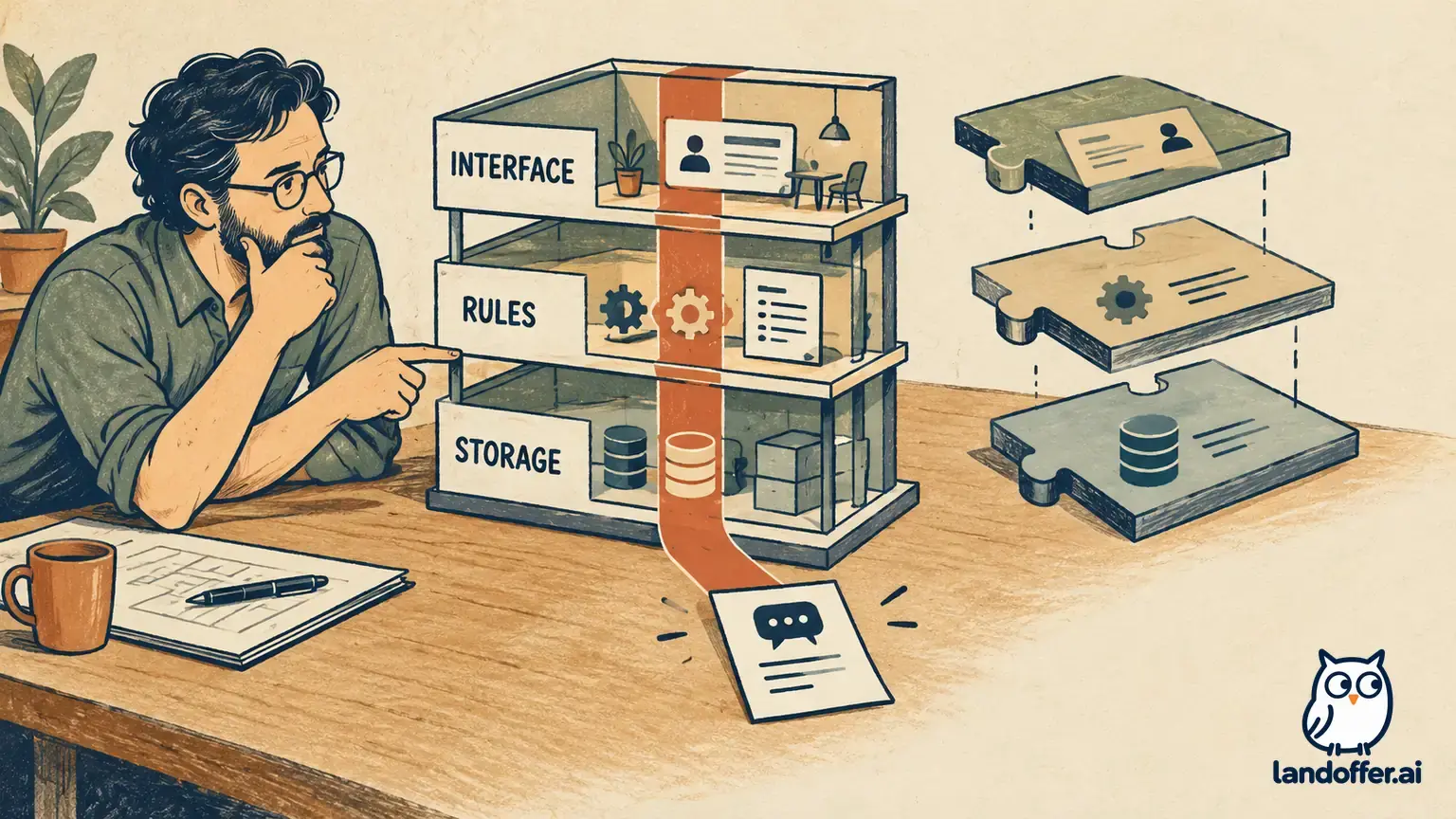
Jeff Patton's story-mapping presentation explains why a flat prioritized backlog is difficult to use for understanding a whole system. Arranging stories around use makes omissions and release choices easier to discuss. That is a planning method, not evidence that a particular map describes a real user's needs correctly.
Begin with a specific person doing something in a specific context. “Improve content operations” is too broad to test against a release slice. “A curator submits a correction request for one exhibition label and can return later to read the editor's decision” gives the team an inspectable beginning and ending.
Our fictional pilot serves three already-provisioned curators and one editor. Curator Dario needs to request a label-text correction; editor Keiko needs to understand and decide it. Coordinator Freya owns pilot operations, product owner Mirek owns scope, and engineer Hassan reviews the implementation estimate. These are not real participants or accepted workplace assignments.
The pilot ends with a traceable request and decision. It does not automatically correct or reprint the physical label. An accepted request can still await layout work. Public submissions, account signup, automatic publishing, and a complete museum collection-management system remain outside this first release.
Build the backbone from user activities
NN/g's story-mapping guide distinguishes activities, steps, and details. Activities and steps show the sequence across the map; smaller details sit beneath them. The map concerns anticipated use and needs research support. A workshop's agreement is not proof that users can complete the proposed experience.
For this case, the backbone is identify the label → describe the change → submit the request → resolve review → read the outcome. These are actions in the user's story. “Frontend,” “database,” and “notification service” might be necessary engineering work, but they do not describe what the curator is trying to accomplish.
Use the same level of detail across the backbone. “Manage the collection” beside “click Submit” mixes an entire domain with one control. Put the click or validation detail under the appropriate activity, where it can be discussed without replacing the larger purpose.
The story also changes actors during review. Keiko must open the request, ask a question if necessary, and record a decision. Dario must be able to answer and return to the result. A curator-only map that ends at Submit would hide half the work needed for this stated outcome.
Worked asset: the completed map and first-release slice
The table reads left to right. Its first-release row spans the entire chosen task; later capabilities stay visible below it. All proposed behavior is fictional and untested. The estimates are person-days for the stated increment, including implementation and verification, not elapsed calendar days or a production-readiness guarantee.
| Map layer | Identify the label | Describe the change | Submit the request | Resolve review | Read the outcome |
|---|---|---|---|---|---|
| User task | Dario opens a label he is allowed to access | Dario explains the proposed wording and reason | Dario sends once and keeps a request reference | Keiko reviews; Dario can clarify | Dario retrieves the current decision and next owner |
| First-release stories | S1: authorized label record, 1 day | S2: text/reason entry and required-field feedback, 2 days | S3: submission receipt and repeat-submit handling, 2 days | S4: editor queue, 1 day; S5: clarification question, 1; S6: requester answer, 1; S7: decision/reason, 1 | S8: persistent request status, outcome and next owner, 1 day |
| Deferred details | X1: image attachment | X2: wording suggestions | X3: automatic email notifications | X4: bulk triage | X5: reporting dashboard |
| First-release limit | Existing pilot accounts and known label records | One text correction per request | One durable reference; no bulk import | One named editor plus approved coverage | Accepted/rejected decision is visible; physical label work remains separate |
The eight retained stories total 10 person-days: 1 + 2 + 2 + 1 + 1 + 1 + 1 + 1. This is the authored planning estimate Hassan reviews within the fiction. No one has timed the work, and the total does not establish available skills, dates, or the adequacy of security review.
Mirek initially considers a different ten-day slice: S1, S2, S3, S4, S7, plus three days of automatic email X3. It retains automatic email but omits clarification and persistent outcome retrieval. Its six stories also total ten person-days. Equal estimated effort therefore does not establish equal coverage of the user task.
The goal explicitly requires returning to the current decision without relying on receipt of an email. The initial slice cannot support that return. It also lacks a way to resolve an ambiguous proposed wording through the product. The team rejects this slice and exchanges X3's three days for S5, S6, and S8, one day each. The budget is unchanged; the supported task becomes more coherent.
That exchange is a case-specific decision. It does not mean notifications are always optional or three particular stories always cost the same as email. A different user, operating model, or channel requirement could produce a different slice.
Reduce breadth while preserving the job
Atlassian's story-mapping guidance connects the user goal, activities, smaller tasks, gaps, and release choices. It describes a story map as planning around a journey rather than treating every backlog item as an independent priority. Use that structure to ask what the release still enables after a cut.
Here, dropping image uploads is acceptable only because the pilot handles text corrections on known labels. A damaged physical label requiring a photograph is outside the declared pilot, not a problem silently solved by the text box. Record that exclusion so a stakeholder cannot describe the slice as handling every label issue.
Removing email also introduces operating work: someone must review the queue, and the curator must return to the status view. In this fictional five-working-day pilot, Keiko agrees to inspect the queue once each working day, and curators are told to reopen their request list for updates. Freya covers a missed queue check through the approved pilot procedure. These arrangements are assumptions accepted inside the example, not observed service performance or a promise of a particular response time.
Do not remove permission checks, essential validation, or recovery merely because their interface is less impressive. S1 still needs an authorized record; S2 still needs a clear response to a missing reason; S3 still needs to avoid creating duplicate requests on a repeat attempt. These requirements support this narrow task rather than expand its audience.
Keep implementation tasks linked beneath the user stories. Persistence, access enforcement, and duplicate-submission protection need technical work, but replacing the map with a backend-first phase would not establish a usable release. Conversely, a continuous drawn path does not prove that the technical pieces exist.
Worked asset: verify what survives the cuts
Use the same fictional input before and after cutting X1–X5: label L-17, proposed title “Harbor at Dusk,” reason “match the approved catalog title,” and request reference Q-41. These strings are authored test material, not museum records. The traces below are written model checks, not observations of Dario using a prototype.
| Case and input | Complete retained path | Completed model assessment |
|---|---|---|
| Clear correction | Open authorized L-17; enter wording/reason; submit; receive Q-41; Keiko opens it and records Accepted for layout with a reason; Dario reopens Q-41 | S1/S2/S3/S4/S7/S8 cover the path. Dario can read Accepted for layout, the reason, and Keiko as next owner; the physical label remains unchanged in this model |
| Ambiguous wording | Same request, but Keiko needs to distinguish the printed title from a catalog heading | S5 asks a specific question; S6 returns Dario's clarification; S7/S8 preserve decision and retrieval. Initial slice lacked S5/S6 |
| Required reason missing | Dario enters the proposed text but leaves the reason empty | S2 blocks submission, explains the missing field, and permits correction before S3. No successful receipt is invented for invalid input |
| Submission retried | Dario repeats the same submission attempt after uncertainty | S3 requires the existing Q-41 reference rather than a second request. This is a required behavior, not a tested backend guarantee |
| Unauthorized label | A pilot account tries to open a label outside its allowed set | S1 must deny access without revealing the record. Task stops; no correction request is created. Actual authorization testing remains required |
The ordinary path and clarification path remain covered after all five convenience features are removed. The invalid-input and access-denial cases appropriately stop instead of being forced into a success state. A coherent release includes necessary failure handling; it does not mean every attempted task must succeed.
We executed an original local check of these authored requirements against the two story sets. The retained set covers both successful paths. The rejected set misses S8 on the ordinary path and S5, S6, and S8 on the clarification path. The script also confirms the equal ten-day totals. It verifies the model's coverage arithmetic, not usability, persistence, authorization, duplicate protection, or real data correctness.

Separate the thin release from permission to launch
Mirek's completed scope decision reads: “Retain S1–S8 for the limited text-correction pilot. Defer X1–X5. The user can submit, clarify, and return to a recorded decision; accepted requests still require separate layout work. Keep broader issue types outside this increment.”
Hassan's ten-day estimate is not a dated commitment. Before implementation is committed, the team needs actual availability, interface decisions, and verification ownership. Before pilot launch, it needs saved-output checks and an approved operating arrangement, including actual authorization and repeat-submit verification. Before broader release, it needs evidence that the intended users can complete the task and that access and recovery behavior work.
The term “walking skeleton” can help describe a deliberately thin end-to-end path, but it does not exempt the team from these checks. A map can reveal a plausible connection while leaving its usability, feasibility, and value uncertain. Call the artifact a planned release slice until those uncertainties are addressed.
If a later constraint makes S3 persistence or S8 retrieval infeasible, reopen the scope decision. Do not ship the initial email-only design while retaining the same promise about current status. Change the audience, outcome, implementation, or release expectation explicitly, with the responsible owner accepting the revised boundary.
Use the map in the next scope conversation
When someone proposes another cut, ask them to walk the chosen user from start to finish using only the retained stories. Name where the user gets stuck, what an error looks like, and who completes a cross-role handoff. Keep any missing activity visible alongside the priorities. A high score on another feature does not supply the absent user action.
Keep deferred ideas below the slice with the reason they were deferred. They remain options, not commitments to a second release. New research can change the backbone, reveal a different user, or show that the narrower outcome has insufficient value. Preserve those findings rather than treating the first map as a fixed specification.
For your next planning review, bring the user goal, populated map, one rejected slice, and completed ordinary and exception traces. More workplace guides are available from LandOffer.ai. Choose the release whose declared task still holds together after the cuts, then obtain the actual evidence and approvals needed to build and release it.
Sources and Further Reading
- Jeff Patton: User Story Mapping Presentation — January 28, 2008; primary practitioner explanation checked October 27, 2026.
- NN/g: Mapping User Stories in Agile — January 24, 2021; last reviewed August 27, 2026.
- Atlassian: User story mapping — undated current primary guidance checked October 27, 2026.