LandOffer
Job search
Two-Page Federal Resume for Tech Jobs: Preserve Qualification Evidence Under the USAJOBS Limit
A guide to current official policy with a fictional backend qualification map, edited work entry, and content allocation. Two-page compliance does not establish eligibility or required experience.
A federal tech resume must now fit the USAJOBS two-page limit while still showing the experience and other qualifications required by the announcement. Preserve employer, title, relevant dates, hours per week, and clear personal duties before cutting useful evidence. Within two pages, show your own work, its duration, and the responsibility relevant to the announcement.
This guide uses current OPM and USAJOBS instructions checked October 13, 2026, including the migrated USAJOBS Help Center. The candidate, experience, and requirement map are fictional teaching examples; no agency assessed them. LandOffer publishes this guide and offers recent tech listings. Federal applicants must inspect the exact official announcement rather than relying on a job-board summary or this article for an eligibility decision.

The page limit does not reduce the qualification requirement
OPM's applicant guidance states a two-page maximum and explains the September 27, 2025 USAJOBS transition. It also says the resume must address the announcement's minimum qualifications and other requirements. Treat those as simultaneous obligations: a compliant length and assessable evidence.
The current USAJOBS writing guide confirms that the system will not allow uploaded or builder resumes longer than two pages. It directs applicants to read Duties, Qualifications, Specialized Experience, Education, evaluation instructions, and Required Documents. Older general advice recommending a long federal resume is insufficient for the current workflow.
Separate three questions before editing. Are you eligible through an accepted hiring path? Do you meet the qualifications for this particular position and grade? Does the submitted resume establish the relevant facts within the allowed length? Improving the third answer cannot create missing eligibility or experience.
This matters for private-sector engineers whose titles do not map neatly to federal classifications. “Senior” at a startup does not establish a federal grade equivalent. Describe your actual responsibilities and technical scope rather than assigning yourself a GS level. The agency evaluates the evidence against the announcement.
Start with the requirement, then choose the evidence
Create a private map from each required experience clause to a specific work example and its location in your draft. Keep the map as an editing aid unless the agency asks for it. Use the map to choose sentences within the two-page resume. Submit additional documents only as the announcement requests or permits.
Read compound requirements carefully. An announcement might require several kinds of experience together, distinguish independent work from assistance, or specify a particular level. A familiar technology name does not demonstrate every part of that clause. Preserve the action and responsibility that establish the connection.
For a technical role, a useful description can identify the system or service, your own contribution, the conditions under which you worked, and the relevant outcome or scope. Use a measured result only when you can support it. A clear explanation of implemented validation or diagnosed failures is better than an invented percentage improvement.
A requirement map also exposes real gaps. If your work was limited to staging tests, do not rewrite it as production operations because the target role asks for production experience. If another part of your actual history provides the needed evidence, select it. If none does, stronger wording will not resolve the gap.
A completed technical qualification map
Ellis is a fictional backend engineer at the invented employer MiraWorks. From January 2023 through September 2026, Ellis worked 40 hours per week. For this teaching case, assume Ellis personally implemented Python APIs, investigated production failures using service logs, and wrote release tests and rollback runbooks. A manager approved release decisions; Ellis did not supervise the team.
The invented target announcement asks for experience implementing application services, diagnosing operational problems, and supporting controlled releases at its stated required level. This is not a live vacancy or a substitute for a particular qualification standard. The table maps only those limited illustrative clauses.
| Invented required experience | Ellis's supported example | Evidence selected for the resume | Boundary retained |
|---|---|---|---|
| Implement application services | Built Python API endpoints and input validation | Names the implementation and validation work | Does not claim ownership of every service |
| Diagnose operational problems | Investigated production failures using service logs | States production context and personal diagnostic work | Does not invent an availability improvement |
| Support controlled releases | Wrote release tests and rollback runbooks | Identifies the artifacts and release purpose | Manager retained approval authority |
Under the invented facts, the map selects three relevant examples and leaves out unsupported leadership. It is an editing result, not an agency qualification finding. It does not establish that Ellis meets every requirement, the required duration at a particular level, or the agency's final assessment. Those questions need the full announcement and a more complete review of the underlying history.
Ellis separately checks whether the cited work occurred throughout the employment period or only during a narrower assignment. A job's full dates do not prove that every listed duty was performed for the entire tenure. If a task's duration is material, Ellis adds the truthful narrower period rather than stretching it across the role.
This approach helps a reader understand why the selected work matters. A skills list saying Python, PostgreSQL, Docker, and Kubernetes would not show who implemented the API, who diagnosed incidents, or who approved releases. Tools can support the explanation; they cannot replace the explanation.
Preserve dates and hours before trimming
OPM's guidance calls for each relevant employer and job title, start and end dates with month and year, and hours worked per week. Federal positions also need their series and grade. Include required education, certification, or licensure information and the supporting documents the announcement specifies. Do not add a federal series or grade to a private-sector role.
These fields can look less impressive than an achievement bullet, but they make the experience assessable. A title without dates hides duration. A date range without hours leaves the work commitment unclear. Cutting both to make room for another software list can weaken the qualification evidence even while making the page look cleaner.
For overlapping jobs, describe the actual hours accurately. Do not add together simultaneous date ranges as if they were sequential years, and do not assume that two concurrent roles automatically establish double the experience. The announcement's applicable rules determine how the agency evaluates the record.
Use plain month-and-year dates consistently. If an internship was part time during school and full time during a summer, preserve the distinction where it matters. A compact entry can still communicate a changing schedule; the answer is not to replace the details with a vague multi-year label.
Replace repetition with a factual experience entry
Ellis's original fictional draft repeats “Python development,” “built APIs,” “developed REST APIs,” and several overlapping technology lists. It says “responsible for reliability” but gives no diagnostic example. It also omits weekly hours. Those are editing problems even before considering the page count.
The revised excerpt reads:
MiraWorks — Backend Engineer
January 2023–September 2026 | 40 hours/week
Implemented Python APIs and input validation. Diagnosed production failures using service logs. Wrote release tests and rollback runbooks; a manager approved releases.
This is a worked excerpt, not a complete two-page resume or an agency-approved qualification statement. A real applicant would add supported detail needed to show the required level and any other announcement requirements. The example demonstrates replacing duplicated vocabulary with personal duties while retaining employment facts.
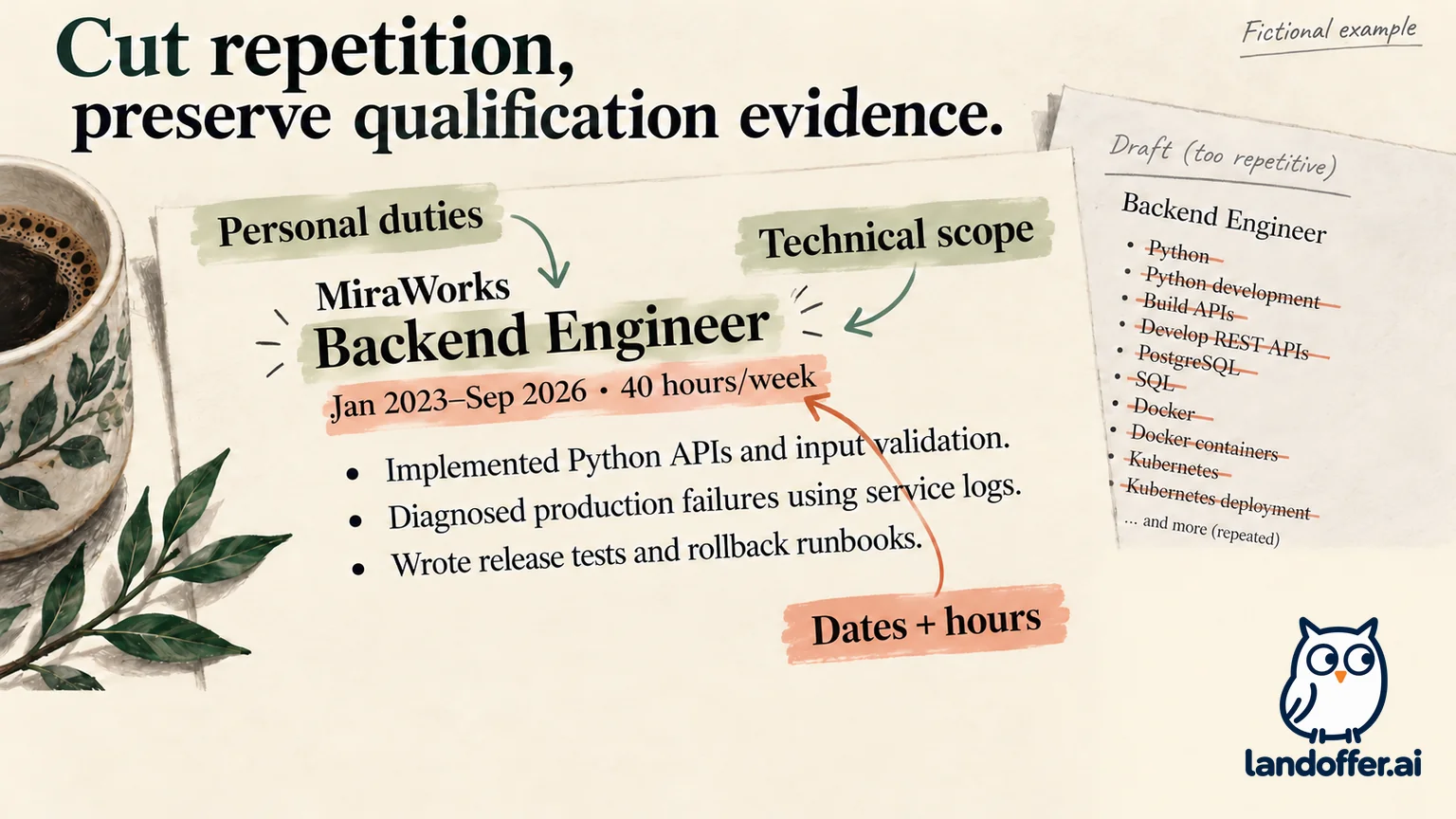
The revision makes three decisions visible. Ellis keeps the employer, title, dates, and hours together. The technical description identifies work actually performed. The final clause preserves the manager's approval role rather than turning release support into release authority.
If Ellis has a supported result relevant to the requirement, it can replace less useful wording. Without such evidence, there is no reason to manufacture “reduced incidents by 40%.” Describe the diagnostic process or system scope honestly. Precision is possible without an impressive number.
Allocate two pages around the strongest relevant work
Ellis makes a completed content selection for this fictional resume: page one carries contact information and the recent MiraWorks experience; page two carries an earlier relevant role, required education information, and a concise skills section. An unrelated early job and repeated technology lists are removed. This is an editorial allocation example; actual pagination must be checked in the rendered document.
| Material in the fictional draft | Completed editing decision | Reason |
|---|---|---|
| Recent API, production diagnosis, and release work | Keep together with dates and hours | Directly addresses the invented technical clauses |
| Earlier relevant role | Keep a shorter factual entry | Adds distinct evidence rather than repeating the same stack |
| Required education information | Retain in the selected layout | Cannot be removed simply because work experience is stronger |
| Repeated Python and API wording | Consolidate | Frees space without removing a distinct qualification |
| Unrelated early work and generic objective | Remove in this limited scenario | Does not establish a requirement in the assumed announcement |
The allocation changes for another position. If required education or an older specialized assignment supplies the decisive evidence, give it enough space. “Newest first” is a useful organizing convention, not permission to omit older experience essential to a requirement.
Edit the content before shrinking the type. A dense page with tiny type can technically contain more words while making the evidence hard to find. Group related duties, remove duplicate phrasing, and shorten generic summaries. Preserve the factual fields and the specific work that supports the qualification.
Formatting recommendations and announcement rules are different
The current USAJOBS guide requires a file of 5 MB or less and recommends PDF to preserve layout, using standard 8.5-by-11-inch pages. It gives font and margin guidance, including 0.5-inch margins and considering 10-point body text with larger headings. Read those as the help page's recommendations alongside the exact announcement's instructions.
Do not turn one suggested font size into a universal agency rule. If the announcement specifies a different document format or other requirements, follow and reconcile those instructions. It can be tempting to preserve a favorite template. Follow the announcement if its document instructions require a different layout or format. Conversely, do not invent formatting restrictions that the agency did not impose.
Keep sensitive material out. USAJOBS's writing guide excludes classified or government-sensitive information, Social Security numbers, photos, and specified personal information. Explain technical work at a permissible level without including private system details merely to make the example more concrete.
A private evidence note can help you verify a statement without belonging in the application. Retain only records you are permitted to keep. You do not need to expose a client's data or internal architecture to explain your role accurately.
Check the version that will actually be reviewed
The current resume-profile guide says users may keep up to five resumes. Uploaded files require a new upload to change their contents. Builder resumes can be duplicated and edited, and a preview longer than two pages cannot be saved. It also warns that copied formatting may not survive and that some agencies request documents in their own application systems.
Open the final file or builder preview after editing. Check the page count, readable text, dates, weekly hours, required qualifications, and selected document name. A two-page source document can reflow when exported or pasted. This article did not upload a sample or test a signed-in builder, so it makes no claim about a particular file's acceptance.
Review the document selected for the exact application, not just the newest version in your folder. If you maintain several targeted resumes, a name such as “Ellis-backend-announcement-ID.pdf” can identify the intended role. Use your actual announcement identifier. Keep the submitted copy and any confirmation so later interview preparation uses the same record.
Your next action is to map one announcement's required qualifications to your truthful experience, then cut repetition around that evidence. Open the exact uploaded file or builder preview and confirm the page count and required evidence before submitting. Preserve what lets the agency assess you, and leave unsupported claims out.
If you also explore private-sector tech work, you can browse recent roles on LandOffer.ai. Keep federal application decisions tied to the official announcement.