LandOffer
Job search
One-Page or Two-Page Tech Resume? Use a Relevance Test Before Shrinking the Font
Choose a one- or two-page tech resume by testing which relevant evidence survives, how easily it reads, and what the employer requires.
Choose one page when it presents your strongest evidence clearly. Use a second page when relevant work needs room to be understood. For a tech resume, check the job's instructions, the proof your target role needs, and whether the finished document stays readable. Do not shrink the font to reach an arbitrary page count. Private-sector software jobs have no universal one-page rule, and years of experience alone do not decide the question.
If you are comparing openings, browse recent roles on LandOffer.ai and note which skills each posting actually asks you to demonstrate. Then make the resume version fit those requirements. LandOffer publishes this guide, so use the link as a starting point for research, not as a hiring promise or resume score.

Start with the application instructions
Before debating one page versus two, read the specific posting and application portal. An employer may set a maximum length, request a particular document, or ask for detailed information in a separate form. A named requirement controls that application. Do not submit a longer version because a general article says two pages are acceptable, and do not assume a private employer has a limit it never stated.
Federal applications illustrate why context matters. OPM's current USAJOBS applicant guidance sets a two-page limit for standard resumes in that process and says they must address the job announcement's requirements. A specific VA announcement can define a different document requirement: one active nursing vacancy checked on October 13, 2026, asks for a long-form resume or CV and says the two-page limit does not apply to that position. That is a posting-specific exception, not a general rule for tech jobs. Check the live announcement and required documents each time.
University career offices often give student-specific advice. Berkeley Career Engagement recommends a simple one-page resume for college students and says a longer resume can make sense when experience is extensive and related to the objective. That is useful context for a student or early-career applicant, not evidence that every employer expects one page. Career centers serve particular audiences, and their examples should be read in that light.
If the posting says “one page,” treat it as a hard limit unless the employer clarifies otherwise. If it says “two pages maximum,” use the available space only when the extra material adds relevant evidence. If no limit appears, you can decide based on the document itself. If an application form duplicates your employment history, that does not automatically mean your resume must be one page; it means you should avoid needless repetition while still following all instructions.
Use a relevance test, not a tenure rule
For an infrastructure role, relevant evidence could include service ownership, reliability work, migrations, incident response, or platform tools. For an applied machine-learning role, a project might show evaluation design, data constraints, deployment, monitoring, and collaboration with product teams. A resume for a product-facing frontend job may need more on user impact, performance, accessibility, and cross-functional decisions. These examples are prompts for reading a posting, not a fixed checklist for each job title.
A useful item earns space when it answers at least one of these questions:
- Does it demonstrate a qualification or responsibility named in this posting?
- Does it clarify the scale, complexity, or ownership behind an achievement?
- Does it add a distinct skill or result that the other bullets do not already show?
- Would removing it make an important part of my experience harder to evaluate?
If the answer is no to all four, shorten or remove it. ## Compare two versions of the same candidate
The fictional candidate below, Alex, has seven years of software experience and is applying for a backend engineer role. The posting emphasizes API design, operational ownership, data migration, mentoring, and clear collaboration with product teams. Alex has one current platform role, an earlier product-engineering role, a degree, a side project, and older internship experience. The examples and outcomes are illustrative, not a real candidate's employment record.
| Evidence Alex can document | One-page version | Two-page version | Why the decision changes |
|---|---|---|---|
| Current service redesign: clarified API ownership, added versioning, coordinated rollout and a deprecation plan | Keep one concise bullet describing the decision, scope, and verified outcome | Keep and add the constraint and partner teams if they clarify the work | Central evidence for API design and ownership |
| Production incident follow-up: changed alert thresholds and wrote a runbook with operations | Keep a compact reliability bullet if the target role includes on-call or service ownership | Explain the incident pattern, Alex's action, and what the team measured afterward | Useful when reliability is named; avoid implying Alex alone prevented all future incidents |
| Data migration from a legacy service | Keep if migration is a core posting requirement; otherwise compress with adjacent platform work | Give it a separate bullet if the trade-offs, validation, and rollback plan show distinct skill | Adds evidence only when it is more than another generic “modernized system” claim |
| Mentoring two newer engineers through reviews and design sessions | Keep a short bullet for roles with mentorship expectations | Add one example of the practice and scope if the posting values technical leadership | Clarifies collaboration without implying formal management |
| Earlier product role with customer-facing feature work | Retain one selected result to show a useful breadth of experience | Expand only if it demonstrates a requirement missing from the current role | Age alone does not make the work irrelevant; duplication may |
| Personal monitoring dashboard built for learning | Usually omit or link only if it directly supports the role | Include only if the implementation proves a skill absent from work examples | “Personal project” is not automatically valuable or irrelevant |
| Internship details and coursework | Usually omit after stronger professional evidence exists | Keep only a credential or project the posting specifically needs | History can be accurate without receiving equal space |
In the two-page version, page one can hold the current role and the strongest evidence. Page two can preserve a distinct migration example, a mentoring example, and selected earlier experience if those items answer requirements the first page does not. Page two should not be a storage area for every old project. If the additional material only restates “built APIs,” “improved performance,” or “worked cross-functionally,” it has not earned the extra space.
The difference is not “junior equals one page” and “senior equals two.” If a one-page version forces Alex to remove the only clear migration example required by the posting, the second page may make the application more complete. If page two mostly repeats the current role, the one-page version is stronger. Either can be the right answer for different openings and the same person.
Check whether page two earns its place
1. Name what page two adds. Write a short label beside each item: a required skill, a different project, a leadership example, a credential, or a useful career transition detail. If you cannot name what it adds, remove or rewrite it. A page filled with old tools and duties may create length without answering the role's questions.
2. Check for repetition. Two bullets should not describe the same project with different verbs. Combine related work when the combined sentence remains understandable. Keep separate examples when they demonstrate materially different skills or decisions. Do not copy a summary statement into each job entry.
3. Look at the page break. Page two should begin with meaningful information, not a lone orphan bullet or a heading separated from its content. A role continuing across pages should be easy to follow, and section headings should not imply that page two is an unrelated document. If the break looks accidental, adjust spacing or wording instead of reducing every line's type size.
4. Read the export at ordinary zoom. Open the PDF at a comfortable screen size and print it if paper review is likely. Check that body text is easy for you to read without zooming, that line lengths are not crowded, and that dates and section labels are distinct. Berkeley's student resume guide gives 10–11 point type and 0.5–1 inch margins as its own general formatting advice; use that as one reference, not a universal cutoff. The actual test is whether the full page is clear and consistent in the submitted file.
5. Inspect the file that will be sent. Export the final version, reopen that exact file, and verify page count, fonts, dates, links, margins, and page breaks. A document editor can paginate differently from the PDF. If the application requests a format or length, obey it even if another version looks better.

If page two adds a distinct role-relevant example and the PDF is easy to read, keep it. If it adds only volume, refine the content. If the only way to reach one page is to make the text visibly smaller, tighten wording, adjust genuinely excessive spacing, or accept two pages when the instructions allow it. Your goal is a document that communicates clearly, not a contest to fit the most characters into a page.
Build a one-page version without losing the argument
Choose the strongest examples, not simply the newest nouns. A bullet that states a decision, scope, and outcome usually carries more information than a list of tasks. For example, “Introduced staged API deprecation with product and operations partners; coordinated migration and rollback checks before removing the legacy route” gives a reader more to discuss than “Used Python, REST, Kubernetes, Postgres, Jira, and AWS.” Add measured results only when you can explain how they were measured and what your role was. Do not manufacture numbers to make a compact resume look more impressive.
If a career detail does not fit but matters to the application, determine whether the employer has another field for it. Avoid moving required qualifications into a tiny footer or hiding them in graphics. Keep important facts in searchable text and in the requested section. Layout design and file format can affect how a resume is read; the separate one-column vs. two-column resume test and PDF vs. DOCX guide cover those choices in more depth.
Keep different versions accurate
You may need a one-page version for a career fair, a two-page version for a detailed application, and a separate federal document that follows USAJOBS instructions. Store them with clear filenames and dates so you do not upload the wrong version. A “master resume” can hold additional factual detail, but it is a source document for tailoring rather than a file to send unchanged to every employer.
An academic CV, a federal resume, a portfolio, and a private-sector resume can have different purposes. The VA vacancy cited below is one current example: its required-documents list asks for a long-form resume or CV and says the two-page limit does not apply to that position. Review each announcement's instructions rather than converting that special case into advice for all employers. If an employer asks for a CV or a specific long-form format, provide what was requested.
Make the decision with a short review
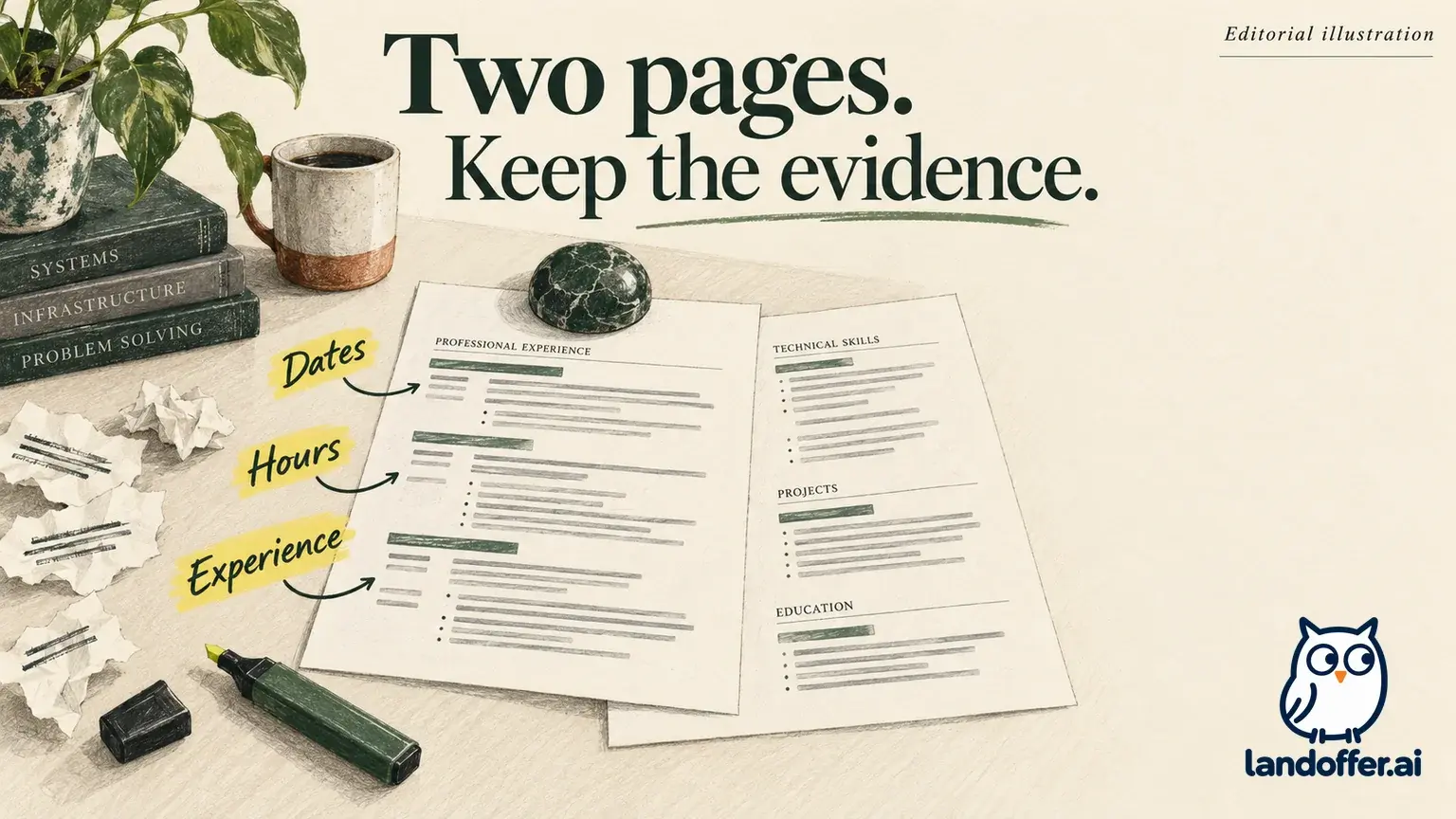
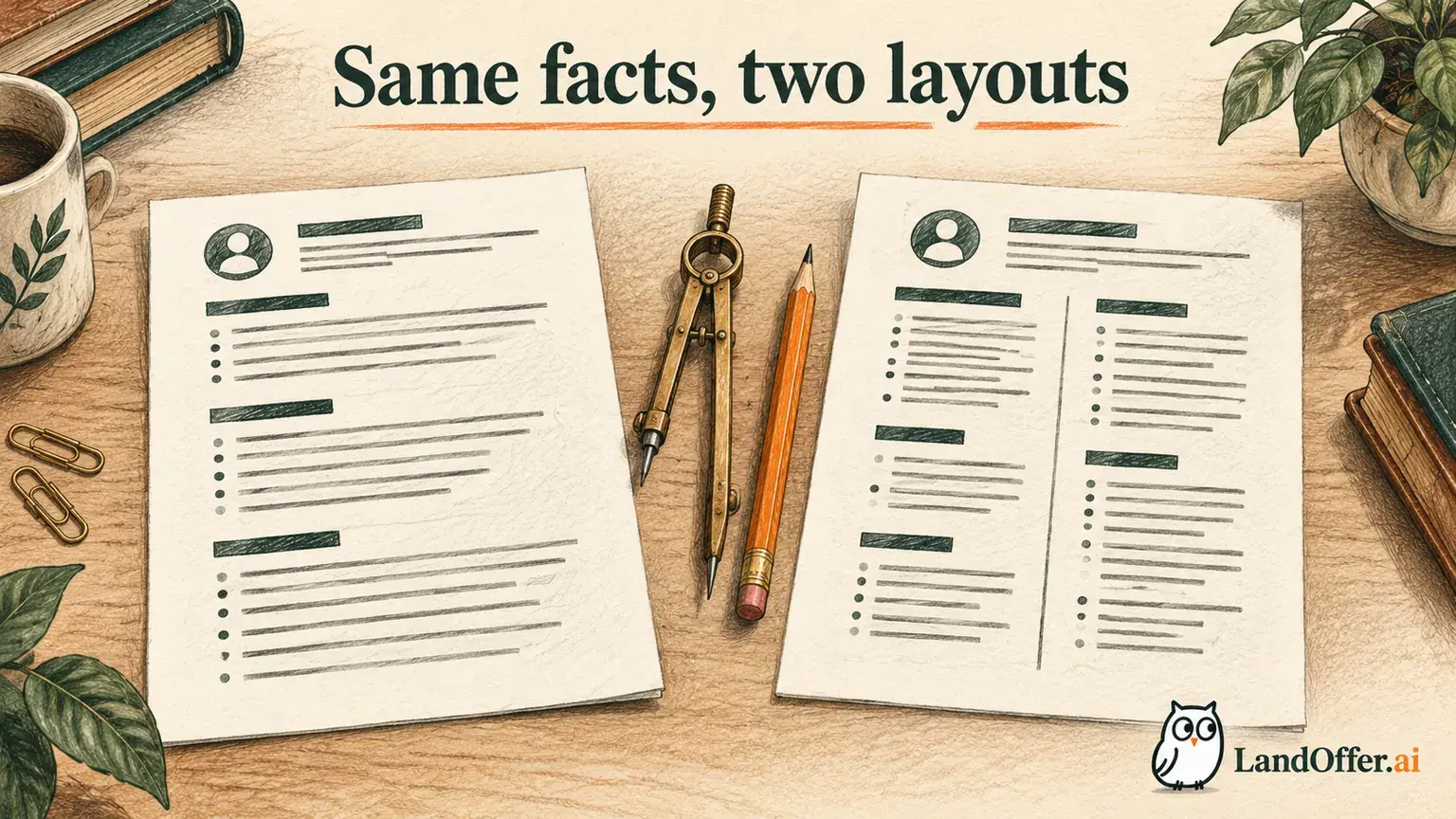
Before applying, keep both a one-page and a two-page draft for a few minutes and compare them side by side. Highlight the proof each version provides for the target posting. Which requirements are supported by an actual example? Which version makes your role and scope clearer? Can someone locate the strongest evidence without decoding crowded formatting? Does the second page add distinct, relevant information? Did the application set a limit?
If the answers favor one page and the text remains readable, use it. If the second page adds important evidence and the instructions allow it, use two. If neither version works, the next step may be revising the examples or narrowing the target—not shrinking the font further. A resume is a selection of evidence, so each page should help the reader assess a specific fit.
For more application options, explore recent LandOffer roles and tailor one accurate resume version to the evidence each posting requests. Follow the employer's own application requirements, and verify the final exported file before you submit.
Sources and Further Reading
- Berkeley Career Engagement: Resumes — student-oriented page-count and formatting guidance.
- Berkeley Career Engagement: Sample Resumes — role-specific resume guidance for students and graduate students.
- U.S. Office of Personnel Management: Applicant Guidance on the Two-Page Resume Limit — current federal two-page guidance and its stated scope.
- USAJOBS: Example VA vacancy with a long-form resume/CV requirement — one posting-specific exception, inspected October 13, 2026; not a tech-role rule.