LandOffer
Job search
Rate Your Technical Skills on a Job Application: Use Evidence Instead of Inflated Labels
Rate technical skills with recent tasks, your contribution, debugging evidence, and support used. Apply the employer’s scale without inflating labels.
A job application asks you to rate Python from beginner to expert. You have finished a course, modified scripts at work, and built one small tool. Those facts describe experience, but you still need the employer’s scale to choose a supported label. Selecting expert because it seems more competitive creates a claim you may be asked to demonstrate.
Start with the employer's definitions, then compare them with work you can build, debug, and explain at the required level of independence. LandOffer publishes this guide and offers a place to browse recent job listings. The worked examples use fictional applicants and explicitly invented employer scales; they are not universal rating standards or predictions of screening scores.

Read the scale before rating the tool
Read a proficiency label together with its definition and the role’s tasks. One employer may define intermediate as completing routine tasks independently. Another may use a numerical scale with descriptions of increasingly complex work. Read the field instructions, help text, and job duties before choosing. A three on a five-point scale is not automatically equivalent to intermediate on another application.
If the form provides no definitions, look at the work the role actually requires. A data assistant using established reports and a backend engineer designing services may both be asked about SQL. Your answer should be grounded in your current capability, with an explanation where the form permits one. Do not claim the employer uses a standard it has not supplied.
Separate a skill level from years of exposure. Five years around a tool can include occasional use of a narrow feature. Six months of direct ownership can establish some independent tasks without establishing broad expertise. If the application asks for both years and proficiency, answer each from the relevant facts instead of using one as a shortcut for the other.
Build an evidence note around actual work
For each requested skill, identify a recent task, your own contribution, the support you used, and the result you can explain. Include a limitation that would matter in this role. A short evidence note makes a vague rating easier to explain: “Python: independently built a CSV validation script; wrote checks for missing columns; needed review for deployment and access handling.”
The CareerOneStop overview of skills assessment describes technical skills in terms of accomplishing specific tasks and recognizes training and experience as ways to develop them. Use that task focus to organize your evidence. CareerOneStop’s overview helps organize task evidence; it does not define expert for this employer or certify the applicant.
Useful evidence can come from employment, study, volunteering, or a personal project, provided you identify the setting honestly. A class assignment is not production ownership. A team project is not wholly your individual work. Record what you personally did so that a reviewer can understand the scope without needing access to confidential files.
Worked example: Ari rates Python using a defined scale
Ari is a fictional applicant for an operations analyst role. This fictional employer defines beginner as completing tasks with step-by-step guidance, intermediate as completing routine tasks independently with review for unfamiliar problems, and advanced as independently designing and maintaining complex solutions while guiding others. These definitions belong only to this example.
Ari built a small Python tool that validates incoming CSV files. Ari wrote the column checks and error messages, tested several bad-input cases, and explained the logic to a colleague. A senior engineer reviewed deployment and data access. Ari has not designed a larger service, maintained concurrent processing, or taught a team to build complex Python systems.
| Evidence question | Ari's completed note | Effect under the fictional employer's scale |
|---|---|---|
| What did Ari build? | A CSV validation tool for a routine workflow | Supports a specific independent task |
| What did Ari debug? | Missing columns and invalid values in sample inputs | Supports bounded troubleshooting |
| What required help? | Deployment and data-access review | Limits the scope of independence |
| What can Ari explain? | The validation logic and selected test cases | Supports ownership of the stated contribution |
| Which label fits these definitions? | Intermediate, with a task explanation where allowed | Does not claim advanced complex-system ownership |
Ari's allowed explanation reads: “Python: independently built and tested a CSV validation tool; routine scripting and input debugging; deployment and access handling reviewed by a senior engineer.” This is stronger evidence than adding “expert Python” to a profile. It also leaves an interviewer a clear task to discuss rather than an undefined global claim.
Ari separately rates SQL from SQL evidence. Having built the Python tool does not establish database design proficiency. For SQL tasks completed only by following course instructions, Ari records that guided setting. The application can therefore contain different levels for different skills without being inconsistent.
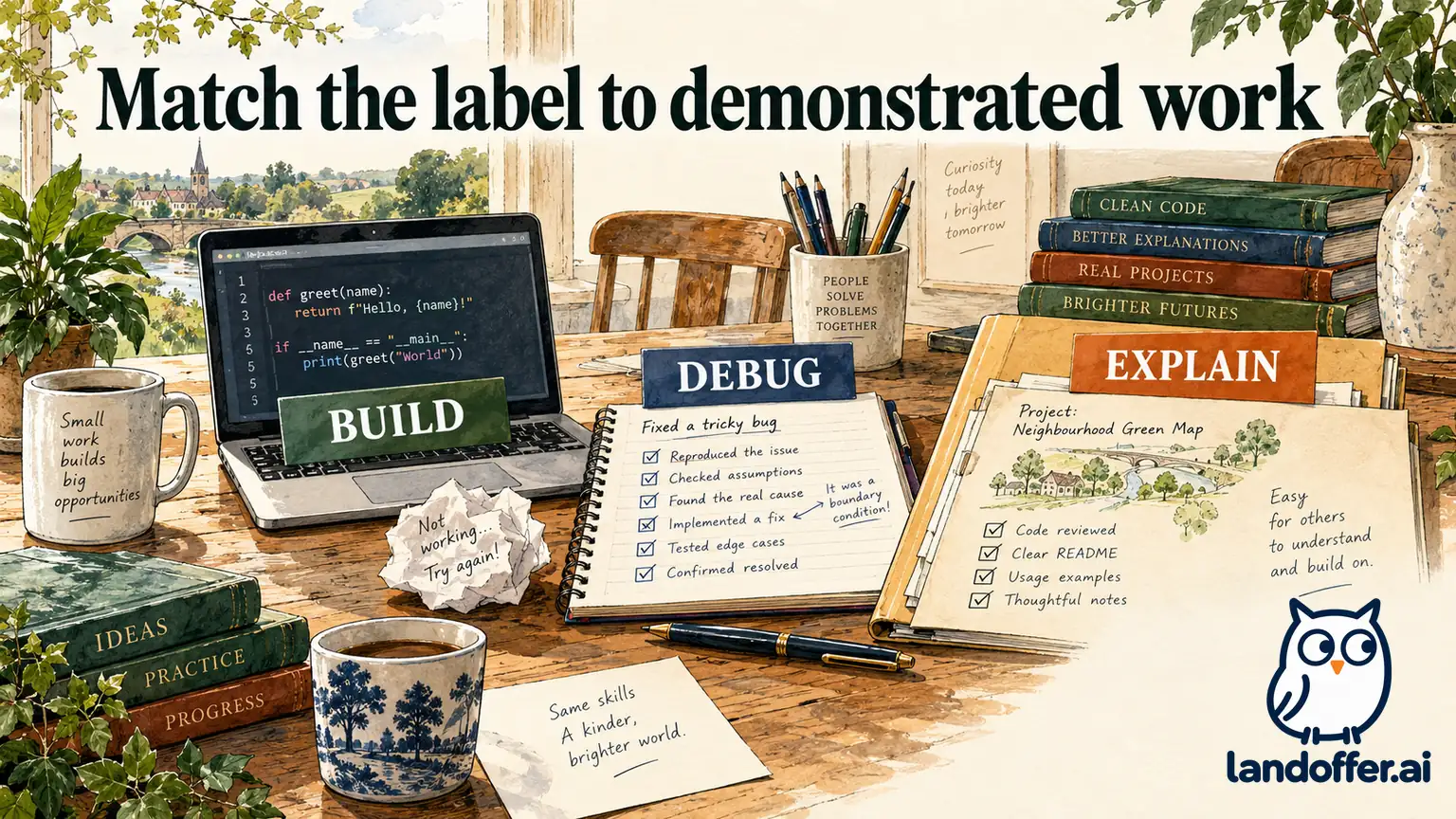
Distinguish learning exercises from independent performance
A completed tutorial shows that you worked through particular material. What it proves depends on what you actually did: copied a solution, followed instructions, modified an example, or solved a new problem independently. Keep those distinctions visible when deciding which application label you can support.
The official Python tutorial introduces Python to programmers who are new to the language; it is not a complete catalog of everything an experienced developer may need. Completing it is a learning milestone, not an employer-issued proficiency rating. Explain the tasks you can now perform instead of treating the tutorial title as a qualification level.
GitHub's Skills catalog offers interactive exercises covering specific workflows, such as introductory Git use and pull-request review. An exercise can help you practice and identify gaps. It does not make a claim about your production responsibility at a former employer. List a course, exercise, or credential accurately in the appropriate field rather than converting it into invented work experience.
Worked example: Morgan checks an old Excel claim
Morgan is a fictional applicant whose saved profile says advanced Excel. The label came from a reporting role five years ago. The new application defines advanced, for this example, as independently building and troubleshooting complex reporting models; intermediate means independently maintaining routine reports. Morgan's recent work has involved updating an established workbook, not creating its model.
Before submitting, Morgan tries a permitted practice task using invented data: build a small summary report from a new table and explain the formulas and checks. Morgan can make a routine summary independently but needs instructions for the more complex modeling approach remembered from the old role. This is private practice, not an employer assessment or a certification.
| Item Morgan reviews | Completed finding | Application treatment |
|---|---|---|
| Saved advanced label | Based on older responsibilities | Does not reuse it without current evidence |
| Recent workbook work | Updates inputs and checks routine totals | Describes maintenance accurately |
| Independent practice | Can create a routine summary with invented data | Uses it to check current capability, not as paid work history |
| Complex model troubleshooting | Needs guidance to complete unfamiliar steps | Does not claim current independent complex-model work |
| Fictional employer definition | Routine independent reports fit intermediate | Selects intermediate and explains recent scope where allowed |
Under this fictional employer’s scale, Morgan’s revised entry reads: “Excel: independently maintain routine reporting workbooks and create summary reports; earlier experience with more complex models, with a refresher needed for unfamiliar modeling tasks.” If the form permits only a label, Morgan selects according to the supplied definition and keeps the evidence note for a later discussion.
The check changes the current claim without erasing truthful past experience. Morgan can still describe the earlier reporting role with its dates. The distinction is between what happened then and what Morgan can independently demonstrate now. Morgan records the refresher needed for unfamiliar modeling tasks alongside the work still performed independently.
Account for review, documentation, and AI assistance
Independent work does not always mean working from memory without documentation. Professional tasks often involve reference materials, code review, and collaboration. The relevant question is what the employer's scale asks and what support was necessary for you to complete the work. Distinguish ordinary reference use from dependence on someone else's solution.
If an AI tool generated most of a script, identify what you personally specified, checked, changed, and understood. Do not claim independent authorship of every line merely because you submitted the result. Can you explain an input failure, recognize a faulty assumption, and make the required change within the role's expectations? Those are useful questions for your private evidence review.
An application assessment may have stricter tool rules than everyday work. Follow those rules even if the job permits tools after hiring. This article does not authorize AI use on a restricted test or suggest using outside assistance to manufacture evidence of independent performance. If the instructions are unclear, ask before beginning the assessed task.
Handle an unclear numerical rating without inventing a standard
For a required one-to-ten field with no anchors, check whether the employer offers instructions elsewhere. If an explanation is allowed, give the rating together with a narrow task description and support boundary. Do not add an invented statement such as “seven means three years of experience” and present it as the employer's rule.
When the difference affects a required qualification, ask a specific question. For example: “Does the SQL rating refer to independently writing analytical queries, maintaining existing reports, or database administration?” The answer may clarify which evidence matters. It does not guarantee that the employer will accept your chosen number or change the requirement.
If the employer does not respond before the deadline, make the most accurate assessment you can support from the available wording. Avoid selecting the maximum simply because the system accepts it. Save the scale and explanation with the application record so you can describe how you interpreted the question if asked later.
Check consistency without inflating every field
Compare the rating with your resume, portfolio descriptions, years-of-experience answers, and examples. “Maintained an existing dashboard” can coexist with intermediate SQL. “Designed the organization's database architecture independently” would require different evidence. Resolve a contradiction in the underlying claim rather than making every field sound equally senior.
Remove skills you cannot describe beyond their names if the form asks specifically for demonstrated capability. Where the application allows “not used” or an equivalent selection, use it when accurate. If every skill is required and no accurate option appears, ask the employer about the form rather than assigning a level to a tool you have never used.
You can prepare an interview explanation from the same evidence note: the task, your contribution, a problem encountered, the help used, and the limit. Do not share proprietary code or private data to make the claim look stronger. An authorized description can be useful evidence without exposing a former employer's materials.
Submit a rating you can explain
Before the final certification, reread the scale and the saved selection. Autofill may carry an old rating into a differently defined question. Verify the current field instead of assuming that a technically successful fill produced a truthful answer. Keep the selected value and any permitted explanation with the rest of your application record.
If you discover an overstatement after submitting, contact the employer about the specific entry and provide the correction. Do not rewrite a project description to justify a rating that was never supported. Track whether the correction was acknowledged separately from the original application receipt; neither event establishes an interview or hiring outcome.
The useful rating connects a label to work you can perform and explain, with limits that matter for the role. As you browse recent jobs on LandOffer, check the posting’s scale against a recent task, your contribution and the support used before reusing a saved rating.