LandOffer
Job search
Technical Account Manager Resume: Show Customer Risk and Operational Follow-Through
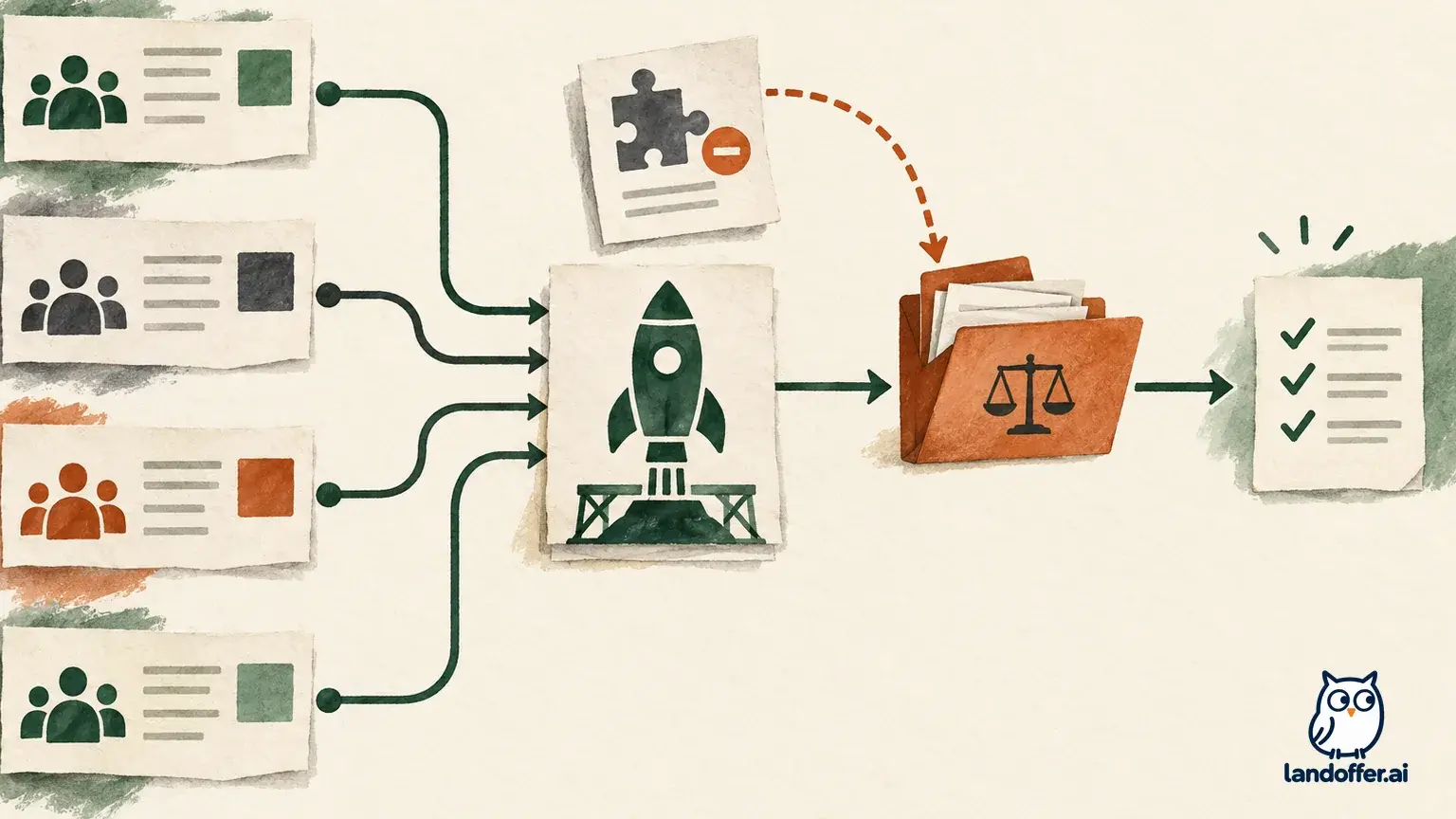
Three complete fictional TAM bullets and a checked account-action ledger distinguish risk logging, ownership, technical resolution, customer confirmation, and closure.
A technical account manager resume should show how you recognized customer risk, brought in the right owner, maintained useful communication, and followed through on the result. “Managed strategic accounts” leaves those contributions invisible. “Saved customer revenue” can overstate them when you coordinated technical work but did not establish its financial effect.
LandOffer publishes this guide and offers job-search tools. The account stories, action records, and finished bullets below are original editorial fiction, not customer information or anyone’s employment history. We inspected current primary sources on October 21, 2026 and checked a synthetic ledger locally; we did not access customer accounts, send messages, or change services.

Start with the responsibilities in the target posting, then compare relevant opportunities through recent jobs on LandOffer.
Describe the technical relationship after the sale
A post-sale technical relationship can include readiness planning, operational reviews, escalation coordination, and tracking improvements across customer and vendor teams. Choose examples from the post-sale responsibilities you actually performed. Do not substitute a presales demonstration, a technical sales win, or an account executive’s commercial ownership for operational follow-through.
AWS’s current Enterprise Support description provides one vendor-specific example: its designated TAM offers architectural guidance, brings in specialists, supports event readiness, and participates in post-event reviews. The page separately describes support engineers and additional specialist services. It does not establish a universal TAM job description or prove that a candidate personally implemented every recommendation.
Read the actual role for its mix of technical depth, customer communication, and account planning. If you owned the action register and escalation narrative while engineering applied a fix, say so. If you were the engineer who implemented a change as well, identify that additional work and its evidence rather than assuming the title supplies it.
Keep technical and commercial claims separate. A customer’s annual contract value may describe an account’s scale if you are permitted to disclose it, but it is not revenue you personally generated or protected. A renewal following an incident also does not establish that your intervention caused the renewal.
Build a customer-risk evidence chain
For one account example, record the affected customer workflow, observed risk or reported impact, agreed next action, responsible owner, communication artifact, and confirmation. Preserve what remained unknown. Use that chain to write a precise bullet and explain your contribution without exposing confidential logs or customer identities.
Distinguish a potential risk from a realized incident. An untested capacity assumption ahead of a launch is not proof that an outage was imminent. A customer’s report of timeouts is not a confirmed root cause. A mitigation proposed by engineering is not an implemented change until the appropriate record supports that state.
AWS’s case-management guidance recommends detailed context, including relevant resource information and timestamps or logs for performance issues. It ties severity to actual urgency and business impact and describes target timeframes for an initial response. An acknowledgment or first response is not a resolution guarantee.
For resume preparation, use only records or recollections you are authorized to retain. Replace identifying details with a truthful, nonconfidential description of the workflow and your contribution. Do not export a customer’s environment details, service credentials, private communications, or support attachments into a personal portfolio.
Worked risk records into three complete TAM bullets
Consider fictional TAM Ishan at fictional vendor Alder Coast. These are account-level service relationships, not individual help-desk tickets. All actions and responses in the table are stipulated for illustration; no actual customer or engineering team performed them during article production.
| Account record | Risk, action, and owner | Communication and supported result |
|---|---|---|
| AC-11: peak-event readiness | A customer’s checkout peak plan lacked an assigned capacity-test owner. Ishan led a readiness discussion and documented a test action owned by the customer’s platform lead, with vendor specialist input. | The customer lead accepted the named actions and next review date. The test had not yet run; launch readiness and outage prevention remained unproven. |
| AC-12: recurring timeouts | The customer reported timeouts in an order-export workflow. Ishan consolidated impact descriptions, timestamps, and sanitized observations into an engineering escalation. Engineering investigated and applied a mitigation. | Ishan maintained dated progress summaries and obtained customer confirmation that the affected export completed after the mitigation. Engineering owned the technical change; no permanent root-cause elimination was established. |
| AC-13: stale operational handoff | A service review found an outdated escalation contact and an unowned runbook-update action. Ishan reconciled customer and vendor responsibilities and assigned the documentation work to the appropriate owners. | The owners acknowledged their actions; the contact entry was corrected. The runbook revision remained pending and was retained for the next review. |
Here are three complete resume bullets within those fictional boundaries:
- Led a customer peak-event readiness review, aligning platform and vendor specialists on a named capacity-test owner, documented actions, and an agreed follow-up date.
- Coordinated an engineering escalation for recurring export timeouts, maintaining customer-impact summaries and recording customer confirmation of the affected workflow after engineering applied a mitigation.
- Reconciled customer and vendor escalation responsibilities after a service review, correcting a stale contact entry and retaining an owner-acknowledged runbook action for follow-up.
The first bullet reports a completed review and accepted action plan, not a successful capacity test. The second credits engineering for the mitigation. The third preserves the unfinished runbook work instead of turning acknowledged ownership into completed documentation.
None claims that Ishan saved a contract, prevented an outage, or single-handedly resolved the customer’s technical issue. The evidence still shows useful TAM work: translating risk into accountable action, maintaining a shared narrative, and checking the customer’s operational experience.
Make communication evidence specific
“Kept stakeholders informed” becomes more useful when you can explain what the update contained and how it changed as evidence arrived. Separate customer-reported impact, confirmed findings, the current owner, the next checkpoint, and unresolved questions in each update. Do not fill a gap with a root-cause guess merely to make the update look complete.
For AC-12, the completed fictional communication record says: customer-reported export timeouts; engineering investigation accepted; mitigation applied by engineering; customer rerun completed; permanent cause and recurrence review still open. This is a summary of stipulated events, not a message sent to anyone or a quotation from a real customer.
AWS’s guide for creating a case from an interaction says to verify prepopulated details and the case’s subject, description, service, category, and severity. The broader lesson for a TAM’s evidence is to preserve accurate context rather than treating an automatically created record as complete or correct. This does not imply that every vendor uses AWS’s fields or processes.
A promised next update is also different from a confirmed resolution time. If your real record shows an agreed update cadence, describe that cadence and whether you maintained it. Do not present a vendor’s initial-response target as your personal record of fixing incidents within that interval.

Audit a finite account-action ledger before claiming closure
A second original example contains six fictional action snapshots across three accounts. These are separate records from Ishan’s first three cases. The declared review rule requires recorded technical resolution and customer confirmation before an incident action can be marked closed. It is an example rule, not a claim about an AWS console workflow or every employer’s closure policy.
| Action and account | Furthest recorded evidence | What remains open |
|---|---|---|
| A01 / North Pine | Risk logged | No escalation or owner acknowledgment recorded |
| A02 / North Pine | Escalation sent | No receiving-owner acknowledgment recorded |
| A03 / Cedar Harbor | Receiving owner acknowledged | Technical resolution not recorded |
| A04 / Cedar Harbor | Engineering reported technical resolution | Customer confirmation and closure not recorded |
| A05 / Brook Meadow | Technical resolution, customer confirmation, and closure recorded | No further action stated within this limited snapshot |
| A06 / Brook Meadow | Technical resolution and customer confirmation recorded | Closure decision not recorded |
The completed audit counts six logged risks, five escalations, four owner acknowledgments, three technical-resolution records, two customer confirmations, and one recorded closure. These are nested states in the supplied fixture, not six different populations to add together. Keep the two actions attached to each account rather than counting six distinct customers.
We executed an original local Python consistency check of those records. It verified six unique action identifiers and three account labels, preserved A04’s pending customer confirmation, and preserved A06’s missing closure. A deliberately invalid version of A04, marked closed without customer confirmation, was rejected under the example’s declared rule.
This was not a live customer-system audit, an AWS support action, or proof that any underlying technical issue was resolved. The checker validates only the stipulated records; it supplies no real owner acknowledgment or customer response. The snapshots also do not support a closure rate, service-level attainment percentage, or financial return calculation.
A complete bounded bullet based on that second exercise would be: “Reviewed six technical account actions across three accounts, distinguishing owner acknowledgment, engineering resolution, customer confirmation, and closure while flagging incomplete follow-through records.” In real work, use those counts only if your authorized records support them. A qualitative alternative is: “Maintained a technical account action register with named owners, evidence-based status updates, and explicit follow-up for unresolved customer confirmations.”
Show risk reduction only when the evidence supports it
Identifying a risk, assigning an owner, and scheduling a review are completed contributions. They are not evidence that the risk disappeared. If a mitigation was tested, record the environment, test scope, observed result, and who accepted the remaining exposure. If a customer deferred an action, retain that decision rather than calling it remediation.
For a real resume metric, define the unit and period first. An account count describes coverage; an action count describes work items; a closed support case describes a workflow state. None alone measures customer health, adoption, retention, or avoided downtime. Avoid combining them into a larger achievement number.
Financial attribution needs particular care. A contract’s value is not loss prevented, and a renewal outcome belongs to a broader commercial and delivery context. If you participated in a renewal review, describe your technical readiness contribution and the evidence you supplied. Do not claim the customer’s revenue or a sales team’s commercial result as your personal production.
The same restraint applies to risk scores. Support a red-to-green status change with a defined rubric and recorded observations. Without that definition, a finished action plan or a documented customer confirmation can be the honest endpoint of the bullet.
Assemble an experience section you can explain
Harvard’s resume guidance recommends specific, active, fact-based language that quantifies and qualifies. For TAM experience, the qualifiers often identify the value: customer workflow, technical risk, responsible owner, agreed next step, and confirmed outcome.
Choose complementary bullets rather than repeating “managed accounts” with different adjectives. A readiness review can show proactive planning; an engineering escalation can show technical context and coordination; an ongoing action register can show continuity after the meeting ends. Name tools and cloud services only where you actually used them and can explain your depth.
Prepare to answer who identified the problem, what you personally did, who applied the change, what the customer confirmed, and what remained unresolved. Keep confidential details out of both the resume and the interview. If an action was awaiting engineering or customer confirmation, say so consistently instead of upgrading it to closure.
The records and bullets remain local fictional exercises; no customer communication or resume was submitted. Tailor your own verified post-sale experience to the opportunities you select through LandOffer’s recent listings, with technical ownership, customer confirmation, and commercial outcomes attributed accurately.
Sources and Further Reading
- AWS Enterprise Support — vendor-specific TAM guidance, specialist coordination, and event reviews.
- AWS Support: Case Management — issue context, severity, and initial-response boundaries.
- AWS Support: Create a Case from an Interaction — verifying automatically populated case details.
- Harvard: Creating a Strong Resume — specific, fact-based resume language.