LandOffer
Job search
Teal vs. Rezi: A Job-Search Workspace or a Resume-First Workflow?
A task-based comparison of Teal’s job-search workspace and a Rezi-centered resume routine, with current plan and export boundaries.
Choose Teal when your main problem is keeping job descriptions, follow-ups and resume choices connected. Choose a Rezi-centered workflow when your tracking already works and you want to concentrate on writing, job-specific keyword feedback or an editable Word export supported by the plan and template. Both tools do more than these labels suggest. The useful distinction is which work you want the product to own. This comparison uses current public documentation and plan pages checked October 19, 2026; we did not test authenticated imports, AI writing, job capture or exports.
LandOffer publishes this comparison and also offers job-search tools. Open one relevant role from LandOffer’s recent jobs and identify the work between finding it and sending an accurate application. A broader workspace is useful when it replaces scattered records. A resume editor is useful when improving the document is the task that needs attention. Keep an existing routine when it already handles both well.

Compare the work each tool would own
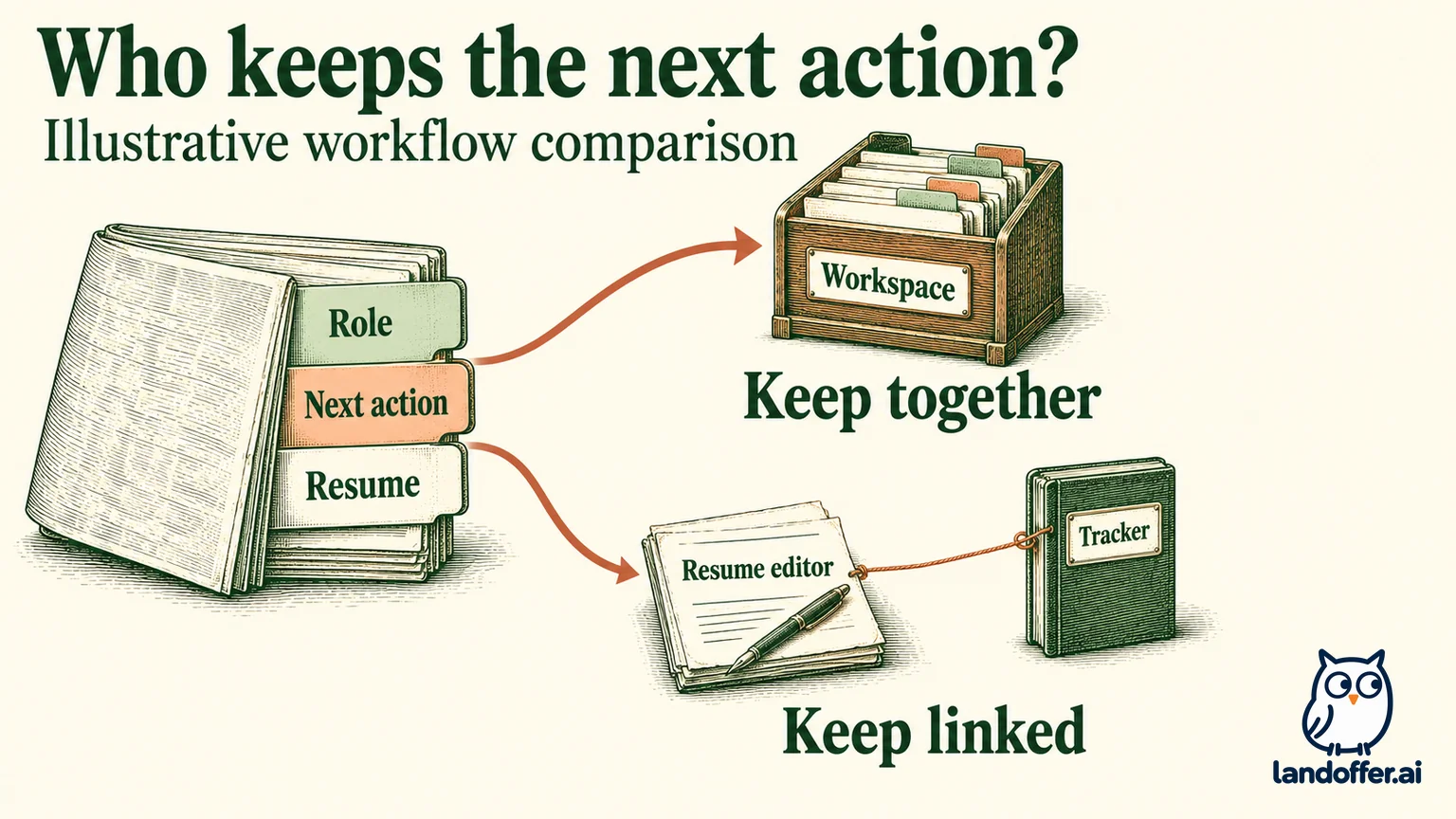
Teal’s tracking guide describes job details, saved descriptions, stages, follow-up dates, notes, contacts and resume associations. It documents extension capture and manual entry. That supports a workflow centered on the opportunity record, with the next action beside the relevant materials.
Rezi’s keyword-targeting guide starts with resume content and a target job. You add the title, company and full description, then review included and missing terms. Suggested bullets and manual edits are both documented. That supports a workflow centered on revising a document against a selected role.
Rezi also advertises job search and interview tools, while Teal includes writing and analysis. Use these labels to choose where to start. Both products have overlapping features, so the comparison follows the responsibility you give each tool.
| Decision | Teal-centered routine | Rezi-centered routine |
|---|---|---|
| Where do next actions live? | Job records can hold stages, notes and follow-up dates. | Keep an existing ledger if it already handles these reliably. |
| What is the editing context? | A resume connected to selected job context and shared career content. | A resume targeted with the company, title and full description. |
| What needs checking outside the editor? | Employer events and the actual exported attachment. | Employer events, the chosen export and any separate tracking record. |
| What justifies switching? | Bringing scattered opportunity information together. | Improving repeated document work without moving a functioning tracker. |
This is a comparison of documented workflows, not a timed usability trial. We have not established that one captures every posting correctly or produces better sentences from the same input.
Start with the free boundary before comparing subscriptions
Teal’s pricing page lists unlimited resumes and job tracking on Free, with ten templates, basic analysis and limited keyword visibility. Its free-versus-paid guide agrees on that core capacity. Saving more jobs alone therefore does not establish a need for Teal+.
The official pages disagree about free bullet-generation credits: pricing lists ten, while the help guide lists five. We did not inspect an account balance or verify a reset period. These are conflicting descriptions of the same free allowance; do not add them together. Keep that uncertainty when planning AI use. The pages agree on unlimited tracking and resume creation.
Rezi’s pricing lists one resume and three PDF downloads on Free, with limited advanced feedback. The number of editable resumes and the number of exported files are separate limits. Revising one document repeatedly can still use several downloads, so count the attachments you need to inspect and deliver. Do not assume three downloads renew monthly or that a free account includes Word export.
Current public paid prices are:
| Product | Displayed individual plan | What the commitment means |
|---|---|---|
| Teal+ | $13 every seven days; $29 every 30 days; $79 every 90 days | Choose the interval you actually need; the weekly figure is not monthly. |
| Rezi Pro | $29 per month | Expanded resume, feedback and download access. |
| Rezi Lifetime | $149 one-time | Long-term access differs from Pro’s recurring human-review benefit. |
We opened Rezi’s pricing FAQ, which says Pro includes a monthly expert review and Lifetime excludes that recurring free review. A longer access period is therefore not identical to every monthly benefit. These are public offers, not quotes from an authenticated checkout, and taxes or account-specific terms were not tested.
Pavel’s completed choice: organize the opportunity record
Pavel is a fictional backend candidate whose documents are reasonably clear but whose next actions are scattered across messages and notes. Two invented roles show the problem. Orchard OR-61 has an unsent application draft and an unresolved hybrid-attendance question. Mariner MR-44 has a submission confirmation and an interview invitation in this fictional scenario.
His completed packet is:
| Role | Preserved state and evidence | Document reference | Next action |
|---|---|---|---|
| Orchard OR-61 | Applying; no submission confirmation | Planned attachment Pavel-OR61-v1.pdf |
Clarify attendance requirements on October 20 before submitting. |
| Mariner MR-44 | Interviewing; fictional confirmation DEMO-MR44 and October 23 invitation | Fictional sent-file reference Pavel-MR44-sent.pdf |
Prepare project examples on October 21 for the October 23 interview. |
Every employer, reference, date and event here is invented. The table is our completed teaching record, not a Teal import, Rezi export or real employer interaction. The filenames describe the case’s intended associations; no vendor files were created for it.
Pavel chooses a Teal-centered routine because its documented records can hold the information he keeps losing. His initial task is to preserve these two states, document associations and next actions. OR-61 needs an attendance answer before submission; MR-44 needs interview preparation while its sent-file reference stays attached to the earlier event. Free tracking fits that task. Seeing the next action beside the right role would address his frustration with searching through scattered notes.
A Rezi-centered routine could still work, but it would leave his existing ledger responsible for the opportunity events and follow-up dates. Improving the OR-61 resume would not answer when he should clarify attendance. A higher document score would not tell him which conversation belongs to MR-44. His choice follows from the missing organizational connection.
The distinction also changes how he handles an export. Teal’s export guide documents an optional Move job to applied toggle. Exporting with that option can update a connected job’s status. For OR-61, Pavel’s intended state remains Applying until an employer submission occurs; preparing its PDF does not resolve the unanswered question or establish receipt.
Understand the reach of a resume edit
Teal’s resume-syncing guide describes an option to save an existing edit across resumes. Leaving it unchecked keeps the edit local, while another version can present an Update Available comparison. Entirely new details are added across resumes automatically.
That shared-content model can reduce repeated factual maintenance, but unlimited resumes should not be read as unlimited isolated career histories. Before changing something, decide whether it is a shared correction or a role-specific emphasis. Then inspect the relevant versions and selected content.
For a Rezi-centered routine, retain the source facts and identify the target attached to the document you are editing. The targeting guide allows manual changes as well as generated suggestions. We did not verify cross-resume synchronization in Rezi and do not infer equivalence from the fact that paid plans allow several resumes.
Choose the maintenance model you can explain. Someone who wants one job-record workspace may accept shared content and its update controls. Someone who already manages source files and tracking may prefer to keep that arrangement while using an editor for targeted writing. Neither choice removes the need to preserve the factual meaning of a revision.
Bruno’s completed choice: keep tracking, solve the Word requirement
Bruno is a second fictional engineer. His existing tracker already holds five active roles, dates and next actions. His problem is developing clearer job-specific content and supplying an editable Word document to a reviewer. He is willing to budget $29 for one paid editing period if a supported template meets that requirement.
Teal’s current export guide states PDF-only output. Rezi’s download guide documents PDF across templates and DOCX or Google Drive on some templates. Rezi’s pricing table places Word and Drive export in paid access. Both the plan and selected template matter.
| Route Bruno considers | Fit for his stated task | Completed decision |
|---|---|---|
| Teal+ at $29 for 30 days | Adds analysis and writing capacity, but its documented PDF-only route leaves Word unresolved. | Skip for this task. |
| Rezi Pro at $29 per month with a DOCX-compatible template | Provides the documented editable-export route alongside resume work. | Select this route, subject to checking template access before paying. |
| Existing Word source | Avoids a new subscription if it already supports the writing and review he needs. | Retain as the fallback; choose it if no new editing assistance is needed. |
Bruno keeps his tracker. There is no reason in this case to migrate five functioning opportunity records merely because he changes the resume editor. His source notes remain the authority for dates, responsibilities and project scope, whichever writing interface he uses.
This is a conditional editorial choice, not a purchase or completed DOCX export. He still needs to open the actual Word file in the reviewer’s environment and inspect headings, dates, links and page breaks. Paying for format access does not establish identical rendering in every editor.
The opposite constraint changes the result. If Bruno only needed a PDF and also lacked a reliable record of follow-ups, the Teal-centered route would address more of his named work. The comparison turns on the missing capability rather than a claim that the same $29 buys equal value for everyone.
Use feedback without comparing incompatible scores
Teal’s export guidance distinguishes resume Analysis from Job Matching. Those are different checks within its own workflow. Rezi’s score guide describes 23 audits across five categories and explicitly says these are not ATS scores.
A Rezi Score and a Teal Match Score therefore should not be placed on one winner’s scale. They have different purposes and evaluation rules. Neither number establishes whether an employer received a file, whether a qualification is true or how likely a candidate is to be hired.
Use a flagged issue to identify an action you can explain: include relevant experience already in the factual record, clarify a supported term or acknowledge a real requirement gap. A missing production-ownership keyword cannot turn coursework into production ownership. A generated sentence also needs comparison with the original facts before it belongs in a resume.
We did not feed identical material to both tools or compare their suggestions. If writing quality drives your decision, review a small representative task with your own source notes and preserve the factual differences you observe. Public feature descriptions alone cannot rank the output.
Choose one primary routine and keep the necessary handoff
Teal is a reasonable starting point when job context, dates and document associations need a shared home. Rezi is a reasonable starting point when a working tracker can stay in place and resume development or a verified export route is the repeated task. Both can be unnecessary if your present editor and records already meet the requirements.
Before moving substantial information, decide where the job record, factual source, editable resume and final attachment will live. Keep one primary place for stage changes and next actions. A second editor should have a defined handoff rather than become another conflicting record.
Choose one opening from LandOffer’s recent jobs. Write down its required file format, next action and follow-up date, then choose the routine that covers the missing work. Keep the existing source document until you have inspected the replacement file. Record an employer submission or reply separately from preparing or exporting an attachment.
Sources and Further Reading
- Teal pricing and billing intervals
- Teal Free versus Teal+ and the conflicting AI allowance
- Teal job records, notes and follow-up dates
- Teal resume synchronization
- Teal PDF export and optional job-status update
- Rezi pricing, plan comparison and pricing FAQ
- Rezi job-specific keyword targeting
- Rezi Score’s stated scope
- Rezi template-dependent downloads