LandOffer
Workplace Communication
A Stakeholder Adds More Work: Negotiate Scope Without Saying Yes to Everything
Turn an additional stakeholder request into a specific outcome, an assessed trade-off, an authorized decision, and a revised scope record with explicit exclusions.
When a stakeholder adds work, acknowledge the need without turning the request into a commitment. Clarify the requested outcome, compare it with the agreed scope, and explain what must change if the team accepts it. Offer a concrete trade-off to the person who owns priorities, then record the revised deliverables, exclusions, and decision. You can support a valuable change without quietly promising every addition.
The starting point here is an incoming request, not an already missed deadline. This guide from LandOffer.ai uses a fictional software project to work through an assessment, a conversation, and an updated scope record. Its estimates and decisions are teaching assumptions, not observations of a real team or guarantees about delivery.

Clarify the request before estimating the extra work
“Can we also export this?” could mean a manual download of the current view, a bulk data extract, or an automated message to external recipients. Those outcomes have different implementation, permission, review, and support needs. Ask who needs the output, what they will do with it, when they need it, and what would make a smaller version useful.
Restate the request in observable terms. For example: “An authorized analyst downloads the visible inventory fields as a CSV file after applying the current filters.” That description gives the team something to evaluate. “Add exports” leaves the boundary open and makes it difficult to distinguish a later expansion from a misunderstood original request.
Next check the existing agreement. Is this a new deliverable, a clarification of promised behavior, or a defect that prevents an agreed use case? Do not label every question scope creep. A missing condition needed to accept the original work may already belong to that work. Equally, a requester's enthusiasm does not make an unrelated feature part of the approved baseline.
Atlassian's scope-creep guidance recommends a visible baseline, an impact assessment, a trade-off decision, and an updated record. The practical value is making the change explicit. Its working-method advice does not require your team to adopt a particular tool, meeting schedule, or approval hierarchy.
Identify the decision owner and the constraints they can change
The requester may understand the business problem without having authority to change the team's priorities. Identify who can approve a change to this release, who must assess technical or operational effects, and who owns any work proposed for removal. Involve that owner before proposing to cancel another team's commitment.
The Association for Project Management's change-control overview describes capturing and evaluating changes before approval, rejection, or deferral, followed by updating the plan when approved. A formal project may require a sponsor or board; a smaller team may have a named product owner. Use the route that actually applies to your work.
Be explicit about which constraints are fixed and which can be discussed. A compliance requirement, an agreed quality condition, or a permission boundary should not silently disappear to make a feature fit. An optional display control might be negotiable. Adding a developer also does not automatically remove coordination or review work, particularly when the new person lacks project context.
Basecamp's Shape Up chapter on deciding when to stop describes questioning additions and adjusting scope within a time budget. It distinguishes choosing what to build from lowering quality. That is Basecamp's method, not a universal six-week rule. The useful question is which part of the outcome matters enough to displace something else.
Completed impact assessment: accept a swap, reject an unbounded addition
The following project, people, effort figures, and decisions are fictional. Omar is implementing a sample-inventory list for an internal laboratory team. Elena, the operations stakeholder, asks for a CSV download and a nightly emailed export. Mika is the product owner authorized to decide release priorities, including whether the optional column picker remains in scope; the engineering lead reviews the technical assessment.
The agreed remaining plan contains six estimated engineering days for the core list, required permission behavior, and verification, plus two estimated days for an optional column picker. The scheduled review date is November 20. Elena's new request has not yet been accepted, and no implementation outcome has been observed.
Omar clarifies that the immediate need is to reconcile the visible list during a weekly operations review. A manual CSV of permitted visible fields can address that task. The nightly email is a different workflow involving recipients and data handling that the current plan does not define.
| Option or request | Completed impact assessment | Decision presented to Mika |
|---|---|---|
| Keep the original scope | Six estimated days for core work and checks, plus two for the column picker: eight remaining days. No export feature. | Valid baseline if the new request is not more important than the picker. |
| Swap the picker for manual CSV | Six estimated days remain for core work; the CSV is estimated at two days including permitted-field selection, formatting, and export checks. Total remains eight estimated days. | Recommended for the clarified reconciliation need, subject to the lead's assumption check and Mika's decision to remove the optional picker. |
| Add CSV without removing work | Original eight days plus two estimated CSV days: ten remaining days. | Requires a separate decision about capacity, timing, or other scope; no silent commitment to the original plan. |
| Add nightly emailed exports | Recipient authorization, allowed data, delivery handling, and ongoing ownership are undefined. No reliable effort estimate is supplied. | Reject inclusion in this release; consider a separately authorized assessment if there is still a business need. |
The arithmetic makes the proposed swap visible, but it is not a delivery forecast. The two-day CSV estimate is stipulated for teaching and could be wrong in a real project. The team must still examine dependencies, review availability, and uncertainty. Equal estimated effort does not prove two deliverables have equal risk or value; Mika needs that distinction to decide whether the swap is worthwhile, rather than merely possible on paper.
Notice what does not move: the core permission behavior and required checks remain. The proposal removes a discrete optional deliverable instead of saying the team will somehow work faster. The nightly-email request also has an explicit disposition; it is not left in a vague “maybe” state that Elena could interpret as included.
Use a conversation that resolves the request
Begin with the outcome you understood, then present a recommendation and its cost. “I can investigate that” may be appropriate, but state whether investigation itself needs time or approval. A discovery task is not the same commitment as delivering the requested feature.
Here is a complete fictional exchange based on the assessment above:
Elena: Can we add CSV download and email the inventory every night? We need the data for reconciliation.
Omar: For the weekly review, do you need a manual file of the filtered fields you are already allowed to see, or do you need data sent to people who may not use the inventory tool?
Elena: The manual file would cover this review. The nightly email is something I hoped we could add for later convenience.
Omar: My recommendation is the manual CSV instead of the optional column picker. Each is currently estimated at two days, so the swap preserves the eight-day remaining estimate while retaining the core list, permissions, and checks. Adding both would be ten estimated days. The engineering lead still needs to confirm the export assumptions. I cannot include nightly email without a separate assessment of recipients, data handling, and ownership.
Mika: I approve the CSV-for-picker swap on that defined basis. Keep the core permission and verification work. The nightly email is not approved for this release. Please update the scope record; if the lead identifies an assumption that changes the estimate or boundary, bring it back to me before expanding the commitment.
Elena: The manual permitted-fields export meets the immediate reconciliation need. I understand the picker and nightly email are out of this release.
The exchange obtains the requester's understanding and the decision owner's approval. It also retains a specific technical review boundary. Omar has not promised a broader export, future email delivery, or an unconditional completion date. Mika's decision is approval of revised scope in this invented scenario, not evidence that the software has shipped.
Update the scope where the team actually works
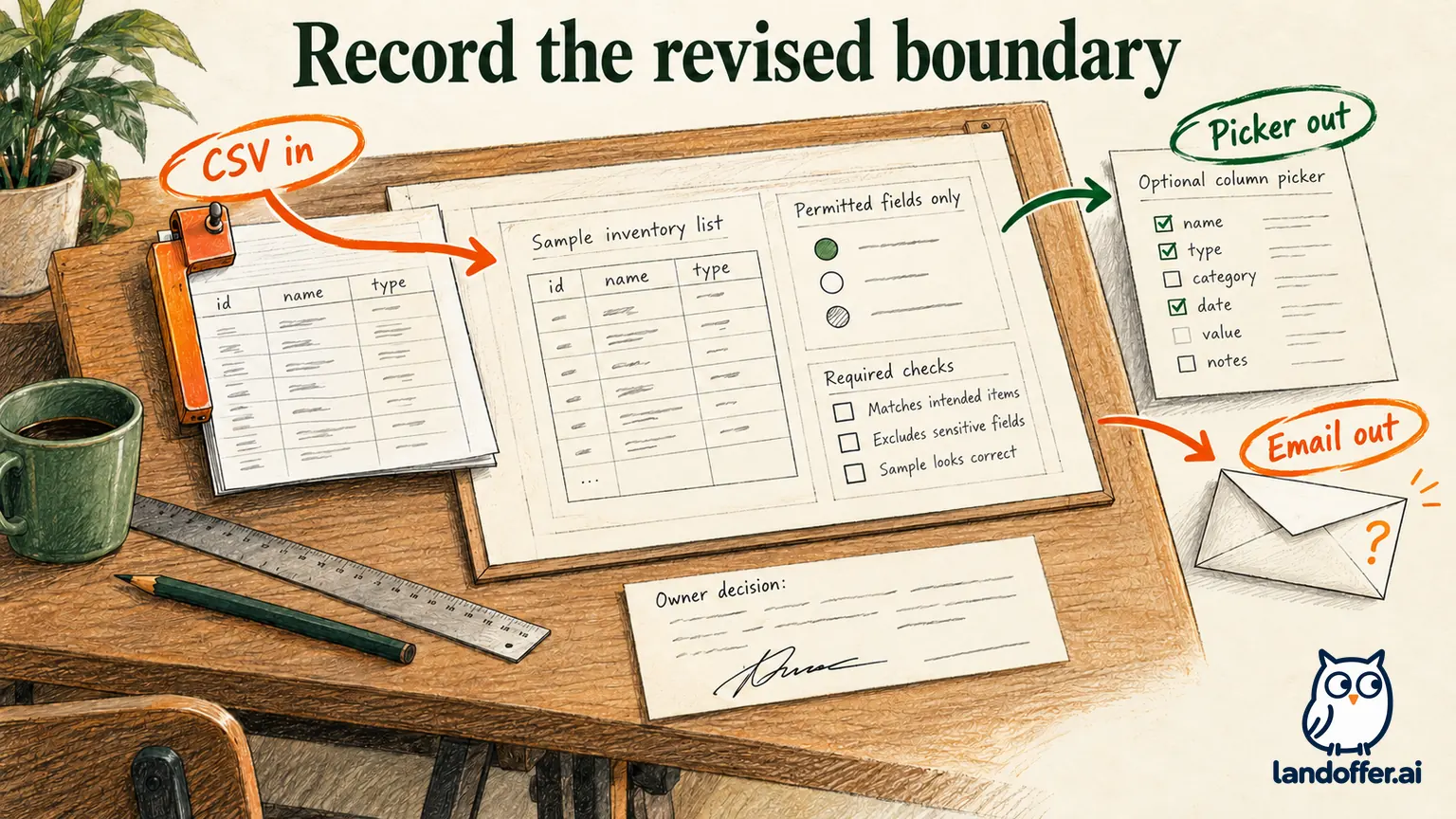
After the decision, replace ambiguous notes with a revised agreement. In the fictional record, Omar writes: “Revision 2, November 4, approved by Mika; Elena confirms the manual export addresses the immediate task. In: core inventory list, existing role permissions, manual filtered CSV of permitted visible fields, required verification. Out: optional column picker and nightly email.”
The same fictional record retains November 20 as the planned review date, eight estimated remaining engineering days, the engineering lead's export-assumption check, and Mika as the owner of any further scope decision. The next checkpoint is November 6 to confirm that assessment. These dates illustrate coordination, not a measured team delivery schedule. No approval of recipients, recurring delivery, or additional fields is implied.
Update the relevant tasks and acceptance notes as well as the summary. Close or move the column-picker item with a reason so that another person does not continue building it from an older list. Mark the email request “not approved for this release”; putting it in a backlog does not give it a future delivery date.
Tell affected collaborators what changed. A revised document that only the engineer sees may leave operations expecting three features and another developer expecting the picker. The purpose of the record is a shared boundary, not documentation for its own sake. Use your team's permitted tool and access rules; a public document is unnecessary.
Handle pressure without inventing capacity or authority
It can be uncomfortable to pause a request from someone senior, especially when they call it “small.” Explain the relevant work rather than argue over the adjective. The visible button might require data selection, permissions, formatting, verification, and support decisions. Identify the specific unknown that prevents a confident answer. Avoid presenting a worst-case number as established fact just to make the request go away.
If two stakeholders insist that their own addition is highest priority, bring the competing outcomes to the person who can rank them. Present the choices and the affected commitments. Do not make private promises to both parties or use overtime as an unstated resource. When you lack authority to refuse or swap work, make your recommendation explicit and request the required decision.
Some requests reveal a genuine omission from the original requirement. If permitted users cannot complete the agreed core task, determine whether that is unfinished original work before negotiating an optional swap. Scope control should not become a way to exclude necessary acceptance behavior. Conversely, “we might want this someday” does not establish that it is essential now.
If no decision arrives, record the request as pending and state the plan you are continuing under, subject to your actual authority. Name the decision owner and the latest useful decision point if delay would remove an option. Acknowledgment, an investigation, and approval to implement are different states; do not allow a friendly response to blur them.
Close the conversation with a revised commitment
Before acting on an addition, check whether you can state the new deliverable, what leaves or changes, the person who approved it, and the remaining conditions. If one is missing, that is the next question to resolve. Keep newly discovered work visible rather than quietly absorbing it after the conversation ends.
Start with the next additional request you receive: restate the outcome and propose one concrete trade-off to the priority owner. Keep it labeled as a proposal until the required decision and conditions are recorded. This guide is from LandOffer.ai; the useful result is an explicit revised agreement, not a promise that every request can fit.
Sources and Further Reading
- Basecamp, Shape Up: Decide When to Stop — scope trade-offs and the distinction between variable scope and lower quality.
- Association for Project Management: What Is Change Control? — capture, evaluation, approval/rejection/deferral, and plan updates.
- Atlassian: How to Manage Scope Creep — visible baseline, change decisions, and updated scope records.