LandOffer
Job search
Huntr Pricing: When the Free Plan Is Enough and When Pro Adds Value
Compare Huntr Free limits and Pro charges, calculate one- to six-month commitments, and decide whether tracking capacity or repeated tailoring justifies paying.
Huntr's free plan is enough when you mainly need a manageable job tracker, base resumes and PDF exports, and can work within its published limits. Pro becomes useful when a specific limit interrupts your search or you repeatedly use paid tailoring and detailed feedback. Buy for the work you will do during the billing period, rather than for a lower monthly-equivalent label or a promised job-search outcome.
Prices and plan descriptions below were checked on October 12, 2026. This is a public-documentation review, not a paid-account test or a measurement of AI accuracy. LandOffer publishes this guide and provides job-search tools. You can browse recent roles on LandOffer before deciding how much tracking and tailoring capacity your current search actually needs.
The current free boundaries that affect a purchase
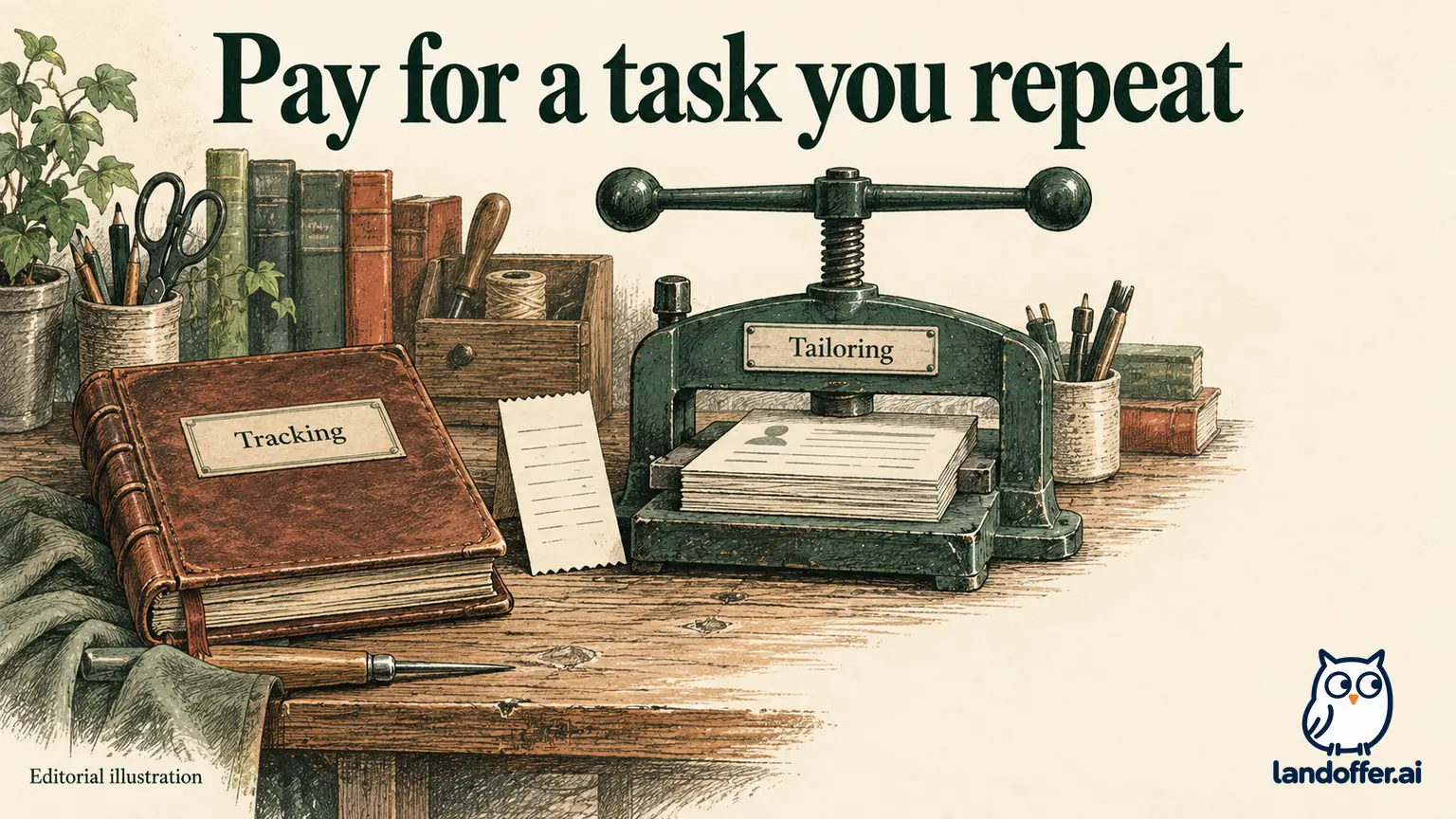
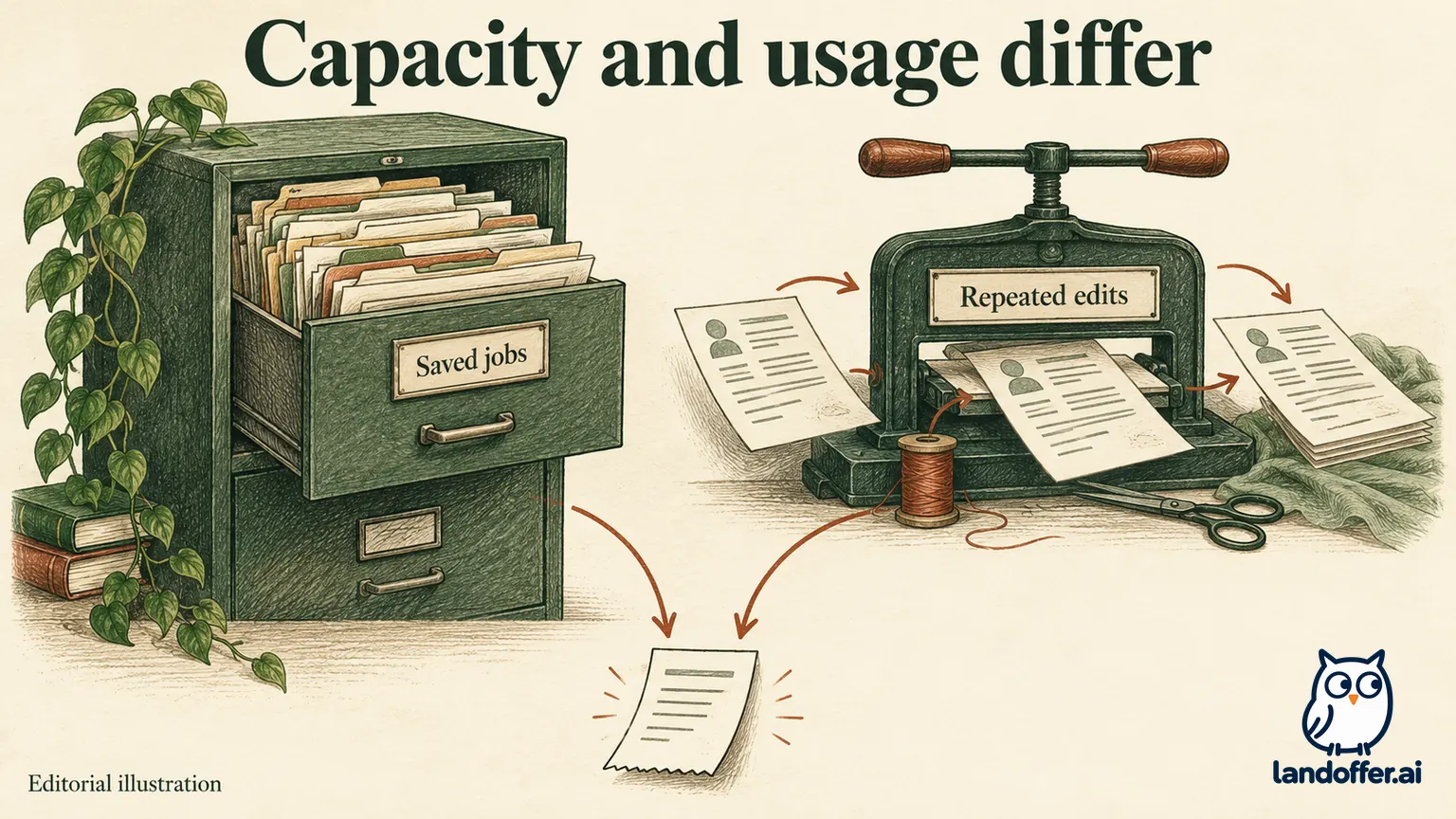
Huntr's pricing page lists unlimited base resumes, PDF export and access to resume templates on Free. It also lists two job-tailored resumes, two application packets, up to 100 tracked jobs and up to 100 document uploads. These are separate allowances. A candidate can run out of one while remaining comfortably within another.
The current general FAQ distinguishes Basic matching and scoring from Pro's advanced matching, scoring and AI review or tailoring. Free also includes job clipping, contact management and application autofill. “Unlimited autofills” describes the plan allowance; it is not evidence that every employer form is supported or will be populated correctly.
| Your task | Published Free boundary | Why Pro might matter |
|---|---|---|
| Maintain ordinary base resumes and download PDFs | Unlimited base resumes; PDF export included | Paying is unnecessary solely to unlock the listed PDF export |
| Store a job-search queue | Up to 100 tracked jobs | A verified capacity problem can justify unlimited tracking |
| Keep job-specific resume variants and packets | Two tailored resumes; two packets | Repeated role-specific preparation may exceed this allowance |
| Use detailed matching and AI editing repeatedly | Basic feedback and limited complimentary AI use | Pro lists advanced matching and unlimited AI features |
| Store documents | Up to 100 uploads | Frequent document storage can encounter a separate cap |
Do not interpret two tailored resumes as two new AI credits every month. The pricing page does not state that reset rule. Nor does a stored-resume allowance establish how many AI generations can be made inside it. Huntr says Free includes a small number of complimentary AI credits without publishing an exact quantity there. Check the actual balance if your decision depends on that number.
A useful first purchase question is: “Which named action can I no longer complete?” Reaching the tracker limit, needing a third tailored resume and wanting another detailed AI review are different answers. Recording the blocked action lets you compare the paid feature with a practical alternative, such as editing an existing resume manually when another AI review is unnecessary.
What Huntr Pro costs at each billing period
The dedicated pricing page and general FAQ agree on the current public charges: $40 monthly, $90 every three months, or $160 every six months, in USD. The three billing options provide the same Pro features; the amount charged upfront and the period purchased differ. Taxes, promotions and account-specific checkout terms can change the amount payable; the calculations here use the advertised charges only.
The quarterly label is $30 per month because $90 divided by three is $30. The six-month page displays $26.66 per month; $160 divided by six is $26.666… . Neither label means you can buy one month for that amount. The billing charge, rather than the rounded display, belongs in your budget.
Here is a completed cost comparison for continuous access over different horizons. It assumes recurring periods at the advertised prices and no refund or promotional discount.
| Access needed | Monthly plan paid through that horizon | Quarterly plan paid through that horizon | Six-month plan paid through that horizon | Smallest listed commitment covering it |
|---|---|---|---|---|
| One month | $40 | $90 | $160 | One monthly charge |
| Two months | $80 | $90 | $160 | Two monthly charges |
| Three months | $120 | $90 | $160 | One quarterly charge |
| Six months | $240 | $180 | $160 | One six-month charge |
For someone needing two months, the quarterly option's lower monthly equivalent still costs $10 more than two monthly charges. For someone who will use paid features continuously for three months, one quarter saves $30 against three monthly charges. These are cost comparisons, not recommendations about how long a search should take.
If your need is uncertain, the monthly option has a higher unit price but a smaller initial commitment. If you already know you need six months of recurring paid work, the longer period may be cheaper.
A completed capacity decision: Rosa keeps Free
Rosa is a fictional QA engineer who tracks 76 jobs and has 18 uploaded documents. She stores one general resume and one job-tailored version, edits her writing in an existing word processor, and exports PDFs. Her application routine is modest and she does not repeatedly need detailed matching reports.
Her completed purchase ledger is straightforward: tracker headroom is 24 records under the published cap; document headroom is 82 uploads; her one tailored version is below the listed two-version allowance. Rosa does not need more saved jobs or documents merely because her account has room for them. She keeps Free because no paid feature solves a current problem in this example.
She does have nine stale records in the queue. She marks their status accurately and reviews them during her weekly maintenance pass. She does not assume that archiving makes them stop counting toward the cap: the public pricing page says tracked jobs, without explaining that counting rule. If capacity becomes a real issue, she will check whether the account's displayed job count changes after archiving a record; this review did not test that behavior.
Rosa also does not delete useful history merely to avoid a future subscription. Deleting a record can discard notes she may need if a recruiter contacts her later. Her decision is to maintain a coherent queue and revisit capacity when it is actually constrained. An unused Pro feature would not make the record more accurate.
This is why tracking volume and application volume should remain separate. A saved role can be under consideration, closed or deliberately skipped. Buying room for more records does not imply that Rosa should submit more applications. The purchase decision concerns the history she wants to retain and the work she needs the tool to support.
A completed tailoring decision: Malik considers one month
Malik is a fictional data engineer with 32 tracked roles and eight documents. Storage is not his bottleneck. He is preparing four genuinely different role-specific resumes: batch pipelines, streaming, analytics infrastructure and an internal platform role. He has already used the two listed tailored-resume slots and wants repeated detailed reviews during the next month.
His completed ledger names the constraint: more tailored variants and repeated advanced feedback, rather than more job cards. The advertised monthly Pro plan covers those documented feature needs. He budgets $40 before applicable tax for four planned resume variants, then records a review date before the next invoice; later paid use is still uncertain.
The purchase does not make every generated sentence acceptable. For the streaming role, Malik's evidence includes maintaining a Kafka consumer and investigating delivery failures. It does not include designing the company's entire streaming architecture. He can accept a clearer description of the consumer work and reject a rewrite that expands his ownership.
He also keeps one factual base history so that four variants do not drift into contradictory employment dates or different job titles. Each copy emphasizes different evidence, but all remain defensible. If he spends most of the month fixing invented claims or receives feedback that does not help him make decisions, unlimited generation has limited practical value.
His end-of-period review asks three concrete questions: Did he use the paid features for the four planned variants? Did the feedback lead to useful, accurate edits? Does another month contain similar work? He renews only if the upcoming routine justifies it. He does not use interview responses from a small, mixed batch as proof that the subscription caused better outcomes.
Trials, cancellation and conflicting refund descriptions
Huntr's current pricing FAQ says there is no Pro free trial, while the free plan supplies limited complimentary AI credits. The general help FAQ offers a support contact for trial or coupon requests. That route does not establish an entitlement to a trial. A purchase should be affordable under the displayed terms even if support provides no exception.
The upgrade and downgrade guide directs candidates to Personal Account Settings and Plan & Usage. It describes canceling Pro to downgrade and retaining previously created content. The pricing page says paid access continues through the current period. Data retention does not mean all Pro operations remain available afterward.
Cancellation and a refund are different events. Huntr's billing FAQ says canceling does not automatically trigger a refund. Its Refund Policy, dated February 4, 2026, describes a discretionary review influenced by timing and usage, rather than a guaranteed return of every unused day.
There is a material discrepancy: the Plan & Pricing FAQ, dated April 25, 2025, describes prorated refunds for quarterly or six-month cancellation. The newer dedicated policy and current billing FAQ do not support treating that older wording as an automatic refund promise. If a longer commitment is affordable only with a prorated refund, obtain written clarification before buying.
After canceling, keep the displayed next-invoice or cancellation information and verify the plan state. These are practical recordkeeping steps, not a claim that we tested cancellation in an account. If a charge or plan state is disputed, use Huntr's support route with the relevant billing details rather than repeatedly starting new subscriptions.
Buy the smallest plan that supports a defined routine
Free fits candidates like Rosa who need organized records, ordinary resume versions and exports within the listed allowances. Pro fits candidates like Malik when recurring advanced review or additional tailored materials solve a present constraint. Someone already comfortable with a spreadsheet and editor may reasonably keep both if moving tools adds work without improving the routine.
Before upgrading, write one sentence naming the blocked action, the period in which you will use it and the maximum charge you can accept. Then choose the smallest commitment that covers that work. This prevents a discount from becoming the main reason to buy several months of features you have not yet needed.
For broader product workflow details, read our Huntr review. This pricing decision is narrower: which allowance matters today, how much will be charged and what future use would justify renewal? Those questions remain useful even if a feature count changes later.
Start with a few relevant openings from LandOffer's recent roles, track the work they actually require, and revisit your Huntr plan only when that work encounters a named limit. Keep the billing amount and next review date beside the decision, and verify cancellation in Plan & Usage if you stop. Do not budget on receiving an unconfirmed refund.