LandOffer
Job search
SMART Scholarship for Computing Students: Evaluate the Sponsoring-Facility Commitment
Compare computing disciplines, facility preferences, internships and the service agreement before accepting SMART funding tied to a specific civilian employer.
The SMART Scholarship is worth considering when you want a funded computing degree and a civilian career at a participating sponsoring facility. Evaluate those together. A facility preference is not an assignment, a computing discipline tag is not a software vacancy, and an award's employment pathway does not promise your preferred team, salary or location.
This guide reviews official public pages and the 2026 Scholar Handbook checked on October 13, 2026. LandOffer publishes it; we did not create a SMART account, submit preferences, contact a facility or accept an agreement. You can browse recent roles on LandOffer.ai to compare career options, but those listings do not establish a SMART sponsorship or satisfy its service requirement.
Start with the facility you might actually join. Then compare the degree, summer commitments, funding and written service terms. Write down the proposed degree, possible work location and unanswered questions before comparing the award with your other options.

Match the application year to the funded degree
SMART's current eligibility page labels its requirements for 2026 while specifying study in Fall 2027 and funding beginning August 2027. It requires a cumulative 3.0 GPA on a 4.0 scale, an eligible US institution, the ability to obtain and maintain a clearance, and age 18 by January 1, 2028. The page lists citizenship in the United States, Australia, Canada, New Zealand or United Kingdom; citizenship alone does not establish that every other requirement is met.
For computing students, listed disciplines include Computer Science and Engineering, Data Science and Analytics, Information Sciences and Software Engineering. Use the exact degree and field recorded by your institution. A job interest in AI does not turn an unrelated degree into an approved technical program.
The application FAQ describes an annual window from August 1 to the first Friday in December. Purdue's computer-science department posted a December 4 application notice, updated September 23, 2026. Check the current application instructions for the closing time; we did not verify a timezone-specific cutoff inside an applicant account.
Do not collapse application, admission and funding into one date. The public Proposed Award instructions contain both a July 2027 admission reference and August 2027 funding/enrollment wording. That inconsistency remains unresolved. An applicant awaiting admission should clarify the required evidence and date before relying on either sentence.
Record both the degree you currently study and the degree for which you are requesting funding. Someone applying during a bachelor's final year for a future master's award needs a proposed graduate program and realistic completion date. They should not assume that their current enrollment establishes the next degree's admission or funding terms.
Use the facility directory to investigate work
The sponsoring-facility directory offers filters for discipline, degree level, location, service and facility type. We selected Software Engineering, ran the search and observed the directory change from 198 to 70 facilities after it finished updating. These were facility records, not 70 open software jobs or available scholarship seats.
That difference changes how to use the results. Open a profile for evidence about its mission and preferred background. Then ask what work could use your particular skills. A software tag might connect to research, system sustainment, testing, secure communications or another mission; the tag alone does not choose among them.
We inspected the Naval Information Warfare Center Atlantic profile. It lists Charleston, South Carolina, an MS among its preferred degree levels, and Computer Science and Engineering and Software Engineering among its disciplines. Its skill areas include C++, software development/maintenance/analysis and secure communications. The expanded daily-work answer describes varied research, technical work and meetings.
That is enough to justify further investigation by a computing student. It is insufficient to infer an open backend-engineer position, a particular programming assignment or a remote arrangement. The profile also warns that facility information may change from year to year. Save the relevant evidence with the date, then distinguish it from any later award-specific information.
For a student seeking production software work, the useful follow-up concerns actual responsibilities: writing and reviewing code, integrating systems, maintaining deployed software, conducting research, or coordinating projects. Those are different experiences even when they share a computing discipline. A broad mission statement can be accurate while leaving the daily work unresolved. That matters if you want coding experience and would be disappointed by a role centered on coordination.
Complete a preference review before ranking facilities
Consider Rowan, a fictional software-engineering master's applicant. Rowan likes secure communications and systems programming, can consider living in Charleston, and wants substantial technical work. Here is the completed record after reviewing the actual NIWC Atlantic profile; no facility response or award is implied.
| Question in Rowan's review | Evidence available | Decision recorded |
|---|---|---|
| Is there a relevant academic connection? | MS, computing and software disciplines appear in the profile | Keep as a plausible facility preference |
| Is the mission connected to Rowan's interests? | Secure communications and software work are listed | Explain the specific connection instead of citing reputation |
| Is the location workable? | The profile names Charleston | Rowan can consider relocation; exact work location still needs confirmation |
| Is a particular team or coding role established? | The daily-work answer is broad and varies | Leave team, duties and work arrangement unresolved |
| Has Rowan been selected? | Only public information has been reviewed | No award, assignment or offer recorded |
Rowan's conclusion is conditional: retain the facility for the preference list, research other acceptable facilities and resolve the work questions if an award is offered. The profile provides a reason to continue, not a reason to record every missing fact as favorable.
The preference instructions call for three facility preferences with reasons and permit up to five. They also say preferences do not guarantee an award or prevent other facilities from reviewing an application. Any displayed ranking is a selection aid, not a hiring decision. We read those instructions without entering an application or testing a personalized ranking.
Rowan can write a truthful preference explanation: the listed software and secure-communications areas connect to the intended master's study, while Charleston is a location Rowan could consider. Rowan should not claim prior discussions with a mentor or certainty about an assigned project. Explain how the listed mission connects to your study, using only experience and interests you can accurately describe.
Now consider Ari, a fictional applicant who cannot relocate to an offered facility. The award FAQ says declining an unsuitable facility's offer means forfeiting that award; seeking another location requires reapplying. Ari declines before accepting and looks for another funding route. An application preference does not make later reassignment Ari's choice.
Budget for the funded study and the summer arrangement
SMART's public overview describes full tuition and annual stipends ranging from $30,000 to $46,000 by degree level. The award FAQ distinguishes payments to the university from the scholar's stipend. Obtain your actual funding breakdown rather than treating the top advertised stipend as your personal award or adding tuition support to spendable income.
There is a payment-language conflict worth resolving. The award FAQ calls recruitment internships paid. The separate internship FAQ says there is no separate internship pay while the monthly stipend continues. Do not budget an additional summer salary from the word “paid.” Ask which payments apply to your award and avoid counting the same support twice.
The internship FAQ describes an eight-to-twelve-week experience for multi-year recruitment scholars, with possible support based on distance and internship length. Retention scholars follow a different summer-work arrangement. The eligibility page specifies internships for awards longer than 1.5 years. Verify your own requirement and dates; do not infer that a summer course or another internship automatically replaces it.
For Rowan, a summer commitment means planning around the master's research schedule and temporary housing, not simply adding a line to a resume. Before choosing a summer class, Rowan would identify whether attendance conflicts with the required facility period. Before booking travel, Rowan would confirm dates and the applicable support. The public FAQ describes possible internship support, not Rowan's eligibility or payment amount. Rowan leaves that budget entry unconfirmed until the applicable terms are provided.
A facility location can affect both temporary summer travel and a later permanent move. Keep those costs separate. A budget that covers a short internship stay may still leave a gap when relocating after graduation, particularly if it assumes an unconfirmed salary or employer-paid move.
Read the service agreement before changing the degree plan
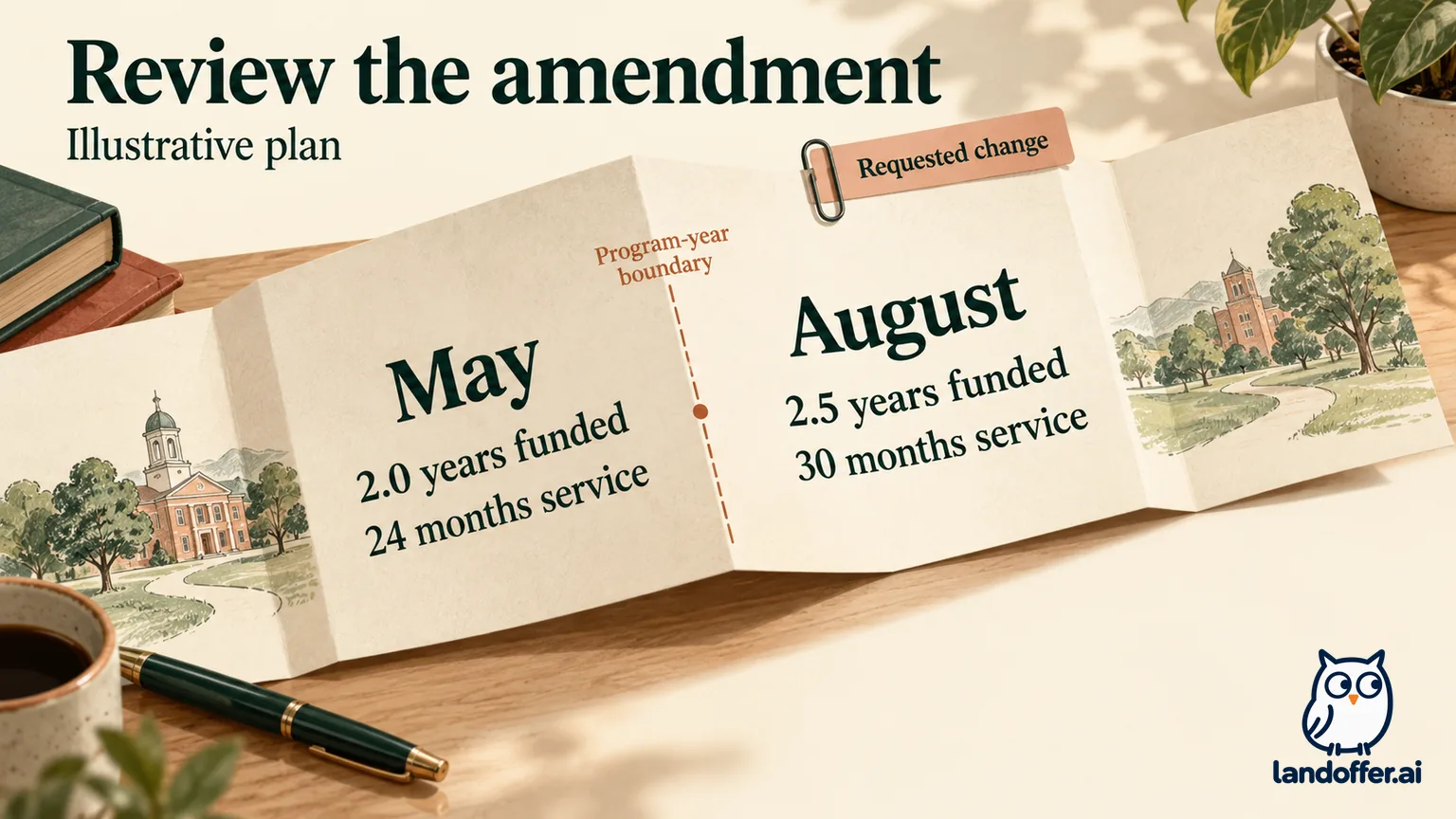
The 2026 Scholar Handbook treats the SMART Service Agreement as binding. It gives two funded academic years as 24 months of service. Its example of moving graduation from May to August across a program-year boundary adds 0.5 years to the award and service commitment. Changes require the applicable formal process; a request does not amend the agreement by itself.
Morgan, a fictional scholar, starts with an agreement for two funded years and a May completion. Morgan's thesis work now points toward August. The completed comparison exposes what needs resolution before Morgan treats the change as a simple three-month extension.
| Morgan's planning version | Funded length being considered | Service implication to resolve |
|---|---|---|
| Current agreement | 2.0 academic years | 24 months of service |
| Requested May-to-August change crossing the program year | 2.5 years in the handbook's example | 30 months of service if that amendment applies and is approved |
| Request sent, outcome not received | Current terms still govern | Do not record the proposed dates as approved |
Morgan keeps May as the current agreement date and labels August as a requested change. The next task is to reconcile the academic completion plan with the program and facility, including the requested funding and resulting obligation. The example is a planning comparison, not an approved amendment or personal service calculation.
For someone considering further graduate study, this review also changes the order of decisions. Establish what the current award covers and what would happen at its end before assuming an additional degree can follow immediately. An academic ambition and a facility's staffing plan need to be considered together; an informal discussion cannot settle the written arrangement.
Separate the civilian career pathway from a specific offer
The post-graduation FAQ connects each funded academic year to twelve months of civilian service and directs scholars to the assigned facility for salary, benefits and relocation information. Plan for the location and work relationship attached to the award, rather than assuming you can choose any government-related employer after graduating.
The handbook adds several limits: service is full-time federal civilian employment at the approved facility, not contractor work; waiting for final hiring action does not count as service; informal salary or role discussions are not the formal HR offer. Facility transfers are controlled, case-by-case changes. Failure to complete the obligation can lead to dismissal and repayment procedures. Review those provisions alongside the agreement; this guide does not decide a clearance outcome or calculate debt.
These limits do not remove SMART's value. A student who wants the facility's mission may welcome the connection between study and future work. They make it important to distinguish what is already written from what remains a future hiring detail. Keep a possible role, an award and a formal employment offer as separate records.
At the award decision, Rowan would bring a short list of unresolved questions: the expected technical responsibilities, actual location, required summer periods, funded degree dates and service terms. Some future details may remain unsettled. Rowan must decide whether the confirmed arrangement is acceptable without treating hopeful answers as commitments.
Accept only a facility relationship you can support
The useful outcome of this review is a decision about a particular path. Rowan has a defensible preference and questions to resolve. Morgan has identified a degree change with a service consequence. Ari has a location constraint that makes an offered relationship unsuitable. None needs an invented success rate to make that reasoning useful.
Before accepting, compare the actual facility assignment, funding breakdown and service agreement with your degree and relocation plans. Ask the program and facility to resolve the payment, dates or work conditions that would change your decision. Keep the written answers with the award documents before accepting. If you are also weighing an unrestricted job search, browse recent roles on LandOffer.ai and compare those career options separately; a listing does not replace a SMART award or alter its obligations.
Sources and Further Reading
- SMART: Public program overview
- SMART: Eligibility for the 2026 application cycle and Fall 2027 study
- SMART: Application and selection FAQ
- Purdue Computer Science: Apply by December 4 notice, updated September 23, 2026
- SMART: Proposed award and facility-preference instructions
- SMART: Sponsoring-facility directory
- SMART: Naval Information Warfare Center Atlantic profile
- SMART: Award details FAQ
- SMART: Summer internships and mentors FAQ
- SMART: Post-graduation employment FAQ
- SMART: 2026 Scholar Handbook, especially sections 3.1.11, 3.2 and 6.1