LandOffer
Job search
CyberCorps Scholarship for Service: Plan the Government Cybersecurity Job Commitment
Evaluate SFS funding together with the approved government cybersecurity work, job search, service period and documentation it requires after study.
CyberCorps Scholarship for Service can help fund a cybersecurity education, but accepting it also commits you to qualifying public-service work afterward. Evaluate the school, the funding agreement and the employment obligation together. A funded place does not come with a guaranteed government job, and an appealing security role does not automatically count toward service.
This guide reviews public OPM, NSF, university and regulatory sources checked on October 13, 2026. LandOffer publishes it; we have not applied for funding, tested a scholar account or obtained a service-approval decision. You can browse recent roles on LandOffer.ai while comparing career options, but a listing there does not establish SFS eligibility or approved employment.
The strongest fit is a student who wants both the education and the public-service career attached to it. If you only want the tuition support and expect to choose unrestricted private-sector employment afterward, resolve that conflict before accepting an award.
Start with the participating school and the right program version
Students apply through participating institutions. OPM's student overview explains that funding goes to colleges and universities, which select recipients. Use the participating-institution list to find a school, then inspect that school's current scholarship instructions. Being listed does not establish an available funded seat, admission to a degree program or your selection.
Program names also need a date. NSF's current 26-503 solicitation, posted February 4, 2026, uses CyberAICorps Scholarship for Service, or CyberAI SFS, and includes AI and cybersecurity education. OPM continues to use CyberCorps language. Ask the institution which award and agreement govern your cohort; do not assume a newly posted institutional requirement rewrites an existing scholar's agreement. Dates for institutions to propose NSF projects are not student application deadlines.
UMBC provides a useful dated example. On our check, its SFS page said it was accepting applications for Fall 2026 while showing a February 15, 2026 deadline. Its linked Apply & Deadlines page repeated that primary date and said additional rounds may depend on funding and cohort needs. February had already passed. We did not verify a later open round.
Following the main page's application link opened those internal instructions. The instructions named a resume, transcript and short statements about interests, goals and service commitment, but their Scholarship Retriever application link had a placeholder destination. We could not verify a working submission route from that page. Keep the school on a follow-up list until you confirm a current round and its official application destination.
OPM's student registration page serves students already accepted by a participating university and enrolled in SFS. It is not the general starting application for someone comparing schools.
Separate education funding from employment eligibility
OPM describes support for up to three years of eligible study. Its public eligibility information includes US citizenship or lawful permanent residence, full-time enrollment and qualifying cybersecurity study. Specific academic standing, degree pathways and institutional selection criteria still matter. A school can impose requirements beyond the broad overview.
The student information page lists academic-year stipends of $27,000 for undergraduates and $37,000 for graduate students, tuition and education-related fees, and a $6,000 professional allowance. Housing, meals and parking are excluded from the tuition-and-fees component. A stipend is separate from tuition support and from a later employee salary.
Ask for the written funding breakdown for your award. Identify the funded academic periods, what the institution pays directly, which expenses you pay yourself and what conditions preserve support. “Up to three years” does not mean every recipient receives three funded years, and an academic-year stipend is not automatically a twelve-month household budget.
Scholarship eligibility also does not settle every hiring requirement. OPM identifies federal employment criteria and the ability to obtain a clearance if the position requires one. A particular university may describe its own clearance expectations. Neither a scholarship selection nor your reading of a university page is an adjudication of a future employer's requirements.
This distinction matters when comparing two schools. One may offer an academic program you prefer while its funded cohort, timing or additional requirements do not fit you. Compare the actual scholarship offer alongside admission and the degree plan; a general program description does not establish your funded periods or uncovered costs. Without those details, you cannot compare the award with your actual degree expenses.
Work through the service calendar before accepting
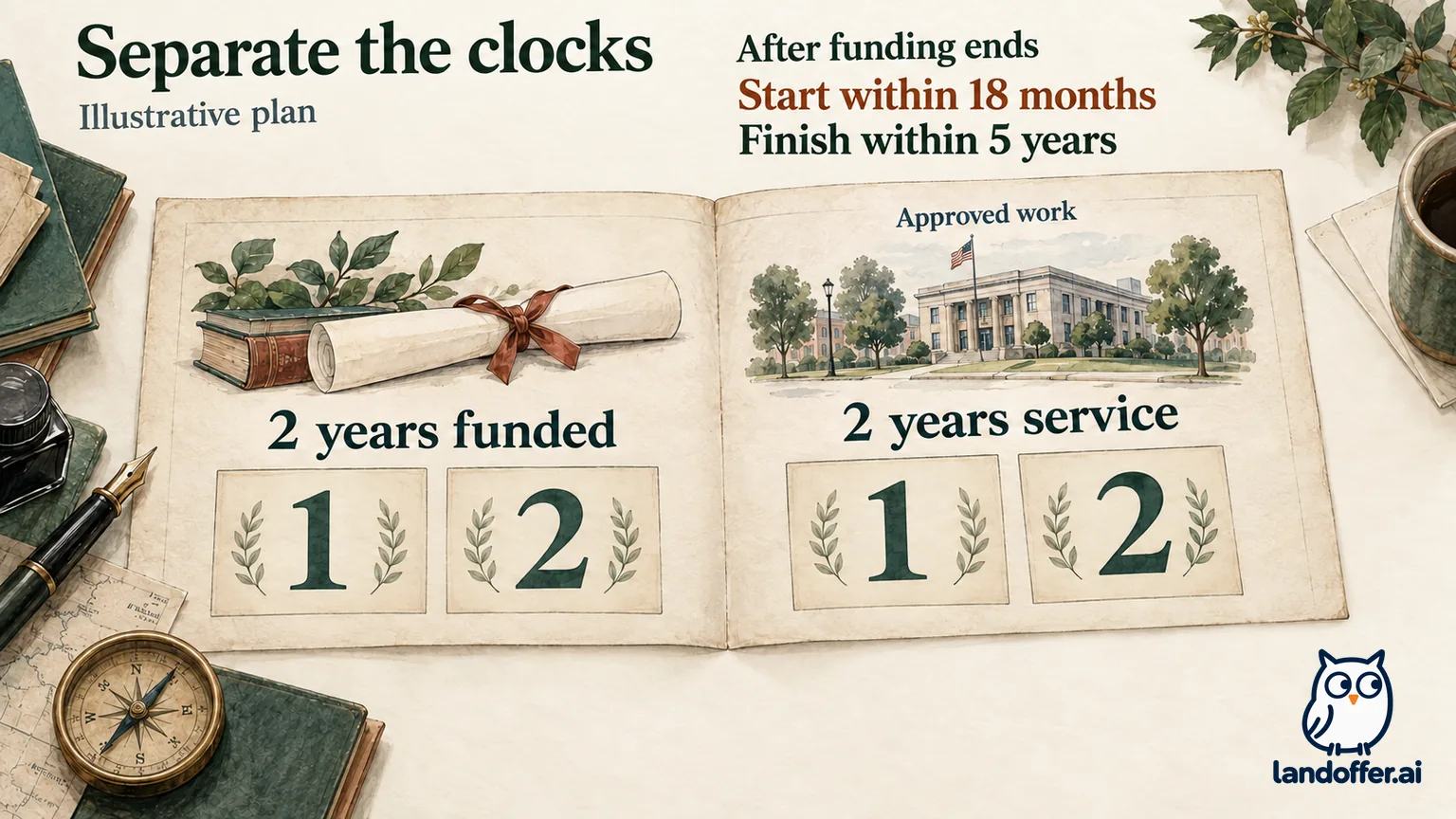
The regulations distinguish the funded Scholarship Phase from the following Commitment Phase. Under 45 CFR part 620, the commitment phase begins immediately after the scholarship phase ends. Approved service must generally begin within 18 months and be completed, with required verifiable employment documentation, within five years, unless an approved extension applies. The required service duration is tied to the scholarship support; the current NSF solicitation describes at least an equivalent period.
Consider Dina, a fictional master's student, evaluating two funded years. For this planning example, suppose her institution confirms that her Scholarship Phase ends May 31, 2028, and her Commitment Phase starts June 1, 2028. Her initial plan provides at least two years of qualifying service.
| Item in Dina's illustrative plan | Planning entry | What the entry establishes |
|---|---|---|
| Funded study | Two years | Basis for planning at least two years of service |
| Commitment Phase begins | June 1, 2028 | A separate clock after scholarship support ends |
| Eighteen-month marker | December 1, 2029 | A start-window marker to confirm with the program |
| Planned approved employment | September 1, 2028–August 31, 2030 | An intended two-year service period, subject to credited service and records |
| Five-year marker | June 1, 2033 | A completion-and-documentation marker, not five years of required employment |
These are illustrative calendar markers, not a determination of anyone's legal deadlines. Dina still needs the program's confirmed dates, counting rules, employment approval and evidence requirements. Her table separates the required service duration, the window for starting employment and the deadline for completing service and documentation.
The plan also reveals a dependency: her job search must start before she wants employment to begin. The 18-month window does not make waiting 18 months a sound search strategy. If recruitment, suitability review or clearance processing takes time, a late search can leave little room for a failed lead or delayed start.
Summer internships during study are a separate requirement to plan with the institution. Do not quietly count an internship toward the post-study obligation without an applicable determination. Likewise, elapsed calendar time and credited service can differ. For federal executive-agency cybersecurity employment, the regulatory definition includes paid-duty periods and excludes unpaid non-duty periods. Keep the actual service record alongside the planning calendar.
Screen the employer and the cybersecurity work together
An impressive job title is not enough. OPM's agency information describes government and certain approved government-related employment categories. The regulations require prior SFS program-office approval for qualifying employment. The employing entity, cybersecurity mission and actual position need to support the decision.
Dina has four fictional leads. Her completed screen retains promising options without treating her own judgment as approval.
| Lead | What Dina can establish from the description | Her disposition |
|---|---|---|
| Application-security employee at a federal agency | Direct federal employer; work includes securing agency software | Retain for program review and prior approval |
| Security engineer at a private contractor serving a federal customer | Government customer, but the contractor is the employer | Do not count as qualifying on the customer relationship alone |
| SOC analyst employed directly by a county | Local-government employer; described cybersecurity duties | Retain for program review and prior approval |
| Engineer at a private nonprofit hospital | Nonprofit status; government affiliation and qualifying category unverified | Leave unresolved; request the missing evidence before relying on it |
The contractor lead might be attractive work outside SFS. Its federal customer does not establish the necessary employment category. The hospital lead needs more evidence: a nonprofit label alone does not prove the government affiliation or other conditions relevant to an approved category.
Dina's next request to the program would name the employing legal entity, appointment arrangement, position description and cybersecurity duties. She would ask whether this particular job can qualify and what written approval is needed before she relies on it. No approval or employer contact occurred in this example.
This screen prevents two different mistakes: discarding every non-federal lead and counting every role associated with a public mission. It leaves room for approved categories while requiring an actual determination. Save the decision with the position description so a later change of employer or duties does not silently inherit an earlier approval.
Plan to find the internship and job yourself
NSF's current FAQ says scholars are responsible for securing their internships and post-graduation employment. Institutions coordinate and monitor placement, and the program offers tools such as job-search resources and events. That support is useful, but it does not assign every scholar an employer. A noncompetitive hiring authority also does not guarantee an appointment.
Build a search around actual government opportunities, including USAJOBS and agency recruitment portals. For each role, record the employer, appointment type, location, eligibility instructions, required materials and intended start date. Then connect that record to the service-approval question. A role can be open for applications while still being unsuitable for your timetable or unconfirmed for service credit.
Dina prepares the resume and other materials required by each vacancy while sending the program the employer and position details needed for a service determination. She does not wait for an offer to discover that she has been pursuing an unsuitable employer category. She also does not treat program approval as a hiring decision. The employer must still select her through its own process.
Keep verification and changes in the plan
45 CFR 620.3 requires service documentation within 30 days of beginning employment and after each year of service, with annual proof to the institution. An offer letter alone does not establish that service has been completed.
OPM's public 2025 employment-verification guide describes evidence such as the verification form, applicable SF-50 records or employer letters, and review outcomes including approved, action required and rejected. Follow the instructions applicable to your case rather than assuming a document upload equals approval. Keep current contact details and the final completion notice.
The guide also calls for removing sensitive identifiers such as Social Security numbers and dates of birth from relevant records and excluding classified or government-sensitive information. Prepare employment evidence that establishes the required facts without attaching unnecessary personal or restricted material. We reviewed the public guide, not a private scholar's submission.
If study, health, employment or other circumstances change, raise the issue promptly through the program. Section 620.4 provides a written deferral-request process before the Commitment Phase expires, with supporting documentation. A request is not an approved pause, and a personal difficulty does not by itself establish a waiver.
Section 620.6 addresses repayment and possible conversion to a Direct Unsubsidized Loan with interest when obligations are not met. Missing a notice does not remove the underlying responsibility. Read the agreement's terms before accepting; this guide does not calculate a personal debt or decide eligibility for relief.
Make the funding decision with a credible employment path
Dina's review supports continuing with the scholarship application: she wants public-service cybersecurity work, understands that she must search for it, and has identified the approval and documentation questions her plan depends on. It does not establish an award, a job or completed service.
Nico, another fictional student, wants only private-startup employment and cannot accept a government-service commitment. He sets this funding route aside and investigates other education funding. For Nico, the required career commitment outweighs the funding benefit. He can make that choice before signing an agreement.
Before accepting, take the actual agreement and your completed funding, calendar and employer records to the institution's SFS contact. Confirm which award governs, the required service period, the approved-employment process and how changes must be documented. Keep the written answers with the agreement before deciding whether to accept. For a broader comparison of career options, browse recent roles on LandOffer.ai; assess any SFS prospect separately with the program before counting on it for service.
Sources and Further Reading
- OPM: Student overview and institution-based selection
- OPM: Funding, eligibility and summer internships
- OPM: Participating academic institutions
- OPM: Registration for accepted scholars
- NSF 26-503: CyberAI SFS solicitation, posted February 4, 2026
- NSF: CyberAI SFS FAQ, published April 1, 2026
- UMBC: SFS program and dated Fall 2026 information
- UMBC: Application instructions and deadlines
- OPM: Agency employment information
- eCFR: 45 CFR part 620, service obligations
- eCFR: Section 620.3, documentation
- eCFR: Section 620.4, deferral
- eCFR: Section 620.6, repayment
- OPM: Public employment-verification guide, filename 2025