LandOffer
Productivity & Workflows
Deleted Text in a Shared Google Doc: Recover the Passage Without Replacing Everyone's Work
A fictional three-person document timeline and completed text comparison show a local passage repair without restoring the entire old document.
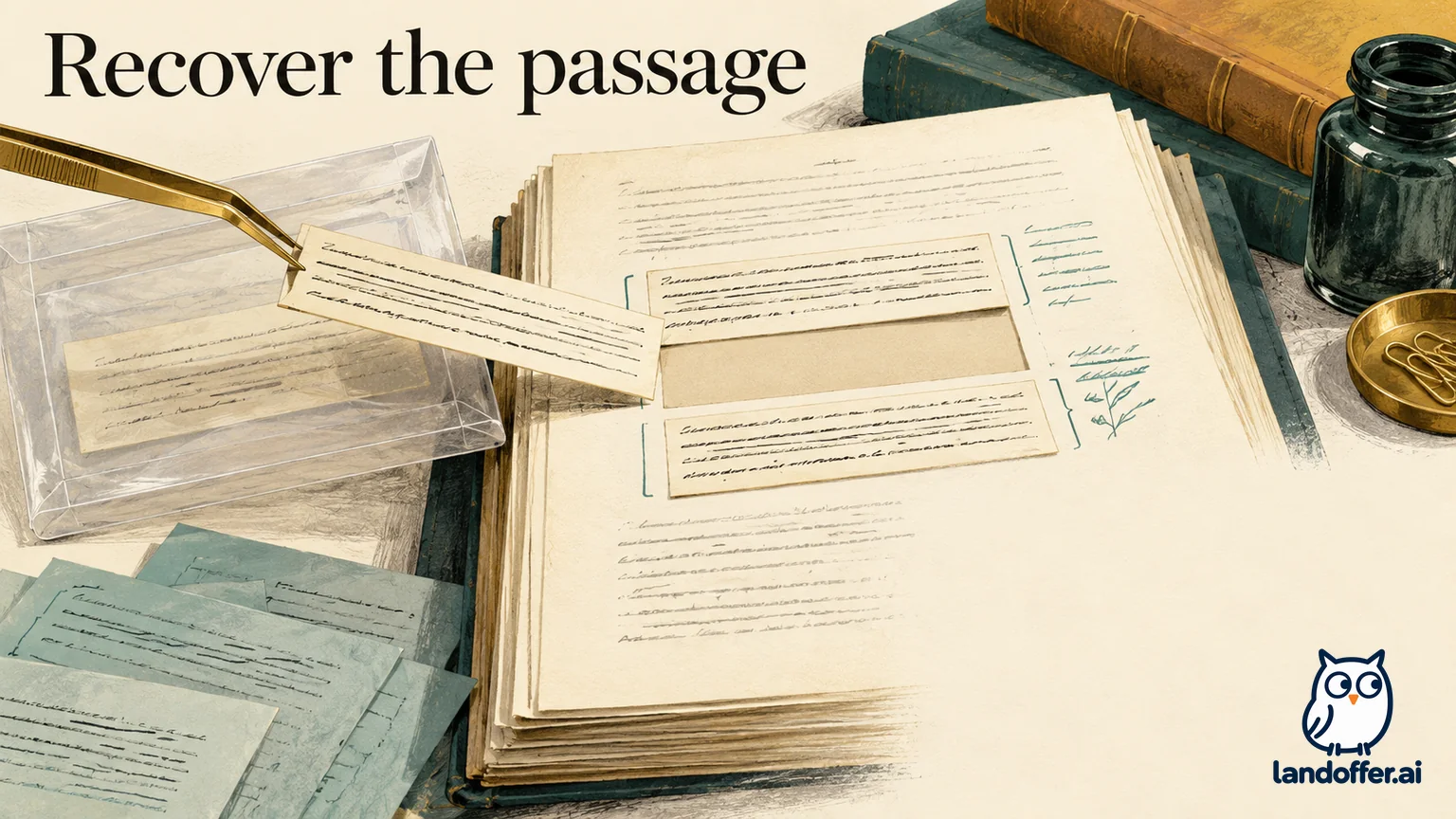
When a passage disappears from a shared Google Doc, compare the earlier wording with the current document before choosing a recovery action. If colleagues have made useful edits since the deletion, retrieve the missing passage from an earlier-version copy and review its insertion into the current file. A whole-version restore would also bring back the older document state, so first identify later edits that must survive.
Confirm that you have the necessary access and the team's agreement on the repair. This LandOffer guide uses a fictional three-person document to show the decision, the recovered text, and the completed review. We checked Google's public help on October 25, 2026; we did not open a work document, inspect real history, make a Google Docs copy, or perform a restore.
Establish what is missing and what must remain
Start in the current file. Identify the section, the missing idea, and the last point at which someone remembers seeing it. Also identify later work that must survive: changed dates, corrected figures, new responsibilities, or accepted wording elsewhere. A document can contain a small deletion and several important improvements at the same time.
Ask what changed before attributing intent to the last editor. A passage may have been removed accidentally, moved, or deliberately replaced. Ask the relevant author or owner what the text was meant to do. Recovering old words without checking their purpose can reintroduce a decision the team has already changed.
Write a narrow repair objective. For example: restore the explanation of how pilot participants submit questions, while keeping the revised session date and the new facilitator assignment. Reviewers can then check both the recovered instruction and the newer details that must remain. “Put the document back” leaves the scope unclear and makes it easy to discard unrelated work.
If the file is actively being edited, coordinate a review point with the collaborators. Do not assume that reading history freezes the current document. Before applying the repair, check again for changes to the target section. A comparison made twenty minutes earlier may no longer describe the text you are about to edit.
Use history as evidence before choosing a repair
Google's version-history help says browsing earlier versions requires edit permission. On a computer, the Last edit control opens history; grouped versions can be expanded. The documented actions distinguish viewing a version, restoring it, and making a separate copy of it. Choose deliberately rather than treating those controls as interchangeable.
For a local passage repair, an earlier-version copy provides a separate place to inspect the old text. Name it clearly and keep its storage and audience appropriate. Copy only the passage you need back into the current document after reviewing the surrounding context. Do not assume a copy should become the team's new working document or inherit a wider audience.
If you cannot browse history, ask an authorized editor to help locate the passage. Commenter access can support a proposed wording review without providing history access. Do not request broad permissions merely because they are convenient when an authorized collaborator can provide the minimum text or review needed.
Whole-document restoration may be appropriate for a different problem, such as an agreed recovery of widespread damage. It requires a decision about the document as a whole and the later edits that would need to be preserved or reapplied. For the single-passage case below, the team chooses a narrower repair because later work is valid.
Completed recovery decision: three collaborators and one lost paragraph
All names, dates, history entries, and actions in this example are fictional. The file is an imaginary “Research Pilot Brief.” Noor owns the brief, Elena coordinates the sessions, and Sam maintains the participant instructions. The scenario demonstrates a recovery decision; it is not a record of actions performed in a Google account.
At 10:20 a.m. on November 18, Sam notices that the “Questions before the pilot” paragraph is missing. The current file still has its heading, followed immediately by the “During the session” heading. Sam recalls the paragraph in the previous morning's review, but does not assume the deletion was accidental until Noor confirms that its instructions are still needed.
Here is the completed timeline the collaborators use:
| Fictional time, Pacific | Change or observation | Recovery consequence |
|---|---|---|
| November 17, 9:00 a.m. | Noor's review version contains the questions paragraph and a November 24 session date | Candidate source for missing instructions, but its date is now obsolete |
| November 18, 9:15 a.m. | Elena changes the session to November 26 and assigns Priya as facilitator | Preserve both accepted changes |
| November 18, 9:40 a.m. | Sam's cleanup removes the questions paragraph while retaining the heading | Local passage is missing; intent needs confirmation |
| November 18, 10:20 a.m. | Sam notices the gap; Noor confirms the instructions are still required | Recover the relevant content, with current details checked |
| November 18, 10:35 a.m. | Collaborators agree to review one insertion in the current file | Do not restore the whole November 17 version |
The older version's paragraph says participants should send questions to Elena by November 23. The current plan has changed: questions should go to the pilot mailbox by November 25. That means copying the old paragraph verbatim would repair the deletion while reintroducing outdated instructions.
Noor authorizes Sam to make a working copy of the November 17 review version in the team's approved recovery location. They call it “Recovery reference — November 17 review — not current.” The fictional team agrees to limit reference-copy access to the necessary reviewers and check the actual audience before using it. The current brief remains the shared working file; its link is not replaced with the reference copy's link.
The agreed repair is to use the old paragraph as evidence of the missing instruction, update its recipient and deadline to match the current plan, and suggest the resulting paragraph under the existing heading. Elena will check logistics, Noor will review intent, and Sam will verify the final placement. These roles are the fictional team's agreement, not automatic Google Docs permissions.
Review the recovered passage against the current plan
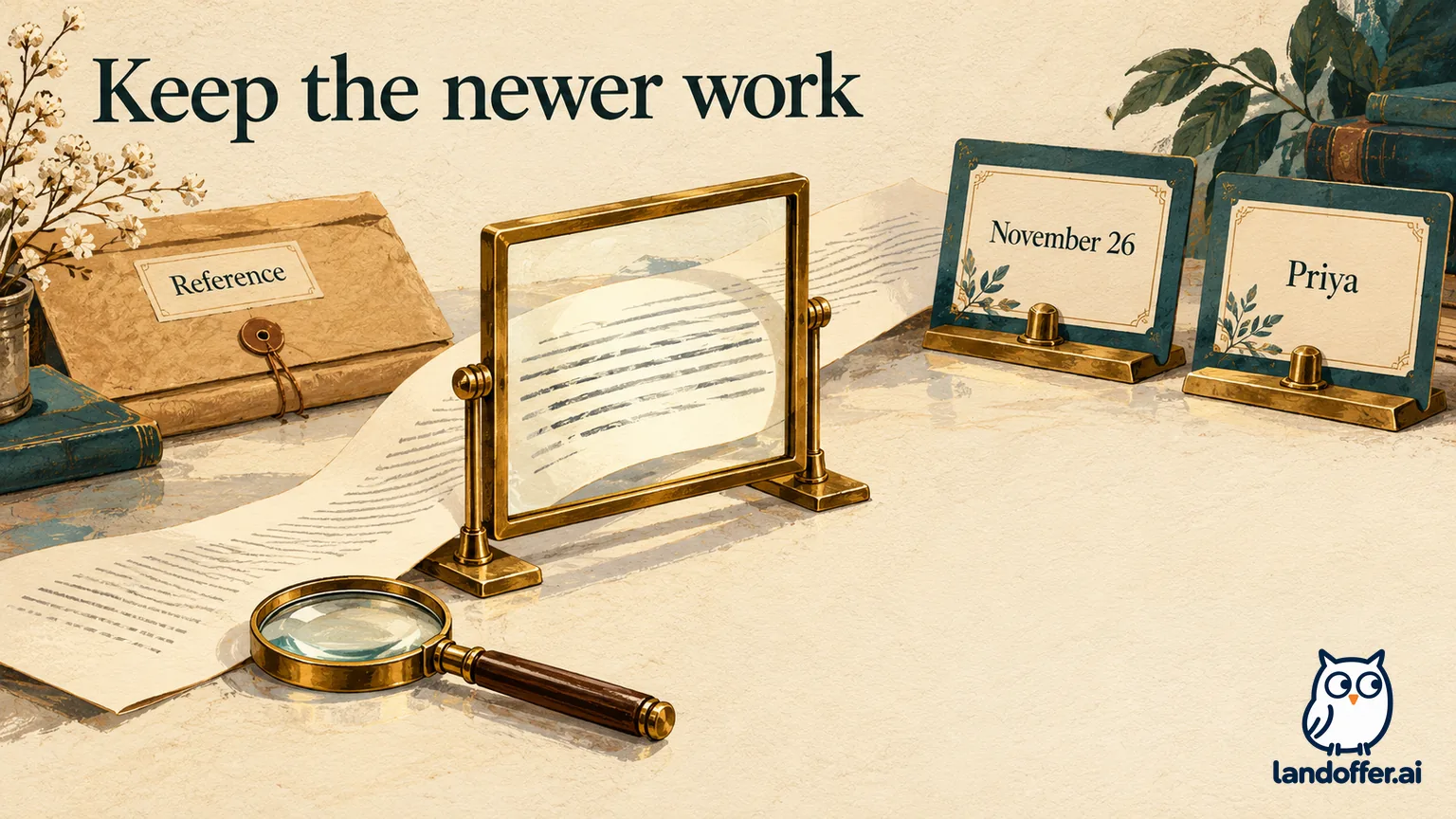
Google's suggested-edits help describes proposing edits without immediately replacing the original text, with suggestions available to people allowed to comment or edit. A suggestion makes the repair reviewable. It does not establish that the recovered information is correct, and it does not give the person proposing it authority to accept every other pending suggestion.
The completed text comparison below shows the actual wording of the fictional repair. It separates historical recovery from current editorial judgment:
| Text location | Earlier reference copy | Current file before repair | Reviewed repair |
|---|---|---|---|
| Questions paragraph | “Send questions to Elena by November 23 so we can prepare examples for the pilot.” | Paragraph missing; heading retained | “Send questions to the pilot mailbox by November 25 so we can prepare examples for the pilot.” |
| Session date | November 24 | November 26 | November 26 retained |
| Facilitator | Elena | Priya | Priya retained |
| During-session instructions | Take notes in the participant worksheet | Updated to include the agreed anonymous-feedback step | Current anonymous-feedback step retained |
Sam's proposed insertion is therefore one paragraph, not a pasted copy of the earlier document. The change record identifies the November 17 reference as the source for its purpose and structure, and the current logistics decision as the source for its updated recipient and deadline. Historical text is useful evidence without being the final authority on current details.
Sam adds this fictional review comment: “Recovered the missing questions instruction from the November 17 review copy. I updated the recipient and deadline to match the current plan. Please check those two details and the placement under Questions before the pilot. The November 26 date, Priya assignment, and anonymous-feedback instruction are unchanged.”
Elena confirms the mailbox and November 25 deadline. Noor confirms that the paragraph still expresses the intended preparation step. Sam then checks that the insertion appears once under the correct heading and does not duplicate instructions elsewhere. After that review, an authorized editor accepts this specific suggestion in the fictional case. It does not use Accept all on the document's unrelated pending suggestions.
In the fictional final review, the paragraph is present with the updated details, the November 26 session date remains, Priya remains the facilitator, and the anonymous-feedback step remains. The reference copy is still labeled as historical. These are completed example findings, not a reliability test of Google's history or suggestion features.
Check permissions, formatting, and the working link
A recovery copy creates another file to manage. Google's Drive sharing guidance distinguishes viewer, commenter, and editor roles and describes owner-controlled sharing options. Check the actual storage location and audience for the reference copy. Do not broaden access to internal material or tell everyone to switch documents solely to solve a small text gap.
Review the inserted passage beneath its current heading and alongside the instructions that refer to it. Check its heading, paragraph style, links, list numbering, and neighboring sentences. A text-only comparison cannot establish that a link still leads to the right resource or that an instruction agrees with a table farther down the page. Inspect the relevant context rather than counting a successful paste as completion.
Keep unrelated decisions visible. If the old paragraph conflicts with a new policy, changed owner, or updated project boundary, ask the responsible collaborator which rule should govern the repaired wording. Keep the historical passage as a reference, leave the insertion pending, and name the unresolved question when current instructions conflict with it.
If the passage cannot be found in the available history, record that result and ask collaborators for approved reference material. Do not claim that every deleted character must be recoverable. Avoid reconstructing the text from memory and labeling it as an exact recovery; a newly written replacement should be identified as new wording requiring review.
Record what was recovered and what was preserved
The example's closing note is short but specific: “Recovered the questions paragraph from the November 17 reference, updated its recipient and deadline, and accepted the reviewed insertion. Verified that November 26, Priya, and the anonymous-feedback step remain in the current brief. The recovery reference is historical; continue using the existing shared brief.”
For your own repair, retain the earlier-version identifier, the reason for the chosen passage, the current details used to update it, the reviewer, and the checks on later work. Use the team's normal document record rather than creating an elaborate parallel tracking system. Where a checkpoint label would help future collaborators, agree on a useful version name in the existing history.
A named checkpoint is an aid to navigation, not proof that the document's contents are correct or a substitute for reviewing the change. Likewise, preserving the current link does not by itself prove every collaborator can access the file. Check the outcome that matters for the repair and report any remaining access or content question separately.
Start with the smallest passage that is actually missing, compare it with the current plan, and review the insertion with the people whose later work it touches. LandOffer's workplace guides cover related collaboration tasks; the practical result here is a repaired passage and a clear record that valid newer work survived.