LandOffer
Job search
Google Careers Application Limits: Plan Three Choices and Reapplication Timing
Plan Google Careers applications around three jobs in a rolling 30-day window, the same-job waiting rule, and a completed evidence-based shortlist.
Google Careers allows up to three job applications in a rolling 30-day window and requires a 90-day wait before reapplying to the same job. Plan around the roles your evidence supports, not a calendar-month reset. Keep a dated submission ledger, choose three evidence-supported roles, and review the outgoing file before using an available application.
LandOffer publishes this guide and offers recent job discovery, so we have a commercial interest in job-search tools. We checked Google's public application help on October 12, 2026, without submitting or inspecting a candidate account. Anika's roles, identifiers, dates, and resume revisions below are fictional teaching examples. They illustrate planning under the documented rules, not a strategy proven to improve hiring outcomes.

Separate the rolling cap from the same-job waiting period
Google's application help states two different rules: three jobs in a rolling 30-day window, and 90 days before reapplying for the same job. The first concerns recent application volume. The second concerns returning to a particular opening. Satisfying one does not automatically satisfy the other.
A rolling window is different from “three every calendar month.” Applications from late September can still matter in October. Use the actual submission dates and the account's current controls rather than assuming October 1 restored every available choice. A saved draft should be recorded as a draft, not a completed submission.
The same-job wait is a minimum timing condition, not a recommendation to reapply as soon as possible. Google's help separately says technical-role reapplicants tend to be more successful with an additional 12–18 months of experience. That is guidance about a changed candidacy, not a guarantee or another mandatory waiting rule.
Before revisiting a role, ask what has changed. A new relevant project, deeper operational responsibility, or a genuinely different opening may justify a fresh assessment. Changing the order of the same technology list does not establish additional experience. Keep the reason for the new decision alongside the date.
Select by responsibilities and evidence before titles
Begin with a shortlist larger than three. Read each posting's actual responsibilities, required qualifications, location, and work arrangement. A familiar title is a search clue; it does not settle whether you can support the work described.
For each role, identify two or three pieces of evidence you would want a reviewer to notice. They might be an API you implemented, a reliability problem you investigated, or an analysis that changed a decision. Write the connection in plain language. If you cannot explain the connection without inflating your responsibility, the role may need more investigation or lower priority.
Separate a hard constraint from a preference. A location you cannot work in is different from a technology you could learn. A stated experience requirement deserves an honest reading rather than being converted into keywords. Do not use an appealing match label to avoid the underlying qualifications.
This approach also keeps your three choices coherent. They need not have identical titles, but they should each make sense from your actual background. A backend engineer can reasonably consider adjacent platform work when the scope fits. Applying to unrelated senior, junior, and specialist roles solely to fill capacity creates a less useful set of decisions.
Anika completes a five-role selection
Anika is a fictional engineer with three years of backend experience. Her records show service implementation, integration testing, and shared incident investigation. She has not led an infrastructure organization or built production machine-learning systems. The names below are invented opportunities, not current Google postings.
| Fictional role | Relevant evidence | Constraint or gap | Completed selection |
|---|---|---|---|
| Alder API-21 | Implemented reconciliation endpoints and integration tests | Responsibilities align with her individual-contributor work | Select |
| Birch DATA-16 | Maintained ingestion jobs and investigated failed imports | Confirm the posting emphasizes engineering rather than advanced modeling | Select after reading that scope in the example |
| Cedar REL-32 | Shared incident diagnosis, alert cleanup, and documented runbooks | No claim of organization-wide reliability ownership | Select for the bounded scope described |
| Dune ML-45 | Small personal model experiment | Required production-model experience is absent | Do not prioritize |
| Elm LEAD-08 | Mentored one teammate informally | Posting requires broad technical leadership she cannot evidence | Do not prioritize |
Anika chooses three supported roles and excludes two. Available capacity does not change Dune’s production-model requirement or supply Elm’s missing leadership evidence. Anika does not fill the last slot with Dune because machine learning sounds interesting, nor rename informal mentoring as organization-level leadership. The matrix exposes the evidence gap before she spends an application on it.
Birch requires an additional check because “data” can describe different work. In the fictional posting, the responsibilities concern ingestion reliability and service interfaces, which her experience supports. If the body instead required advanced statistical modeling, the same title would produce a different decision. The title alone did not win the place.
Cedar is also a scope decision. Anika can explain specific reliability contributions without claiming she owned the entire function. She retains that boundary when tailoring the resume. Selecting a plausible role does not authorize expanding her history to resemble every sentence in its description.
Her shortlist now records why she selected each role. If a recruiter later asks about her interests, she can explain the relationship among API work, data ingestion, and service reliability. She does not need to invent a single title that covers everything.
Keep the dated ledger through the next month
Anika submits Alder on September 20, Birch on September 29, and Cedar on October 4 in this fictional example. On October 12, all three dates are within the preceding 30-day period. She cannot treat the month boundary as an automatic reset.
| Record | Submission date in the example | Planning interpretation on October 12 |
|---|---|---|
| Alder API-21 | September 20 | Still within the rolling window |
| Birch DATA-16 | September 29 | Still within the rolling window |
| Cedar REL-32 | October 4 | Still within the rolling window |
| New Nectar API-63 lead | Not submitted | Evaluate fit now; inspect actual capacity before attempting submission |
In this fictional ledger, adding 30 calendar days to September 20 gives October 20; this is Anika’s planning calculation, not a platform-confirmed reset time. Anika treats that as a planning estimate, not a promise about the service's exact reset timestamp or time zone. She checks the account's actual availability when she is ready. There is no need to guess a minute at which to repeatedly press Submit.
If Nectar closes before capacity is available, she records the conflict. In the completed planning example, Nectar closes October 18, so she removes it from the pending-submission list on October 12 and keeps it only as a closed-date reference. She has no evidence of an exception and does not promise herself a late application. She returns to other eligible leads whose deadlines and responsibilities she can actually support. This decision saves the time she would otherwise spend preparing a form she cannot currently submit. She does not create another account or try to disguise a repeat application as a workaround. The practical response is to maintain other suitable opportunities and use the available choices deliberately.
She also records the evidence behind each submitted date: the confirmation, role identifier, and account email. This prevents a preparation date from accidentally becoming the application date. A resume created on September 18 and sent on September 20 belongs to the latter submission entry.
The ledger should remain short enough to use. Employer, requisition, submitted date, selected file, confirmation, and next action are sufficient for this task. Keep a separate notes field for an estimated capacity boundary so an estimate is not mistaken for a platform-confirmed entitlement.

Tailor the selected file without changing the underlying facts
For Alder, Anika's original bullet reads: “Worked on backend systems using Python, SQL, and cloud services.” It is accurate but gives little evidence of what she contributed. Her project notes describe a reconciliation endpoint, automated integration tests, and weekly investigation of import exceptions.
Her completed revision is: “Implemented a reconciliation endpoint in Python, added integration tests for import exceptions, and used SQL to investigate recurring data mismatches.” This explains the work and tools without adding an unsupported percentage improvement or platform-ownership claim.
For Cedar, she foregrounds a different true contribution: “Updated runbooks and alert descriptions after shared incident investigations so the on-call team could distinguish import failures from downstream reporting delays.” She keeps the collaboration visible. She does not replace “shared” with “led” simply because the posting values ownership.
The two versions have different emphasis but the same employment dates, titles, and education. Anika keeps the source notes with both versions. That lets her answer a screening question consistently even when the application highlights a different part of the same job.
Before submitting, she checks the actual attachment and populated fields. A polished file can still be paired with stale information in a new form. Read any reused answers in the context of the specific role, especially questions about location, availability, or experience scope.
The useful output is a resume she can defend in conversation. A keyword match is not a reason to add a technology she has only seen in the posting. If a required capability is absent, preserve that gap and reconsider the role rather than manufacturing a stronger match.
Preserve the submitted version and understand edit limits
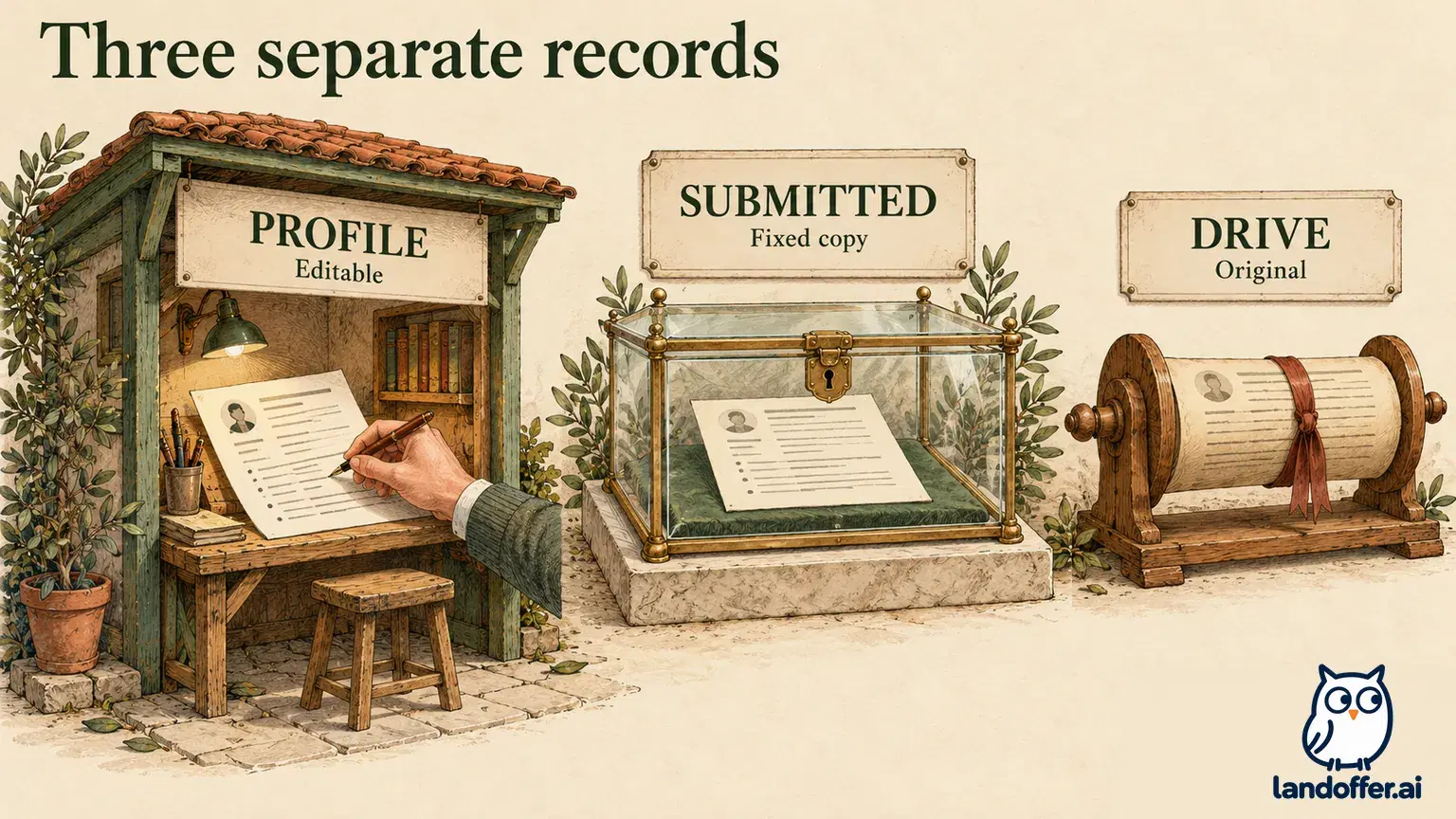
Google's help says application documents can be changed before submission, but not afterward. The Careers profile can still be updated separately. It also says submitted applications cannot be deleted, closed, or withdrawn through the described controls; only drafts can be deleted. The documented controls do not support a plan to remove a submitted application and restore capacity. Keep its original date in the ledger.
The same help explains that a Drive upload attaches a separate copy. Editing the original Drive file afterward does not update that application attachment. If you revise a document before submitting, upload the intended version again and inspect it. After submission, preserve the sent copy rather than assuming the live source document represents it.
Anika therefore archives the exact files selected for Alder, Birch, and Cedar. Her general master resume can evolve, but the application ledger points to historical copies. If a recruiter asks which document she used, she can find it without reconstructing the answer from a later version.
A request for adjustment is also different from a profile update. Google's help directs candidates to raise adjustments with a recruiter when contact occurs. Do not infer a universal immediate replacement channel from the fact that your profile accepts another upload. Record any request and response precisely.
Reassess before using the next available choice
Google's search guidance lets candidates skip its initial questions or answer only some, then edit the filters. Its filter guide describes experience, location, degree, skills, team, and job-type controls. Use those tools to build the shortlist before spending an application choice. Anika searches more than one eligible location and compares experience requirements; she still reads each posting rather than treating a filtered result as proof that she qualifies.
When capacity becomes available, Anika rereads Nectar's current posting instead of applying automatically from an old saved link. The opening may have changed scope, location, or availability. Her earlier shortlist is a starting point, not a standing instruction to submit.
For a previous role, she checks both the same-job wait and what new evidence supports another application. An elapsed interval does not itself change the employer's requirements. A new requisition should also be compared carefully with the old one rather than assumed identical from its title.
Choose a small shortlist from LandOffer's recent roles, then use the verified employer posting to assess responsibilities and qualifications. For Google applications, pair that fit assessment with a dated submission ledger. Use an available choice when the posting and your evidence support it; leaving capacity unused can be the sensible result of a narrow shortlist.
Sources and Further Reading
- Google Careers Help: Apply for a job, rolling application limit, same-job wait, document copies, and edit boundaries; checked October 12, 2026.
- Google Careers Help: Search for jobs, initial questions and revising filters; checked October 12, 2026.
- Google Careers Help: Filter your results, available search controls; checked October 12, 2026.