LandOffer
Job search
Self-Paced Interview Course or Coaching Program? Match the Purchase to Your Prep Gap
Test whether you can explain and transfer a correction before buying more content or a program; verify personal review rights and total commitments.
Choose a self-paced interview course when you can turn an explanation into an independent solution, test it, and identify the next gap yourself. Consider a coaching program when you repeatedly cannot diagnose why your reasoning fails and need a person to challenge it. Content access gives you material to study; personal review gives someone a chance to examine your reasoning. A package may include both.
This guide uses current official offers checked October 20, 2026, plus an original algorithm exercise executed locally. We did not enroll, attend coaching, or benchmark a provider's teaching. LandOffer.ai publishes this guide. If you need a preparation target, browse recent roles on LandOffer.ai, then identify the interview task you need to perform rather than collecting broad course subscriptions.

Compare the purchased rights, not the marketing category
AlgoMonster's public product organizes coding preparation around patterns, explanations, tools, and practice. Its pricing page lists a free plan, a displayed $99 yearly Pro offer, and $189 lifetime Pro access. Pro includes lessons, problems, and an AI assistant; the page describes a member discount on live bootcamps. The listed bootcamp discount does not establish that Pro includes individual coaching.
Interview Kickstart's backend program page advertises live instruction, individual technical help, mocks, and structured feedback. That makes it a program to investigate when you need repeated human review across a defined curriculum. It does not establish that every advertised instructor is available for your preferred topic or date.
The categories also overlap. Interview Kickstart's public terms distinguish live and self-paced program families, and both categories refer to mock interviews. A course can contain human support; a coaching program can contain recordings and independent practice. Read the actual entitlement: content access, group instruction, private review, mock allocation, feedback records, scheduling rules, and end dates.
A useful purchase comparison asks who examines your work, what they examine, how often, and what happens after the review. The word “mentorship” alone cannot answer those questions. Neither can a long lesson library or an instructor's employer name.
Test whether self-study is doing the missing job
Before choosing a program, work through one complete learning cycle. Can you state the task, produce an attempt without copying, find a counterexample, and explain the correction? The result matters more than how familiar the explanation felt while you watched it.
A self-paced route can suit a learner who needs a particular technique and can evaluate progress. You can stop at the missing prerequisite and repeat it before advancing, while studying outside a cohort schedule. You still need a way to detect misunderstandings; community replies and AI suggestions should be checked against a clear specification and actual outputs.
Human review becomes more relevant when the same misconception survives those attempts, or when your uncertainty concerns explaining and defending a decision. A coach can ask why an invariant holds or why a test case is sufficient. That potential value depends on the review format you actually buy. Check whether the session reviews your submitted attempt or presents a general solution to the group.
Account for the practice time you can protect before choosing a program. If you cannot protect time to practice, purchasing access does not create it. Conversely, do not keep buying low-cost courses when the missing task is someone identifying the assumption you cannot see.
Worked diagnostic: finding a value versus finding its boundary
Here is an original exercise that makes the learning gap visible. For a sorted list, find the insertion position immediately before every occurrence of a target. If the target is absent, return the position where it could be inserted while maintaining sorted order. This is the behavior documented for Python's bisect_left.
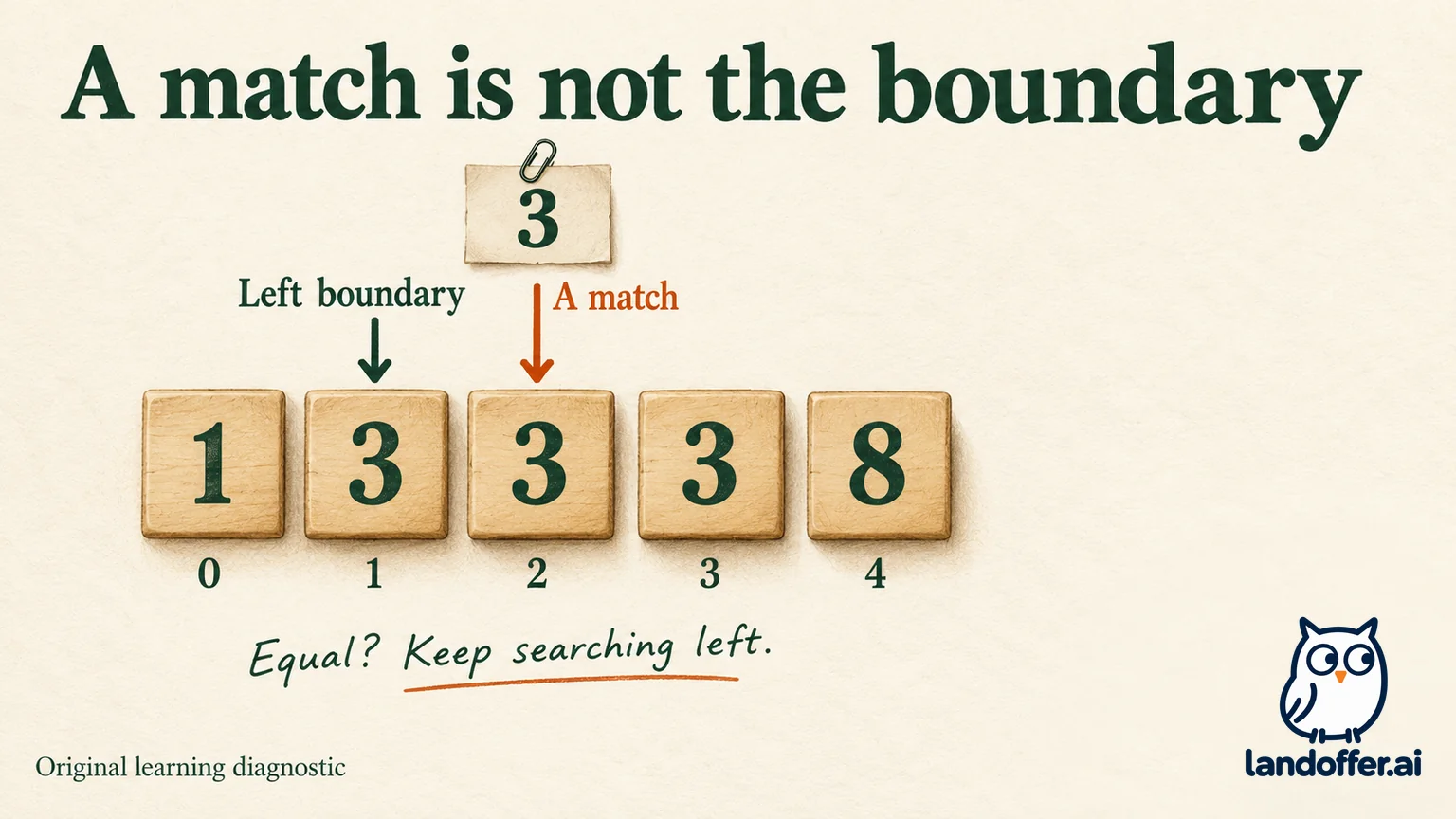
A fictional learner, Mara, initially writes a search that returns immediately when the middle element equals the target. On [1, 3, 3, 3, 8] with target 3, it returns index 2. That finds a matching value, but the requested left boundary is index 1. The failure concerns the task definition, not an off-by-one patch chosen at random.
She rewrites her solution as:
def left_boundary(values, target):
    lo, hi = 0, len(values)
    while lo < hi:
        mid = (lo + hi) // 2
        if values[mid] < target:
            lo = mid + 1
        else:
            hi = mid
    return lo
The crucial explanation is that everything excluded on the left is strictly less than the target, while everything excluded on the right is at least the target. Equality therefore moves the right boundary leftward rather than ending the search. The interval shrinks until the boundaries meet.
| Input and target | Initial matching search | Required left boundary | What the case reveals |
|---|---|---|---|
[1,3,3,3,8], target3 |
2 | 1 | A matching duplicate is not necessarily the first one |
[2,2,2], target2 |
1 | 0 | Equality does not justify returning the middle |
[], target7 |
-1 | 0 | An insertion position exists even without a match |
[1,3,3,3,8], target4 |
-1 | 4 | Absence requires an insertion position, not a failure marker |
We executed the original matching search and the corrected function locally. We also compared the correction with bisect_left on 756 generated cases: nondecreasing lists of lengths zero through five using values zero through three, with targets minus one through four. They agreed in every case. This tests our teaching example, not AlgoMonster's runner, paid material, or a coaching program's outcomes.
The function assumes sorted input and comparable values; it does not validate those conditions. The learning checkpoint is whether Mara can explain those assumptions, reproduce the duplicate counterexample, and justify the changed equality branch without looking at the solution. Merely copying the corrected code would not establish that self-study filled the gap.
For a transfer check, change the requirement to “return the first matching index, or minus one if absent.” The boundary function still helps, but its result now needs a check: the position must be inside the list and hold the target. For target nine in the example list, the insertion position is five, past the last index; returning it as a matching index would be wrong. Mara needs to explain that change in specification before reusing the template.
Worked support decision: a result sheet can hide a misconception
Now consider a second fictional learner, Dev, working on the same exercise. He copies the correction and obtains all four displayed results. That gives him a green result sheet, but a short explanation check exposes a different need.
| Editorial probe | Dev's stated answer in this fictional case | Completed diagnosis |
|---|---|---|
Why does equality move hi? |
“That is what the template does.” | He cannot yet justify the boundary rule |
| What if the target is absent? | “Then the answer should be minus one.” | He is still solving ordinary membership search |
| What must be true about the input? | “It works for any list.” | He has not retained the sorted-input assumption |
Dev's next purchase decision is hold another broad course purchase. His immediate need is a review of the problem definition and invariant, not another list of problems. He first seeks a technically competent peer or a suitable focused review. If the same kind of gap recurs across several topics and he can sustain the work, a coached program becomes more plausible.
His completed feedback request is narrow:
Please ask me to explain the left-boundary specification, trace the duplicate example, and defend each interval update. I can bring my initial search, the corrected attempt, and the output table. I need you to identify where my explanation stops being valid and suggest a transfer problem. I will implement the next attempt myself.
For a program under consideration, he now needs evidence that its support actually permits this interaction. A recorded explanation is content access. A group solution walkthrough may answer a shared question. A private mock or technical review may let an instructor examine Dev's reasoning. He does not treat those formats as interchangeable merely because all appear under “support.”
The completed decision differs from Mara's. She can use a course to learn a technique and verify the correction; Dev's supplied answers expose an unresolved conceptual gap despite correct outputs. Neither case proves one learning format is universally better. Both give a concrete reason to buy less, seek a specific review, or investigate a program.
A coached program needs a usable commitment
Interview Kickstart's general FAQ describes an eight-month flagship arrangement with intensive teaching followed by support, while noting other offerings have different timelines. The backend page describes a typical ten-to-twelve-hour study week and a mix of preparation, live teaching, assignment review, and practice. These are public descriptions, not a dated timetable for a particular enrollment.
If Dev wants live critique of his own reasoning, he should obtain the selected program's individual-session allocation, booking lead time, duration, and review method. He also needs separate end dates for teaching, recordings, mocks, and support. Long content access does not help if the human-review entitlement ends before he can use it.
Ask how a review feeds the next attempt. Will he receive written comments, a recording, a structured rubric, or only the live conversation? Can he revisit the same misconception after implementing feedback, or does the next appointment consume another limited mock? The public marketing inspected does not settle every one of these rights for a specific buyer.
He should also confirm prerequisites. The FAQ expects knowledge of at least one programming language and says its programs are not a recruiting agency or a guarantee of interviews. If his underlying need is introductory programming or obtaining employer contact, an interview program may be the wrong purchase even if its instructors are experienced.
Compare total obligations and exit terms
The AlgoMonster prices above are displayed access offers. The yearly amount is billed annually, rather than a verified monthly installment option. Its lifetime offer describes access, not unlimited personal instruction. We did not enter checkout; the pricing page did not establish a general refund entitlement for this review.
Interview Kickstart's cost information directs prospective buyers toward current program pricing through its enrollment information. We did not obtain an individual tuition quote. Comparing a $99 content subscription with an unquoted program cannot produce an honest numerical return-on-investment calculation.
Its conditional refund terms are also distinct from an ordinary withdrawal policy. The published fifty-percent remedy requires all listed conditions, including coursework and attendance thresholds, tests, mocks and qualifying grades, relevant company interviews, documentation, and a claim deadline. A buyer should not interpret “money-back guarantee” as permission to leave at any time and recover tuition.
Before enrolling, obtain the named program, full payment obligation, ordinary cancellation terms, applicable outcome-based remedy, and any separate financing terms. A course cancellation does not establish that a separate payment arrangement disappears. We did not inspect financing or calculate its cost.
Buy the missing learning function
A self-paced course is a reasonable first route when you can generate and explain evidence that learning transferred. A coaching program merits investigation when repeated gaps need personal diagnosis and the agreed review format can deliver it. A peer or one focused review can help you identify that need before a larger commitment.
Keep your next decision tied to a visible artifact: a counterexample, an explanation, a corrected implementation, or a reviewer question you cannot yet answer. Do not judge preparation by lessons watched or appointments purchased alone. Use LandOffer.ai to connect preparation with relevant roles, then buy the support your actual work shows you need.
Sources and Further Reading
- AlgoMonster course and practice overview
- AlgoMonster free, yearly, lifetime, and live-bootcamp boundaries
- Python bisect documentation and left insertion semantics
- Interview Kickstart backend program: curriculum and support
- Interview Kickstart general FAQ
- Interview Kickstart current cost information
- Interview Kickstart conditional refund terms