LandOffer
Job search
The Muse Interview Coaching Review: Coach Tiers, Mock Sessions, and Follow-Up
Choose the coach and define the work inside a 75-minute interview coaching session, including preparation and the follow-up email.
The Muse's Interview Coaching service is worth considering when you want to choose a named coach and agree on a specific interview problem to work through. Its three advertised tiers all include a pre-coaching assessment, a 75-minute phone or video session and a follow-up email. Paying for a higher tier does not automatically buy a longer interview, another appointment or ongoing review of revised answers.
The choice therefore starts with the coach's relevant experience and the work that can fit inside those 75 minutes. On October 14, 2026, we inspected the public service page and a coach's selected offer. We did not book, submit an assessment or receive coaching. This is a review of documented scope and observed public offers, with delivered feedback quality and appointment availability untested.
LandOffer publishes this review. You can browse recent roles on LandOffer.ai to find a target posting for preparation. A particular role and interview format give a coach more useful context than a request to improve everything about your search.

Three price tiers, the same listed session length
The Interview Coaching page displayed these offers when checked:
| Tier | Displayed price | Listed call | Other included work |
|---|---|---|---|
| Mentor | $155 | 75 minutes, phone or video | Pre-coaching needs assessment and follow-up email |
| Coach | $329 | 75 minutes, phone or video | Pre-coaching needs assessment and follow-up email |
| Master Coach | $659 | 75 minutes, phone or video | Pre-coaching needs assessment and follow-up email |
The call can be adapted to a mock interview, strategy or a preparation plan. The coach can adapt the single call to those goals; the listing does not promise one meeting for each goal. The follow-up email is described as relevant notes and next steps; no second live mock appears in these listed inclusions.
The Muse describes the tiers through coach experience, with Mentor positioned as a more affordable level and Master Coach associated with more experienced work, often involving leaders and executives. That is provider positioning. It does not establish which individual can assess your particular technical answer.
The site's general explanation says some services add time or interactions at higher tiers. For Interview Coaching, the displayed call length remains 75 minutes across all three. Do not import the durations, document revisions or prices from its separate Resume Review service into this purchase.
Inspect the coach and the selected service together
Choosing a person is a useful feature of this marketplace. You can read a profile before deciding whether its background matches the criticism you need. The platform's help page says it does not offer complimentary calls before booking, so do not plan around a free introduction unless a specific current offer establishes one.
We opened Jenna Starkey's listed profile and its public service selector. The selected Interview Coaching offer showed $329, the 75-minute call, the assessment and the follow-up email. We stopped before the final booking action. The selector's “Just 1 left” label did not show a calendar or establish a date that would work for a candidate.
Her profile describes professional development and communication coaching, including work with people in technology. Those descriptions may be relevant to explaining decisions and handling a career conversation. They are not evidence of an observed coding or system-design assessment. We also found a featured testimonial labeled Resume Review. A favorable Resume Review testimonial does not tell you whether the coach asks useful interview follow-ups or delivers helpful rehearsal notes.
The service roster also displayed Steven Davis as sold out at the time of inspection. That sold-out label describes one listed coach at the time we checked. It does not establish that every coach at the same tier is unavailable, or that a Mentor price card has an immediately bookable coach behind it.
The public vetting description also needs a qualification. The service page describes vetted coaches; the terms, revised October 6, 2025, describe independent consultants and disclaim endorsement or verification of coaches and their services. Neither statement substitutes for evidence that the person can challenge your target interview work.
A completed pre-coaching brief for a UX engineer
Omar is a fictional UX engineer with five years of experience, preparing for a cross-functional frontend interview. He wants feedback on explaining the release decision and collaboration, rather than a review of his implementation. When describing disagreements, he tends to spend most of the answer defending the technical fix and leaves little room for how he worked with design and QA.
He prepares the following brief. This is our completed editorial example, not The Muse's actual assessment form, a submitted customer record or a coach's evaluation.
| Brief field | Omar's completed input |
|---|---|
| Target conversation | A behavioral discussion with an engineering manager and design partner |
| Specific difficulty | Explaining a disagreement without making the designer sound careless |
| Project facts | Keyboard focus was lost after closing a checkout modal before release |
| My contribution | Added focus restoration and a keyboard regression test; proposed deferring a nonessential animation so the repair stayed in the release |
| Shared work | The designer reviewed the interaction; QA checked the keyboard path |
| Question to rehearse | Why did you change release scope instead of postponing the accessibility repair? |
| Desired feedback | Identify where my explanation loses the decision, collaborators or remaining limitations |
| Material boundary | A sanitized description and target posting; no customer information, private screenshots or internal source code |
The brief gives the coach a decision to examine. Omar wants to discuss a difficult release choice without sounding as though he is blaming a colleague. His contribution and collaboration both need to remain clear. The animation was deferred; he should not turn that into a claim that he redesigned the entire checkout flow.
His own success check is equally specific: can a listener explain why he protected the repair, who helped evaluate it and what still needed checking? That is a practice standard he sets for himself. It is not a vendor score or evidence that a real interviewer would approve the answer.
This preparation also helps determine coach fit. A communication coach may be able to challenge blame, missing context and an unclear decision. Whether the focus-management implementation is technically correct requires a reviewer with the relevant frontend and accessibility knowledge. Omar should specify which kind of criticism he is purchasing.
Decide how the 75 minutes will be used
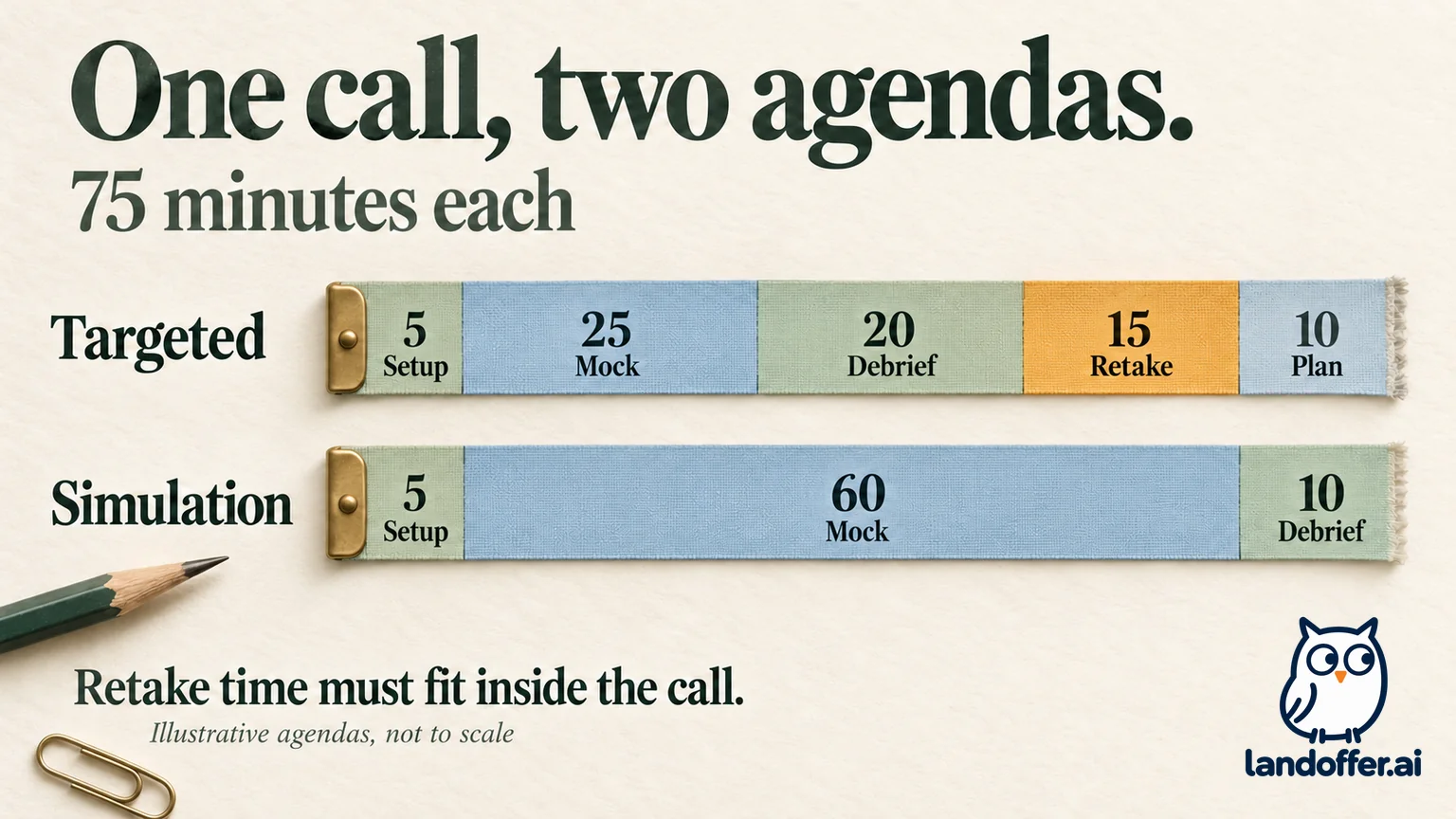
A full mock and a targeted rehearsal use time differently. Omar completes two possible agendas against his brief. Both add to the advertised 75 minutes. The allocations are our illustrative plans to discuss with a coach, not The Muse's prescribed curriculum or a schedule we observed in a paid session.
| Activity | Targeted rehearsal | Longer simulation |
|---|---|---|
| Set context and confirm the goal | 5 minutes | 5 minutes |
| Mock interview | 25 minutes | 60 minutes |
| Debrief | 20 minutes | 10 minutes |
| Try a changed answer | 15 minutes | 0 minutes |
| Agree on next practice steps | 10 minutes | Included in debrief |
| Total | 75 minutes | 75 minutes |
Omar chooses the targeted version because he wants to hear criticism and try a changed explanation during the appointment. The longer simulation could be appropriate for testing whether he sustains a full interview, but it leaves only ten minutes for discussion and no separately allocated retake. Neither format gives him everything simply because the call is long enough to contain several activities.
His mock can cover the disagreement and a follow-up about the scope decision. The debrief can examine whether he explained the accessibility problem, his proposed compromise and his collaborators' roles. During the retake, he focuses on the weakest part rather than repeating the entire project history.
He would confirm that division with the selected coach. If the coach recommends a different allocation, the question is what useful work replaces the retake or debrief time. Buying the Master Coach tier does not solve that trade-off by adding minutes; the service page lists the same duration.
Omar can also keep peer practice for the longer simulation and reserve paid coaching for the narrower explanation problem. That is a coherent division of work when a peer already provides a realistic conversation and the paid session adds a kind of criticism the peer cannot supply.
Make the follow-up email useful without expanding its scope
The follow-up email is a defined deliverable. Ask what notes and next steps will be useful for your goal instead of assuming the coach will write a polished interview script, review future drafts indefinitely or provide another appointment.
For Omar, the request is small and concrete: identify two observations about his disagreement explanation, name one practice action and record one unresolved question. He can use those notes to decide what to rehearse next. He should confirm whether the coach can provide that form of follow-up and when it will arrive.
For example, his own practice action might be to explain the release choice aloud while naming the designer and QA contributions. His unresolved question might be how to describe the limits of the keyboard test without implying that it covers every accessibility issue. These are candidate-defined practice needs, not feedback we received from The Muse.
Keep receipt of the promised email separate from the quality of advice inside it. A missing deliverable is a different problem from disagreement with a recommendation. The service FAQ identifies missed listed deliverables as potential refund grounds, while its satisfaction help article directs customers to the coaching care team. We did not test either resolution process.
Scheduling, cancellation and the material you share
The service page says the coach will contact you by the next business day to arrange the first appointment. A help article uses 24-hour email wording. These describe contact and scheduling, not a verified appointment within 24 hours. If the real interview is close, establish the available date and time zone before relying on the purchase.
The terms say missed appointments or cancellation without at least 24 hours' notice may forfeit the fee. The service FAQ also describes a full refund for cancellation before the first call. Confirm how those statements apply to a late cancellation; “before the call” should not be read as permission to disregard the notice requirement. Purchased coaching must be used within 12 months under the terms.
Do not import the FAQ's separate initial-call and first-draft refund percentages into an interview purchase. Those statements appear under dissatisfaction with resume or cover-letter services. Keep the purchased service, appointment record and listed deliverables together if you need to raise a concern.
The privacy policy, also revised October 6, 2025, covers professional information, uploaded content and communications, with described sharing and retention purposes. It does not establish a coaching-specific recording arrangement for this review. Confirm any proposed recording and use a project description you are permitted to share. Omar's sanitized checkout example is sufficient to discuss collaboration without exposing a client's internal material.
When the service fits
The Muse provides a clear starting scope for someone who wants a named coach, one adaptable 75-minute conversation and a follow-up email. Consider it when the person's relevant experience adds something your existing practice lacks. The higher tiers make sense only if that particular experience is useful to you; the posted duration alone does not justify the price difference.
Keep an existing peer arrangement if it already supports your goal. Seek more specific evidence before buying for code correctness, employer-specific technical simulation, urgent appointment access or repeated reviews. This public review cannot establish delivered coaching quality.
Choose a target role and complete a short brief like Omar's before comparing coaches. State whether you want a longer simulation or time to try a revised answer. Use LandOffer.ai for job discovery, then bring a specific conversation and feedback need to your preparation decision.
Sources and Further Reading
- The Muse Interview Coaching: tier prices, duration, inclusions and service FAQ
- Jenna Starkey's profile and selected Interview Coaching offer
- Coach Connect help: complimentary calls before booking
- Coach Connect help: initial contact timing
- Coach Connect help: dissatisfaction and refund contact
- The Muse terms: Coach Connect rules, revised October 6, 2025
- The Muse privacy policy, revised October 6, 2025