LandOffer
Job search
Resumake Has Closed: How to Replace the Builder and Keep an Editable Resume
Verify Resumake’s retirement and source branches, then preserve editable content through a documented alternative and a checked fictional JSON-to-outline mapping.
Resumake's hosted builder has closed. Its original website now displays a farewell notice, and its repository confirms that the main branch serves that static page. If you need to update an old resume, first identify whether you still have JSON, TeX or only a PDF; that determines how much editable content and layout you can recover.
LandOffer publishes this guide and offers job-search tools. We checked the original project and current alternative-tool documentation on October 21, 2026. We did not access anyone's resume, create accounts, install a builder or compile a document. A small local conversion below uses entirely fictional data. Compare recent roles on LandOffer after preserving a factual master copy, rather than rewriting your history during a hurried migration.

The closure is confirmed; a completed handoff is not
The original Resumake site explicitly announces the closure. Its update says the developer cannot continue the work and is seeking a trustworthy person to take it over while preserving the free, ad-free, account-free philosophy. It also contemplates possible paid future extras. This is an update about a hoped-for continuation, not a named successor or a reopening date.
The original GitHub repository independently says the app is retired and the main branch hosts the farewell page. That confirms more than an inaccessible URL or a third-party alternatives list would. At the time of this check, these sources did not announce a completed transfer or a functioning replacement editor.
A tool with a similar name, a fork or an alternative's claim to be a successor needs separate verification. Check who operates it, what access it requires and what files it actually exports. The original site's former privacy and account model should not automatically be assigned to a different service.
Preserve content, source and output as different artifacts
A resume PDF is useful for sending and for checking the appearance of a particular version. It is not the same as the structured content or the layout source used to create it. Retain the content file, layout source and final PDF as separate artifacts when they are available.
The preserved Resumake documentation describes PDF, TeX and JSON downloads, with JSON output compatible with JSON Resume. That tells you what an old export may contain; it does not prove which files you saved or that every future builder can import them without loss. Inspect your actual archive before choosing a replacement.
Treat the original file as read-only during migration. Work on a duplicate and record which source produced each new version. If an importer omits a section, an untouched original lets you recover omitted material without reconstructing it from memory or a reformatted PDF.
Completed recovery triage: three fictional archives
The following three archive inventories are invented examples. No private download folder or real applicant's files were inspected. Each decision is completed against the files listed, rather than assuming the old website can retrieve missing content.
| Fictional archive found | Completed next-step decision | What is still unproved |
|---|---|---|
resume.json and a PDF |
Preserve both; inspect JSON sections and map the content into the chosen editable format | Whether a new tool imports every section or reproduces the old layout |
resume.tex, supporting files and a PDF |
Preserve the complete source bundle; review its dependencies before choosing a LaTeX editor | Whether the current environment can compile that exact template |
Only resume.pdf |
Use it as a reference while reconstructing a new editable master; verify every extracted field | Exact recovery of the original JSON, TeX or reading order |
The result is three different recovery plans. The first starts with structured content, the second with typesetting source and the third with reconstruction. A new template may be appropriate in any route, but it should not be confused with a recovered original source file.
For a PDF-only archive, text extraction can provide a draft. Review dates, employer names, bullet boundaries, links and missing characters against the visible PDF. Treat extracted text as an intermediate artifact that requires review against the PDF and your records. If a date or result is unclear, verify it from your records rather than letting an AI fill the gap.
A YAML-based replacement: RenderCV's current CLI
RenderCV's official documentation describes a text-based workflow: maintain a YAML resume and render it to a PDF. The current documentation shows Python 3.12 or newer for installation, structured content and design settings, including a US Letter page option. That makes it an alternative for someone comfortable maintaining a text file and a local toolchain.
Its current renderer documentation identifies Typst as the PDF compilation engine. Do not assume that an old Resumake TeX file is its native input just because both tools produce typeset resumes. JSON Resume and RenderCV YAML are also distinct structures; content may need deliberate field mapping rather than a renamed file extension.
The editable master for that route is the YAML input together with any design or asset dependencies you choose to use. Generated files remain outputs. We did not install RenderCV, validate a migrated YAML document or render a sample, so this is a documented route rather than a tested end-to-end migration.
Keep the CLI and hosted products separate. The documentation links a web app, but that does not establish identical account requirements, data handling or feature access across the local and hosted workflows. This guide evaluates the documented source-file route without assuming that a web service preserves Resumake's former operating model.
A TeX-based replacement: retain the whole project
If you saved TeX, preserving the source and its supporting files can avoid rebuilding every layout choice immediately. A local LaTeX setup or a hosted editor may be suitable, depending on your technical comfort, dependencies and sharing requirements. A missing style file or font can matter even when the main .tex file looks complete.
Overleaf's download documentation distinguishes the source ZIP from the final PDF: the ZIP contains source files, and the typeset PDF must be downloaded separately after successful compilation. That is a useful preservation model even if you ultimately choose another editor.
Overleaf is a separate service, not an announced Resumake successor. We did not create a project, upload source or test compilation, account access or plan limits. Before using any hosted editor, review its current account and data terms; a former account-free builder does not make the next service account-free.
A TeX source bundle preserves editability, not guaranteed reproducibility. Keep the template files and relevant environment notes with it, and verify the rendered document after changes. Do not promise yourself an identical PDF simply because a source file still opens in a text editor.
The old application source is not the main-branch download
The original repository's main README points to the preserved v2 branch. That branch's historical README refers to a rewrite and directs readers toward v2-(old) for the earlier app; the older branch also contains historical development notes. Use the branch descriptions to locate historical code; they do not establish current maintenance or support.
Downloading the main branch now gives you the farewell-page project. It does not restore the old form-based builder. The continued availability of older code is useful for investigation, but it does not establish that its dependencies, rendering service or installation instructions work unchanged today.
For a job seeker with a near-term application, a working editable content file may be a better first milestone than reviving a legacy application. Self-hosting can be a separate engineering project if you choose it. We did not install or run either preserved branch and cannot call that route a verified recovery service.
Worked preservation exercise: JSON to an editable outline
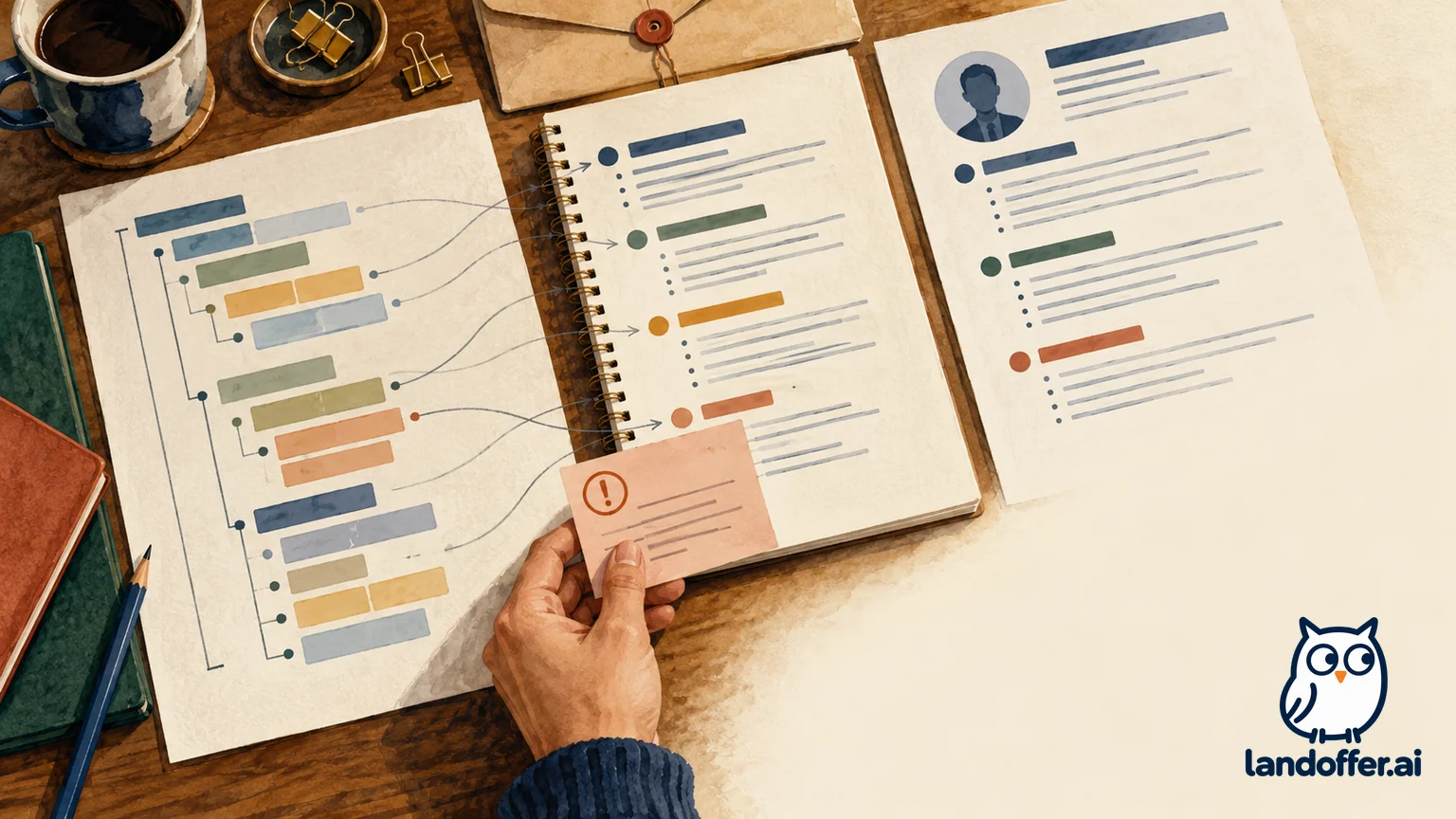
Nola Example and Northstar Demo are fictional. We created a small JSON file shaped like a JSON Resume document: a name and role label, one work entry with dates, two experience bullets, one skill group with two keywords, and a custom migration note. It is not an old user export or a complete production resume.
A local Python script parsed that fixture and explicitly copied known fields into a Markdown outline. The purpose was to create a readable editable content copy while preserving the original. It did not call a service, install a package, import into a builder or generate a PDF.
| Fixture content | Completed outline mapping | Preservation check |
|---|---|---|
basics.name and basics.label |
Name heading and professional label | Exact supplied strings retained |
One work entry |
Role, fictional employer, date range and two bullets under Experience | Both dates and both bullet strings retained |
skills[0].keywords |
Tools: Python, Bash | Both keywords retained without a new proficiency claim |
meta.migrationNote |
Deliberately not printed in the outline | Still retained in the unchanged source JSON and named in the mapping record |
The executed local assertions compared the original source bytes and checked exact presence of each selected name, label, role, employer, date, bullet and skill keyword in the outline. It also checked the one-entry, two-bullet and two-keyword counts. This is an executed check of that particular mapping, not full JSON Resume schema validation or a universal Resumake importer.
The resulting experience content remains modest: “Maintained internal search-index status pages” and “Documented release checks and recovery handoffs.” No impact percentage, new job duty or invented tool was added. Preserve the factual content in an editable backup before changing the wording or presentation.
Finish the migration with an omission record
The custom note makes a useful distinction visible: content can remain in the source without appearing in the rendered resume. That can be intentional. A section disappearing from every retained file without a record is a different problem. Do not treat “the preview looks fine” as proof that all source fields survived.
For the fictional fixture, the completed acceptance result is an intact source JSON, an editable outline containing the selected content and an explicit record of the one nonprinted field. It is not a new Resumake-compatible round trip. The conversion is one-way: later Markdown edits do not update the JSON, so explicitly designate the file you will maintain as the master.
For your real archive, record the important fields and inspect their destinations: work entries, dates, bullets, education, projects, links and any extra sections you need. If a replacement does not print a section, preserve it elsewhere before proceeding. A smaller public resume can coexist with a richer private master.
Then make a controlled content change and verify both the editable file and the new output. That future acceptance check belongs to the tool and document you actually use. The local fictional mapping above does not prove a RenderCV import, a TeX compilation or an employer's ATS behavior.
Keep the next builder replaceable
Choose a replacement by the file you can keep editing, not only the preview it displays. For structured content, preserve the original JSON and a reviewed mapping. For a typesetting workflow, keep YAML or TeX with its dependencies. For a visual editor, check whether it exports reusable content or source in addition to a PDF before investing heavily in it.
Maintain a master, a dated editable version and the corresponding final PDF. Review links, text selection, page breaks and the employer's required file format after rendering. No builder or file extension guarantees that every hiring system will interpret the document correctly.
LandOffer can help organize target roles while you maintain that portable evidence base. Resumake's closure is confirmed; an official replacement has not been announced in the sources checked here. Preserve the files you have, choose a documented editable route and verify the actual migration before discarding an older copy.
Sources and Further Reading
- Resumake farewell and original repository — closure and current main-branch identity.
- Preserved v2 and v2-(old) — historical source and export descriptions.
- RenderCV documentation and current PDF renderer — YAML-based route and Typst compilation.
- Overleaf project downloads — source ZIP and PDF are separate artifacts.
- JSON Resume schema — structured resume fields.